Tag Archives: etf-hub

Opportunities In Utilities For Dividend Investors?
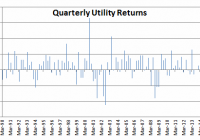
Summary Utilities have produced their worst quarterly returns in 2015 since the financial crisis. Higher interest rates have disproportionately hurt rate-sensitive sectors like utilities. In a relatively fully valued market, the relative underperformance of utilities may present investors an opportunity. The S&P 500 Utility Index, replicated by the Utilities Select Sector SPDR ETF (NYSEARCA: XLU ), has produced a -9.96% return to begin 2015, trailing the S&P 500 (NYSEARCA: SPY ) by over 12%. What has happened? The increase in Treasury yields disproportionately disfavored bond-like stocks with high dividend payouts including utilities and telecom. The trailing dividend yield on the Utilities ETF is now 3.69%. Investors have punished equity sectors with more fixed income-like return streams. After a -5.17% return in the first quarter, the utility index has followed up with a -5.05% return so far in the second quarter. These are the worst returns for the sector since the financial crisis when risk premia on all assets increased as graphed below: Source: Standard and Poor’s; Bloomberg Comparison Versus Bonds For the pounding that interest rate sensitive stocks have taken in 2015, the yield on XLU is still higher than the yield on iShares iBoxx Investment Grade Corporate Bond Index ETF LQD at 3.43%. For the same cash flow stream, I would rather own the equity upside of being a utility shareholder than be the leverage provider by owning their corporate bonds. The -9.96% loss on XLU in the first half has been larger than the -7.54% return on the Barclays Long Treasury Index as proxied by the iShares 20+ Year Treasury Bond ETF (NYSEARCA: TLT ). Conclusion I believe that the utility sector is now relatively cheap, and should be viewed as increasingly attractive to the large Income Investing community on Seeking Alpha. However, I use the term relative as I still expect forward returns on domestic assets to be subnormal . The index I have used as my sector proxy in this article features both gas and electric utilities, fully regulated and a mix of regulated and unregulated business, and features companies located in geographies with different growth trajectories. These utility stocks, at 15.9x trailing earnings, are still collectively trading at a 8% discount to the price Berkshire Hathaway paid for NV Energy in 2013 . Since that purchase in June 2013, the earnings multiple on the broader market has expanded by 13%. Consider this a margin of safety discount to a purchase made by an investor that has a long history of traditionally not paying full sticker price. When Berkshire Hathaway’s ( BRK.A , BRK.B ) MidAmerican Energy Holdings unit bought Pacificorp in 2006, it was reported in Electric Utility Week that Buffett told Oregon regulators that owning utilities was “not a way to get rich – it’s a way to stay rich.” In 2015, utilities have gotten 12% cheaper relative to the rest of the market. Perhaps utilities present dividend-paying investors with long-term horizons an opportunity in a relatively fully valued equity market. Disclaimer: My articles may contain statements and projections that are forward-looking in nature, and therefore inherently subject to numerous risks, uncertainties and assumptions. While my articles focus on generating long-term risk-adjusted returns, investment decisions necessarily involve the risk of loss of principal. Individual investor circumstances vary significantly, and information gleaned from my articles should be applied to your own unique investment situation, objectives, risk tolerance, and investment horizon. Disclosure: I am/we are long SPY. (More…) I wrote this article myself, and it expresses my own opinions. I am not receiving compensation for it (other than from Seeking Alpha). I have no business relationship with any company whose stock is mentioned in this article.

The Phases Of An Investment Idea

Investing ideas come in many forms: Factors like Valuation, Sentiment, Momentum, Size, Neglect… New technologies New financing methods and security types Changes in government policies will have effects, cultural change, or other top-down macro ideas New countries to invest in Events where value might be discovered, like recapitalizations, mergers, acquisitions, spinoffs, etc. New asset classes or subclasses Durable competitive advantage of marketing, technology, cultural, or other corporate practices Now, before an idea is discovered, the economics behind the idea still exist, but the returns happen in a way that no one yet perceives. When an idea is discovered, the discovery might be made public early, or the discoverer might keep it to himself until it slowly leaks out. For an example, think of Ben Graham in the early days. He taught openly at Columbia, but few followed his ideas within the investing public because everyone was still shell-shocked from the trauma of the Great Depression. As a result, there was a large amount of companies trading for less than the value of their current assets minus their total liabilities. As Graham gained disciples, both known and unknown, they chipped away at the companies that were so priced, until by the late ’60s there were few opportunities of that sort left. Graham had long since retired; Buffett winds up his partnerships, and manages the textile firm he took over as a means of creating a nascent conglomerate. The returns generated during its era were phenomenal, but for the most part, they were never to be repeated. Toward the end of the era, many of the practitioners made their own mistakes as they violated “margin of safety” principles. It was a hard way of learning that the vein of financial ore they were mining was finite, and trying to expand to mine a type of “fool’s gold” was not a winning idea. Value investing principles, rather than dying there, broadened out to consider other ways that securities could be undervalued, and the analysis process began again. My main point this evening is this: when a valid new investing idea is discovered, a lot of returns are generated in the initial phase. For the most part they will never be repeated because there will likely never be another time when that investment idea is totally forgotten. Now think of the technologies that led to the dot-com bubble. The idealism, and the “follow the leader” price momentum that it created lasted until enough cash was sucked into unproductive enterprises, where the value was destroyed. The current economic value of investment ideas can overshoot or undershoot the fundamental value of the idea, seen in hindsight. My second point is that often the price performance of an investment idea overshoots. Then the cash flows of the assets can’t justify the prices, and the prices fall dramatically, sometimes undershooting. It might happen because of expected demand that does not occur, or too much short-term leverage applied to long-term assets. Later, when the returns for the investment idea are calculated, how do you characterize the value of the investment idea? A new investment factor is discovered: it earns great returns on a small amount of assets applied to it. More assets get applied, and more people use the factor. The factor develops its own price momentum, but few think about it that way The factor exceeds the “carrying capacity” that it should have in the market, overshoots, and burns out or crashes. It may be downplayed, but it lives on to some degree as an aspect of investing. On a time-weighted rate of return basis, the factor will show that it had great performance, but a lot of the excess returns will be in the early era where very little money was applied to the factor. By the time a lot of money was applied to the factor, the future excess returns were either small or even negative. On a dollar-weighted basis, the verdict on the factor might not be so hot. So, how useful is the time-weighted rate of return series for the factor/idea in question for making judgments about the future? Not very useful. Dollar weighted? Better, but still of limited use, because the discovery era will likely never be repeated. What should we do then to make decisions about any factor/idea for purposes of future decisions? We have to look at the degree to which the factor or idea is presently neglected, and estimate future potential returns if the neglect is eliminated. That’s not easy to do, but it will give us a better sense of future potential than looking at historical statistics that bear the marks of an unusual period that is little like the present. It leaves us with a mess, and few firm statistics to work from, but it is better to be approximately right and somewhat uncertain, than to be precisely wrong with tidy statistical anomalies bearing the overglorified title “facts.” That’s all for now. As always, be careful with your statistics, and use sound business judgment to analyze their validity in the present situation. Disclosure: None

NRG Energy Is Ready For A Turnaround

Summary Despite NRG Energy’s current troubles in the fossil fuels arena, the company’s decentralized generation segment is booming. NRG Energy’s heavy footprint in the distributed generation market ensures that it a place in the future energy landscape. NRG Energy’s enormous fossil fuels business will help pave the way for the company’s future. Although NRG Energy has a bright long-term future, near-term volatility in the fossil fuels arena represents a significant risk to the company. NRG Energy (NYSE: NRG ) has been on a steady decline over the past year, with its stock price dropping from a high of $37 to its current levels of around $25. Much of this drop has been associated with the company’s increasingly volatile fossil fuels business, in which recent fluctuations and margin compressions have taken a toll on the company’s financials. With the majority of NRG Energy’s business being based in fossil fuels, the company’s recent underperformance is not so surprising. Given the heavy oil price volatility, plummeting natural gas prices, and unfavorable coal rulings, it is no wonder that NRG Energy has been experiencing pressure on the margins front. While the company’s total revenues is on an upward trend, its net income is facing much more uncertainty. Given that nearly one-third of the company’s energy generation comes from coal, which is facing an unprecedented amount of industry headwinds, NRG Energy may face some difficulties in the near-term. Regardless of NRG Energy’s underperformance in its fossil fuels business, the company’s heavy presence in residential solar should provide it with a massive long-term boost. Whereas the benefits of the company’s early residential solar involvement are not yet apparent, they should be soon enough as NRG Energy ramps up its involvement. Given the comparatively small size of residential solar, it is only natural that investors are overlooking this crucial energy market. NRG Energy Is Hedging Its Bets As one of the first major power companies to enter the residential solar market, NRG Energy still has upside even in spite of the obstacles facing its fossil fuels business. If predictions of the global rooftop solar market being worth $2.7 trillion by 2040 are anywhere near accurate, NRG Energy is on the cusp of explosive growth. Given the growth trend of solar PV and the theoretical advantages of decentralized generation, this prediction may even underestimate rooftop solar’s impact in the long-run. As NRG Energy is one of the few large companies fully on board with rooftop solar, it is well-positioned to reap the benefits of such growth. Despite the fact that NRG Energy’s residential solar segment still only accounts for a tiny fraction the company business, with just over 16K customers as of Q1, NRG Energy is paying particularly close attention on the segment. Such enthusiasm about an extremely small but promising aspect of its business shows how dedicated NRG Energy is to distributed solar. Such a forward thinking mindset is exactly what will push NRG Energy to the forefront of the energy industry. Given residential solar’s potential, NRG Energy is definitely on the right path. In fact, NRG Energy CEO David Crane is so convinced of the distributed energy paradigm that he is even starting to throw jabs at the electric utility industry. David Crane has recently implied in an interview that utilities are too near-sighted to full embrace new energy concepts(e.g. distributed solar), stating that “There are no thirty-year-old C.E.O.s of electric utilities, no Zuckerbergs,” and that “You have to pay your dues, come up through the ranks. You become C.E.O. when you have five years, max, left. Some of them are just not worrying about ten, fifteen years in the future.” Clearly, NRG Energy is fully committed to the distributed generation paradigm in a way that most other energy companies are not. The company’s residential solar wing NRG Home Solar is growing in prominence, and is set to even compete with residential solar powerhouses SolarCity (NASDAQ: SCTY ) and Vivint Solar (NYSE: VSLR ) in the coming quarters. It would not be surprising to see its residential solar segment double or even triple in customer count over the next few quarters, which would place it squarely among the leading residential solar companies. Despite the uncertainty of NRG Energy’s fossil fuels business, the company’s residential solar business remains a bright spot. (click to enlarge) Source: NRG Catalyzing Residential Solar Growth Using Fossil Fuels With tens of billions in revenue from its fossil fuels business, NRG Energy is one of the largest power companies in the world. The company’s enormous fossil fuels business will allow the company to more easily dominate the distributed solar business. Rather than reinvesting its future profits into its fossil fuels business, the company will likely funnel more and more of its money into its solar operations. Given the hundreds of millions of dollars in annual net income that NRG Energy will likely see moving forward, the company is in a better position than most of its distributed generation competition from a financial standpoint. Rather than having to borrow enormous amounts of cash at relatively high rates, NRG Energy should have a wealth of capital from its fossil fuels business. While hundreds of millions of dollars is a negligible amount in the fossil fuel industry, such a quantity of money will undoubtedly make a huge impact in the comparatively miniscule solar industry. NRG Energy’s cheaper access to capital is likely a big reason why the company has been able to make such a large impact on the decentralized generation scene so quickly. While NRG Energy will have an extremely hard time outcompeting SolarCity in the long-run due to various other factors, the company definitely has the potential to eventually beat out second place residential solar company Vivint Solar. With $15.35B in revenues for 2014, NRG Energy should be able to produce net incomes of around the half-billion dollar range moving forward. Access to such large finances should allow NRG Energy to accelerate it distributed solar business. Obstacles NRG Energy still faces many obstacles in its transition to solar. Given that the vast majority of its business is still based on fossil fuels, the company’s near-term prospects are more uncertain due to the fossil fuel industry’s current volatility. Even if NRG Energy can stabilize its fossil fuels business, there are still many questions regarding the long-term viability of its residential solar business. Despite the enormous promise associated with the solar leasing model, this business model is still relatively young and untested. There is almost a complete absence of data regarding long-term default rates, module performance, etc. As such, the present value of the long-term solar lease contracts are still heavily debated. Conclusion Despite the uncertainty facing NRG Energy in the near-term, the company’s amazing progress in the residential solar sector is undeniable. The potential rewards associated with the residential solar business model far outweigh the risks, which puts NRG Energy in a great position moving forward. After dropping nearly one-third of its value over the course of a year, NRG Energy should experience significant upside moving forward. NRG Energy is at the forefront of the distributed generation movement, and has the financial resources to truly make a long-term impact. At a valuation of $8.12B , NRG Energy still has much more room to grow. Disclosure: I am/we are long SCTY. (More…) I wrote this article myself, and it expresses my own opinions. I am not receiving compensation for it (other than from Seeking Alpha). I have no business relationship with any company whose stock is mentioned in this article.