Tag Archives: etf-hub

Use Market Dips To Buy VTI

Low rates will push stocks higher well in to 2016. Passive ETFs are still the best bet for average investors. VTI offers greater diversification, stronger performance, and lower fees than SPY. The purpose of this article is to discuss the attractiveness of the Vanguard Total Stock Market ETF (NYSEARCA: VTI ) as an investment option. To do so I will review the funds recent and long-term performance, current holdings, and trends in the market to determine if this investment is suitable for average investors. VTI has performed very strongly over the past few years, but with some serious headwinds on the horizon, it makes sense to revisit this investment strategy and see if it has the potential to be as profitable in the new year. First, a little about VTI. VTI attempts to track the performance of the entire stock market, unlike other popular ETFs, such as the SPDR Dividend ETF (NYSEARCA: SDY ) or the iShares Select Dividend ETF (NYSEARCA: DVY ), which track specific companies within the S&P 500 or Dow Jones, respectively. Th e fund is designed to track the performance of the CRSP U.S. Total Market Index and does so by holding stocks that are large, mid, and small-cap. As of 5/31/2015, VTI has 3824 stocks in its portfolio, making it one of the most diversified funds you can buy. Currently, VTI is trading at $107.95/share and pays a quarterly dividend of $.47/share, giving the fund an annual yield 1.74%. Year to date, the fund is up roughly 2% and over the past year the fund is up around 6% (both figures exclude dividend payouts, which would increase its total return). While VTI does not just track the Dow or S&P 500, it is worth noting that the investment has slightly outperformed those benchmark indexes over the past year, as they returned 5.5% and 6% , respectively. (Dividends give VTI its superior return.) Aside from its strong historic performance there are a few other reasons why I believe VTI will continue to outperform over the next 12-18 months. First, I expect stocks to continue to rise going in to 2016 because of macroeconomic events that will benefit the U.S. economy. Interest rates are going to stay low until at least the end of next year, U.S. hiring is coming to show grow – lowering the unemployment rate, and wages may finally be starting to climb for the average U.S. worker. Given these trends, I would look to increase positions in U.S. equities during market dips on issues such as Greek debt or other international concerns such as flare-ups in the Middle East. The U.S. economy is pushing forward, and the bigger trends over the next year will outweigh current headwinds and should increase stock prices. Let’s look at each point in turn, starting with interest rates. The on-going discussion on when the Federal Reserve will raise their key benchmark rate has been influencing the market for years. Most predictions indicate that in September, the Fed will finally increase rates for the first time since the financial crisis. When we get closer to that date, expect to see some volatility in the market and there is a chance equities could move lower as higher rates have the potential to curtail growth and stall the recovery. However, I think these fears are overblown and will provide investors with another good buying opportunity. While I just mentioned that interest rates are set to rise, the increases are sure to be modest and slow. In fact, Janet Yellen indicated, after the most recent Fed meeting, that interest rates will rise slower than previously anticipated . The current consensus now is that rates will not exceed 2% by the end of 2016, meaning that the U.S. will continue to experience a historically low rate environment for at least another year and a half. I think that the market will benefit under these conditions, as the Fed will be signaling that the U.S. economy is strong enough to stand on its own, yet rates will still be low enough to encourage investors to search for a greater return in the stock market. Second, U.S. hiring has been steadily increasing and the Labor Department recently reported that, while the number of people seeking unemployment aid rose slightly last week, the figures remained at a historically low level that signals “an improving job market.” Job growth is especially important for the stock market as the resulting domino effects, such as increased consumer spending, increased demand for housing, and greater consumer confidence, are all positive for equities. In fact, these trends are already beginning to take hold as The Commerce Department recently reported that consumer spending rose 0.9 percent last month (May). Finally, wages, a drag on the U.S. economy for some time, may be finally starting to rise. An increase in wages will benefit the economy and stocks much in the same way that the improving employment figures will, discussed in the previous paragraph. May’s figures indicate that the “average wage of American workers rose 0.3% in May to $24.96 a hour, pushing the increase over the past year up to its highest level since mid-2013.” If this trend continues, inflation will start to increase and equities will continue their march higher, directly benefiting VTI. While the trends I just talked about will benefit VTI, they will also benefit most equity investments, so I will now point out why I prefer VTI to other similar investments, such as the SPDR S&P 500 Trust ETF ( SPY). VTI and SPY have almost identical returns over the past year and pay similar yields of 1.85% and 1.94%, respectively. However, over the past five years VTI has beaten SPY with a return of over 96% compared to a return of just under 93% for the SPY. So longer term, VTI seems to be a stronger bet, and there are a few reasons for this. One, VTI covers the entire stock market, and thus has exposures to stocks in the Dow Jones Index, S&P 500, and the Nasdaq. Therefore, when, for example, technology stocks in the Nasdaq outperform, VTI will benefit to a greater degree over the SPY. This additional exposure provides a greater chance of upside in a rising market, which is what I expect to happen. I mentioned that VTI has over 3800 stocks in its portfolio, this compares with 500 for the SPY , giving investors greater diversification. Also importantly, VTI sports a lower expense ratio than SPY, at .05% for VTI compared to .1098% for SPY . While the difference is not huge, how could one argue that paying less for greater diversification is a bad thing? With more holdings, a superior long-term return, and a cheaper cost to own, VTI seems the obvious choice. Of course, investing in VTI is not without risk. The stock market is headed in to a time period of uncertainty, as we enter uncharted territory with events such as a Greek exit from the Eurozone and an increase in interest rates from the Fed for the first time since the recession. The market could hit a period of volatility that sends stocks sharply lower. Additionally, employment figures could stall, giving employers added leverage to keep a lid on wages and, in effect, inflation. Finally, rates could rise faster than anticipated, which could send investors away from equities and into safer investments that would then offer a higher yield, which would hurt the stock market overall and take VTI lower. However, these are not scenarios I expect to occur. The U.S. economy has increased consistently, and I expect domestic growth will outweigh scares from abroad, such as Greece. Additionally, the Fed has repeatedly noted it is mindful that raising rates too fast could derail the recovery, so I do not expect them to be too aggressive, too quickly. Bottomline: The stock market been on an incredible bull run over the past few years and VTI, as it covers the entire stock market, has directly benefited. Heading in to summer, headwinds exist that could send stocks sharply lower. However, these are perfect opportunities to “buy the dip,” as the U.S. economy is proving each month, through employment and consumer spending figures, that the rebound is real and sustainable. VTI should continue to increase as rates, while set to increase, will remain low through 2016 and passive investors continue to favor cheap ETFs that offer broad exposure. VTI offers investors a cheap way to gain exposure to the entire stock market, and also a history of outperforming the S&P 500 and its flagship ETF, the SPY. Because of this, I would encourage investors to consider VTI as an investment option on each, and any, market drop we have over the next few months. Disclosure: I am/we are long VTI, SPY, DVY. (More…) I wrote this article myself, and it expresses my own opinions. I am not receiving compensation for it (other than from Seeking Alpha). I have no business relationship with any company whose stock is mentioned in this article.
How Does VXUP/VXDN’s Corrective Distribution Work?

It’s now clear that the AccuShares Spot CBOE VIX Up Shares ETF (NASDAQ: VXUP )/the AccuShares Spot CBOE VIX Down Class Shares ETF (NASDAQ: VXDN ) naysayers were right – the actual behavior of these funds is nowhere close to Accushares’ claim that ” VXUP and VXDN are the first securities to offer direct “spot” exposure to the CBOE Volatility Index (VIX). ” Accushares has said nothing publicly about the poor behavior of the funds. Their only response has been to move up the “go live” date of their Corrective Distribution process. This is a desperation move. Apparently not understanding what has happened to them they are rushing to use the last weapon at their disposal to fix their horrible tracking error (as high as 18%) relative to the VIX. This move will reduce their tracking problem for less than a day and add yet another complexity to these already complicated and broken funds. Accushares’ Corrective Distribution (CD) is intended to reduce any ongoing differences between VXUP/VXDN’s Net Asset Value (NAV) and its market price. I don’t know what specific scenarios they were targeted with in this process, but I’m guessing they were worried about a slow, progressive creep in the market prices versus the NAV. The CD is triggered if there are 3 consecutive days where the tracking error (difference between NAV and closing price) is 10% or greater. To be a valid closing price the last trade must occur within 30 minutes of market close. When the CD is triggered it doesn’t occur immediately, it’s scheduled to accompany the next monthly Regular Distribution or a Special Distribution if that occurs first. A Special Distribution is triggered by a greater than 75% rise in the VIX compared to the reference VIX value established at the beginning of the monthly cycle. Accushares did not expect frequent CDs to be required; in the prospectus they state: “The Sponsor expects that Corrective Distributions will be infrequent, and may never occur.” It’s likely they will occur on a near monthly basis. When there is a significant gap between the VIX’s value and VIX futures prices (which is most of the time) the VXUP/VXDN tracking error will be large. See this post for a near real time accounting of these errors. With a combined Regular Distribution and Corrective Distribution three things occur: The NAV of the higher valued fund is set to equal the NAV of the lower valued fund. A dividend is issued that compensates the holders of the higher valued fund for the drop in NAV value. The dividend is either in cash or an equal number of VXUP/DN shares with a net value equal to the cash dividend. Accushares issues a new complementary share to every shareholder. If you have VXUP, you will get VXDN shares and vice versa. This is the Corrective Distribution mechanism. Since Accushares can’t create assets out of thin air, they must compensate for the newly doubled number of shares outstanding by dropping their value by half (or do a 2:1 reverse stock split). The effect of the Corrective Distribution is not obvious. Working through an example is a good way to understand it. Imagine that a CD has been triggered and that a Regular Distribution is about to occur. You own 1,000 shares of VXUP. Let’s assume that the market price of VXUP is $27.5, the VXUP NAV is $25, and that the VXDN NAV is $22 at market close right before the distribution. You would receive a dividend of $3/share due to the resetting of VXUP’s $25 NAV value down to VXDN’s ending cycle value of $22. You would also receive 1,000 shares of VXDN. The new NAV value would be $22/2 = $11/share because Accushares doubled the number of shares outstanding. Before the CD the VXUP shares in your account were worth $27.5 X 1,000 = $27.5K. After the Regular/Corrective Distribution your account has: Your net account value drops to $25K – your $2.5K premium over NAV has disappeared. Any premium over the closing NAV value is wiped out by the CD. The next day VXUP will likely trade at a multiple percentage points over NAV, but your VXDN shares will likely be trading at a symmetrical discount from NAV, so the net value of your shares will remain at around $22K. Accushares has essentially cashed out your account at the NAV price – no premium for you… No diligent shareholder will willingly take this sort of loss, nor short seller pass up this opportunity for profit; the market will ensure the value of these funds converges near to NAV the eve of the distribution. From an entertainment value perspective, there will be a couple of things to watch once the CD mechanism becomes effective: Will traders attempt to prevent CDs from happening? Imagine a scenario where some groups are trying to prevent a CD from happening by selling, or short selling shares, while others hoping to profit from a CD are buying shares hoping to keep the tracking error above 10%. How low will the tracking errors go before the CD date? Short sellers would tend to drive the tracking errors to zero, but the about to expire VIX futures values will be decaying rapidly at that point, so significant intra-day profits might still be available to arbitrageurs on the last days of trading. The net effect of the CD will be to complicate and disrupt an already difficult situation. It won’t fix the funds. What Accushares should do is eliminate the Corrective Distribution. Once broken is better than twice broken. Disclosure: None

Tough Choices: Alternative Funds In 2015

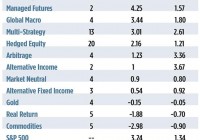
The Oxford English Dictionary provides two definitions of the adjective “alternative.” In one, the term is used to describe something “available as another possibility or choice.” The other, more proscriptive definition pronounces the choice between two things as “mutually exclusive.” In what context are we to view “alternative investments” or “alts”? Are they portfolio adjuncts or replacements? These nontraditional assets are, for the most part, utilized for risk diversification within a portfolio, not as a portfolio themselves, so it’s good to keep this in mind when reviewing performance records. Yes, returns are important but so, too, are correlation and other dynamics. Ideally, alts should be the yin to a portfolio core’s yang. Once available only to well-heeled investors through privately placed hedge funds, an increasing number of alternative investment strategies can now be found in mutual fund and exchange traded product wrappers. The array of retail-sized alts has, in fact, become dazzling. Last year, 109 liquid alt products debuted and this year’s shaping up to be similarly fecund. Through May, 54 new funds have been launched. This proliferation is a recent phenomenon, though. Relatively few liquid alt products can truly be considered seasoned. All told, when the alt universe is culled for funds with track records extending five years or more, just 68 candidates squeak through. So how have these time-tested funds fared in 2015? Just three categories–risk parity, managed futures and global macro-have outdone the broad-based domestic equity market through mid-year. In some cases, that’s to be expected; the idea is that these funds will dampen volatility of an overall portfolio and provide some cushion for a falling market. For many alts, that thesis has yet to be tested, of course, and in an extended bull market, it gets harder to make the case for funds that don’t keep up. So here, we’ll concentrate on the strategies that have enhanced returns over the broader market. Risk Parity Risk parity? What’s that? An in-depth examination of risk parity strategies can be found in REP. ‘s March issue, but the quick-and-dirty is this: These portfolios allocate assets on the basis of risk, not dollars. Typically, risk is balanced by overweighting lower-volatility assets. The granddaddy of risk parity funds is the AllianceBernstein Global Risk Allocation Fund (MUTF: CABNX ), which keys on tail risk to invest in an array of global asset classes. “Tail risk” refers to the probability of a significant downside event. Allocations are made so that each class contributes equally to the fund’s expected tail loss. Through May, CABNX rose 4.51 percent, comfortably ahead of the 3.24 percent contemporaneous gain in the SPDR S&P 500 Trust ETF (NYSEARCA: SPY ). CABNX’s year-to-date gain came in second to that of its category mate, the AMG FQ Global Risk-Balanced Fund (MUTF: MMAFX ). The AMG portfolio, which recorded a 5.13 percent total return through May, primarily relies on derivatives to dynamically balance risk. Over a five-year span, these risk parity funds have done yeoman’s work, coming in second behind hedged equity products in average annual returns. Still, given the strength of the protracted stock market rally, alpha-positive alpha, that is-remains elusive. Managed Futures The case for short-enabled active management was emphatically made in the commodities sector this year. Unlike commodity index trackers, actively managed futures funds can short-sell with as much abandon as they can buy. Margin’s the same, and so too the practical risk for either a long or short market stance. And a good thing that was for fund runners this year. Most of 2015’s commodity price action has been to the downside, primarily led by plummeting tariffs for oil. The Equinox MutualHedge Futures Strategy Fund (MUTF: MHFAX ) capitalized upon this trend and other tactics by allocating its assets to several subadvisors with diverse trading styles. Through May, MHFAX gained 5.27 percent, outdoing the 3 percent earned by its single-manager category mate, the Guggenheim Managed Futures Strategy Fund (MUTF: RYMTX ). Over the long run, managed futures have been a middling performer on the alts stage, but still have handily outperformed long-only commodity actors. Global Macro Big picture investing paid off in 2015’s first half as global macro products collectively eked out a 20 basis point advantage over the gain earned by an S&P 500 proxy. Global macro strategies bank on forecasts and trends in systemic factors such as interest rates, policy changes and fund flows. Leading the charge, the PIMCO Global Multi-Asset Fund (MUTF: PGAIX ) returned a best-of-class 6.35 percent through May. PGAIX fund runners allocate assets across a spectrum of equities, fixed income securities and commodities, utilizing a top-down approach enhanced by some bottom-up alpha-seeking tactics. Tail risk hedging is also employed to insulate the portfolio. That said, PGAIX isn’t the least volatile fund in the category, but neither is it the most. The Ivy Asset Strategy Fund (MUTF: WASAX ) actually has the best five-year Sharpe ratio (0.74) in the category, but its inherent volatility can take investors on a bit of a roller coaster ride. What’s Not Hot This year’s laggards are physical assets-gold, real return assets and commodities. No surprise there, given the disinflationary mood in early 2015. All five seasoned commodities funds were under water through May, some significantly more than others. The tiny Rydex Commodities Strategy Fund (MUTF: RYMEX ) floated just below the surface with a -0.72 percent return while the Direxion Indexed Commodity Strategy Fund (MUTF: DXCTX ) foundered with a 5.54 percent loss. Such disparate performance arises because the funds track dissimilar indices: DXCTX a long/flat benchmark comprised of a dozen commodities and RYMEX a broader-based long-only construct. Real return funds pursue strategies that seek to outperform the broad equity market during periods of rising inflation. Typically, these funds invest in a portfolio of “real” assets including interests in residential property, energy, metals and agriculture. Three of the five real return portfolios were actually above water in May, but because the behemoth PIMCO Commodity Real Return Strategy Fund (MUTF: PCRIX ) commands an 89 percent market share, its 2.24 percent loss dragged the category return down. Three of four senior gold funds, tracking the metal’s spot price assiduously, ended May at pretty much the same level as the year’s start. One portfolio, the PowerShares DB Gold ETF (NYSEARCA: DGL ), which replicates the returns of gold futures rather than bullion, underperformed the others, largely due to the continuous costs of rolling expiring contracts forward. The Road Ahead If you look at the five-year track records recapped in Table 2, one thing becomes readily apparent: the higher a category’s correlation to the broad market, the better its performance. The average annual returns of the top five categories, all pegged against the S&P 500, line up perfectly with their r-squared correlations. No doubt, those funds have basked in the warmth of a torrid equity market. The stock rebound will one day turn to a dribble and when it does, the out-of-favor categories will have an opportunity to rise to the top of the league table. It’s then that the alpha column is more likely to be populated by positive numbers. This article originally appeared in the July issue of REP. Magazine and online at WealthManagement.com .