Tag Archives: etf-hub

Are Mexico ETFs Ready For A Rebound?

After sluggish growth over the last several months, Mexican economy has started picking up steam of late, on positive sentiments building up on a slew of encouraging indicators. This is especially true as Mexican industrial production expanded 3% year over year in December, up from 1.8% annual growth in November and above the market expectation of 2.7%. Both construction and manufacturing activities improved substantially buoyed by strong U.S. demand for Mexican exports. The job market is also showing signs of improvement as unemployment dropped to 3.8% in December from 4.3% a year-ago month. This trend is likely to continue in the coming months. With this, Latin America’s second largest economy is expected to have grown above 2% in 2014, up from 1.4% in 2013. It will likely pick up to 3.5% this year, according to economists polled by the Bank of Mexico. The HSBC Mexico Manufacturing Purchasing Managers’ Index rose to 56.6 in January from 55.3 in December, representing the best performance in more than two years. Further, annual inflation eased sharply to 3.08% in the first half of January, well below 4.08% in December and the Reuters’ expectation of 3.45%, according to the latest data from Mexico’s national statistics. This suggests that inflation could reach the central bank’s 3% target by midyear. However, a slump in Mexican currency could act as a major headwind and might raise inflationary pressures in the coming months. Notably, the peso has fallen to a five-year low and has lost more than 12% against the U.S. dollar since the start of September. The drop in global oil prices coupled with international market volatility and the prospect of a U.S. interest rate hike later in the year pose major risks to the currency and economic growth (read: Can Energy ETFs Regain Fervor on Capital Spending Cuts? ). In order to cope with declining oil prices, the Mexican government reduced the spending budget by $8.3 billion for this year. Most of the 2015 cuts will be seen in the energy sector and state-owned oil company, Pemex, which generates one third of the revenues for the country. The central bank also plans to review spending in 2016 and beyond. The move will aid in narrowing deficits without increasing taxes and lower public debt to GDP in the coming years. Investors should note that public debt rose to 41% of GDP in 2014, up from 39% in 2013. Apart from these, being an export-oriented economy, Mexico is a huge beneficiary of the strong U.S. economic recovery, probably stronger than many other countries in the world. This is because the United States is Mexico’s largest trading partner with the latter exporting more than 75% of commodities to the former. Moreover, a slumping peso is actually benefiting exporters and the manufacturing industry by making goods more competitive, resulting in soaring stock prices. Given these bullish fundamentals, investors could tap the potential strength of the economy in the form of ETFs with lower levels of risk and diversification benefits. Below are three funds targeting the second biggest economy of Latin America: iShares MSCI Mexico Capped ETF (NYSEARCA: EWW ) This fund is by far the most popular and liquid ETF in the Latin American space with AUM of $1.8 billion and average daily volume of more than 2.3 million shares a day. It tracks the MSCI Mexico IMI 25/50 index and holds 60 securities in its basket. The fund charges 49 bps in fees per year from investors. The product is heavily concentrated on the top firm – America Movil (NYSE: AMX ) – accounting for 17.1% share while other firms hold less than 8%. The ETF is well spread across a number of sectors with consumer staples, financials, telecom, materials, industrials, and consumer discretionary all making up for double-digit exposure. The fund has lost nearly 1% in the year to date time frame and has a Zacks ETF Rank of 3 or ‘Hold’ rating with a Medium risk outlook. Deutsche X-trackers MSCI Mexico Hedged Equity ETF (NYSEARCA: DBMX ) This product offers exposure to the Mexican equity markets while at the same time hedges against any fall in the peso against the U.S. dollar by tracking MSCI Mexico IMI 25/50 US Dollar Hedged Index. The fund holds 57 securities with the largest allocation to the top firm – AMX – at 17.4%. Other firms do not make up for more than 8.20% share in the basket (read: 3 ETFs to Fight Against Global Currency War ). From a sector look, telecom accounts for the largest share at 29.7% closely followed by financials (21.8%), consumer staples (16.4%) and industrials (12.4%). The fund has amassed $4.8 million in its asset base while trades in light volume of about 3,000 shares. It charges 50 bps in fees per year and is down 2.4% so far this year. DBMX has a Zacks Rank of 2 or ‘Buy’ rating with a Low risk outlook. SPDR MSCI Mexico Quality Mix ETF (NYSEARCA: QMEX ) This fund offers exposure to the 32 Mexican stocks that have value, low volatility and quality factor strategies. This is done by tracking the MSCI Mexico Quality Mix A-Series Index. This ETF is also highly concentrated on AMX at 16.7% and other firms hold less than 8% of total assets (read: SPDR Launches Quality ETFs Targeting Mexico, Korea and Taiwan ). Further, it is skewed toward the consumer staples sector, which makes up for 31.9% share. Other sectors make up for a nice mix in the portfolio. The fund has accumulated $2.4 million in AUM since its debut five months ago. It charges 40 bps in fees per year from investors and trades in paltry average daily volume of 3,000 shares. The product has lost 1.7% in the year to date time frame.
Why Active Managers Like Volatility

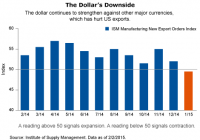
With quantitative easing finished and the Fed poised to raise rates, we are already starting to see stocks exhibit more volatility. We expect that to continue, and that stocks will rise or fall based on their fundamentals. In this environment, we believe active management is likely to become increasingly important to achieving sufficient returns. Capital markets offered some surprises for investors last week. Stocks rose globally with the Dow Jones Global Index rising 0.72%, while US stocks rallied with the S&P 500 hitting another record high. In addition, Treasury bonds sold off and oil continued its multi-week rebound. Clearly, asset classes are rotating and moving in different directions. A good example of this rotation can be found in the energy sector. Energy stocks have disappointed since last summer, falling in lockstep with the price of oil. However, in the past few weeks the price of oil has rapidly reversed course, helping energy stocks to rebound. The average energy-sector equity mutual fund returned almost 12% in the past month (as of February 13, 2015), well above every other sector fund average, according to Morningstar. Home and Away We’re also seeing divergent paths among fourth-quarter earnings reports. So far, earnings season has been positive, beating expectations. But there’s a substantial difference between companies that derive their earnings domestically from companies that derive their earnings largely from outside the United States. Why? Because the rising dollar has dragged down their fourth-quarter earnings results. A look at factory activity over the past few months drives home this point. The ISM manufacturing index has dropped to 53.5 in January from 57.6 in November. Weakness in foreign demand pushed new export orders down to their lowest level since November 2012. The caveat is that, like the price of oil, the dollar could reverse course relative to other currencies and the above scenario could change. Divergence can also be found in economic growth in the euro zone. For the fourth quarter, the euro zone skirted a recession and actually delivered modest growth. However, growth varied widely across member countries. Germany and Spain both saw their economies grow 0.7% in the quarter, beating expectations. Not surprisingly, some European countries didn’t fare as well, with both France and Italy falling short of expectations and Greece experiencing a -0.2% growth rate. Despite the disparity in growth, sovereign bond yields may not be dramatically different between these countries (except Greece) thanks to investors’ belief that the European Central Bank will stand behind this debt. Still, the performance of their stock markets could be where we see that growth gap reflected. The Perils of Indexing At Allianz Global Investors, we have long argued that once quantitative easing ended, we would see a change in the market environment. In other words, a move away from QE – which served as a rising tide lifting all boats – to an environment where stocks rise and fall on their individual fundamentals. We worry that the large number of investors who have enthusiastically embraced indexing in the past decade will be negatively impacted in this market environment, where we’re likely to see far more volatility, asset-class rotation and overall differentiation among individual securities. Unfortunately, indexing generally does not allow investors to avoid those companies that can be hurt by a rising dollar or the falling price of oil. And indexing does not allow investors to pivot when the dollar begins falling or the price of oil again changes course. In addition, as we look out on 2015, we expect relatively low stock returns. This again makes the case for active investing as investors will need to make active bets in an effort to surpass low market returns. In short, there are periods when markets are more conducive to index investing, as we saw over the past few years, but this environment isn’t one of them. We hope investors recognize the importance of active management in this unique and ever-changing market environment. We believe, a “buy the index and go home” strategy in times of uncertainty could come back to haunt investors.

My Duke Energy Fourth-Quarter Earnings Prediction

I predict the stock to report a $1.27 earnings number on $6.344 billion in revenue. Analysts are predicting an average of $0.80 and $6.25 billion. Duke is definitely a solid name to hold onto to during difficult times and the 4% dividend yield offers pretty good protection for when the stock price drops. As earnings season continues we’ve seen the utility sector of the market show some chinks in the armor as the ten-year treasury yield has begun to climb. Duke has been the beneficiary stock recently of falling yields and now is becoming a victim of rising yields. I selected this stock for my portfolio of thirty back in May of 2013 because I liked the prospect of having a great dividend and a business which is always going to have a customer. During the past year the stock price has increased 11.74% excluding dividends and only just in the past two weeks has it lost 10% due to rising treasury yields. With that said I’d like to make my prediction for Duke Energy for the fourth quarter of 2014 that the company will be announcing on February 18, 2015 before the market opens. DUKE ENERGY CORPORATION (NYSE: DUK ) INCOME STATEMENT Fiscal year ends in December. USD in millions except per share data. 2014-12 2014-09 2014-06 2014-03 2013-12 2013-09 Revenue $6,344 $6,395 $5,949 $6,624 $6,112 $6,709 Cost of revenue $2,275 $2,307 $2,287 $2,531 $2,281 $2,474 Gross profit $4,069 $4,088 $3,662 $4,093 $3,831 $4,235 Operating expenses Operation and maintenance $1,398 $1,409 $1,467 $1,506 $1,527 $1,458 Depreciation and amortization $810 $788 $761 $790 $763 $707 Other operating expenses $491 $272 $318 $1,739 $338 $327 Total operating expenses $2,699 $2,469 $2,546 $4,035 $2,628 $2,492 Operating income $1,370 $1,619 $1,116 $58 $1,203 $1,743 Interest Expense $412 $405 $413 $406 $419 $379 Other income (expense) $175 $137 $122 $131 $211 $87 Income before income taxes $1,132 $1,351 $825 -$217 $995 $1,451 Provision for income taxes $340 $460 $209 -$127 $309 $457 Net income from continuing operations $793 $891 $616 -$90 $686 $994 Net income from discontinuing ops $100 $378 -$3 -$3 $6 $14 Other $3 $5 -$4 -$4 -$4 -$4 Net income $896 $1,274 $609 -$97 $688 $1,004 Net income available to common shareholders $896 $1,274 $609 -$97 $688 $1,004 Earnings per share Basic $1.27 $1.80 $0.86 -$0.14 $0.97 $1.42 Diluted $1.27 $1.80 $0.86 -$0.14 $0.97 $1.42 Weighted average shares outstanding Basic 707 707 707 706 706 706 Diluted 707 707 707 706 706 706 So you may notice that I have revenue to be about equal to what it was during the past quarter and that’s because I don’t believe the economy has excelled much during the past couple of quarters. The average analyst estimate for the quarter is $6.25 billion with a high of $6.8 billion. So I appear to be a bit optimistic for the quarter on revenue than the average but on a GAAP basis I’m predicting earnings to be $1.27 while the average estimate is $0.80 with a high of $0.98. I’m actually quite a bit higher than the rest of the pack because I’ve assumed best case scenarios for operating expenses as all their commodity prices have dropped significantly during the fourth quarter. We’ll have to wait and see what happens in a few days, but one thing is for sure, I’m not going to be buying any of the stock before the earnings report. However, I purchased a batch last week right before the ex-dividend date so I can increase my dividend a little. Duke is definitely a solid name to hold onto to during difficult times and the 4% dividend yield offers pretty good protection for when the stock price drops. Disclaimer: This article is in no way a recommendation to buy or sell any stock mentioned. This article is meant to serve as a journal for myself as to the rationale of why I bought/sold this stock when I look back on it in the future. These are only my personal opinions and you should do your own homework. Only you are responsible for what you trade and happy investing! Disclosure: The author is long DUK. (More…) The author wrote this article themselves, and it expresses their own opinions. The author is not receiving compensation for it (other than from Seeking Alpha). The author has no business relationship with any company whose stock is mentioned in this article. Are you Bullish or Bearish on ? Bullish Bearish Neutral Results for ( ) Thanks for sharing your thoughts. Submit & View Results Skip to results » Share this article with a colleague