Tag Archives: etf-hub

Time To Exit Junk Bond Funds?

Summary Junk bond funds have outperformed other bond classes and maturities over the last five years but will the good times end once interest rates begin to rise? An improving economy as we’ve seen with stronger job and wage growth could improve the ability of companies to repay their debt. Rising interest rates could ultimately make junk bond yields look less attractive. The struggling energy sector has been particularly rough on the junk bond group. As the Fed seems poised to raise interest rates at some point during the remainder of 2015 high yield bond funds and ETFs have enjoyed a solid run over the last several years when compared to other Treasury and corporate bond funds. Over the past five years, junk bonds funds like the iShares iBoxx High Yield Corporate Bond ETF (NYSEARCA: HYG ) and the SPDR Barclays Capital High Yield Bond ETF (NYSEARCA: JNK ) have outperformed their investment grade counterparts across all durations. Junk bond funds have been increasingly popular among yield seekers looking to do better than the measly yields offered by Treasuries and CDs. But as the economic landscape begins to shift it’s worth asking the question if junk bond funds have seen their best days. The free money period looks like it’s going to be slowly coming to a close and so to may the comparatively solid returns offered by high yield notes. There’s evidence pointing in both directions so it’s worth examining the major ideas one by one. Junk bonds could correlate more closely to a stronger stock market and economy The argument that high yields trade more like stocks than bonds could be viewed as a positive sign for their outlook. The stock market has had quite a run over the last three years and while valuations are almost certainly stretched there’s not much evidence to suggest that a huge correction is imminent. That’s not to say that the straight line up should be expected to continue but the environment could be conducive to high yields continuing to outperform other bond funds. The economy could be in a similar spot. While GDP has been weak overall job growth and wage growth have been improving. Additionally, the JOLTS report that was issued last week showed that the number of open jobs advertised at the end of April – 5.4 million – was the highest number in the 15 year history of the survey. The government also indicated 280,000 jobs created in May. Even the unemployment rate which ticked up slightly could be an indication that job seekers could be reentering the marketplace. A stronger economy could indicate an improved ability for companies to pay off their debt making junk bonds attractive. The Fed seems to think that the economy is improving enough to warrant higher interest rates and economic growth could lead to a positive environment for junk bond performance. Higher interest rates could make junk yields less attractive Junk bond funds and ETFs are offering current yields in the 5-6% range. Those yields looked especially attractive when the 10 year treasury note was yielding just 1-2%. The 10 year note is now yielding 2.4% and could soon be heading towards 3% again. An increasingly narrowing yield gap could make the risk/return tradeoff of junk bond funds less attractive. Net outflows in junk bond funds have been increasing in the last several weeks as bonds in general have been selling off – an indication that investors could be viewing fixed income investments as less attractive in the face of rising rates. Junk bond default rates are rising The default rate in junk bonds climbed to its highest level in almost 6 years last month but we have the flailing energy sector to thank for that. Energy and mining accounted for 93% of all defaults in the 2nd quarter. Roughly 15% of the high yield universe comes from the energy sector so weakness in this area of the economy is having a significant effect on the overall group. Conversely, it means that the rest of the high yield universe is performing well. If you can stay away from energy the risk exposure to junk bonds could be much more limited. Conclusion We’ve been in a prolonged period where taking risk has been rewarded but the imminent rising rate environment could be the catalyst that reverses that trend. A stronger economy should help junk bonds but I believe overall that riskier investments will begin falling out of favor as investors seek safer alternatives like treasuries, defensive and health care stocks. High yields exposure to energy could further limit upside. While energy prices look to have stabilized $60 oil is squeezing the margins of many companies and many rigs are still sitting idle. Junk bond funds may have helped boost income seeking investors’ returns over the past couple of years but now might be the right time to take some of those chips off the table. Disclosure: The author has no positions in any stocks mentioned, and no plans to initiate any positions within the next 72 hours. (More…) The author wrote this article themselves, and it expresses their own opinions. The author is not receiving compensation for it (other than from Seeking Alpha). The author has no business relationship with any company whose stock is mentioned in this article.
Improve Your Sector Returns With Equal Weighting

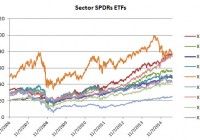
Summary Sector ETFs are great trading vehicles, but they are not weighted the best way for you. Equal weighting is always better than capitalization weighting. The problem with the existing equally-weighted ETFs is that they have too many stocks. You can do it yourself with fewer stocks and get better returns. There is no doubt that ETFs are a good way to invest. They reduce your exposure to the ups and downs of a single stock and avoid having to choose which stock in a sector is going to be the best next year. It turns out there is an easy way to get the same protection, better returns, and lower risk, doing it yourself. It goes back to understanding equal weighting versus capitalization weighting, but it doesn’t try to replicate the entire sector, it just focuses on the larger, more liquid stocks. Sector SPDRs are capitalization weighted, the same as the S&P. They deliver exactly what is expected, the portion of the S&P representing that sector, using the same calculations. We can’t evaluate every sector, so we’ll look at the best, Health Care (via the Health Care Select Sect SPDR ETF (NYSEARCA: XLV )) and one of the worst, Energy (via the Energy Select Sector SPDR ETF (NYSEARCA: XLE )). The chart below shows the performance of the major sector SPDRs since late 2006. If you combine them all, you get returns similar to the SPDR S&P 500 Trust ETF (NYSEARCA: SPY ). Equal weighting is not a new idea and the advantages are well known. Equal weighting maximizes diversification; therefore, it reduces risk. If you weight by capitalization, or any other scheme, then some stocks have greater exposure in the portfolio. For that to work, those stocks must have proportionately greater returns. Unfortunately, we don’t know that. It may turn out, strictly by chance, that the stock with the largest exposure also had the biggest returns. But the chances of that are small. The safest portfolio, and normally the most stable, is the one that has equal dollar exposure to each stock. In 2006, Guggenheim introduced ETFs that matched the sector SPDRs but were equally weighted. If there are 55 Health Care stocks in XLV then there are 55 stocks in the Guggenheim S&P Equal Weight Health Care ETF (NYSEARCA: RYH ). Similarly, there are 49 stocks in XLE and 49 in the comparable Guggenheim S&P Equal Weight Energy ETF (NYSEARCA: RYE ) . When we compare the returns of the SPDRs and the Guggenheim sectors, we see that the equally-weighted sectors performed slightly better. The information ratio, the annualized returns divided by the annualized risk, shows a similar pattern. Data source : CSI Is this what the investor, you and me, really wants? I would rather have a sector ETF that performed better than the weighted average of all the stocks in that sector, and we can do that. Components of XLV and RYH The Health Care SPDR, XLV, has 55 components, shown in the chart below in order of descending weights, with Johnson & Johnson (NYSE: JNJ ) at the top of the list with an allocation of 9.68%, and the 26 companies on the right all below allocations of 1%. Let’s look at the 9 on the left, representing 50% of the total weight of the XLV. Their performance from January 2010 is also shown below. (click to enlarge) Data source : sectorspdr.com Data source : CSI Nine stocks represent 50% of the index and the remaining 46 make up the other 50%. The smaller 50% are generally much less liquid, which tends towards greater relative volatility. More important, if we use them in an equally-weighted portfolio, will we be emphasizing companies that are very small and not representative of the performance we are seeking? Remember, we don’t care about duplicating the S&P, we are looking for better returns. Equally Weighting the Top 50% We’re going to select only a few of the stocks with the highest capitalization in the XLV, those that make up 50% of the index. Those are the 9 stocks shown in the previous chart. We’ll dollar weight them equally, then compare the results of XLV with the capitalization and equally-weighted versions using the smaller group of 9 stocks. The results are impressive. By discarding the smallest components of the index, you can increase returns significantly and reduce risk at the same time. The numbers can be seen in the Table below. Besides looking at the rate of return (AROR), the ratio of returns to risk shows that equal weighting had the best investment profile. Data source : CSI The Health Care Industry has taken off since 2008, not coincidentally timed with the passing of the Affordable Care Act. We’re not judging the merits or good intentions of that Act, but it gave the health care companies an opportunity to raise prices in advance of services, and maintain those high prices; hence, large and continued profits. Given the aging population, the industry should continue to prosper, although it seems unlikely that it could continue at this rate. The Energy Sector: XLE and RYE The Health Care sector may be an outlier, given its exceptional performance. While the energy stocks have seen wide ranging price swings, the net effect is nearly the worst performance of all sectors, certainly the highest risk. Does equally weighting the top members of this sector also improve returns? In this case we’ll choose the top 10, representing 60% of the allocations, because it’s a similar number of stocks and the allocations to energy stocks vary much more. We don’t think it makes any real difference if you use 50% or 60% of the weighting. Going through the same steps as with Health Care, we first compare the SPDR XLE with Guggenheim’s RYE in the chart below. In this case the XLE outperforms since 2010; however, the pattern is very similar. Data source : CSI We then take the 10 stocks that represent the top 60% of the XLE allocation and equally weight them. We construct cap-weighted and equally-weighted portfolios from 2010 using the same weighting as XLE. The results, in the chart below, show that equal weight again outperforms cap weighting. The numbers, also in the table that follows, shows a similar picture of higher returns and a better reward to risk ratio. Data source : CSI Doing It Yourself There is no magic in equally weighting a small number of stocks. You want enough companies to give diversification, but none of the low-cap ones. The weighting of the XLV and XLE will change regularly, but since we will be equally weighted, that won’t matter. Only the specific stocks in the top 9 for Health Care, and the top 10 for Energy will be used. “Equal” means allocating an equal dollar amount for each stock. Then an investment of $100,000 in 9 stocks means putting $11,111 into each, not much of a strain on the liquidity of these companies. JNJ at $99 would get 112 shares and Pfizer (NYSE: PFE ) at $34.50 would be allocated 322 shares. They should be rebalanced quarterly. Current Holdings The current top 50% holdings of the Health Care and 60% Energy sector ETFs are: (click to enlarge) Disclosure: The author is long XLV. (More…) The author wrote this article themselves, and it expresses their own opinions. The author is not receiving compensation for it (other than from Seeking Alpha). The author has no business relationship with any company whose stock is mentioned in this article.

Reality Shares’ DIVS ETF: A Really Complex Dividend Tracker

Summary DIVY is Reality Shares’ primary ETF offering. DIVY is an interesting ETF that is based on dividend growth. DIVY, however, isn’t about income. If you love dividends, wouldn’t an exchange traded fund, or ETF, that ties itself to the growth of dividends be an ideal investment? The answer depends on what you want from your investments. This isn’t about income To get this out of the way up front, the Reality Shares DIVS ETF (NYSEARCA: DIVY ) isn’t looking to produce income for investors. So, if you like dividends for the income they provide, this ETF is not for you. However, if you like the fact that broader market dividends have a history of increasing over time and buy dividend stocks because you expect them to increase in value (capital appreciation) as their dividends increase, then, well, you might be interested… maybe. A little confused? You should be. DIVY is a very complicated ETF. For example, according to the sponsor, DIVY uses, “An investment strategy seeking to deliver the dividend growth of Large Cap Securities independent of stock price.” So, looking at this from a big-picture perspective, DIVY’s value is intended to increase by the amount that dividends grow. It is all about capital appreciation. But DIVY’s value won’t change based on the stock price movements of dividend paying stocks. Or at least that’s the goal, anyway. Why would you want that? Because dividends have historically grown in most years (though not every year). For example , the S&P 500 Index has seen dividends grow in 40 of the last 43 years. We all know painfully well that stocks have a habit of going up and down in often violent fashion. So dividend growth, while slow and steady, is really not well correlated with stock price movements. That offers diversification and, potentially, safety in broad stock market downdrafts. OK, that’s interesting. But remember, this is about capital appreciation, not dividends. So if you want income, you won’t find it here. An “option” to watch The thing is, DIVY can’t just buy dividend growth. It has to use an options strategy to mimic dividend growth: The Fund may purchase a series of listed index option contracts that, when combined together, are designed to eliminate the effect of changes in the trading prices of the Large Cap Securities and the effect of interest rate changes on the prices of the option contracts. As a result, the value of the Fund’s option portfolio is designed to change based primarily on changes in the expected dividend values reflected in the option prices. These option combinations are designed to reflect expected dividend values and eliminate the Fund’s exposure to changes in the trading prices of the Large Cap Securities. There’s a lot of math involved in figuring out how to turn that mouthful into actual investments. And, to be sure, it’s an impressive feat that DIVY even exists. But all that math leads to an expense ratio of around 0.85%, so in ETF land this is a pricy product. And then there’s the not-so-small fact that this is a relatively new product that hasn’t lived through a market downturn. The idea sounds really great, but that doesn’t mean it will stand the tests of a bear market. After all, DIVY is an ETF that trades based on supply and demand. True, it should trade fairly close to its net asset value, or NAV, because of the ETF structure, but it might not, too. Why do I say that? Because ETFs trade close to their net asset values because of the arbitrage available to large traders who take make payment in kind redemptions. For an S&P 500 Index that means getting all the stocks in the index. So, if an S&P 500 Index ETF is trading below its NAV a large investor will simply redeem via payment in kind and sell the securities it receives at a profit. But DIVY is a complex collection of options contracts. If it trades below its NAV, who’s going to want to own all those options contracts? In reality, it’s more likely that redemptions will be paid in cash , but DIVY has fees in place to discourage frequent creation and redemption activities. And what if everyone rushes to redeem at once? This process hasn’t been stress tested by a bear market and the fund’s complexity could mean it implodes at exactly the time when you are expecting it to hold steady. Wait for the next downturn At the end of the day, DIVY is an interesting concept that hasn’t proven itself. I’d suggest waiting and watching, for now. The idea sounds great, but then so did the idea of portfolio insurance, bonds backed by mortgages, and any number of other investment ideas that blew up in the face of adversity (tulip bulbs anyone?). If DIVY does what it’s supposed to, it could be a good addition to a diversified portfolio. If it doesn’t, you’ll be glad you waited before jumping aboard a complicated new product. Disclosure: The author has no positions in any stocks mentioned, and no plans to initiate any positions within the next 72 hours. (More…) The author wrote this article themselves, and it expresses their own opinions. The author is not receiving compensation for it (other than from Seeking Alpha). The author has no business relationship with any company whose stock is mentioned in this article.