Tag Archives: earnings-center

Inside ALPS’ New Sector Leaders’ ETF

Probably, every investor dreams of beating the benchmark index. And to fulfill this investor desire, issuers are increasingly resorting to smart-beta or unique approaches. After all, with the industry presently sporting close to 1,745 products and sitting on an asset base of $2.13 trillion, it is tough to wait out competition with a product that lacks novelty. To serve the need of the hour, ALPS recently launched an ETF, which does not focus on a specific sector or style like most, but uses the equal-weighted strategy as its winning mantra. To do so, the issuer targets the U.S. market itself, which is sitting pretty right now amid global market gloom spread by ‘Grexit’ worries and the Chinese equities sell-off. Below we give the details of this ETF. ALPS Sector Leaders ETF (NYSEARCA: SLDR ) in Focus The fund looks to track the S-Network Sector Leaders Index which is a benchmark of the U.S. large cap equities with equally weighted sector exposure. The index starts screening stocks from the S&P 500 index emphasizing high quality and growth scores. From every nine sectors of the S&P 500, five securities with the highest growth criteria are chosen. The fund charges 40 bps in fees. Investors should also note that the product uses an equal-weight methodology both in terms of individual securities and sectors. As a result, each company takes up about 2% of the total while each of the sectors has a roughly 11% weighting. Cigna Corp (CT) (2.64%), Alexion Pharma (NASDAQ: ALXN ) (2.45%) and Edward Lifesciences (NYSE: EW ) (2.39%) are top three holdings of the fund. How Does it Fit in a Portfolio? This ETF could be an interesting fit for investors who want a slight smart-beta approach, but want to stay invested in the broad markets. The product could also be an intriguing addition for those seeking an equal-weight strategy. The ETF is a fairly priced option as the fees on this product is in line with the average expense ratio of the U.S. large-cap blend equities ETFs. However, costs are roughly 4.5 times higher than what the biggest U.S. large-cap blend ETF – the SPDR S&P 500 Trust ETF (NYSEARCA: SPY ) – charges. The fund’s strategic approach might have caused it to charge higher than the plain vanilla market-cap oriented funds like SPY, the iShares Core S&P 500 ETF (NYSEARCA: IVV ) and the Vanguard S&P 500 ETF (NYSEARCA: VOO ) . In a nutshell, the fund offers huge diversification benefits with lower volatility as it provides meaningful exposure to every sector of the market. None of the sectors dominates the fund’s returns, thereby preventing the portfolio from heavy concentration. ETF Competition While SLDR may have a lucrative investment objective, the ETF will be facing some stiff competition for assets from some of the players in the U.S. large-cap blend equities ETFs. Among these, the Guggenheim S&P Equal Weight ETF (NYSEARCA: RSP ) , the PowerShares Russell 1000 Equal Weight Portfolio ETF (NYSEARCA: EQAL ) and the ALPS Equal Sector Weight ETF (NYSEARCA: EQL ) seem to be the top contenders. Link to the original article on Zacks.com
How To Find The Best Style Mutual Funds: Q2’15 In Review

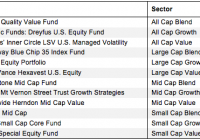
Summary Finding the best mutual funds is an increasingly difficult task in a world with so many to choose from. Performance of a mutual fund’s holdings equals the performance of the fund. Our coverage of mutual funds leverages the diligence we do on each stock by rating mutual funds based on the aggregated ratings of their holdings. Finding the best mutual funds is an increasingly difficult task in a world with so many to choose from. How can you pick with so many choices available? Don’t Trust Mutual Fund Labels There are at least 904 different Large Cap Value mutual funds and at least 6391 mutual funds across twelve styles. Do investors need 500+ choices on average per style category? How different can the mutual funds be? Those 904 Large Cap Value mutual funds are very different. With anywhere from 17 to 1003 holdings, many of these Large Cap Value mutual funds have drastically different portfolios, creating drastically different investment implications. The same is true for the mutual funds in any other style, as each offers a very different mix of good and bad stocks. Large Cap Value ranks first for stock selection. Small Cap Blend ranks last. Details on the Best & Worst mutual funds in each style are here . A Recipe for Paralysis By Analysis We firmly believe mutual funds for a given style should not all be that different. We think the large number of Large Cap Value (or any other) style mutual funds hurts investors more than it helps because too many options can be paralyzing. It is simply not possible for the majority of investors to properly assess the quality of so many mutual funds. Analyzing mutual funds, done with the proper diligence, is far more difficult than analyzing stocks because it means analyzing all the stocks within each mutual fund. As stated above, that can be as many as 1003 stocks, and sometimes even more, for one mutual fund. Any investor worth his salt recognizes that analyzing the holdings of a mutual fund is critical to finding the best mutual fund. Figure 1 shows our top rated mutual fund for each style. Figure 1: The Best Mutual Fund in Each Style Sources: New Constructs, LLC and company filings How To Avoid “The Danger Within” Why do you need to know the holdings of mutual funds before you buy? You need to be sure you do not buy a fund that might blow up. Buying a fund without analyzing its holdings is like buying a stock without analyzing its business and finances. No matter how cheap, if it holds bad stocks, the mutual fund’s performance will be bad. PERFORMANCE OF FUND’S HOLDINGS = PERFORMANCE OF FUND If Only Investors Could Find Funds Rated by Their Holdings The Eaton Vance Hexavest U.S. Equity Fund (MUTF: EHUIX ) is the top-rated Large Cap Value mutual fund and the overall best fund of the 6391 style mutual funds that we cover. The worst mutual fund in Figure 1 is the Royce Special Equity Fund (MUTF: RSEIX ), which gets our Neutral rating. One would think mutual fund providers could do better for this style. Disclosure: I/we have no positions in any stocks mentioned, and no plans to initiate any positions within the next 72 hours. (More…) I wrote this article myself, and it expresses my own opinions. I am not receiving compensation for it. I have no business relationship with any company whose stock is mentioned in this article.

Puerto Rico Debt Worries Loom: 2 ETFs To Watch

While Greece recently defaulted on its payments to the International Monetary Fund, America’s island Puerto Rico has managed to avert a last minute July 1 default giving some relief to its creditors. The island has paid back $645 million of general obligation bonds along with a $415 million installment from the troubled Puerto Rico Electric Power Authority (PREPA). Moreover, Puerto Rico has paid back a short-term bank loan of about $245 million. Though the last minute payment has helped the island to buy some time to negotiate with its creditors, it still has a huge debt load to repay in the coming months and years. In fact, the island has a massive debt load of $72 billion amassed by the government and its agencies. The government owned utility company – PREPA – is crippled by debt and is in talk with creditors to renegotiate its $9 billion of debt. Though Puerto Rico has managed to avert the default, Moody’s Investors Service has cut about $56 billion of Puerto Rico’s other bonds into junk category . The island has been in recession for nearly a decade and there are meager chances of its paying back its debt. This is especially true as many residents of the island are moving to the mainland U.S. in search of better job opportunities which further reduces the island’s tax base. The island’s debt problems also have a significant bearing on the financial market and the investor community, given the fact “estimated in 2013 that 180 mutual funds in the United States and elsewhere have at least 5% of their portfolios in Puerto Rican bonds,” as per investment research firm Morningstar, in a report for USA Today . Apart from mutual funds, a lot of ETFs also have exposure to Puerto Rican debt. Below we have highlighted two ETFs which have significant exposure to Puerto Rican bonds. SPDR Nuveen S&P High Yield Municipal Bond ETF (NYSEARCA: HYMB ) The fund tracks the S&P Municipal Yield Index, measuring the performance of high yield municipal bonds issued by U.S. states and territories or local governments or agencies. Puerto Rico takes the second spot with 10.45% exposure in the fund, ahead of California which has 12.7% allocation. The fund has a portfolio of 432 bonds with an average maturity of 19.74 years and a 30-day SEC yield of 4.60%. Sector-wise, Industrial Revenue takes the top spot with 28.3% allocation, followed by Healthcare and Special Tax each with double-digit exposure. The fund manages an asset base of $393.5 million and trades with moderate volume of 75,000 shares a day. The ETF currently has a Zacks Rank #4 or Sell rating. Short High-Yield Municipal Index ETF (NYSEARCA: SHYD ) The fund tracks The Barclays Municipal High Yield Short Duration Index giving exposure to the high-yield municipal bond market. The fund holds a total of 328 bonds with a modified duration of 3.96 years and a weighted average maturity of 7.23 years. SHYD has a 30-day SEC yield of 3.39%. Puerto Rico has 4.5% weightage in the fund. Sector-wise, Industrial Revenue takes the top spot with a little more than one-third assets, followed by HealthCare (22.6%) and Transportation (10.1%). The fund manages a small asset base of $105.4 million and trades with low volume of less than 30,000 shares a day. SHYD also has a Zacks Rank #4. Original Post