Tag Archives: earnings-center

Common Sense Trumps Smart Beta

Summary Smart beta is more or less a marketing term. In application, it represents a form of factor investing. Trusting your money to a single factor that worked in the past has a far greater chance of producing inferior rather than superior returns in the future. Use your trump card known as common sense when Wall Street comes calling to offer you their latest great idea to make you rich. Every few years or so the powerful money men of Wall Street come up with a new idea they believe will lead to unimaginable wealth for their clients and themselves. These ideas often stem from rigorous statistical studies which attempt to confirm that a particular idea offers better than average returns to investors. Of course, in the world of academia, any believable idea originally promoted by one researcher will quickly be followed by additional research from academics around the world expanding on, reinforcing, or contradicting the original study. With the passage of time, the studies find their way into the hands of those on Wall Street who create investment products, and are then easily distributed through the army of Wall Street salesmen. At the present time, the “great idea” making the rounds is “smart beta.” Before I begin my discussion of smart beta, I want to briefly pay tribute to a soon-to-be relic from my past. For many who live near the border of North and South Carolina, Independence Day includes a trip to the Carowinds theme park for a day of thrills and fireworks. With that in mind, I wanted to give a tip of the hat to the grand old roller coaster Thunder Road, whose time is unfortunately up. Perhaps the wooden structure hasn’t been thrilling visitors like the park’s newest addition, the Fury 325, the world’s tallest and fastest coaster. However, I will certainly miss it. Back when the kids were young, we purchased season passes to the park every year. The best part of having season passes is that we could run up after work for a few hours on a weekday. One of our favorite rides was Thunder Road. Unlike the Fury 325, old Thunder Road traveled a mere 45 miles per hour. Instead of smooth and fast, she bucked, shook, and rattled over the rails. To increase the fun, a simple seat restraint was used, but it wasn’t quite tight enough to hold you firmly in place. During those weeknights we could ride once, twice, or as many times as we wanted, as we rarely had to wait in line between rides. What fun it was for all. As we look back over the past six months, the ride in the world of investing is a lot like the ride given by Thunder Road. The economy, interest rates, stock prices, the dollar, gas prices and just about everything else shook, rattled, and bucked around, but ended just about where they started on January 1st. I wish it was as fun as those days with my kids on the coaster, but it wasn’t, as you know. We have mentioned many times that when prices for common stocks are at or above our calculation of fair value, forward returns will depend on growth in earnings, dividends, and the general level of interest rates. All of these change slowly. As we see it today, forward returns for the rest of the year should be positive, but less than we are used to. Of course, anything could happen when prices are not at bargain levels, including some thrilling shakes, rattles, and rolls. An old sage used to warn me to “buckle up,” for we are in for a good ride. You can be assured that we have tightened the seat belt in hopes that it will hold us in place. Now, on to “smart beta.” The phrase sounds as though it must refer to something special. After all, every one of us wants to be a “smart” investor. As for the word “beta,” it sounds smart on its own. Combine the two words, add a great marketing team, and you are sure to capture a few dollars from investors who believe you can outsmart the market and reap better than average returns. And wouldn’t that be nice? Earning better than average returns over time would assure that each of us could easily have more than enough money to meet any goal we may have. Over the years, I have become quite skeptical of any claims of easy outperformance, and smart beta is no exception. Without going into mathematical equations, we can explain beta using an example. Take the size of your home. If your home is 3000 square feet, and your neighbor’s home is 1500 square feet, you know that your house is twice as large as your neighbor’s. At the same time, if you know that the average house in your community is 1500 square feet, you know that your house is twice the size as the average house in your community. Beta measures the volatility of one investment to the volatility of the average investment. It is the same as comparing the square feet of your house to the average square feet of the houses in your community. If the beta of one investment is high relative to the average investment, it would be considered riskier, or more volatile than the average of all investments. If the beta is low relative to the average, it would be considered less risky, or less volatile than the average of all investments. To simplify the measuring, in math, the beta of the average is always equal to 1. If an investment has a beta of 2.0 it would be twice as risky as the average of all investments. If the beta is 0.50 it would be one-half as risky as the average. I guess now, simply because we have some idea of what beta is, we can claim to be smart, and if we use that knowledge to make better than average returns, I guess we can claim to be “really smart!” Smart beta is more or less a marketing term. In application, it represents a form of factor investing. A factor such as price to book, price to earnings, dividend yield, or one of the multitude of individual stock characteristics that are studied to see how a portfolio which owns a number of companies with the same factor has performed relative to the entire market. If one of these characteristics produces greater than average returns historically, then an assumption is made that a portfolio based on these characteristics will outperform in the future. The last count I have, which seems to change daily, is that there are more than 300 different factors that people claim offer better than average returns. Of course finding something which worked in the past is meaningless unless the future is identical to the past. Trying to identify factors that provide superior returns has had its rewards. But not in the way you might think. I want to share a little story about a young man who early in his career thought he was pretty darn smart. In fact, he was so full of himself that he knew with a little extra effort he could find a way to build portfolios that would perform better than everyone else’s. This young man, with a brand new CFA (Chartered Financial Analyst) Charter hanging on his wall, a new computer, and a database full of information on thousands of individual public companies, plus a big head, began a study of the 500 companies that were currently held in the S&P 500 index. He ranked all 500 companies based on S&P quality ratings, price to book value, price to cash flow, price to earnings, dividend yield and a few others factors that he believed were important. To build a portfolio, he divided the 500 companies into five equal weighted portfolios of 100 each. Then he compared the returns of each portfolio to the returns of the entire market Low and behold, if he had purchased the 100 companies with the highest S&P Quality rating at the beginning of the year, and rebalanced at the end of the year, selling those shares whose S&P Quality rating dropped and replacing them with the highest over the past five years, he would have outperformed the S&P 500 by over 3% a year. Not only that, but he would have done it with less risk as measured by a beta of 0.90 over the same five years. Excited, the young CFA wanted to share this with as many people as he could knowing full well that they would be just as excited about making extra returns as he was. Of course it was a good thing he did not do that until some real-time testing could be done. Since his own portfolio was meager, buying 100 stocks was beyond his means, so he just did it on paper, thinking that if it worked over the next twelve months surely a big investor would come along and reward him for his expertise. A year later, the young CFA was quite embarrassed at the results. This real-time testing without using real money taught him a pretty good lesson. On review, the young man recognized one problem after another. Let’s take the time to look at a few of these. Every year the companies included in the S&P 500 change. There may not be a large number of changes, but changes there are. The original 500 companies used in his study were not the same as the 500 used to build his portfolio. In other words, he was comparing apples to oranges. The original results may have had nothing to do with quality. It may have been that those companies with a high quality rating also increased cash flow, or dividends, or the market simply wanted to own quality during the five years for any given reason. The original study did not include any extra cost. He did not account for the cost of commissions, fees, or the actual price paid for each company bought or sold during the day instead of just using a closing price. These costs were so great that any outperformance on paper was erased. In the real world, five years isn’t even a full economic cycle. Would the performance still be good over a lifetime, and not just the last five years? Would it have performed just as well over a ten year period, or over a five year period twenty years earlier? The recent five years is just too short of a time period to have real meaning. If the excess returns were real, and all he needed was S&P’s Quality rating, anyone could find the same quality rating, causing others to piggyback on his research. Given how easy it would be to do that, other investors could easily wipe out any extra returns by driving up the prices of the highest quality companies. Most of the products created by investment companies that market to you under the heading of smart beta are based on a single factor. This is dangerous for individual investors. The only guarantee is that the future will be different than the past. It may rhyme, but it will not be the same. Trusting your money to a single factor that worked in the past has a far greater chance of producing inferior rather than superior returns in the future. Our young CFA was able to learn the pitfalls of back-testing without causing damage to himself or his clients. Managing a portfolio to meet long or short term goals is far more difficult than applying a little math. So this is a reminder: use your trump card known as common sense when Wall Street comes calling to offer you their latest great idea to make you rich. _______________________________________________________________________________ Anderson Griggs & Company, Inc., doing business as Anderson Griggs Investments, is a registered investment adviser. Anderson Griggs only conducts business in states and locations where it is properly registered or meets state requirement for advisors. This commentary is for informational purposes only and is not an offer of investment advice. We will only render advice after we deliver our Form ADV Part 2 to a client in an authorized jurisdiction and receive a properly executed Investment Supervisory Services Agreement. Any reference to performance is historical in nature and no assumption about future performance should be made based on the past performance of any Anderson Griggs’ Investment Objectives, individual account, individual security or index. Upon request, Anderson Griggs Investments will provide to you a list of all trade recommendations made by us for the immediately preceding 12 months. The authors of publications are expressing general opinions and commentary. They are not attempting to provide legal, accounting, or specific advice to any individual concerning their personal situation. Anderson Griggs Investments’ office is located at 113 E. Main St., Suite 310, Rock Hill, SC 29730. The local phone number is 803-324-5044 and nationally can be reached via its toll-free number 800-254-0874. Disclosure: I am/we are long SPY. (More…) I wrote this article myself, and it expresses my own opinions. I am not receiving compensation for it. I have no business relationship with any company whose stock is mentioned in this article.
The SEC Is Going Too Far On ‘Clawback’

Summary Andrew Ross Sorkin of DealBook reported that the new SEC proposal could obligate all publicly traded companies to recover incentive-based compensation from executives contingent on certain events. If the proposal is passed, it would result in widespread ramifications for Corporate America. In this piece, I detail the potential negative consequences that I believe are the most salient to the discussion at hand. Ramifications would revolve around the misalignment of interests between shareholders and management. Increased compliance costs and reduced market liquidity would be possible consequences as well. Investors should consider allocating capital to international corporations not subject to SEC regulation. “Clawbacks” are coming Recently, New York Times DealBook founder Andrew Ross Sorkin reported that the Dodd-Frank regulation, which aims to overhaul the financial system post-2008 requires the Securities & Exchange Commission to devise a rule relating to “clawbacks”. As a quick reminder to readers who are not familiar with the term, clawbacks are provisions that are included in employment contracts which allow the principal (i.e. the employer) to limit bonus compensation upon the occurrence of certain events specified in the employment contract. Moral hazard and measures taken to mitigate the problem The reason why clawbacks generate a great deal of discussion is largely as a result of the sub-prime mortgage crisis. Public and political commentators have opined that one major factor contributing to the crisis was that of moral hazard. Pre-2008, traders could take a lot of risks for a chance at an outsized payout. If it worked, the trader would be compensated heavily. If the trade failed, the trader would be fired. However, the downside risk was minimal as the trader could simply get employed at another firm. With the possibility of an outsized payout and minimal downside risk, incentives were highly asymmetric. Thus, to mitigate the problem of moral hazard, clawbacks were proposed by the SEC. However, I believe that the Commission is going too far as its current proposal would extend to all publicly-traded companies , instead of just financial institutions. Essentially, the new proposal would obligate public companies to recover incentive-based compensation from executives for up to three years if they ever have to restate their earnings. Due to the all-encompassing nature of the provision, I believe that this topic should be of great interest to investors who invest in corporate America (NYSEARCA: SPY ) – in other words, nearly every investor out there. The proposal is deceptively simple. Despite its simplicity, I believe that there are severe ramifications that may materialize if it is passed. These ramifications primarily revolve around the misalignment of interests between shareholders and management . In his piece, Mr. Sorkin explained briefly how base/incentive compensation may be affected. Due to his brevity, I believe that readers may not have grasped the essence of his article. Therefore, I will expand upon the points he made. Before I do that, I believe that some context is required. A brief history of compensation Historically, employers compensated employees with a fixed base salary that grows by a small amount (usually somewhat correlated with inflation) every year. However, employers soon realized that this model was not sufficient to motivate their employees. As they were being paid a fixed base salary, employees were not incentivized to strive for performance – they were happy to complete the minimum required of them. After all, there was no need to outperform; there were no financial rewards for outperformance. Lip service might be given as a courtesy, but we all know what that is worth. In a bid to motivate outperformance, employers soon started offering bonus compensation to employees that exceed what was required of them. This bonus compensation can come in many forms – restricted stock, stock options, etc. However, they all have one thing in common. They were tied to performance. Some may be tied to sales targets, others may be tied to profit targets. This compensation model worked well for a while. However, employees soon found that it was a better idea to take stratospheric levels of risk for a probability at an immense financial payout. This produced the rogue traders that I believe that many readers are familiar with (London Whale, Nick Leeson, etc). The new SEC proposal The Commission’s new proposal is intended to mitigate the problem of moral hazard that comes with the asymmetric compensation model discussed above. The idea is rather simple – an employee that takes projects with unusually high amounts of risk may manage to achieve success in the short-term, but in the long-term the proposition is likely to blow up. Said another way, profits in the short-term might be outsized, but may need to be restated in the future (after being marked-to-market, for example). Thus, the employee would be compensated on the basis of the restated profits (which are typically much lower). In theory, it seems like it would work out. However, the situation is likely to manifest very differently in practice. Faced with reduced bonus compensation, executives are likely to take one of two routes: increase base compensation substantially to offset the decrease in bonus compensation, or increase bonus compensation to such a height that would ensure bonus compensation remain at pre-proposal levels post-proposal. Both routes are equally dismal for shareholders of corporate America. Suppose base compensation was increased in order to offset the decrease in bonus compensation. In this case, the situation would simply revert back to what it was historically – where employees were compensated with a salary that was largely fixed. Incentives for outperformance would be minimal. Thus, management would not be motivated to strive for performance. It is likely that management would simply be concerned with keeping their jobs, thus reducing the likelihood of them taking on large projects that would allow their company to grow. After all, there is no incentive to. As a result, shareholders of corporate America like you and me would be paying more for management that is content with maintaining the status quo. Growth realized by the S&P 500 has been sluggish in recent years, and the new proposal would exacerbate the problem. Alternatively, suppose that bonus compensation was increased to such a height that would ensure bonus compensation remains at pre-proposal levels post-proposal. In this situation, the net effect on bonus compensation would be minimal. However, as this scenario implicitly requires bonus compensation to be tied to a larger percentage of performance, the incentive to take on extremely high-risk projects would be heightened even further. In a nutshell, the problem of moral hazard would be amplified. Shareholders would be footing the bill once again. Expect this to contribute to a repeat of the 2008 crisis. In addition to the above, I believe that there other ramifications to consider as well. Other possible consequences Due to the fact that restatements of earnings tend to be as a result of an honest accounting error for the most part, corporate America as a whole is likely to hire more compliance personnel in a bid to minimize the possibility of error. Although compliance personnel play an important role, they do not generate any revenue or profit for the company. They are a necessary cost, but a cost nonetheless. For particularly large organizations, the increase in hiring of compliance personnel is likely to be substantial, which will materially reduce their bottom line. Once again, shareholders end up picking the tab. Recent regulation that called for banks to hold more capital (per Basel standards) have greatly reduced market liquidity . I opine that if this new SEC proposal was passed, liquidity would decline even further. It is no secret that financial institutions such as Citigroup (NYSE: C ), Goldman Sachs (NYSE: GS ) and Bank of America (NYSE: BAC ) are market-makers. Market-makers provide liquidity to the markets. They stand by willing to sell or purchase securities to and from willing market participants. Without a doubt, their role is a vital one. Recall that the new SEC proposal allows bonus compensation to be recovered in the event of a restatement of earnings. Mark-to-market gain/losses are one example of one such event. As bonus compensation is typically far greater than base compensation, executives of financial institutions are likely to cut back their presence in market-making in order to reduce the probability of the firm suffering from huge mark-to-market losses. Due to increased illiquidity, investors should expect increased volatility if the proposal is passed. Conclusion The new proposal proposed by the SEC aims to rein in outsized compensation. Despite its well-intended nature, the proposal is likely to result in widespread ramifications across corporate America if it is passed. No matter how you slice it, a misalignment of interests between shareholders and management are sure to occur. Increased compliance costs should follow as well. When all is said and then, public shareholders would be the one footing the bill. Additionally, the proposal could also result in a further diminishing in market liquidity, which would increase illiquidity. Although the proposal has not been passed yet, I believe that there is a high likelihood that it would be. The general public has always been inundated and resentful towards executives who command high levels of compensation. A proposal that aims to reduce compensation levels would likely be very popular. However, such proposals may have unintended consequences as detailed above. As these consequences are far-reaching, I believe that every investor should take note of the situation and perhaps consider investing abroad where public companies are not subject to SEC regulation. Disclosure: I/we have no positions in any stocks mentioned, and no plans to initiate any positions within the next 72 hours. (More…) I wrote this article myself, and it expresses my own opinions. I am not receiving compensation for it (other than from Seeking Alpha). I have no business relationship with any company whose stock is mentioned in this article.

Today’s Most Competitive Emerging Country ETF Investment

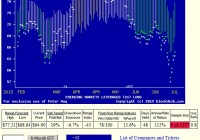
Summary From a population of some 350 actively-traded, substantial, and growing ETFs this is a currently attractive addition to a portfolio whose principal objective is wealth accumulation by active investing. We daily evaluate future near-term price gain prospects for quality, market-seasoned ETFs, based on the expectations of market-makers [MMs], drawing on their insights from client order-flows. The analysis of our subject ETF’s price prospects is reinforced by parallel MM forecasts for each of the ETF’s ten largest holdings. Qualitative appraisals of the forecasts are derived from how well the MMs have foreseen subsequent price behaviors following prior forecasts similar to today’s. Size of prospective gains, odds of winning transactions, worst-case price drawdowns, and marketability measures are all taken into account. Today’s most attractive ETF Is the ProShares Ultra MSCI Emerging Markets ETF (NYSEARCA: EET ). Yahoo Finance profiles this ETF as follows: The investment seeks daily investment results, before fees and expenses, that correspond to two times (2x) the daily performance of the MSCI Emerging Markets Index®. The fund invests in securities and derivatives that ProShare Advisors believes, in combination, should have similar daily return characteristics as two times (2x) the daily return of the index. The index includes 85% of free float-adjusted market capitalization in each industry group in emerging market countries. The fund is non-diversified. The fund currently holds assets of $37.5 million and has had a YTD price return of +1.9%. Its average daily trading volume of 14,205 produces a complete asset turnover calculation in 41 days at its current price of $64.90. A typical bid~offer spread is 0.6%. Behavioral analysis of market-maker hedging actions while providing market liquidity for volume block trades in the ETF by interested major investment funds has produced the recent past (6 month) daily history of implied price range forecasts pictured in Figure 1. Figure 1 (used with permission) The vertical lines of Figure 1 are a visual history of forward-looking expectations of coming prices for the subject ETF. They are NOT a backward-in-time look at actual daily price ranges, but the heavy dot in each range is the ending market quote of the day the forecast was made. What is important in the picture is the balance of upside prospects in comparison to downside concerns. That ratio is expressed in the Range Index [RI], whose number tells what percentage of the whole range lies below the then current price. Today’s Range Index is used to evaluate how well prior forecasts of similar RIs for this ETF have previously worked out. The size of that historic sample is given near the right-hand end of the data line below the picture. The current RI’s size in relation to all available RIs of the past 5 years is indicated in the small blue thumbnail distribution at the bottom of Figure 1. The first items in the data line are current information: The current high and low of the forecast range, and the percent change from the market quote to the top of the range, as a sell target. The Range Index is of the current forecast. Other items of data are all derived from the history of prior forecasts. They stem from applying a T ime- E fficient R isk M anagement D iscipline to hypothetical holdings initiated by the MM forecasts. That discipline requires a next-day closing price cost position be held no longer than 63 market days (3 months) unless first encountered by a market close equal to or above the sell target. The net payoffs are the cumulative average simple percent gains of all such forecast positions, including losses. Days held are average market rather than calendar days held in the sample positions. Drawdown exposure indicates the typical worst-case price experience during those holding periods. Win odds tells what percentage proportion of the sample recovered from the drawdowns to produce a gain. The cred(ibility) ratio compares the sell target prospect with the historic net payoff experiences. Figure 2 provides a longer-time perspective by drawing a once-a week look from the Figure 1 source forecasts, back over two years. Figure 2 (used with permission) What does this ETF hold, causing such price expectations? Figure 3 is a table of securities held by the subject ETF, indicating its concentration in the top ten largest holdings, and their percentage of the ETF’s total value. Figure 3 (click to enlarge) Source: Yahoo Finance This shows how leveraged ETFs do their magic. The top ten holdings of EET are mainly swaps contracts in the iShares MSCI Emerging Markets ETF (NYSEARCA: EEM ), with a value per share of 184.57% of the EET share. The 4.01% in bonds helps balance out the 2x relationship of price change in EET with the underlying Emerging Markets Index security. But that doesn’t tell much about what the investor has driving his investment. To find that out, we look at the holdings of EEM: Source: Yahoo Finance That’s better, and shows the emphasis on Financial Services and Technology, making up almost half of the portfolio. Unfortunately, the offshore nature of virtually all the underlying equity holdings are ones that we do not have information support from arbitrage activities in derivative markets, so our analysis of this dimension of EET must stop here. In markets as unpredictably dynamic as this, wide variations in market experience seem to be the rule. A comparison of the data row for EET from Figure 1 with a similar one from an ETF proxy for the U.S. market helps to highlight the unique and attractive features of EET. For EET: For the SPDR S&P 500 Trust ETF (NYSEARCA: SPY ) : The Sell Target for EET offers 3 times as much potential gain as the U.S. market proxy, SPY. But it exposes the investor to worst-case price drawdown exposure that is more than twice as large. Still, taking Sell Target and Drawdown as Reward and Risk elements, EET is favored with a ratio of 3 to 1, rather than SPY’s 2 to 1. Just as importantly, the ability to recover from extreme price drawdowns and achieve some or all of the upside potential is indicated by each one’s Win Odds out of 100. For the U.S. market proxy that desired objective has been accomplished 7 out of every 8 times. EET has achieved it a bit better than 6 out of 8. But the payoff for EET at a net (including losses) average of +15.6% is 5 times bigger than the U.S. market’s +3.5%. Since both alternative investments took 9-10 weeks to achieve their gains, the Annual Rates of Return [AROR] from price change gains is also 5 times better, 115% to 21%. EET’s relatively small sample of prior experiences, only 9 in the past 5 years is not surprising or troubling, given its presently depressed price, relative to its forecast. That is measured by its Range Index. When negative, it tells by how much the current market quote is below the least justifiable forecast price. Here a -43 means it is cheap by nearly half its total forecast price range. The U.S. market proxy, on the other hand is presently priced right about at its mid-point, with only slightly more upside than downside. A quick reference to the small thumbnail picture in Figure 1, of the past 5 years distribution of Range indexes, emphasizes how extreme (and opportune) is the current pricing. Conclusion EET provides attractive forecast price gains, supported by a recognized index of major established investments in emerging countries. The daily forecast graphic and its weekly extracts over the longer period of two years demonstrate the cyclic nature of the ETF. Its dynamic character offers an opportune point in time to take advantage of world events that may be distracting investors’ attention from the potentials presented here. Disclosure: I/we have no positions in any stocks mentioned, and no plans to initiate any positions within the next 72 hours. (More…) I wrote this article myself, and it expresses my own opinions. I am not receiving compensation for it (other than from Seeking Alpha). I have no business relationship with any company whose stock is mentioned in this article.