Tag Archives: earnings-center

How To Avoid The Worst Style Mutual Funds: Q2’15 In Review
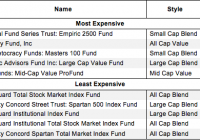
Summary The large number of mutual funds has little to do with serving your best interests. Below are three red flags you can use to avoid the worst mutual funds. The following presents the least and most expensive style mutual funds as well as the worst overall style mutual funds per our 2Q15 style ratings. Question: Why are there so many mutual funds? Answer: Mutual fund providers tend to make lots of money on each fund so they create more products to sell. The large number of mutual funds has little to do with serving investors’ best interests. Below are three red flags investors can use to avoid the worst mutual funds: 1. Inadequate Liquidity This issue is the easiest issue to avoid, and our advice is simple. Avoid all mutual funds with less than $100 million in assets. Low levels of liquidity can lead to a discrepancy between the price of the mutual fund and the underlying value of the securities it holds. Plus, low asset levels tend to mean lower volume in the mutual fund and larger bid-ask spreads. 2. High Fees Mutual funds should be cheap, but not all of them are. The first step here is to know what is cheap and expensive. To ensure you are paying at or below average fees, invest only in mutual funds with total annual costs below 1.95%, which is the average total annual cost of the 6391 U.S. equity Style mutual funds we cover. Figure 1 shows the most and least expensive style mutual funds. Empiric provides one of the most expensive mutual funds while Vanguard mutual funds are among the cheapest. Figure 1: 5 Least and Most Expensive Style Mutual Funds Sources: New Constructs, LLC and company filings Investors need not pay high fees for quality holdings. The E aton Vance Hexavest U.S. Equity Fund (MUTF: EHUIX ) earns our Very Attractive rating and has low total annual costs of only 1.22%. On the other hand, no matter how cheap a mutual fund, if it holds bad stocks, its performance will be bad. The quality of a mutual fund’s holdings matters more than its price. 3. Poor Holdings Avoiding poor holdings is by far the hardest part of avoiding bad mutual funds, but it is also the most important because a mutual fund’s performance is determined more by its holdings than its costs. Figure 2 shows the mutual funds within each style with the worst holdings or portfolio management ratings . Figure 2: Style Mutual Funds with the Worst Holdings Sources: New Constructs, LLC and company filings Northern Lights appears more often than any other providers in Figure 2, which means that they offer the most mutual funds with the worst holdings. Our overall ratings on mutual funds are based primarily on our stock ratings of their holdings. The Danger Within Buying a mutual fund without analyzing its holdings is like buying a stock without analyzing its business and finances. Put another way, research on mutual fund holdings is necessary due diligence because a mutual fund’s performance is only as good as its holdings’ performance. PERFORMANCE OF MUTUAL FUND’s HOLDINGs = PERFORMANCE OF MUTUAL FUND Disclosure: David Trainer and Max Lee receive no compensation to write about any specific stock, style, or theme. Disclosure: I/we have no positions in any stocks mentioned, and no plans to initiate any positions within the next 72 hours. (More…) I wrote this article myself, and it expresses my own opinions. I am not receiving compensation for it. I have no business relationship with any company whose stock is mentioned in this article.
ETFs To Play The Market During More Volatile Conditions

The markets are experiencing greater volatility. More conservative investors may take a look at low-volatility ETF related strategies. Low-vol ETF strategies for domestic and international markets. With the sudden bout of volatility shaking up the markets from its listless first half, more conservative investors may consider exchange traded funds that track a low-volatility strategy. Market watchers argue that investors should get used to stock volatility as it is here to stay for some time, reports Michelle Fox for CNBC . Fueling the risk, the escalation in the Greek debt crisis and a major sell-off in Chinese markets sent global markets reeling. “People are not taking a lot of risk right now. There are too many cross-currents right now to really take a big position out there,” Brian Kelly, founder of Brian Kelly Capital, said on CNBC. “Yes, potentially we get some kind of deal in Greece but then it’s unclear exactly what the damage has been done in China.” Consequently, retail investors have been hesitant on joining the market as market swings remain a major concern. Nevertheless, there are a number of low-volatility ETFs available that track more steady segments of the markets. For instance, over the past month, the PowerShares S&P 500 Low Volatility Portfolio ETF (NYSEARCA: SPLV ) , which tracks the 100 least volatile stocks on the S&P 500, rose 1.3% and the iShares MSCI USA Minimum Volatility ETF (NYSEARCA: USMV ) , which selects stocks based on variances and correlations, along with other risk factors, rose 0.9%. In contrast, the S&P 500 has declined 1.2% over the past month. “Low-volatility stocks have historically offered higher risk-adjusted returns than their more-volatile counterparts, suggesting that the market has not offered adequate compensation for incremental risk,” according to Morningstar analyst Michael Rawson. ETF investors can also take the low volatility theme to overseas markets. The low-volatility ETFs have helped soften the blow from the global sell-off. For example, the PowerShares S&P International Developed Low Volatility Portfolio ETF (NYSEARCA: IDLV ) and the iShares MSCI EAFE Minimum Volatility ETF (NYSEARCA: EFAV ) provide a low-volatile option for developed overseas markets. Over the past month, IDLV dipped 2.8% and EFAV fell 1.4% while the iShares MSCI EAFE ETF (NYSEARCA: EFA ) declined 2.9%. Additionally, investors can target emerging market exposure through the iShares MSCI Emerging Markets Minimum Volatility ETF (NYSEARCA: EEMV ) and the PowerShares S&P Emerging Markets Low Volatility Portfolio ETF (NYSEARCA: EELV ) . Over the past month, EELV was down 3.4% and EELV was 3.1% lower while the iShares MSCI Emerging Markets ETF (NYSEARCA: EEM ) retreated 5.2%. Max Chen contributed to this article . Disclosure: I/we have no positions in any stocks mentioned, and no plans to initiate any positions within the next 72 hours. (More…) I wrote this article myself, and it expresses my own opinions. I am not receiving compensation for it. I have no business relationship with any company whose stock is mentioned in this article.

Tough Times For Broadly Diversified Portfolios

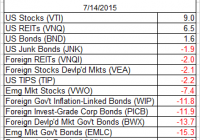
How’s your globally diversified strategy faring these days? Having a tough time? You’re not alone – the headwinds are fierce. For the first time in recent memory, the overwhelming majority of the major asset classes are in the red on a trailing one-year basis. As a result, broadly defined asset allocation strategies are suffering, at least relative to the stellar numbers in recent years. Using a set of ETF proxies for the trailing 250-day (1 year) total return, only US stocks, US REITs (real estate investment trusts), and US bonds (broadly defined) are posting gains among the major asset classes. By contrast, the other 11 asset classes are in varying states of loss over that period. Here’s another view by indexing all the ETFs to 100 as of July 16, 2014… ouch! (click to enlarge) Given the current environment, it’s no surprise that a broadly defined asset class strategy has stumbled lately. For instance, consider an ETF-based version of an unmanaged, market value weighted mix of all the major asset classes – the Global Market Index Fund, or GMI.F, which holds all the ETFs in the table above. Here’s how GMI.F stacks up for the past 250 trading days through yesterday (July 14, 2015). This investable strategy is ahead by less than 1% over that span – below the performance for US stocks (NYSEARCA: VTI ) and US bonds (NYSEARCA: BND ). (click to enlarge) Is GMI’s diminished performance surprising? Maybe, but only if you weren’t paying attention. Risk premia projections for GMI have been relatively soft for some time ( see this month’s update, for instance) – after several years of hefty gains for GMI and equivalent strategies. The lesson, of course, is that mean reversion is alive and well when it comes to market (and portfolio strategy) returns. Share this article with a colleague