Tag Archives: author

ETF Stats For January 2015 – Negative Start

The ETF industry began the year with a thud. Listings decreased by ten, including five actively managed ETFs, and assets dropped by a percentage point. Although 13 new ETFs launched in the first month of the year, 23 other products closed, delisted, and liquidated. Product count now stands at 1,652, consisting of 1,442 ETFs and 210 ETNs. Additionally, 120 of the ETFs are classified as being actively managed, and 44 have been identified as being fund-of-funds products. Assets under management (“AUM”) fell more than $19 billion to $1.98 trillion. This was just a 1% decline and is actually quite healthy given the 3% drop in the S&P 500 for the month. ETFs with more than $10 billion in assets increased from 44 to 47 and account for 57.6% of all assets. It takes $1.2 billion in assets to be an ‘average’ sized product, although only 224 (< 14%) can claim being above average. Trading activity didn't change much from December . Total dollar volume came in at $1.87 trillion, just 0.5% higher for the month. The quantity of highly traded products averaging more than $1 billion a day jumped from nine to twelve. These dozen represent less than 1% of the listed products but account for 59.4% of all trading activity. Actively managed ETFs made significant inroads last year with 56 launches and just 2 closures for a net increase of 54 funds. Things went the other way in January with no new actively managed ETFs coming to market and five shutting down. The year is far from over, but the early trend is unfavorable. Our stats table changed this month with rows for actively managed ETF listing counts and AUM included at the bottom of the table. There is no such thing as an actively managed ETN, so we are using the ETN column to display the monthly change count for listings and percentage change of AUM. Likewise, the Total column displays the year-to-date change for each measurement. January 2015 Month End ETFs ETNs Total Currently Listed U.S. 1,442 210 1,652 Listed as of 12/31/2014 1,451 211 1,662 New Introductions for Month 13 0 13 Delistings/Closures for Month 22 1 23 Net Change for Month -9 -1 -10 New Introductions 6 Months 95 5 100 New Introductions YTD 13 0 13 Delistings/Closures YTD 22 1 23 Net Change YTD -9 -1 -10 Assets Under Mgmt ($ billion) $1,953 $26.2 $1,980 % Change in Assets for Month -1.0% -2.6% -1.0% % Change in Assets YTD -1.0% -2.6% -1.0% Qty AUM > $10 Billion 47 0 47 Qty AUM > $1 Billion 246 4 250 Qty AUM > $100 Million 745 37 782 % with AUM > $100 Million 51.7% 17.6% 47.3% Monthly $ Volume ($ billion) $1,796 $69.9 $1,866 % Change in Monthly $ Volume +0.0% +15.3% +0.5% Avg Daily $ Volume > $1 Billion 11 1 12 Avg Daily $ Volume > $100 Million 97 4 101 Avg Daily $ Volume > $10 Million 316 12 328 Actively Managed ETF Count (w/ change) 120 -5 mth -5 ytd Actively Managed AUM ($ billion) $17.6 +2.2% mth +2.2% ytd Data sources: Daily prices and volume of individual ETPs from Norgate Premium Data. Fund counts and all other information compiled by Invest With An Edge. New products launched in January (sorted by launch date): Direxion Daily FTSE Developed Market Bull 1.25x Shares (NYSEARCA: LLDM ) , launched 1/7/15, is part of the new Lightly Leveraged series from Direxion that aims to provide magnified equity exposure while mitigating the long term volatility decay impacts of daily leverage reset. LLDM is designed to return 125% of the daily performance of the FTSE Developed ex North America Index that includes stocks of large- and mid-capitalization companies in 24 developed countries. Japan tops the list with about a 22% allocation, and Britain is next with 17%. LLDM is a fund-of-funds holding the Vanguard FTSE Developed Markets ETF (NYSEARCA: VEA ), and the expense ratio is capped at 0.50% until 9/1/16 ( LLDM overview ). Direxion Daily FTSE Emerging Markets Bull 1.25x Shares (NYSEARCA: LLEM ) , launched 1/7/15, seeks to return 125% of the daily performance of a FTSE index that includes 22 emerging market countries. China, Taiwan, India, and Brazil each have over a 10% allocation. Countries included with allocations of less than 0.25% include Czech Republic, Hungary, Pakistan, Malta, Spain, and Morocco. The fund-of-funds currently invests in the Vanguard FTSE Emerging Markets ETF (NYSEARCA: VWO ). The fund’s expense ratio is capped at 0.50% until 9/1/16 ( LLEM overview ). Direxion Daily S&P 500 Bull 1.25x Shares (NYSEARCA: LLSP ) , launched 1/7/15, is designed to return 125% of the daily performance of the S&P 500 Index and is a fund-of-funds currently utilizing SPDR S&P 500 ETF (NYSEARCA: SPY ). Information technology and financials top the sector allocation list. The ETF’s expense ratio is capped at 0.50% until 9/1/16 ( LLSP overview ). Direxion Daily Small Cap Bull 1.25x Shares (NYSEARCA: LLSC ) , launched 1/7/15, seeks to return 125% of the daily performance of the Russell 2000 Index. The fund-of-funds invests in iShares Russell 2000 ETF (NYSEARCA: IWM ). Financials tops the sector allocations at 24%, and information technology follows at 17%. The fund’s expense ratio is capped at 0.50% until 9/1/16 ( LLSC overview ). Master Income Fund (NYSEARCA: HIPS ) , launched 1/7/15, will invest in 300 high income yielding securities, which will typically have pass-through structures. It will spread the holdings across MLPs, REITs, BDCs, and debt-based closed-end funds. Based on the underlying index, the initial yield on HIPS is estimated to be about 6.5%. The fund sports an expense ratio of 0.87% ( HIPS overview ). JPMorgan Diversified Return Emerging Markets Equity ETF (NYSEARCA: JPEM ) , launched 1/8/15, will provide exposure to large- and mid-cap equity securities from emerging markets. Stocks are selected using a screening process combining value, momentum, and quality factors, and individual stocks are weighted based on their liquidity. Up to 20% of its assets may be invested in other exchange traded funds. The fund is relatively diversified at about 450 holdings, with iShares MSCI India (BATS: INDA ) being the largest. JPEM’s expense ratio will be capped at 0.45% until 3/1/16 ( JPEM overview ). iShares MSCI International Developed Momentum Factor ETF (NYSEARCA: IMTM ) , launched 1/15/15, provides exposure to large- and mid-cap stocks in developed international markets that are displaying higher price momentum over the last 6 to 12 months relative to the other securities in the space. Japan leads the country allocation at 30%, and health care is on top for sectors at nearly 28%. Investors will pay 0.30% annually to own this fund ( IMTM overview ). iShares MSCI International Developed Quality Factor ETF (NYSEARCA: IQLT ) , launched 1/15/15, will select large- and mid-capitalization stocks in developed international markets that are identified as having high quality characteristics. For this fund, high quality is defined as relatively high return on equity, low debt to equity ratios, and low earnings variability. The country allocation is led by the U.K. with 25%, and the most represented sector is financials at almost 27%. The fund’s annual expenses are 0.30% ( IQLT overview ). QuantShares Hedged Dividend Income ETF (NYSEARCA: DIVA ) , launched 1/15/15, invests in stocks with stable or growing dividends that trade at high yields. In an effort to reduce risk, short positions will be established in stocks with unstable or low dividends. The ETF will be rebalanced to 100% long and 50% short at monthly intervals. The initial yield is estimated to be 3.5%, and the expense ratio will be capped at 0.99% until 10/31/15 ( DIVA overview ). ETFS Zacks Earnings Large-Cap U.S. Index ETF (NYSEARCA: ZLRG ) , launched 1/20/15, will select holdings from the 1,000 largest U.S. equities based on both a quantitative and qualitative review of their earnings. The first step is to rank equities by the most significant positive changes in earnings estimates as published by all sell side analysts. The second step involves identifying firms with the lowest sector-adjusted accruals. Positions are apportioned into sixteen sectors which are equally weighted, and stocks within each sector are equally weighted. The fund sports an expense ratio of 0.66% ( ZLRG overview ). ETFS Zacks Earnings Small-Cap U.S. Index ETF (NYSEARCA: ZSML ) , launched 1/20/15, will select holdings from among the 1,001-3,000 largest U.S. equities based on both a quantitative and qualitative review of their earnings. First, equities are ranked by the most significant positive changes in earnings estimates as published by sell side analysts. The top 5% are then ranked by their relative sector-adjusted accruals with lower accruals being ranked higher. Positions are divided into 15 sectors which are equally weighted, and stocks within each sector are equally weighted. ZSML’s annual expense ratio is 0.66% ( ZSML overview ). ETFS Diversified-Factor Developed Europe Index ETF (NYSEARCA: SBEU ) , launched 1/27/15, will select its holdings from the 700 largest and most liquid stocks listed across 16 European countries. The fund will hold positions based on the following four factors: low volatility, value, momentum, and size. Once stocks are selected, they will be weighted through a proprietary strategy. The country allocation is led by the U.K. with 32%, and the most represented sector is financials at almost 23%. Investors will pay 0.40% annually to own this fund ( SBEU overview ). ETFS Diversified-Factor U.S. Large Cap Index ETF (NYSEARCA: SBUS ) , launched 1/27/15, will select its holdings from the 500 largest and most liquid stocks listed on U.S. exchanges. The fund will hold positions based on factors related to low volatility, value, momentum, and size. Once stocks are selected, they will be weighted through a proprietary strategy. Of the 500 stocks in the universe, 485 are held in the fund. SBUS has an expense ratio of 0.40% ( SBUS overview ). Product closures/delistings in January : ProShares Short 30 Year TIPS/TSY Spread (NYSEARCA: FINF ) ( ProShares closes 17 ETFs ) ProShares Ultra Russell Midcap Growth (NYSEARCA: UKW ) ProShares Ultra Russell Midcap Value (NYSEARCA: UVU ) ProShares Ultra Russell1000 Growth (NYSEARCA: UKF ) ProShares Ultra Russell1000 Value (NYSEARCA: UVG ) ProShares Ultra Russell2000 Growth (NYSEARCA: UKK ) ProShares Ultra Russell2000 Value (NYSEARCA: UVT ) ProShares Ultra Russell3000 (NYSEARCA: UWC ) ProShares UltraPro 10 Year TIPS/TSY Spread (NYSEARCA: UINF ) ProShares UltraPro Short 10yr TIPS/TSY Spread (NYSEARCA: SINF ) ProShares UltraShort Russell Midcap Growth (NYSEARCA: SDK ) ProShares UltraShort Russell Midcap Value (NYSEARCA: SJL ) ProShares UltraShort Russell1000 Growth (NYSEARCA: SFK ) ProShares UltraShort Russell1000 Value (NYSEARCA: SJF ) ProShares UltraShort Russell2000 Growth (NYSEARCA: SKK ) ProShares UltraShort Russell2000 Value (NYSEARCA: SJH ) ProShares UltraShort Russell3000 (NYSEARCA: TWQ ) AdvisorShares Accuvest Global Opportunities (NYSEARCA: ACCU ) ( AdvisorShares closes 2 funds ) AdvisorShares Athena International Bear ETF (NYSEARCA: HDGI ) AdvisorShares Gartman Gold/British Pound (NYSEARCA: GGBP ) ( AdvisorShares closes 2 currency hedged gold funds ) AdvisorShares International Gold (NYSEARCA: GLDE ) Russell Equity (NYSEARCA: ONEF ) ( Russell closes its last remaining ETF ) Morgan Stanley S&P 500 Crude Oil ETN (NYSEARCA: BARL ) ( press release ) Product changes in January: First Trust Value Line Equity Allocation Index Fund (FVI) underwent an extreme makeover and became the First Trust Total US Market AlphaDEX ETF (NASDAQ: TUSA ) effective January 12 ( press release ). Guggenheim added the word ‘Country’ to the name of Guggenheim MSCI Emerging Markets Equal Country Weight (NYSEARCA: EWEM ) effective January 20. The Janus purchase of VelocityShares was announced in October , and the deal closed in 2014. Janus renamed two of the ETFs to Janus Velocity Tail Risk Hedged Large Cap ETF (NYSEARCA: TRSK ) and Janus Velocity Volatility Hedged Large Cap ETF (NYSEARCA: SPXH ) effective January 23. EGShares Low Volatility Emerging Markets Dividend ETF (NYSEARCA: HILO ) was renamed EGShares EM Quality Dividend ETF and began tracking a new index effective January 26. Prior to 10/28/11, the fund was called EGShares Emerging Markets High Income Low Beta ETF. Announced Product Changes for Coming Months: iShares moves its four allocation ETFs to its Core lineup effective February 2. WisdomTree Euro Debt Fund (NYSEARCA: EU ) will have its last day of trading on February 11 ( press release ). Previous monthly ETF statistics reports are available here . Disclosure covering writer, editor, publisher, and affiliates: No positions in any of the securities mentioned. No positions in any of the companies or ETF sponsors mentioned. No income, revenue, or other compensation (either directly or indirectly) received from, or on behalf of, any of the companies or ETF sponsors mentioned.
Price Stability In An ETF: The Appeal Of Guggenheim Defensive Equity

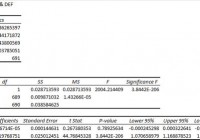
Summary I’m taking a look at DEF as a candidate for inclusion in my ETF portfolio. The only weakness I see is that the ETF has a higher expense ratio as it turns over assets more frequently than I would want. The correlation and standard deviation is very attractive. The data is based on solid liquidity, so feel it is fairly reliable. I’m keeping DEF in the running for my entire portfolio due to the price stability of the ETF. Investors should be seeking to improve their risk adjusted returns. I’m a big fan of using ETFs to achieve the risk adjusted returns relative to the portfolios that a normal investor can generate for themselves after trading costs. I’m working on building a new portfolio and I’m going to be analyzing several of the ETFs that I am considering for my personal portfolio. One of the funds that I’m considering is the Guggenheim Defensive Equity ETF (NYSEARCA: DEF ). I’ll be performing a substantial portion of my analysis along the lines of modern portfolio theory, so my goal is to find ways to minimize costs while achieving diversification to reduce my risk level. What does DEF do? DEF attempts to track the total return (before fees and expenses) of the Sabrient Defensive Equity Index. At least 90% of the assets are invested in funds included in this index. DEF falls under the category of “Large value”. Does DEF provide diversification benefits to a portfolio? Each investor may hold a different portfolio, but I use the SPDR S&P 500 Trust ETF (NYSEARCA: SPY ) as the basis for my analysis. I believe SPY, or another large cap U.S. fund with similar properties, represents the reasonable first step for many investors designing an ETF portfolio. Therefore, I start my diversification analysis by seeing how it works with SPY. I start with an ANOVA table: (click to enlarge) The correlation is 86%. That is a reasonable correlation level under Modern Portfolio Theory. Lower levels of correlation allow more of the risk associated with individual investments to be effectively diversified away. For an ETF that will hold several large U.S. equity securities, that’s a very appealing level of correlation as long as the liquidity is good. Standard deviation of daily returns (dividend adjusted, measured since April 2012) The standard deviation is amazing. For DEF it is .576%. For SPY, it is 0.748% for the same period. SPY usually beats other ETFs in this regard. Because the standard deviation is fairly low and the correlation is pretty good, I’m expecting to see substantial diversification benefits that would make DEF a reasonable fit in most portfolios. Liquidity is moderate Over my sample period the average trading volume was around 35,000 shares per day. Over the last ten days it was over 55,000. Mixing it with SPY I also run comparisons on the standard deviation of daily returns for the portfolio assuming that the portfolio is combined with the S&P 500. For research, I assume daily rebalancing because it dramatically simplifies the math. With a 50/50 weighting in a portfolio holding only SPY and DEF, the standard deviation of daily returns across the entire portfolio is 0.639%. Notice that this is significantly lower than SPY alone. With 80% in SPY and 20% in DEF, the standard deviation of the portfolio would have been .700%. If an investor wanted to use DEF as a supplement to their portfolio, the standard deviation across the portfolio with 95% in SPY and 5% in DEF would have been .735%. Why I use standard deviation of daily returns I don’t believe historical returns have predictive power for future returns, but I do believe historical values for standard deviations of returns relative to other ETFs have some predictive power on future risks and correlations. Yield & Taxes The distribution yield is 2.5%. It’s a reasonable yield for an investor trying to avoid excessive trading costs. A decent distribution yield can help investors avoid feeling a need to open their portfolio up too frequently. Expense Ratio The ETF is posting .66% for a net expense ratio. I want diversification, I want stability, and I don’t want to pay for them. I view expense ratios as a very important part of the long term return picture because I want to hold the ETF for a time period measured in decades. I’m not thrilled with the expense ratio, but it can be tricky to find ETFs with such a low standard deviation of returns and moderate correlation. Market to NAV The ETF is at a .02% premium to NAV currently. Premiums or discounts to NAV can change very quickly so investors should check prior to putting in an order. The ETF is large enough and liquid enough that I would expect the ETF to stay fairly close to NAV. Generally, I don’t trust deviations from NAV and I will have a strong resistance to paying a premium to NAV to enter into a position. I wouldn’t worry about .02%. Largest Holdings The diversification within the ETF may be a substantial part of the lower standard deviation. (click to enlarge) Conclusion This ETF looks like a contender. In the interest of reducing the deviation of returns I find defensive funds appealing as part of a diversified portfolio. The correlation at 86% isn’t too bad and the fund still showed decent returns and holds some of the same companies as SPY while being less volatile. There are some clear diversification benefits here. If an investor was going to hold only SPY or DEF over the next 20 years, I’d expect SPY to end higher. However, the appealing aspect of DEF is that it can reduce the risk of the portfolio. In the context of a more complicated portfolio that is being rebalanced and contains some more volatile ETFs, I like the role of DEF. The average liquidity isn’t too bad. The days with no change in dividend adjusted close is high enough to give me a little concern (18), but there were no days that actually reported 0 trading volumes. Therefore, I think the liquidity is fairly decent and I wouldn’t treat it as a major concern. Having a decent distribution yield doesn’t hurt either in the context of a long term investor. There’s only one area that concerns me. The ETF is posting a fairly high expense ratio relative to the other strong contenders for this space in my portfolio. The portfolio turnover is also very high at 87%. That surprised me a bit. For a defensive ETF, I would expect less shifting in the positions. For comparison, SPY has a turnover ratio of 3%. One strike against the ETF won’t be enough to eliminate it from consideration. I’ll admit that the largest position being Staples makes me scratch my head a little bit, but the position was still under 1.5% so I’d say the diversification is solid and I wouldn’t worry about it. Investors should notice that the ETF does also hold some significant positions in REITs. That doesn’t bother me, but each investor has a different situation. I was expecting to use an ETF dedicated to REITs to increase my exposure in that regard. Disclosure: The author has no positions in any stocks mentioned, and no plans to initiate any positions within the next 72 hours. (More…) The author wrote this article themselves, and it expresses their own opinions. The author is not receiving compensation for it (other than from Seeking Alpha). The author has no business relationship with any company whose stock is mentioned in this article. Additional disclosure: Information in this article represents the opinion of the analyst. All statements are represented as opinions, rather than facts, and should not be construed as advice to buy or sell a security. Ratings of “outperform” and “underperform” reflect the analyst’s estimation of a divergence between the market value for a security and the price that would be appropriate given the potential for risks and returns relative to other securities. The analyst does not know your particular objectives for returns or constraints upon investing. All investors are encouraged to do their own research before making any investment decision. Information is regularly obtained from Yahoo Finance, Google Finance, and SEC Database. If Yahoo, Google, or the SEC database contained faulty or old information it could be incorporated into my analysis. The analyst holds a diversified portfolio including mutual funds or index funds which may include a small long exposure to the stock.

It’s Time To Get Long Volatility

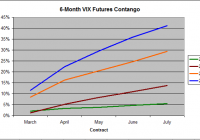
Contango-associated rollover losses have traditionally made holding volatility ETFs for more than a few weeks a dangerous proposition. Over the last two months, however, the VIX futures strip on which volatility ETFs are based has flattened reducing the expense of holding funds such as VXX and TVIX. There is an inverse relationship between VIX price and magnitude of contango. A VIX Risk/Reward score can be used to pinpoint ideal entrypoints for a buy-and-hold position in volatility ETFs. With a current value I have written multiple articles over the past 6 months- Here , Here , and Here -advocating shorting volatility ETFs to take advantage of monthly rollover losses. Recent develops in the VIX Futures market on which volatility ETFs are based, however, has made the sector more attractive as a longer term buy-and-hold position. Anybody who has traded volatility ETFs over the past five years knows that there is a constant uphill battle against the forces of contango. Volatility spikes can generate tremendous short-term gains in these ETFs, but the funds tend to underperform dramatically while awaiting these surges in volatility. While the volatility ETFs are traditionally associated with the VIX-the S&P 500 volatility index-the funds actually hold near-term VIX futures contracts. These contracts expire on a monthly basis and the fund must sell all of its front month contracts and role those funds over into the next month’s contract prior to expiration. Since the market bottom in March of 2009, these later month VIX futures contracts have been persistently more expensive than the front-month, expiring contract, a situation known as contango. This is not that surprising as volatility has been historically low as the markets have rallied these past five years keeping near term volatility low while the prospect of a future market correction has forced investors to pay premiums for later contracts. Unfortunately, this phenomenon has been devastating to short term volatility ETFs such as the iPath S&P 500 VIX Short-Term Futures ETN (NYSEARCA: VXX ) and the leveraged VelocityShares Daily 2x VIX Short-Term ETN (NASDAQ: TVIX ). Each time a fund roles over to a new contract that is in contango, it can buy fewer shares than it just sold, and over time, this results in a significant underperformance of the ETF versus the futures market on which it is based. In 2013, for example, the VIX front month futures lost 10.6% as volatility continued its decline while VXX was down a massive 62%. The 2x leveraged ETF TVIX fared even worse, down 89.8% versus a predicted loss of 21.2%. It is for this reason that I argued for shorting VXX and actively avoiding TVIX as a long term investment in previous articles. Over the past month or two, however, the VIX Futures pattern has evolved to one that I believe to be much more favorable to longer-term traders. Figure 1 below shows the % premium of each contract in the six-month VIX Futures Strip for February 2015 through July compared to the same period in 2014, 2013, and 2012. (click to enlarge) Figure 1: 6-Month Contango 2012-2015 (Source: Yahoo Finance Historical Quotes) It is clear that there has been a flattening of the VIX futures curve in 2015 versus previous years meaning that rollover losses will be limited for volatility ETFs. As of Friday’s close, holding VXX for the next sixth months would result in just a 5.5% rollover-associated loss, assuming no change to the Futures Strip. This compares to a 14% projected loss during the same period in 2014, 29% in 2013 and a disastrous 41% in 2012. Holders of the leveraged ETF TVIX can expect these losses to be doubled. However, this only tells half of the story. There is an inverse relationship between VIX future price and contango. Figure 2 below shows a scatterplot of front-month VIX price against 6-month contango using data for the past five years. As the price of the front-month VIX contract increases, the level of contango tends to decrease. In fact, once the VIX futures reach a certain level-somewhere above 20–the contacts tend slip into backwardation, the opposite of contango in which rollovers actually benefit the longs. (click to enlarge) Figure 2: Over the last 5+ Years, as VIX Futures Price decreases, Contango tends to increase (Source: Yahoo Finance Historical Quotes) At the same time, however, higher VIX levels have a much higher probability to mean revert to the average VIX level, which, over the last 5-years is somewhere around 18, as the market rallies. Figure 3 below shows the average peak six-month return based on the front-month VIX futures contract based on initial VIX starting price. (click to enlarge) Figure 3: Average Peak 6-month return by VIX range (Source: Yahoo Finance Historical Quotes) When the VIX price is less than 12, the average peak six-month return is over 100%, which stabilizes at around 35% between 14 and 20, and then slows to less than 8% when the front month VIX futures is above 30. What is needed, therefore, is a balance between a low VIX entry price while maintaining as minimal level of contango as possible. Sure, a cheap VIX may mean the possibility of a large return on a VIX spike, but you will pay for it through steep rollover losses awaiting for that singular moment. On the other hand, an elevated VIX means that rollover losses will be minimal and it will be cheap to hold the ETF for an extended period of time, but the probability of profiting from a spiking VIX will be much more limited. Overlaying the data from Figures 2-representing the expense curve-and Figure 3-representing the returns curve-produces the chart shown below in Figure 4. This graph implies that at VIX futures prices when the returns curve is greater than the expenses curve, the risk-reward profile is in favor of the longer term holder (that is, out to six-months). However, once the curves intersect at around 22, projected expenses equal projected returns and a buy-and-hold trade is no longer worthwhile. (click to enlarge) Figure 4: Historical projected 6-month return and expenses by VIX range (Source: Yahoo Finance Historical Quotes) This is a good theoretical exercise, but relies on historical averages. What does the current picture look like? A cheap VIX/low contango metric can be calculated simply by multiplying the absolute value of the contango (or backwardation) by the current front month VIX futures contract price. The lower that this number is, the greater the potential for profit while limiting rollover losses. Figure 5 below shows this VIX Risk/Reward Score over the past five years. (click to enlarge) Figure 5: VIX Risk/Reward Score Over the past 5+ years where lower values suggest favorable buying opportunities (Source: Yahoo Finance Historical Quotes) As of Friday’s closing front-month VIX Futures price of $19.18 with a six-month contango of 5.5%, the VIX Risk/Reward Score is 1.05 which, as figure 5 illustrates, is well below the 5-year average of 3.78, indicating a good risk/reward for going long volatility. Indeed, Friday’s close is in the 92nd percentile indicating a historically low score. This effectively allows us to take the projected VIX Expenses curve in Figure 4, which shows an historical average of about a 25% 6-month contango-associated loss at current levels, and shift it downward to match the current 5% projected loss. The proof, as they say, is in the pudding. The VIX risk/reward score has been