Tag Archives: alternative

VTSAX: An Excellent Mutual Fund For Passive Investing
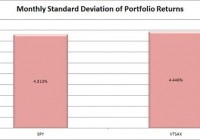
Summary VTSAX offers slightly more diversification than SPY, but it is also slightly more volatile. Because this is a total market fund, it has large weightings for the S&P 500 that create an extremely high correlation. VTSAX is one of the best mutual funds an investor can use for eligible employer-sponsored retirement accounts. Not all plans will offer this fund. VTSAX is the mutual fund version of VTI, which is one of the best total market ETFs available. Investors should be seeking to improve their risk-adjusted returns. Regardless of how they are handling the holdings, the goal is to maximize returns and minimize risks. When it comes to maximizing the returns while maintaining excellent diversification, Vanguard Total Stock Market Index Fund Admiral Shares (MUTF: VTSAX ) is an excellent option. My employer-sponsored retirement accounts are through different brokerages. Mine goes through Schwab, and my wife’s account is with Fidelity. Neither of us is eligible to use VTSAX, but I look for funds that replicate VTSAX, because it embodies most of the things I want in a fund. What does VTSAX do? VTSAX uses an indexing approach to track the performance of the CRSP U.S. Total Market Index. The first thing I’m looking for is diversification, so a total market index seems very attractive. Standard deviation of monthly returns (dividend adjusted, measured since January 2001) The standard deviation is not a problem. Because this is a total market index investors should expect it to be a little more volatile than the S&P 500, and that is exactly what we see. (click to enlarge) Basically, the increase in standard deviation is equivalent to having three percent leverage on a position in SPY. I love low-volatility investments, but when using a retirement account with dollar cost averaging automatically involved, a tiny bit of extra volatility is not problematic as long as the investment is very heavily diversified. Expense Ratio The Admiral shares have an expense ratio of .05%. This is excellent. Largest Holdings The diversification is very good in this mutual fund, and this is easily my favorite thing about the fund. The top 10 holdings appear to be somewhat concentrated, but when you consider that there are over 3800 different securities in the total portfolio, it doesn’t concern me. This is simply a great fund, in my opinion. (click to enlarge) Avoiding Fees There is one downside to Vanguard mutual funds. Vanguard charges a $20 annual account service fee for each mutual fund held in the account with a balance of less than $10,000. If you’re picking VTSAX for a new retirement account and want to save the $20, you can sign up on the Vanguard website for electronic delivery of statements. It appears to me that this fee is largely covering the cost of mailing the investments documents through the postal service. With its huge system in place, being able to send everything by one automated e-mail system saves the company money. I don’t see how it could hold its expense ratio down to .05% without having a way to compel investors to either take electronic delivery or pay for the physical copies. All around, this is a nicely designed system. Want VTSAX from Other Brokerages? You can also effectively invest in the fund using the Vanguard Total Stock Market ETF (NYSEARCA: VTI ), which holds the same assets and has the same expense ratio. Using VTI should automatically avoid the $20 fee and doesn’t require signing up the electronic delivery. The downside about using the ETF is that you would usually be stuck purchasing entire shares. While VTI, shares have been running $107-110; for dollar cost averaging, it is more convenient to be able to buy into a mutual fund with automatic deposits. Conclusion I like VTSAX enough that I’m holding a significant chunk of my portfolio in VTI, the ETF version. Lately, I had been adding to my cash positions rather than my equity positions, because I’m concerned about the market getting a little frothy. Over the last week, I dropped quite a bit of that into buying more broad market ETFs and mREITs when prices dipped. When it comes to long-term investing strategy for the employer-sponsored 401k accounts, my favorite technique is still to use dollar cost averaging on low-fee index funds and to max out (or come close) the contributions every year. If you really want to use VTSAX for your 401k, but are going through Fidelity, I would suggest looking into the Fidelity Spartan® Total Market Index Fund (MUTF: FSTVX ). That is the major mutual fund that I’m using for my wife’s 401k. It has slightly less holdings, with around 3,400 to 3,500 rather than 3,800, but is close enough for my purposes. The correlation between FSTVX and VTSAX is in excess of 99%. Disclosure: I am/we are long VTI, FSTVX. (More…) I wrote this article myself, and it expresses my own opinions. I am not receiving compensation for it (other than from Seeking Alpha). I have no business relationship with any company whose stock is mentioned in this article. Additional disclosure: Information in this article represents the opinion of the analyst. All statements are represented as opinions, rather than facts, and should not be construed as advice to buy or sell a security. Ratings of “outperform” and “underperform” reflect the analyst’s estimation of a divergence between the market value for a security and the price that would be appropriate given the potential for risks and returns relative to other securities. The analyst does not know your particular objectives for returns or constraints upon investing. All investors are encouraged to do their own research before making any investment decision. Information is regularly obtained from Yahoo Finance, Google Finance, and SEC Database. If Yahoo, Google, or the SEC database contained faulty or old information it could be incorporated into my analysis.
I Love This ETF: Vanguard Emerging Markets Government Bond Index ETF

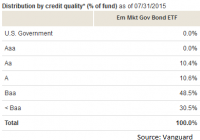
Summary VWOB offers investors exposure to the bond market for government debt in emerging markets. The portfolio has some substantial credit risk, but the yields and duration are solid. When the ETF is combined with other investments in a diversified portfolio, the low correlation is very attractive. I see this as a very solid holding for 3% to 5% of the portfolio. The Vanguard Emerging Markets Government Bond Index ETF (NASDAQ: VWOB ) is a very interesting bond fund. As I’ve been searching for appealing bond funds, I’ve found some of my favorites are from Vanguard. Given my distaste for high expense ratios, it should be no surprise that the Vanguard products would be appealing. After looking through the portfolio, I think the holdings are fairly reasonable for an investor wanting to regularly keep part of their portfolio in a bond fund. However, using only VWOB for bond exposure in a portfolio would be a very unwise decision. VWOB is designed to be an incredible supporting bond fund within a portfolio that already contains other bond investments. Quick Introduction The Vanguard Emerging Markets Government Bond Index ETF is showing a yield to maturity of 5.5% and an average duration of 5.7 years. Given the short duration on the portfolio and the very attractive yield on the bonds, it should be no surprise that the portfolio is carrying a substantial amount of credit risk. The emerging market governments don’t carry stellar credit ratings and there is definitely a material amount of risk in using the bond ETF as an investment. Credit Quality The following chart breaks down the credit quality of the issues being held in the portfolio. Clearly, a substantial portion of the holdings has fairly notable defects in their credit rating; however, the portfolio still offers investors diversification for their portfolio that can be very difficult to acquire in other ways. Emerging Markets and Other The holdings are primarily labeled as Emerging Markets; however, there is also a substantial allocation to a category labeled simply as “Other.” Investors should recognize that areas like Europe have zero allocation in the portfolio. See the chart below: The reason the allocations are so important is this exposure suggests that the portfolio’s correlation with other international bond funds might not be as high. That means even if the ETF is fairly volatile by itself, there could be some very substantial benefits to using it within a highly diversified portfolio that includes equity securities and bond funds allocated to different sectors, regions, and durations. Maturities I grabbed another chart to show the effective maturity on the securities: The maturity profile for the Vanguard Emerging Markets Government Bond Index ETF is fairly reasonable for an investor trying to get a solid diversification across the yield curve. There is a notable amount of exposure to the long-term bonds and the 5- to 10-year range. On the other hand, there is very little exposure to the shortest part of the yield curve. For optimal diversification, an investor may want to include other funds that target the shorter rate part of the yield curve. Risk Measuring returns and statistics since June of 2013 indicates that the portfolio is fairly stable for being invested in emerging markets. The annualized volatility of returns was 5.9%. For comparison, the annualized volatility on the S&P 500 for that period was 11.3% and the annualized volatility for the Vanguard FTSE Emerging Markets ETF (NYSEARCA: VWO ) was 18.3%. Correlation The fund really starts to shine when we consider the correlation in returns between VWOB and other bond funds that the investor might use for a larger portion of their exposure. Look at the correlation matrix below for a comparison: The Vanguard Total International Bond ETF (NASDAQ: BNDX ) is significantly less volatile than VWOB, but the correlation to BNDX is only 28%. BNDX, unlike VWOB, carries a heavy emphasis on Europe, which is entirely absent from the VWOB portfolio. In my opinion, these two ETFs held together in a portfolio are significantly better than either one alone due to the low correlation. Conclusion As far as bond ETFs go, the Vanguard Emerging Markets Government Bond Index ETF is a fairly solid option. An investor that failed to diversify into multiple funds would be taking more risk than necessary to realize returns, but when VWOB is used to enhance the diversification of the portfolio, it is an exceptional ETF. There are only two weaknesses in the entire ETF. One is that the expense ratio of .34% is higher than I want to pay and the other is that the ETF isn’t on the free-to-trade list for Schwab accounts. For investors that have free trading on VWOB through their brokerage and are willing to rebalance their portfolios to take advantage of the low correlations, it would seem that VWOB should be a natural choice for a small portion of the portfolio. My estimate is that the ETF would be a great holding at around 3% to 5% of the total portfolio value. Disclosure: I/we have no positions in any stocks mentioned, and no plans to initiate any positions within the next 72 hours. (More…) I wrote this article myself, and it expresses my own opinions. I am not receiving compensation for it (other than from Seeking Alpha). I have no business relationship with any company whose stock is mentioned in this article. Additional disclosure: Information in this article represents the opinion of the analyst. All statements are represented as opinions, rather than facts, and should not be construed as advice to buy or sell a security. Ratings of “outperform” and “underperform” reflect the analyst’s estimation of a divergence between the market value for a security and the price that would be appropriate given the potential for risks and returns relative to other securities. The analyst does not know your particular objectives for returns or constraints upon investing. All investors are encouraged to do their own research before making any investment decision. Information is regularly obtained from Yahoo Finance, Google Finance, and SEC Database. If Yahoo, Google, or the SEC database contained faulty or old information it could be incorporated into my analysis.

Adams Diversified Equity: A 6-Month Checkup

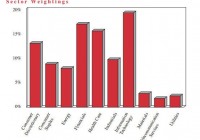
Recently renamed ADX turned in a good first half. Health care and consumer saw new additions. Overall, new management is proving solid so far. Adams Diversified Equity Fund (NYSE: ADX ), formerly known as Adams Express, is one of the oldest closed-end funds, or CEFs, around. That said, a management change in early 2013 meant the potential for big shifts at the fund — and a risk that performance might falter. So far, however, investors should be reasonably pleased with how CEO Mark Stoeckle has been running things. And the first half of 2015 bears that out. Things change… Adams changed its management at the start of 2013, which meant that 2013 was a transition year. Notably, portfolio turnover that year basically doubled compared to historical levels. That said, 2014 saw that number come back down to more-normal levels and that trend has continued so far in 2015. Performance-wise, the fund’s total return in 2013 wasn’t great on a relative basis. Based on net asset value, or NAV, and including reinvested distributions, the fund trailed that S&P by around 3.5 percentage points that year. That said, the fund’s return was 28% in 2013, which is a hard number to complain about. The next year, 2014, wasn’t as good on an absolute basis, but the fund closed the gap with the S&P, with ADX lagging the index by roughly half a percentage point. That’s a much better relative showing. And according to the fund, through the first six months of this year ADX’s return of 2.7% compared favorably to the S&P’s gain of 1.2%. Is this a harbinger of outperformance to come? Maybe, maybe not. As we all know, past returns don’t predict future results. But what it shows is that under new management, ADX hasn’t fallen off a cliff. That said, Stoeckle has only been operating Adams in a generally up market, so he still needs to be tested by a downturn. But investors should be reasonably pleased with the fund’s showing over the last two and half years or so that he’s been running things. New holdings With a fund like ADX, things aren’t usually all that exciting at the portfolio level. This is why the portfolio restructuring in 2013 that doubled the turnover rate was so notable. But with things back to normal, change at the fund is more incremental. For example , Stoeckle noted in the fund’s quarterly report that he added to the fund’s positions in Facebook and Comcast, and added new positions in Valeant and Edwards Lifesciences in health care and Kroger and Spectrum Brands in the consumer space. These aren’t huge shifts or changes, and keep with broader themes already present in the fund. Comcast, around 2.2% of assets at the midpoint of the year, is a top-10 holding, the others are not. That said, while the fund is fairly well diversified, there is one concerning holding — Apple. That stock, the fund’s largest holding, accounted for over 5% of assets at the end of June. That’s a fairly hefty exposure to one company and as the recent Apple sell-off attests, is worth keeping in the back of your mind. Still, at 5% of assets, an Apple sell-off would hurt the fund but alone shouldn’t be enough to cause major damage. The fund sold a number of holding in the period, too. The list includes Abbvie, General Mills, Hershey, Micron Technology, and Unilever. Several positions were trimmed, as well, including Aetna, Coca-Cola, Gilead Sciences, Intel, and Disney. Bouncing those names against the additions, you can see the big picture didn’t alter all that much. Looking at the fund from that greater distance, technology, finance, and health care were the three largest sectors at the end of June, making up roughly half the fund. The consumer sector was number four. Utilities, telecom, and basic materials pulled up the rear, representing the fund’s smallest sector weightings. Dividends and more So the first half was relatively uneventful for the fund. It performed well and aside from Apple, which has long been a large holding, there really weren’t any red flags. Moreover, the portfolio changes were largely shifting within the bigger picture. So mostly good news here. Adams also announced another dividend, of $0.05 a share. That’s relatively small, but keeps with the trend of three small quarterly payments and one larger one at the end of the year. The fund’s goal is to distribute 6% of assets on an annual basis. That’s a number that should interest income-oriented investors. There’s no expected change to that, according to Stoeckle. The way in which distributions are paid out, however, isn’t exactly desirable if you are trying to live off of your investment income. So you’ll have to take that into consideration here if you are buying for the distributions. Note, too, that annual distributions will go up and down based on performance since they are a set as a percentage of NAV, not a hard dollar figure. In addition, the fund bought 765,000 of its own shares in the first half at an average discount of just under 14%. That’s roughly where the discount sits today and in line with its average over the past three years. I’d say that’s a reasonable use of cash and helps to support the fund’s NAV over the long term. Remember, that the fund has been in existence since the Great Depression, so this is far from a fly-by-night operation. And as a stand-alone company, there’s no sponsor manipulating things. What you see is what you get at ADX and it’s looking to stay in business for years to come. So while stock buybacks are interesting, they should be seen in light of a longer-term picture — not necessarily as a way to shift market perceptions today. All of that said, ADX often gets chided for being a closet S&P index clone, which isn’t too far off the mark. However, for investors seeking income, the 6% yield target is much better than the yield on the S&P. True, the expense ratio of 0.65% is high relative to an S&P index, but some investors might be willing to make that trade-off. (Note that actual reported expenses this year will be higher because of one-time items related to the termination of a defined benefit retirement plan, which is likely a net positive for the company and its shareholders.) So, in the end, the first half was a good one for Adams. And while it isn’t a perfect investment, it’s a pretty good one if you are looking to outsource some of your investment load. It’s been around for a long, long time and looks like it will continue to be around for a long, long time to come. Disclosure: I/we have no positions in any stocks mentioned, and no plans to initiate any positions within the next 72 hours. (More…) I wrote this article myself, and it expresses my own opinions. I am not receiving compensation for it (other than from Seeking Alpha). I have no business relationship with any company whose stock is mentioned in this article.