Tag Archives: alt-investing

More Ways To Secure Income That Won’t Be Wiped Out In A U.S. Downturn

There are few options when it comes to international income from corporate bonds and preferred shares. Since the choices for preferred share ETFs is so small, it is better to hold international utilities equities to replace the bond/stock hybrid of preferred shares. EMCB and DBU are the two best choices for international income/compounding. In my last article I discussed various ETFs that would help your portfolio in case of what I see to be an inevitable major crash of the U.S. In that article I ruled out most corporate bond and preferred share ETFs as a means of safe income/compounding, but within the realm of those two categories, there are better choices and worse choices. So we will look at which ETFs can still have the most protection from a crash scenario. One of the main reasons to hold a fixed income investment is to put an emphasis on safety of principal over higher yield. It is unfortunate that so many people have been basically pushed out of savings accounts and into stocks, but some types of corporate bonds and preferred shares might be better for the savers and conservative investors. If you want to read more about why I talk about only corporate bonds and no government bonds, check out my latest Instablog on the topic. Corporate yields are certainly better than government bonds, but there is the inherent default risk. When it comes to chasing high yield in junk bonds, that activity is much closer to speculation than investing. So the key is to find a happy medium where you are getting sufficient yield without too much risk. The credit rating is not the only risk though, as I am looking at ways to generate some income that won’t be affected too badly by a major downturn of the U.S. economy. When it comes to the type of businesses that I want to get income from, I prefer to exclude the financials because I think that they will be affected the most out of any other sector during a downturn. Companies that produce/sell a tangible good or service are the kind that I want income from. Not to dismiss all banks or insurance agencies, but the kind of productivity that happens in tangible companies are different than the productivity of a financial company. There are a few choices as far as international corporate bond ETFs but very few ex-financial corporate bond ETFs. It is unfortunate that there are no corporate bond funds that try to exclude the U.S. as well as the financial sector. The international corporate bond funds are too exposed to the financials and the small list of non-financial funds are too exposed to the U.S. So here is my pick for the best corporate bond fund choice, the WisdomTree Emerging Markets Corporate Bond ETF (NASDAQ: EMCB ). This fund is one of the few that does not include any U.S. companies. Here are all of the choices for international corporate bond ETFs. Ticker Symbol Yield Expense Ratio Investment Grade Credit Quality* Financials Exposure* Non-U.S. Exposure* EMCB 4.97% 0.60% 57.92% 11.69% 100.00% HYEM 6.69% 0.40% 1.59% 34.70% 98.60% CEMB 4.17% 0.50% 68.43% 14.21% 100.00% IBND 1.23% 0.50% 100.00% 51.22% 77.47% IHY 5.50% 0.40% 0.55% 27.00% 97.71% HYXU 4.18% 0.40% 0.00% 21.65% 94.91% GHYG 5.12% 0.40% 0.41% 12.14% 37.95% PICB 2.55% 0.50% 100.00% 52.13% 100.00% *As a percentage of holdings. I have included both emerging markets and developed international funds, the difference is not that important in terms of what would be best protected in a downturn. The important aspects for me are how much exposure do they have to the U.S. And to the financials. Also, I want to find the right balance between investment grade and junk status holdings. Having 100% investment grade bonds will not give you much yield, so this is why I like EMCB for having a good mixture. The almost 5% yield is a decent return without having to behave like a speculator in chasing yield among junk bonds. Only 11% of its holdings are in financials and there are no US companies included at all. The choice of preferred share ETFs is much smaller than all of the corporate bond ETFs, so there is even less variety to meet the needs of avoiding exposure to the U.S. Just as with the case of the corporate bond funds, the international ETFs holdings have too many financials, and the only non-financials preferred share ETF holds entirely U.S. companies. The best solution to this problem is to skip the preferred share funds and instead go with utilities equities. Utilities are known to be a defensive stock that behaves more like a bond, and preferred shares are a hybrid of corporate bonds and common shares, I think this can take the place of preferred shares pretty well. The utilities sector should prove to be one that is relatively safe during economic turmoil, but the companies should be outside the U.S. to have the best insulation from a downturn. Here is all of the choices for international utilities ETFs. *As a percentage of holdings. The main consideration for these funds is to have as much of the holdings as possible be outside the U.S. This makes DBU my choice for the best utilities ETF to hold for income and protection. There are no American companies in its holdings, and it offers the best yield out of all the other international utilities ETFs. The expense ratio for DBU is higher than I would like, but the yield along with the proper exposure is enough to make it still worth owning. Since the U.S. dollar is still the reserve currency, a major U.S. downturn will ripple across the whole world, just as the last financial crisis did. This would affect these two income ETFs too, but the premise of internationalizing is to limit the effects of such a major event. Disclosure: I/we have no positions in any stocks mentioned, and no plans to initiate any positions within the next 72 hours. (More…) I wrote this article myself, and it expresses my own opinions. I am not receiving compensation for it (other than from Seeking Alpha). I have no business relationship with any company whose stock is mentioned in this article.
There Is A Bubble In China; What Does It Mean For FXI Investors?

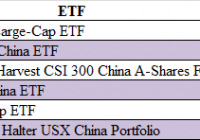
Summary There is a stock market bubble growing in China. Although the share markets in mainland China have grown furiously, the Hong Kong share market has lagged significantly. The iShares China Large-Cap ETF share price hasn’t been affected by the mainland bubble too much as it invests in Hong Kong listed shares. If the current bubble is similar to the 2006/2007 one, FXI should start to grow rapidly in the coming months, with a 50-100% upside potential. If the current bubble turns out to be different and it starts to collapse soon, FXI has only a limited downside of 20-25%. As I wrote in my article last week, there is a bubble underway in China. The Chinese share market has experienced incredible growth in the last 12 months. The main Chinese share indices are up by more than 130%. As I stated earlier, if the current bubble turns out to be similar to the 2006/2007 Chinese share market bubble, it should start to burst sometime in November. In this article, I focus on the performance and perspectives of the iShares China Large-Cap ETF (NYSEARCA: FXI ) – the largest China focused ETF. China focused ETFs There are many ETFs that invest in Chinese shares, but only 6 of them have asset value of over $200 million (table below). By far the biggest is the iShares China Large-Cap ETF with assets of over $7.7 billion, followed by iShares MSCI China ETF (NYSEARCA: MCHI ) ($2.38 billion). Source: ETFdb.com The chart below shows that there are huge differences between performances of these ETFs. 5 of the 6 biggest China focused ETFs grew only by 20-30% over the last 12 months. On the other hand, share price of the db X-Trackers Harvest CSI 300 China A-Shares Fund (NYSEARCA: ASHR ) grew by 133%. The reason is simple. While ASHR invests in A-Shares traded in Chinese mainland, the other ETFs invest in shares of Chinese companies traded in Hong Kong. As we can see, there is a huge difference between the growth of Chinese mainland share markets and the Hong Kong share market (chart below). While Chinese A-shares and B-shares are up by 138% and 125%, respectively, the Hang Seng indices are up only by 15-30%. The Chinese bubble and FXI As shown in the chart below, FXI’s share price is much more related to the Hang Seng China Enterprises Index than to the Shanghai Composite Index. Although FXI experienced huge losses during the collapse of the 2006/2007 bubble, it is important to notice that there was a bubble in Hong Kong as well as in mainland China back then. Today, we can hardly talk about a bubble in Hong Kong as the gap between share valuations in Shanghai and in Hong Kong is huge. FXI recorded its biggest gains during the last growth phase back in 2007. If history should repeat itself, FXI’s share price must start to grow rapidly before it collapses. If the Chinese mainland share bubble starts to burst right now, FXI’s share price will be impacted, but the decline will be only limited. It won’t be comparable to the 2008 one. The table below shows the 15 biggest holdings of FXI. 10 out of the 15 companies are dual listed in Chinese mainland and in Hong Kong. The table shows actual share prices in mainland (in CNY), actual share prices in Hong Kong (in HKD) and Hong Kong share prices converted to CNY using the current exchange rate of HKD/CNY = 0.801016. As the calculations show, 9 out of the 10 dual-listed companies are cheaper in Hong Kong than in mainland China. Only the shares of Ping An Insurance Group (OTCPK: PIAIF ) (OTCPK: PNGAY ) are more expensive in Hong Kong. Some of the differences are really huge. For example, shares of China Life Insurance (NYSE: LFC ) (OTCPK: CILJF ) are 21% cheaper, shares of Bank of China (OTCPK: BACHF ) (OTCPK: BACHY ) are 16% cheaper and shares of PetroChina (NYSE: PTR ) (OTCPK: PCCYF ) are 4% cheaper in Hong Kong than in mainland China. (click to enlarge) Source: own processing, using data of ishares.com and Bloomberg Conclusion Although there is a share market bubble in mainland China, the Hong Kong share market hasn’t inflated yet. The shares of most of the dual-listed companies are much cheaper in Hong Kong than in mainland China. There are only two ways how the valuation gap may be eliminated. The Hong Kong share price must grow or the Chinese mainland share prices must decline (or a combination of both). The first option is favorable for FXI shareholders and the second one is relatively neutral for them. There is a bubble on the Chinese share market, but Hong Kong has been impacted only slightly. FXI shareholders don’t have to fear a bubble burst right now. If the Chinese bubble starts to collapse, FXI shares should experience only a limited impact. During the 2006-2007 bubble, the Hong Kong share market lagged behind the mainland market significantly, only to start to grow furiously during the last phase of the mainland bubble. If history repeats itself, FXI has 50-100% upside potential. If the history doesn’t repeat itself and the mainland share market starts to collapse before the Hong Kong share market inflates, there is only a limited downside of 20-25%. Disclosure: I/we have no positions in any stocks mentioned, but may initiate a long position in FXI over the next 72 hours. (More…) I wrote this article myself, and it expresses my own opinions. I am not receiving compensation for it (other than from Seeking Alpha). I have no business relationship with any company whose stock is mentioned in this article.

China A-Shares: Worth The Wait?

MSCI decided last week not to include China A-shares on the MSCI Emerging Markets Index. The index compiler has decided to defer this decision until it sorts out outstanding issues with the country’s securities regulator. In the same week, data from EPFR Global showed that $9.3 billion was pulled out of emerging market funds and most was from China. This was the biggest weekly outflow in 15 years. Now, the Institute of International Finance (IIF) has warned that emerging markets may face more exodus as the US central bank approaches a “lift-off”. Before we focus on relevant mutual funds, let’s look into some other details. China A-shares The decision to not include China A-shares at least now comes as a temporary setback to China’s efforts to raise the standing of mainland capital markets and internationalize the yuan. China A-shares are listed in Shanghai and Shenzhen. These are denominated in yuan. However, this should be good news for other countries whose stocks are listed on the index. Emerging market investment instruments would thus gain, as this non inclusion will help keep the money flow to them. Outstanding Issues According to MSCI’s website, it will only include mainland shares after it resolves certain outstanding issues. The company said it will form a working group with China Securities Regulatory Commission, the country’s securities regulator for this purpose. Among the issues to be resolved were capital mobility, beneficial ownership details and restrictions on investment. The measured approach adopted by MSCI on A-shares has been praised by several market watchers and analysts. Restrictions on Investment Foreign investors still have to conform to restrictions on investments per the conditions laid down by authorities regarding the Shanghai-Hong Kong exchange link. This link which commenced in November provides investors with a brokerage account in Hong Kong with access to stocks listed on the mainland. However, foreign investors can purchase a maximum of net 13 billion yuan ($2.1 billion) of such shares per day. They are also subject to an aggregate quota of 300 billion yuan. MSCI has said that it will collaborate with Chinese authorities to ensure that such quotas correspond to the amount of assets under management of investors. Close coordination with China’s authorities will hasten this process, the index provider said. However, the announcement of the inclusion of A-shares and the implementation will be separated by a 12-month period. More Exodus On the other hand, IIF believes there may be more outflows from emerging markets. Jean-Charles Sambor, Asia Pacific director at the IIF, said: “We think the weakest emerging markets are likely to continue to suffer from pretty large outflows both on the debt side and equity side.” However, the outflows may be prominent for weaker economies having weak macro fundamentals. These economies mostly pertain to the Middle East and Latin America. Also, of the $9.3 billion outflows from emerging market funds, China equity funds accounted for $7.1 billion of the outflows. This probably hints that not all emerging market economies may be in a spot of bother. Short Term Setback Most analysts believe that this setback for A-shares is only short term in nature. Even though, the majority of market participants would have liked the inclusion to come much sooner, MSCI has sent out a clear signal. Fund managers would have to factor in the possibility of such a change taking place before 2016. In fact, China has already dealt with major concerns on market accessibility raised after last year’s MSCI review. Firstly, an announcement was made in November last year that shares bought via the exchange link will be temporarily exempted from capital gains taxes. Authorities have also reduced restrictions on having more than one broker. Additionally, they have also initiated a trial run of same day trading of select stocks. Funds in Focus If the setback is a temporary phenomenon, certain emerging market and pacific funds would continue to be great investments. The recent dismal performance should not be a cause for concern. Top-ranked funds with great fundamentals should be good additions to portfolios. In any case, the non-inclusion of China A-shares means money would stay with the other emerging market countries’ investment instruments. The following funds carry either a Zacks Mutual Fund Rank #1 (Strong Buy) or Zacks Mutual Fund Rank #2 (Buy) as we expect the funds to outperform its peers in the future. Remember, the goal of the Zacks Mutual Fund Rank is to guide investors to identify potential winners and losers. Unlike most of the fund-rating systems, the Zacks Mutual Fund Rank is not just focused on past performance, but the likely future success of the fund. They also have encouraging year-to-date and 3 and 5-year annualized returns. They carry no sales load and the minimum initial investment for these funds is within $5000. Matthews Korea Fund (MUTF: MAKOX ) seeks capital growth over the long-term. MAKOX invests a large chunk of its assets in common and preferred stocks of South Korea companies. The fund focuses on mid to large cap firms, but is not restricted to them. MAKOX currently carries a Zacks Mutual Fund Rank #1. MAKOX boasts year-to-date return of 12% while the 3 and 5 year annualized gains stand at 14.7% and 12.4%. Wells Fargo Advantage Asia Pacific Fund (MUTF: SASPX ) seeks capital growth over the long run. SASPX allocates a lion’s share of its assets in equities of companies located in Asia Pacific Basin. SASPX emphasizes on factors including earnings growth, financial condition and management efficiency for selecting companies. SASPX may also invest in participation notes. SASPX carries a Zacks Mutual Fund Rank #2. SASPX boasts year-to-date return of 9.3% while the 3 and 5 year annualized gains stand at 15% and 10.4%. Fidelity® Emerging Asia Fund (MUTF: FSEAX ) invests heavily in companies from emerging economies in Asia. FSEAX may also invest in other securities that are related to emerging markets of Asian countries. FSEAX focuses on acquiring common stocks of companies depending on factors such as economic conditions and financial strength. FSEAX carries a Zacks Mutual Fund Rank #2. FSEAX boasts year-to-date return of 7.2% while the 3 and 5 year annualized gains stand at 12% and 8.9%. Original article on Zacks.com