Tag Archives: alt-investing

Predicting The Future Is Difficult
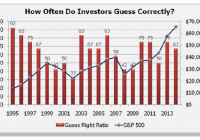
Neils Bohr, a Nobel prize-winning Danish physicist who made foundational contributions to the understanding of atomic structure and quantum theory, is credited to have once said: “Prediction is very difficult, especially if it’s about the future.” While it sounds more like a ” Yogi-ism ,” the point made is interesting particularly as it relates to investing. I was reminded of this quote by a comment made on a recent post entitled “Bullish Or Bearish, What The Charts Say.” As I stated in that post: “I really don’t care much for the “bull/bear” debate that ensues on a daily basis as both camps are eventually wrong. When investing in the markets ‘it is, what it is’ and it is of very little use that some pundit or analyst was ‘right’ during the bull market if they never saw the bear market coming. The opposite is also true.” Predictions of the future are indeed very difficult, and yet individuals are challenged every day with doing precisely that. For traders, it is what the market, or a particular investment, will do in the next few minutes to days. For longer-term investors, those predictions move out to months or years. The problem is that humans generally suck at predicting the future, particularly when it comes to investing. This is clearly shown in Dalbar’s 2015 investor study in what they term the ” Guess Right Ratio .” To wit: “DALBAR continues to analyze the investor’s market timing successes and failures through their purchases and sales. This form of analysis, known as the Guess Right Ratio , examines fund inflows and outflows to determine how often investors correctly anticipate the direction of the market. Investors guess right when a net inflow is followed by a market gain, or a net outflow is followed by a decline. Unfortunately for the average mutual fund investor, they gained nothing from their prognostications. ” (click to enlarge) The inability of investors to correctly predict the future has had serious consequences for their portfolio both in the short and long term as shown by the two tables below. (click to enlarge) (click to enlarge) The massive underperformance over a 30-year span shows that investors, despite the best of intentions of being ” long term ” are saddled not only by poor predictions of the future, but also the ” emotional biases ” that drive accumulations and liquidations at the most inopportune times more commonly known as the “buy high/sell low” syndrome. Currently, it is ” predicted ” that the market will only rise from current levels as witnessed by a recent report from Brian Wesbury at First Trust: “Using a 4% 10-year discount rate gives us a ‘fair value’ calculation of 2,550 and it would take a 10-year yield north of 4.8% and no growth in corporate profits in Q2 for the model to suggest equities are fully valued.. .investors should be more tilted toward equities than they would normally be and we believe those that are should continue to enjoy attractive returns over at least the next couple of years. This bull has further to run .” However, Brian, like all humans, including me, are horrible predictors of future outcomes. As an example, this is what Brian predicted in July 2007 just before the largest financial crash since the ” Great Depression :” “The bottom line is that fears about the underlying health of the economy and financial markets are more about hypochondria than reality. The Fed is not tight, just less loose, the economy is strong, tax rates are low, and corporate earnings remain robust. Let’s not confuse indigestion and heartburn with the ‘big one. ‘” Or this in February of 2008 as the recession was in full swing: “None of this is an attempt to say that a recession is impossible. Recessions are always possible. But neither the policy pre-conditions, nor the data, suggest we are anywhere near a recession today. Current fears of a recession are premature .” Of course, it did turn out to be the “big one.” However, Brian, like all economists and analysts are using data to make future predictions that are highly subject to revisions in the future. This is the equivalent of trying to shoot a moving target while blindfolded riding a merry-go-round. While I am sure there is some trick shot artist that could nail such a feat on “America’s Got Talent,” for the mere mortal the odds of success are extremely low. The same problem that exists for individuals, also applies to ” professionals .” There are but a handful of investment managers that have consistently outperformed the ” market ” over long periods of time. But even that comment is a bit misleading as relative outperformance is of little consolation to investors when the market is down 30%, and the portfolio is down 29%. Did the manager outperform? Yes. Did the investor stick around? Probably not. But it is precisely this conversation that leads to a litany of articles promoting ” buy and hold ” investing. While ” buy and hold ” investing will indeed work over extremely long periods, investor success is primarily a function of time frames and valuation at the beginning of the period. Considering that most investors have about a 20-year time horizon until they reach retirement, the “when” becomes a critical component of future success. (click to enlarge) Of course, ” buy and hold ” commentary is mostly seen near fully mature “bull markets” as the previous bear market fades into distant memory. Eventually, despite the best of intentions, the markets will complete their full-market cycle and investors will head for the exits perpetuating the ” buy high/sell low ” syndrome. It is here that we find the VERY BEST predictor of future outcomes – past behavior. Psychology Today had a very interesting piece on this particular issue as it relates to violent crimes. But when it comes to investing, most individuals fit the requirements necessary to fulfill how they will behave in the future. Habitual behavior – (buy high/sell low) Short time intervals – (months or years, not decades) Anticipated situation aligns with the past situation that activated behavior. (bull vs. bear market) Behavior not extinguished by negative impact. (loss not great enough to deter future action) Person remains essentially unchanged. (speculator vs. saver) Person is fairly consistent (willingness to accept risk/avoid loss) Certainly, past behavior may not accurately predict the future behavior of a single individual. However, when it comes to the financial markets which is representative of the ” herd mentality ,” past behaviors are likely good indicators of future outcomes. Despite an ongoing litany of bullishly biased reports as markets push towards new highs, it should be remembered that markets only attain new highs about 5% of the time historically speaking. The other 95% of the time is recouping previous losses. (click to enlarge) Does this mean that you should sell everything and go to “cash?” Of course not. However, it does mean that as an investor you should critically analyze your past personal behavior during market advances AND declines. If you are like MOST investors , it is likely that you did exactly the opposite of what you should have. If that is the case, does it not make some sense to begin thinking about doing something different?
GREK ETF Surging On Hopes Of A Deal

The latest proposals by the Greek government have raised hopes that a deal might be struck soon with the country’s creditors to stop Greece from defaulting on its debt. Greece’s Prime Minister Alexi Tsipras is expected to meet Christine Lagarde, the head of the International Monetary Fund, Mario Draghi, the president of the European Central Bank, and the Dutch finance minister today to finalize the proposals in the agreement. The Greek government has come out with a slew of measures that will focus on fiscal consolidation and tax increases to attain a surplus of 1% this year, followed by 2% and 3% surpluses over the next two years. According to the new proposal, there will be some changes in the VAT structure and the main rate would be fixed at 23%. Also, the corporate tax rate would be increased from 26% to 29% in 2016 and companies will have to pay a surcharge of 12% on profits over €500,000. Additionally, the retirement age would be slowly raised, which is expected to result in savings of €60 million this year. Moreover, workers’ and employers’ contributions to the pension system would also be hiked. The recent euphoria about the deal has led to a rally in Greece stocks and its related ETF. The Greek ETF – Global X FTSE Greece 20 ETF (NYSEARCA: GREK ) – has gained roughly 15% in the past one week. The rally might continue if the deal is indeed sealed and Greece manages to avert its default. Below, we have highlighted the GREK ETF in detail for investors keen on enjoying the Grecian ride. GREK ETF in Focus The ETF tracks the FTSE/ATHEX Custom Capped Index that is designed to reflect the performance of the 20 largest securities listed on the Athens Stock Exchange. The product holds 22 stocks in the basket and is heavily concentrated in the top 5 holdings that make up for a combined 48% of assets. Coca-Cola (NYSE: KO ), Hellenic Telecommunications ( OTCPK:HLTOY ) and National Bank of Greece (NYSE: NBG ) are the top three holdings. Financials dominates the fund with one-fourth assets, followed by Consumer Discretionary with 17.6% and Consumer Staples with 16.6%. The ETF has around $327.1 million in its asset base and sees a moderate trading volume of more than 800,000. The fund charges 55 bps in annual fees from investors and has a dividend yield of 1.17%. GREK currently has a Zacks Rank #4 (Sell) with a High-risk outlook. Bottom Line The condition of Greek banks is worsening by the day and it is almost on the brink of a collapse as savers have lost all confidence and continue to pull out money. In fact, the European Central Bank has sanctioned a release of more than €900 million to Greek banks on Tuesday so as to enable them to remain open. Some economists fear that these austerity measures are not feasible and it might worsen the recession that Greece re-entered last quarter. Lagarde also believes the measures are only a stopgap solution and are inadequate to bring Greece out of the crisis. Original Post

Preferred Stock ETFs For Retirement

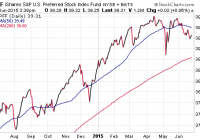
Summary The income investing landscape has certainly shifted in 2015, with many dividend fixtures trading well below their starting point for the year. The backup in interest rates this year has been the primary culprit responsible for rebalancing the scale away from these equity income assets. PFF has managed to remain on a relatively steady course so far this year when compared to other areas of the income-generating universe. The income investing landscape has certainly shifted in 2015, with many dividend fixtures trading well below their starting point for the year. Stalwart asset classes such as REITs, utilities, MLPs, and even dividend paying common stocks have struggled to make positive headway and in some cases are more than 10% off their recent highs. The backup in interest rates this year has been the primary culprit responsible for rebalancing the scale away from these equity income assets. The 10-Year Treasury Note Yield has moved over 40% higher since hitting a low in January and is now firmly situated near 2.40%. Income investors are likely feeling a level of frustration with the lack of progress year-to-date and oversensitivity to interest rates may fuel additional anxiety as they contemplate the looming threat of a Fed rate hike. Nevertheless, one alternative asset class has continued to persevere despite the overarching malaise. The iShares U.S. Preferred Stock ETF (NYSEARCA: PFF ) is a fund I have owned for some time now for my income-seeking clients . PFF has over $13 billion dedicated to over 300 preferred stock holdings and charges an expense ratio of 0.47%. One of the most attractive features of this fund is its current 30-day SEC yield of 5.40%. Income is paid on a monthly basis to shareholders and has historically been very consistent. In addition, PFF has managed to remain on a relatively steady course so far this year when compared to other areas of the income-generating universe. Preferred stocks carry characteristics of both equity and debt, which allow for very low correlations with either asset class. Typically these securities are issued by banks, financial institutions, and real estate companies with long maturity dates. While PFF has been able to escape the wrath of interest rate volatility this year, that doesn’t mean it will hold up under every appreciable change in credit or Treasury-linked securities. This fund experienced a 10% drop in 2013 as changes to quantitative easing programs by the Fed sent shockwaves through the financial markets. The portfolio manager for PFF did an excellent review of its potential weaknesses with respect to interest rates that is worth a read as well. Another ETF in this space that promises a unique dynamic is the PowerShares Variable Rate Preferred Portfolio ETF (NYSEARCA: VRP ). This fund primarily invests in preferred stocks with floating rate or variable coupon components. VRP has an effective duration of 3.86 years and a 30-day SEC yield of 4.92%. In theory, floating rate securities are deemed to be more effecting during periods of rising interest rates because their income component adjusts higher along the way and they typically have shorter durations. Nevertheless, with the relatively short trading history, this strategy has yet to be tested under the rigors of an outsized move in rates. The Bottom Line Preferred stock ETFs can be used for yield enhancement and diversification in the context of a well-balanced income portfolio. However, investors should be aware that as a non-traditional asset class, they may be susceptible to unique risks and price drivers. Keep in mind that the higher yields of preferred stocks should correlate with smaller overall position sizes to avoid becoming overly focused on just one component of these securities. Disclosure: I am/we are long PFF. (More…) I wrote this article myself, and it expresses my own opinions. I am not receiving compensation for it. I have no business relationship with any company whose stock is mentioned in this article. Additional disclosure: David Fabian, FMD Capital Management, and/or clients may hold positions in the ETFs and mutual funds mentioned above. The commentary does not constitute individualized investment advice. The opinions offered herein are not personalized recommendations to buy, sell, or hold securities.