Tag Archives: alt-investing

The Bruce Fund: A Great Long-Term Investment

Summary Fund management is very frugal and the expense ratio is only 0.70%. The fund has earned 16% a year over the last 15 years. The fund tends to be relatively uncorrelated with other equity investments. Bruce Fund: Overall Objective and Strategy The primary objective of the Bruce Fund (MUTF: BRUFX ) is to achieve long term capital appreciation by investing primarily in domestic common stocks and bonds, including convertible bonds and “zero coupon” Treasury bonds. Income is a secondary consideration. The fund has built an outstanding long term performance record using a “barbell” type strategy. They often accumulate long-dated zero coupon Treasuries to seek capital appreciation when they feel there is an absence of viable common stock opportunities. But they will also buy higher risk debt securities and own some defaulted bonds selling at a small fraction of their par value. Their strategy is to use primarily bonds which have a very high yield to maturity, or to use convertible bonds which fluctuate with the common stock. Most of these higher risk bonds carry no credit rating. The Bruce Fund invests in domestic common stocks of any market capitalization, although they seem to focus mainly on smaller companies, as well as micro-cap securities. Both growth and value criteria are used to select these stocks. They actively pursue unseasoned companies, out-of-favor, turnaround and distressed situations. The Fund may invest in foreign securities, either directly or through ADRs or GDRs. At times, they hold a large cash position for a transitional period of time and the Fund tends to have a low “beta”. Fund Expenses The expense ratio for BRUFX is 0.70% which is very low for a fund that uses “hedge fund” style strategies. The Bruce Fund management is very frugal. One reason for the low BRUFX expense ratio is that they do not market their fund through discount brokers like Fidelity or Schwab. These brokers generally charge a mutual fund 40 basis points a year for the “privilege” of being on their platforms. Most mutual funds on these platforms offer “special” share classes with higher expense ratios to cover this platform fee. The Bruce Fund refuses to do this, and the fund can only be purchased directly. A mutual fund has to pay a yearly “Blue Sky” fee to every state where they sell the fund. Some small startup mutual funds only register in states where they have enough investors to make it worthwhile. The Bruce Fund started the same way, and until a few years ago, it was not available to Texas or Nebraska residents. But now it is available in every state. Minimum Investment BRUFX has a minimum initial investment of $1,000. Past Performance BRUFX is classified by Morningstar in the “Moderate Allocation” or MA category. BRUFX has blown away the competition and often ranks as the #1 fund in their category. Over the last 15 years, BRUFX has earned 16.37% a year, which trounces the category average of 5.19%. Here are the annual performance figures computed by Morningstar since 2006. 2006 2007 2008 2009 2010 2011 2012 2013 2014 YTD BRUFX 17.72% -5.13% -27.27% 32.26% 23.96% 7.24% 7.86% 18.95% 13.68% 2.56% Category (MA) 11.29% 5.99% -28.00% 24.13% 11.83% -0.11% 11.72% 16.48% 6.21% 2.58% Percentile Rank 4% 99% 41% 8% 1% 2% 76% 1% 1% Source: Morningstar Mutual Fund Ratings -Forbes Honor roll BRUFX is a member of the Forbes Mutual Fund Honor Roll. Forbes Up Market Grade: A+ Forbes Down Market Grade: A -Morningstar Rating : 5 Stars Fund Management The fund is managed by a father and son team, Robert and Jeffrey Bruce. They rarely speak to the press and spend none of their time marketing the fund, although they are glad to speak with shareholders who call. Instead of marketing the fund, they prefer to increase the assets via fund performance. Robert Bruce is 83 years old and previously helped to establish a great performance record at the Mathers Fund (MUTF: MATRX ) over forty years ago. In 1973, he left the Mathers Fund to manage his own money and eventually formed the Bruce fund in 1983 with his son. Bruce Fund Portfolio Analysis (as of December 31, 2014) Common Stock 48.5% Convertible Pfd. 1.8% Corporate Bonds 4.2% Convertible Bonds 5.4% U.S. Treasuries 16.9% Money Market 23.0% Other 0.2% Top 8 Equity Holdings (as of March 31, 2015) Amerco Inc (NASDAQ: UHAL ) 12.01% Allstate Corp (NYSE: ALL ) 3.23% IBM (NYSE: IBM ) 2.92% Airboss of America ( OTC:ABSSF ) 2.63% Pfizer (NYSE: PFE ) 2.21% Merck (NYSE: MRK ) 2.09% NextEra Energy (NYSE: NEE ) 1.89% Flotek Industries (NYSE: FTK ) 1.85% Source: Morningstar Comments It is common on Wall Street to hear fund managers talk about creating shareholder value. But when push comes to shove, the vast majority of mutual fund managers seem more concerned with growing assets under management (and maximizing their own fees) than with maximizing returns for shareholders. That explains the widespread popularity of mutual funds with 12b-1 fees. I give the Bruce Fund a lot of credit for refusing to use 12b-1 fees. They could probably attract a lot more assets if it was available on the discount broker platforms, even with a higher expense ratio. This would benefit the Bruce Fund managers, but would be detrimental to long term shareholders, would have to pay the higher fees every year. I have had a Roth IRA at the Bruce Fund for over ten years. They charge an annual IRA maintenance fee of $15. At first, I found this fee a little annoying, but on second thought I think it is very fair. It costs the fund a little more to administer IRA accounts, but rather than hike the expense ratio for everyone, they just charge this fee to those with IRA accounts. They also allow you to pay this fee with money outside your IRA, so the fee is tax deductible. The Bruce Fund managers are very frugal, but in a good way. The largest equity holding in the Bruce fund is Amerco, which currently trades for $325 a share. There is an interesting story behind this stock. Amerco is the parent company of U-Haul which was experiencing major problems back in 2003 including lawsuits and accounting irregularities. But the Bruce Fund managers liked the underlying business of renting trailers and the company owned a lot of undervalued real estate. Amerco filed for Chapter 11 in June 2003, but their management intended to leave the common equity intact and restructure the debt. Most institutional investors dumped their Amerco shares during this time period when the stock dropped as low as $2 a share. But the Bruce Fund managers stuck with the company and continued to buy more shares through the bankruptcy process. The stock has appreciated about 150 times since then. Another thing I like about the Bruce Fund is its low beta and relative lack of correlation with other equity investments. It has many hedge fund like attributes in the good sense without having to pay 2%/20% management fees. There is also a low turnover ratio, so BRUFX can also be a good investment in taxable accounts. If you want to purchase this fund, you cannot use a broker, and must buy direct. The fund web site is here . Disclosure: I am/we are long BRUFX. (More…) I wrote this article myself, and it expresses my own opinions. I am not receiving compensation for it (other than from Seeking Alpha). I have no business relationship with any company whose stock is mentioned in this article.
Rising Correlations With Greece In Graphs

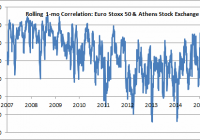
Graphical depiction of the correlation between Greek stocks and the rest of the Eurozone. Correlations have been rising as we careen towards a hard deadline on an extension of the current bailout agreement. If a disorderly outcome in Greece unduly drags down stocks in core countries disproportionately, long-term investors should view it as an opportunity. With the Euro-area finance ministers denying Greece a short-term extension of the country’s bailout and with no future financing in place, we are in for a potentially tumultuous week ahead. The Greek government in turn has called for a referendum vote on demands international creditors have made on the country in exchange for ongoing financial aid. Correlations between the exchange between the Euro Stoxx 50 (NYSEARCA: FEZ ) and the Athens Stock Exchange (NYSEARCA: GREK ) have been rising in recent weeks as the ebbing market perception of the likelihood of a deal is felt throughout the continent’s equity markets. Source: Bloomberg As recently as the end of March, the rolling one-month correlation between Greek stocks and a broad gauge of Eurozone stocks was zero. This makes intuitive sense. Greek stocks were subject to increased volatility following the election of the anti-austerity Syriza party in late January. European stocks were rebounding on the back of strengthening European economic data, but Greek stocks were being pulled lower due to the increased uncertainty around its financing package. In recent weeks, Greek stocks and their European counterparts have been seeing heightened correlation as graphed above. If broader European stocks hit an air pocket next week in the face of the Greek referendum vote, broader European stocks could be pulled down unduly in sympathy amidst this heightened correlation. The median company in the Euro Stoxx 50 has a market capitalization six times larger than bottler Coca-Cola Hellenic, the largest company in Athens Stock Exchange, which represents nearly one-fifth of that index. European stocks are being led by the nose by an economy that makes up less than two-percent of its economic output. As I wrote following my recent trip to Greece , if there is a disorderly outcome, the European financial system should be much better equipped given stronger capital ratios, new stability mechanisms, the deployment of quantitative easing, and lower sovereign yields in the periphery. Near-term dislocations due to outsized correlations with Greek stocks and that of the rest of Europe should be viewed as a longer-term opportunity to grab exposure to developed markets that have lagged the performance of the United States post-crisis and could potentially deliver higher forward returns . Disclaimer : My articles may contain statements and projections that are forward-looking in nature, and therefore inherently subject to numerous risks, uncertainties and assumptions. While my articles focus on generating long-term risk-adjusted returns, investment decisions necessarily involve the risk of loss of principal. Individual investor circumstances vary significantly, and information gleaned from my articles should be applied to your own unique investment situation, objectives, risk tolerance, and investment horizon. Disclosure: I/we have no positions in any stocks mentioned, and no plans to initiate any positions within the next 72 hours. (More…) I wrote this article myself, and it expresses my own opinions. I am not receiving compensation for it (other than from Seeking Alpha). I have no business relationship with any company whose stock is mentioned in this article.

Opportunities In Utilities For Dividend Investors?

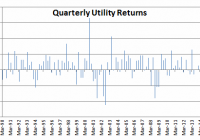
Summary Utilities have produced their worst quarterly returns in 2015 since the financial crisis. Higher interest rates have disproportionately hurt rate-sensitive sectors like utilities. In a relatively fully valued market, the relative underperformance of utilities may present investors an opportunity. The S&P 500 Utility Index, replicated by the Utilities Select Sector SPDR ETF (NYSEARCA: XLU ), has produced a -9.96% return to begin 2015, trailing the S&P 500 (NYSEARCA: SPY ) by over 12%. What has happened? The increase in Treasury yields disproportionately disfavored bond-like stocks with high dividend payouts including utilities and telecom. The trailing dividend yield on the Utilities ETF is now 3.69%. Investors have punished equity sectors with more fixed income-like return streams. After a -5.17% return in the first quarter, the utility index has followed up with a -5.05% return so far in the second quarter. These are the worst returns for the sector since the financial crisis when risk premia on all assets increased as graphed below: Source: Standard and Poor’s; Bloomberg Comparison Versus Bonds For the pounding that interest rate sensitive stocks have taken in 2015, the yield on XLU is still higher than the yield on iShares iBoxx Investment Grade Corporate Bond Index ETF LQD at 3.43%. For the same cash flow stream, I would rather own the equity upside of being a utility shareholder than be the leverage provider by owning their corporate bonds. The -9.96% loss on XLU in the first half has been larger than the -7.54% return on the Barclays Long Treasury Index as proxied by the iShares 20+ Year Treasury Bond ETF (NYSEARCA: TLT ). Conclusion I believe that the utility sector is now relatively cheap, and should be viewed as increasingly attractive to the large Income Investing community on Seeking Alpha. However, I use the term relative as I still expect forward returns on domestic assets to be subnormal . The index I have used as my sector proxy in this article features both gas and electric utilities, fully regulated and a mix of regulated and unregulated business, and features companies located in geographies with different growth trajectories. These utility stocks, at 15.9x trailing earnings, are still collectively trading at a 8% discount to the price Berkshire Hathaway paid for NV Energy in 2013 . Since that purchase in June 2013, the earnings multiple on the broader market has expanded by 13%. Consider this a margin of safety discount to a purchase made by an investor that has a long history of traditionally not paying full sticker price. When Berkshire Hathaway’s ( BRK.A , BRK.B ) MidAmerican Energy Holdings unit bought Pacificorp in 2006, it was reported in Electric Utility Week that Buffett told Oregon regulators that owning utilities was “not a way to get rich – it’s a way to stay rich.” In 2015, utilities have gotten 12% cheaper relative to the rest of the market. Perhaps utilities present dividend-paying investors with long-term horizons an opportunity in a relatively fully valued equity market. Disclaimer: My articles may contain statements and projections that are forward-looking in nature, and therefore inherently subject to numerous risks, uncertainties and assumptions. While my articles focus on generating long-term risk-adjusted returns, investment decisions necessarily involve the risk of loss of principal. Individual investor circumstances vary significantly, and information gleaned from my articles should be applied to your own unique investment situation, objectives, risk tolerance, and investment horizon. Disclosure: I am/we are long SPY. (More…) I wrote this article myself, and it expresses my own opinions. I am not receiving compensation for it (other than from Seeking Alpha). I have no business relationship with any company whose stock is mentioned in this article.