Tag Archives: utilities

NRG Energy: Kicking Its Residential Solar Segment Into High Gear
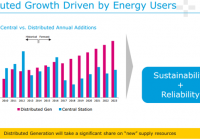
Summary Over the past few days, NRG Energy has further outlined its goals of residential solar domination. The company plans to be the second largest residential solar company by the end of 2015, which is a huge task considering its current 5th place position. NRG Energy’s management is surprisingly forward-thinking in its embrace of distributed residential solar, an industry inherently at odds with centralized fossil fuel generation. Residential solar has been growing at an astounding 40%-50% CAGR over the past few years, outpacing the growth of the broader solar industry. As the inherent advantages of distributed solar have become more clear, the switch from centralized energy to distributed generation has been a no brainer for many individuals. UBS AG (NYSE: OUBS ) has even stated , “By 2025, everybody will be able to produce and store power. And it will be green and cost competitive, i.e., not more expensive or even cheaper than buying power from utilities. It is also the most efficient way to produce power where it is consumed, because transmission losses will be minimized. Power will no longer be something that is consumed in a ‘dumb’ way. Homes and grids will be smart, aligning the demand profile with supply from (volatile) renewables.” While the vast majority of utilities have been bitterly opposing residential solar companies, NRG Energy (NYSE: NRG ) is looking to join them. NRG Energy, which is one of the largest fossil fuel utilities in the U.S., is surprisingly optimistic about home solar. While this viewpoint may seem contradictory given the opposing natures of centralized fossil fuel generation and distributed residential solar, NRG Energy certainly does not view it this way. NRG Energy has made its residential solar intentions much clearer in recent days. The company has announced that is planning to become the 2nd largest residential solar company, right after SolarCity (NASDAQ: SCTY ), by the end of 2015. This goal is indicative of NRG Energy’s incredibly ambitious distributed energy plans, as it has to increase its residential solar business by a number of magnitudes to accomplish this goal. While NRG Energy is currently ranked at a respectable 5th place in residential installs as of quarter 3, the gap between itself and 2nd place Vivint Solar (NYSE: VSLR ) is huge. NRG Energy still has a market share in the low single digit percentages as opposed to Vivint Solar’s approximately 15% market share. In fact, SolarCity and Vivint Solar make up for more than half of the residential solar industry’s market share. As a result, NRG Energy has started putting in enormous efforts to build and scale up its residential solar business in order to compete with the industry standouts. NRG Energy’s Unique Competitive Edge NRG Energy’s current position as one of the nations largest utilities gives it a financial clout and leverage never seen before in the emerging residential solar market. While all the top residential solar companies could have easily been classified as startups just a few years back, with SolarCity as no exception, NRG Energy is entering the industry as a proven and established business with countless billions on its balance sheet. The company’s huge finances and reputation as a proven business will give it an undeniable advantage over its competitors in the form of lower capital costs. Financiers could very well give NRG Energy cheaper access to capital due to the company’s already established brand. Of course, while most of NRG Energy’s cash will be tied its main business of centralized fossil fuel generation, having its huge fossil fuel business backing up its burgeoning residential venture will be invaluable for the company. NRG Energy could easily leverage its financial clout and well-established brand name to help achieve its grand solar ambitions. Forward-Thinking Management While it is extremely surprising to see a fossil fuels based utility focus so much attention on the distributed generation, this hints at NRG Energy’s extremely forward-thinking nature. Despite the fact that residential solar poses an existential threat to the company’s predominantly centralized generation model, NRG Energy’s management hold no bias against residential solar, and is in fact embracing this growing trend. The company’s enthusiasm about distributed residential solar starts at its CEO David Crane. He is so optimistic about residential solar that he has been qouted as saying, “We expect to convincingly persuade our investors that NRG has an embedded SolarCity within it,” and that “everyone is beginning to believe that residential solar is this trillion-dollar market that currently has about 1 percent market penetration.” David Crane is clearly all-aboard residential solar. Having a utility state that residential solar has the potential to be a trillion-dollar market is shocking to say the least, and would have been utterly unbelievable just a few years ago. His optimism is also a clear sign of residential solar’s promise. In fact, Crane sees so much potential in the company’s distributed residential solar segment that he is even considering creating a separate residential solar spin-off. Although a negligible percentage of NRG Energy’s revenue comes from residential solar, the company has been heavily emphasizing this aspect of their business in recent weeks. Just a few days ago, for instance, the company issued a press release and presentation touting residential solar’s immense potential, and the company’s plans for heavy future involvement in this industry. While residential solar currently makes up for less an 1% of the United States total energy generation, the company clearly believes in its exponential growth capabilities. NRG Energy’s recently released presentation constantly reminds investors of the emerging distributed generation. This specific graphical illustration from the presentation depicts the continually diminishing role of centralized generation as opposed to the growing role of distributed generation. (click to enlarge) Source: NRG Energy Risks Despite the immense promise of distributed residential solar, there is a considerable risk that the industry may not grow or mature as fast of NRG Energy has planned. In this case, the company’s would be in danger of losing sizable amounts of money on its massive residential solar infrastructure investments. The company is still, after all, making a huge bet on a relatively young industry with an abundant amount of uncertainty. Many factors pushing residential solar’s growth, such as subsidies or net metering policies, are largely out of the company’s control. Regardless of the risks, NRG Energy is likely making a wise decision by focusing on the residential sector, as most indicators point to distributed generation as the energy model of the future. The only obstacle truly holding distributed residential solar back from mass adoption is the lack of cost-effective storage devices. Even this though, will likely change in the future as battery innovations have sped up dramatically with the recent electric vehicle boon. Conclusion NRG Energy is changing with the times and embracing the shifting energy landscape. With solar power experiencing an exponential growth curve, the company is well-aware of residential solar’s future potential. NRG Energy’s valuation of $9B does not factor in the growth potential of distributed generation, and the company’s involvement in this highly promising arena. If distributed solar generation ends up replacing centralized generation as much of the evidence has suggested , NRG Energy will have a huge amount of upside given its early investment in the arena. While Vivint Solar is rapidly gaining on SolarCity in terms of marketshare, NRG Energy will likely be SolarCity’s true competition moving forward.

GDF Suez Shares Should Get Re-Rated

GDF Suez is uniquely positioned to capture the benefits of changing energy markets. Its vertical integration mitigates against the fallout from commodities, especially in LNG. The shares should see a re-rating as management delivers growth ahead of the sector. One of my core names for exposure to the mega trends of energy. The positioning of GDF Suez in global energy across various value chains is unique. Management has highlighted an area of strength and taken the next strategic step in the current energy cycle: Return to growth. That should see a positive reaction and lead to a re-rating of the shares. GDF Suez has highlighted its areas of strength for growth , Asia, Middle East and Africa. The company is building these as core growth regions. That makes sense given its already strong position in those regions and above average growth. Looking through current weakness, energy demand growth will likely exceed 7% CAGR to the end of the decade (source: IEA). Management also has proactively moved to the post deleveraging phase by committing to new growth. The company targets growth capex of Eur6.5-7.5bn for 2014-18. It is looking to dedicate about 20-30% of growth capex spend to Asia, Africa, and the Middle East. With that, GDF Suez stands out, not only amongst European utilities who are undergoing slow and painful transitions in order to identify new growth opportunities. It also stacks up very well against the global oil and gas sector that is struggling to deliver reserve growth whilst cash flows are strained by weak commodities. Asia, Africa, the Middle East are regions of strong new growth so it makes sense that they are at the core for GDF Suez. IPP, LNG and energy services are the key growth businesses, in line with its tested strategy. The company’s target regions account for over 80% of global energy growth over the next 20 years. The latest guidance implies power capacity growth in the above target regions of 6% CAGR, 2P reserves growth of 8.8% CAGR and energy services revenue growth of 7.9% CAGR to 2020 on the target areas. The regions currently account for c 7% of Ebitda. Visibility on growth is very good. The pipeline provides for 30% power capacity growth to 2020. I would only consider capacity under construction at this stage, which is just short of 1GW. The IPP model is tried and tested and merchant risk very low. GDF Suez has a very good track record of securing PPA’s at good conditions and in strong local partnerships. I expect that and the strong execution capability to continue to as the basic earnings driver. E&P reserves growth of 5-7% is at the high end of the sector, and the gas focus in line with the broader sector. But I see GDF Suez better hedged than the average of the E&P sector, because of its vertical presence all the way through the chain. With that, I think it stands a better chance of profitable reserves conversion to earnings growth to 2020. LNG is a risky sector at this moment. Asian demand weakness and weak oil prices are leading to price falls. Over-capacity is creeping into the market. New capacity build risks not meeting its hurdle rates. Suez currently has a feasibility study under way for an Indonesian LNG terminal. There I see risk of delay. The same goes for the floating LNG terminal project in India. I also see risk of lower utilization of the US terminals. The US Cameron liquefaction terminal may escape the heart of the storm, it won’t come to market before 2018. But the company’s vertically globally integrated business provides for mitigation. Pricing risk for the Japan and Taiwan LNG contracts is in my view relatively low as they were concluded at very tight pricing in the first place. Eventually, gas demand in Asia will recover. On average, the IEA estimates demand growth of 4%pa to 2035 with corresponding infrastructure investment requirement. The industry estimates over USD 100bn of liquefaction and storage capex requirement alone. And for that, the company’s positioning across upstream, infrastructure and power generation is second to none. The changing structure of energy markets with distributed generation, renewables and gas/power convergence are all playing to the company’s strength. The energy services business will be a major beneficiary and additionally deliver strong synergies to these new growth businesses. It will also be a growth driver in its own right in China and a door opener for other business development. GDF Suez has a unique advantage through the combination of its IPP, global gas and energy services business. That is in my view the true attraction of the company. Sentiment will likely be cautious on commodities, but should increasingly return to reflect the early move and strong position on long term growth. This is one of my core names for exposure on the global energy mega trends. The shares trade on a 20% discount to the European utilities sector and offer a well supported 5% yield. Editor’s Note: This article discusses one or more securities that do not trade on a major exchange. Please be aware of the risks associated with these stocks.

Southern Company Doesn’t Look As Good As It Did 12 Months Ago

Summary I’ve recommended buying SO twice over the past 12 months, once at a dividend yield of 5.00% and once at 4.84%. At the current price per share of $49.70, shares are yielding only 4.19%, which I believe is too low, considering the slow rate of dividend growth. I will reconsider if the stock drops by 10% or more. Shares in Southern Company (NYSE: SO ) are currently trading at a price of $49.70, which is $8.32 or 20.1% higher than twelve months ago. I’ve recommended buying SO twice over the past 12 months, once in January of 2014, when the dividend yield reached 5.00%, and once in June, at a current yield of 4.84%. With the recent growth in share price however, the yield has gone down and investors getting in at the current level will get a yield on cost of only 4.19%. SO data by YCharts The dividend growth rate for SO is very low, at 3.74% over the past 3 years and 3.90% annually over the past 5 years. This means it would take 5 years to get back to the yield on cost of 5.0% investors could get 12 months ago. SO Dividend Per Share (5 Year Growth) data by YCharts SO’s revenue for the current fiscal year is expected to reach $18.17 billion, which is an increase of 6.9% to last year’s $17.09 billion. For next year, a further 3.1% increase to $18.73 billion is expected. The trailing twelve month revenues stand at $18.38 billion. The average price to sales ratio for SO over the past 5 years has been 2.2, which is well above the industry average of 1.5 . The current market cap is $44.72 billion. Here’s what SO’s p/s ratios look like at today’s prices:   Dollar amounts Price to sales ratio % above 5 year average Price per share at p/s = 2.2 Trailing twelve month revenue $18.38 billion 2.43 10.5% $44.98 Current FY expected revenue $18.17 billion 2.46 11.8% $44.45 Next FY expected revenue $18.73 billion 2.39 8.6% $45.76 SO Revenue (5 Year Growth) data by YCharts Southern’s 5 year average p/e ratio stands at 18.7. If we aply this multiple to the trailing twelve month earnings per share of $2.34, we get a price per share of $43.76, which is well below the current price. Earnings per share for the current fiscal year are expected to be somewhat higher, at $2.80, putting the forward p/e ratio at 17.8. For next fiscal year, EPS is expected to grow a further 2.5%, to $2.87, which means the 1 year forward p/e ratio is 17.3. SO PE Ratio (NYSE: TTM ) data by YCharts SO Current Ratio (Quarterly) data by YCharts I usually look for current ratios in excess of 1.0, as this indicates current assets are larger than current liabilities. However, with utility companies such as SO, a slightly lower current ratio isn’t an immediate cause for concern, as income streams tend to be very steady and reliable. As we can see in the next graph, SO’s long term debt has slowly but surely been growing in recent years. Low interest rates mean the company is more than able to finance this debt, as net interest costs over the past 12 months were only $800 million, or 4.35% of the company’s trailing twelve month revenue. SO Total Long Term Debt (Quarterly) data by YCharts Conclusion: Buying SO at a dividend yield of 5.0% would have been a great idea. However, considering the company’s slow dividend growth rate, investors getting in now would likely have to wait for roughly 5 years to get to a yield on cost of 5%. Both on a p/e and p/s ratio basis, the company appears expensive compared to historical averages. The long term debt is growing, which isn’t a problem so long as interest rates stay low. I don’t see any reasons to buy at these levels, but may reconsider if the stock drops by 10% or more from its current price of $49.70. Disclaimer: I am not a registered investment advisor and do not provide specific investment advice. The information contained herein is for informational purposes only. Nothing in this article should be taken as a solicitation to purchase or sell securities. Before buying or selling any stock you should do your own research and reach your own conclusion. It is up to investors to make the correct decision after necessary research. Investing includes risks, including loss of principal.