Tag Archives: utilities

New Jersey Resources (NJR) Q1 2015 Results – Earnings Call Webcast

The following audio is from a conference call that will begin on February 04, 2015 at 10:00 AM ET. The audio will stream live while the call is active, and can be replayed upon its completion. If you would like to view a transcript of this call, please click here. Are you Bullish or Bearish on ? Bullish Bearish Neutral Results for ( ) Thanks for sharing your thoughts. Submit & View Results Skip to results » Share this article with a colleague

Brookfield Infrastructure Offers Investors A 5% Dividend Yield And 13% Discount To Intrinsic Value

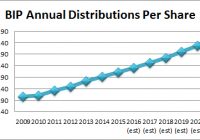
Summary BIP recently increased its dividend by 10% and now sports a 5% dividend yield. We believe BIP’s long-term dividend growth rate is 9%, up from 7% in our previous report. BIP’s shares are still 13% below its fair intrinsic value and we expect its intrinsic value to steadily increase as BIP steadily grows its FFOs per share. BIP’s disciplined approach to investing and its ability to continually identify new investment opportunities. We expect 15% FFO/share growth in 2015 and at least 6.5% growth thereafter. Brookfield Infrastructure Partners (NYSE: BIP ) recently announced it increased its dividend distribution by 10%. Although it was lower than our previous single year dividend growth in 2015, it was higher than our previous 7% estimated long-term dividend growth rate. BIP’s dividend increased by 13% annually since its 2008 IPO and BIP expects its long-run dividend growth rate will be 5%-9%. We believe that future dividend growth will be closer to the higher end of its forecasted range as it offers strong, steadily growing cash flow funds from its operations, which enables BIP to provide investors with strong dividend yields and dividend growth. BIP offers investors a 5% dividend yield and we believe its share price is 13% undervalued relative to its fair intrinsic value. For these reasons, we reiterate investors accumulate shares in BIP, especially income-oriented investors as BIP continues its consistent performance . Source: BIP’s Investor Relations and Our Estimates Companywide Highlights: BIP’s Q4 2014 FFOs/unit was $.86, slightly missing analyst expectations for the fourth time in the last 5 quarters but increasing by 3.6% versus Q4 2013. Key drivers of this performance were as follows Incremental contributions from the mid-August close of its investment in Vale’s cargo transportation division VLI, Improved volumes at its UK ports and Australian railroads, Soft volume demand from its North American energy transmission businesses due to mild weather and The absence of incremental contributions from its former Australasian regulated distribution operations, which BIP sold last November. Source: BIP’s Q4 2014 Report Business Segment Highlights: BIP Transport saw a 20% increase in its FFO’s for 2014 versus 2013 primarily driven by contributions from the additional investment in BIP’s Brazilian toll road in Q3 2013 as well as increased volume from its ports division and a partial quarter’s contribution from its investment in Vale’s cargo transportation VLI. Not only is this a high-quality asset, but Vale provided BIP with a minimum return mechanism to ensure that a minimum return is achieved over a period of up to six years from closing. As the Brazilian economy is facing some negative headwinds , this minimizes the risk of BIP failing to generate a positive return from its investment in VLI. Highlights from BIP Transport’s business units were as follows: BIP Transport’s Ports business enjoyed 21.4% FFO growth due to improved volumes from its UK port operations and incremental contribution from its newly acquired North American container port acquired during the year. BIP Transport’s Railroad business’s FFOs increased by $14M year-over-year (7.5%) because of a partial year’s incremental contribution from its Q3 2014 investment in Vale’s cargo transportation division as well as increased harvest grain volumes from its Australian railroad operations. BIP Transport’s Toll Road business saw its FFOs increase because of additional investment in its Brazilian toll roads completed in Q3 2013. On a “same-store basis”, toll revenues increased by 8% year-over-year due to tariff increases and higher volumes on Chilean roads. Source: BIP’s 2009-14 Annual Reports BIP Utilities saw a 2.65% decrease in its 2014 FFOs versus 2013 on a reported basis but increased 12% on an adjusted comparable continuing operations basis. The decrease in reported FFOs was primarily attributable to the sale of its Australasian regulated distribution operations on November 30, 2013. Excluding the impact of the sale, the segment’s FFOs increased by $39M versus the prior year as of the result of improved performance at BIP’s UK regulated distribution business. Source: BIP’s Financial Reports, Supplemental Reports BIP Utilities’ maintenance capital expenditures in 2014 were $14M and were $27M less than YTD 2013. BIP Utilities’ Regulated Terminal grew by 2.2% as negative movements in foreign exchange offset incremental pro forma operating income growth due to additions to its rate base. BIP Utilities’ Electricity Transmission business increased its FFOs by 7.4% due to inflation indexation, commissioning of projects into rate base and lower operating costs, partially offset by impact of foreign exchange. BIP Utilities’ Regulated Distribution’s adjusted FFOs from continuing operations grew by 22.5% as its United Kingdom regulated distribution operations benefited from a higher rate base, inflation indexation, lower costs and higher customer connections revenue. Source: BIP’s 2009-14 Annual Reports BIP Energy’s FFOs decreased by $2M year-over-year as incremental contribution from the acquisitions district energy businesses during the last 12 months was not enough to offset lower transportation volumes at its Energy Transmission, Distribution & Storage Business. BIP North American gas transmission business continues to see headwinds from the weak natural gas market, which resulted in a $275M asset impairment charge in 2013. Although BIP Energy’s performance has been flat since 2011, at least its capital expenditure backlog more than doubled during the year, which signals potential future growth. Other sources of potential future growth for BIP Energy include the closing of three previously announced acquisitions including gas storage businesses in California and Texas and a district energy system in Seattle. BIP also acquired a district energy business in Australia recently and is closing the acquisition of another one as well. Source: BIP’s 2011-14 Annual Reports BIP’s Corporate and Administrative segment’s FFO decreased by $12M (13%) in the year as increased interest and distribution income and reduced financing costs were offset by the absence of BIP Timber’s results as BIP sold BIP Timber in H1 2013 and higher management fees paid to Brookfield Asset Management. Corporate highlights include the following: BIP’s previously announced acquisition of a 23% interest in the French communications tower infrastructure firm TDF is expected to close in March 2015. BIP Corporate refinanced $4B of its debt in 2014 in order to capitalize on the historically low interest rate environment. BIP’s weighted average cost of debt is 5.9% and the average maturity profile is over 10 years, with minimal maturities over the next 5 years. BIP identified $1B in non-core assets that it seeks to sell in order to redeploy towards areas of growth and core operations, on top of its $1B capital-recycling program in 2013. BIP finished the year with $2.1B worth of total liquidity through its cash and available credit facilities. BIP has a BBB+ credit rating and it expects strong demand for its future offering $300M-$500M corporate debentures, which it seeks to bring to market in H1 2015. BIP’s opportunities for investment Government Privatizations-In Australian alone, BIP identified $50B worth of potential privatizations by the federal and state governments there Brazilian Construction Companies-BIP recognizes that many Brazilian construction companies are facing financial challenges and may seek to part with high-quality infrastructure related assets in order to shore up liquidity. Corporate deleveraging and carve-outs-BIP had success in acquiring utility assets from capital constrained European companies and is now Maturing Infrastructure Funds- Many investment funds raised between 2005 and 2008 are approaching the expiry of their funds. BIP has started to see the first wave of divestitures from this ownership group. Lastly, BIP focuses on investing capital to meet its long-term return targets of 12%-15% and will not reduce its return thresholds to make it easier to acquire assets Conclusion: In conclusion, investors looking for high yields and non-equity correlation should consider accumulating a position in BIP due to its portfolio of unique, hard-to-replicate assets. BIP provided unit-holders with strong returns from capital appreciation and partnership unit distributions since it went public in 2008. BIP offers a 5% dividend yield and its unit price is within 13% of its fair intrinsic value. We expect BIP’s FFOs to increase by at least 6.5% annually over the next seven years and its dividend distributions to increase by at least 9%. We can see why over 50% of BIP’s shares are held by leading asset managers such as Brookfield Asset Management, Legg Mason, BAMCO, Principal Global Investors and Scotia Bank’s asset management divisions. For these reasons, we believe investors should realize that BIP is a great alternative to the S&P 500 and traditional utilities as represented by the XLU and take advantage of market weaknesses to strategically accumulate units of BIP. Source: FactSet Marquee and our Estimates Disclosure: The author has no positions in any stocks mentioned, and no plans to initiate any positions within the next 72 hours. (More…) The author wrote this article themselves, and it expresses their own opinions. The author is not receiving compensation for it (other than from Seeking Alpha). The author has no business relationship with any company whose stock is mentioned in this article.
Between The U.S. Economic Recovery And Global Slowdown There Is GLD

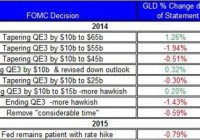
Summary The FOMC is still likely to raise rates in the coming months, but the global economic slowdown could still keep up GLD. I reexamine the relation between GLD and the U.S. dollar. The upcoming non-farm payroll report could bring GLD further down. The FOMC’s recent meeting was concluded with no changes to policy. The statement presented modest changes to the wording. For now, the market still estimates a rate hike in the middle of year. Following this news, the price of the SPDR Gold Trust (NYSEARCA: GLD ) fell down albeit it’s still up for the year. Let’s review the latest from the FOMC, the upcoming reports to be released this week, and reexamine the relation between the U.S. dollar and gold in light of the global economic slowdown. Last week’s main event was the FOMC meeting , in which the FOMC tried not to “rock the boat” and provided little changes in the wording in the statement. Nonetheless, following the release of the FOMC statement, the price of GLD took another tumble. (click to enlarge) Source of data taken from FOMC’s site and Bloomberg The statement still suggested that FOMC remains bullish on the U.S. economy, which isn’t a good sign for keeping rates low for a long time. The recent release of the U.S. GDP , in which the GDP growth rate for the fourth quarter was only 2.6%, market expectations were at 3% and in the third quarter the GDP grew by 5% may have contributed to the rally of GLD on Friday. A closer look at this report, however, reveals a more complex picture: real personal consumption grew by 4.3%; conversely, government spending tumbled down by 7.5%; private inventories added 0.8 percentage points to the growth rate. So even though government spending dropped, the GDP grew by 2.6% – mostly due to higher personal consumption and gain in inventories. All in all, this wasn’t a bad result and could tie up the FOMC’s bullish sentiment with respect to the progress of the U.S. economy. The upcoming non-farm payroll report could provide another indication for the progress of the U.S. labor market. Current estimates are for a gain of 231,000 jobs in January. A much higher gain in number of jobs could result in another fall in the price of GLD. (click to enlarge) Source of data taken from the U.S. Bureau of Labor Statistics and Google Finance Moreover, if the labor market keeps showing signs of recovery over the coming months, then this will bring the FOMC one step closer towards hitting the rate hike button. The debate over the next rate hike is likely to pick up in the coming months as we will get closer to the June meeting. Some still suspect the FOMC could back down from its current direction of raising rates in the coming months. But the FOMC doesn’t tend to make such a deviation from its direction unless the economic climate when it comes to inflation and labor warrants such a change. On both counts, the FOMC continues to voice little concern and to change market expectations with a sudden announcement, while has been done in the past, seems less likely considering the conditions only continue -albeit slowly – to improve. Despite the recent fall in the price of GLD, gold holdings in GLD keep picking up, and as of last week, reached over 758 tonnes of gold – this is a 6.5% gain since the end of 2014. This is also the highest level of gold hoards for the ETF since October 2014. This means, the recent fall in the price of GLD didn’t hold back investors from investing in the ETF. Another point to consider is the ongoing rise in the U.S. dollar, which coincides with the rally of gold prices. The chart below shows the relation between the U.S. dollar and gold prices during 2014-2015. Source of chart taken from FRED The relation between the U.S. dollar and GLD should be, as expected, negative; i.e. when the U.S. dollar appreciates against major currencies, the price of GLD tends to come down. This wasn’t the case, however, in recent weeks, as indicated in the chart above. Since the beginning of the year, both GLD and the U.S. dollar appreciated. But this type of positive relation was also the case back in 2008. (click to enlarge) Source of chart taken from FRED Back then, the U.S. economy, as well as other leading economies, was in a recession. This time, however, the U.S. economy is performing well while other economies show a slowdown in growth. In both times, the demand for gold picked up when the economic climate was uncertain and the global economy wasn’t doing so well. In times of uncertainty, the U.S. dollar tends to rise, U.S. treasury yields fall and gold prices rise. The main difference is that the U.S. economy, this time, is doing much better, and thus the U.S. dollar is likely to keep appreciating. Therefore, the ongoing appreciation of the U.S. dollar is likely to eventually catch up with the price of GLD and curb down its rally. For now, it seems that even if the FOMC were to raise rates in June by 0.25%, it won’t bring down the ongoing fall in the U.S. treasury yields and, consequently, the recovery of GLD. After all, the concerns over the global economy continue to offset the impact of the potential rise in the Fed’s rate on gold. In times of uncertainty, the U.S. dollar and GLD rally. But it also means that the recent rally of GLD could slow down on account of a stronger U.S. dollar. For more see: 3 Questions About Gold Disclosure: The author has no positions in any stocks mentioned, and no plans to initiate any positions within the next 72 hours. (More…) The author wrote this article themselves, and it expresses their own opinions. The author is not receiving compensation for it (other than from Seeking Alpha). The author has no business relationship with any company whose stock is mentioned in this article.