Tag Archives: undefined

WisdomTree Plans Another Small-Cap Hedged Europe ETF

WisdomTree Investments (NASDAQ: WETF ), the industry’s fifth largest ETF provider, has been stuffing up its product pipeline with hedged products. Already a reputable issuer with rich experience in rolling out successful currency hedged products, WisdomTree was quick to spot new opportunities latent in the international arena. Presently, WisdomTree dominates the space with the WisdomTree Japan Hedged Equity ETF (NYSEARCA: DXJ ) and the WisdomTree Europe Hedged Equity ETF (NYSEARCA: HEDJ ) having AUM of $13.5 billion and $10.6 billion, respectively. Other issuers like Deutsche Bank and iShares are far lagging the WisdomTree funds. However, the loose money market policies have now encouraged WisdomTree to file for a new hedged ETF targeting the small-cap European space. Newly Filed Product in Focus The passively managed fund looks to provide exposure to small companies across Europe by tracking the performance of the WisdomTree Europe Hedged SmallCap Equity Index. The index has a tilt toward dividends and rules out the weakness in euro against the greenback. To do so, the concerned index takes into account the dividend paying companies in the bottom 10% of the total market cap of the WisdomTree Dividend Index of Europe, Far East Asia and Australasia. Selected stocks trade in euros and are domiciled in a European country. The utmost weight of any single security is sealed at 2%, whereas the ceiling for the maximum weight of any one sector and any one country remains at 25% . The fund looks to charge 58 bps in fees. How Does It Fit in the Portfolio? The newly launched ETF can be a good choice for investors seeking exposure to the small cap companies within the Europe while avoiding current risks. For the U.S. investors, a descending euro affects total returns, when repatriating to dollars. Following the recent QE launch in the Eurozone and negative interest rates prevailing in several economies, the euro has weakened to multi-year lows versus the U.S. dollar. For this reason, investors wanted to consider a hedged euro play while intending to stay exposed in the likely recovery of Europe. This is especially true given that small cap companies are closely tied to the European economy and generate the majority of their revenues from the domestic market. Moreover, they pick up faster than their larger counterparts in a growing economy. Also, focus on dividends will benefit investors as the region is presently seeing an ultra-low interest rate environment. So monetary easing and currency weakness should support European consumption and may in turn boost small cap stocks. This clearly explains why WisdomTree’s recent filing is well timed. ETF Competition The newly launched fund is likely to face competition from other WisdomTree products such as the WisdomTree Europe Small Cap Dividend ETF (NYSEARCA: DFE ), the iShares MSCI Europe Small-Cap ETF (NASDAQ: IEUS ) and the SPDR EURO STOXX Small Cap ETF (NYSEARCA: SMEZ ). Among the trio, DFE emerged as a popular player as it has amassed as much as $734.5 million in assets and tracks the WisdomTree Europe SmallCap Dividend Index, a fundamentally weighted index that measures the performance of the small-capitalization segment of the European dividend paying market. DFE also charges 58 bps in fees. WisdomTree’s prior success in similar themed products should translate into recognition for the recently filed ETF, if approved. Plus, the new product has a hedged treatment unlike others, calling for additional gains in the current environment.

Duke Energy – FY 2014 Results And Future Guidance Takeaways

Summary Expected EPS growth in 2015 ($4.55-$4.75) from $4.55 in 2014. Expected EPS growth of 4-6% through 2017. Commitment to dividend and maintaining a strong balance sheet. Potential risks include exposure to Brazil, decreased residential energy usage, and volatile oil prices. Duke Energy’s Q4 Earnings Call On February 18, 2015, Duke Energy Corporation (NYSE: DUK ) reported their fourth quarter and full year 2014 earnings. Within the earnings call, the company identified four financial objectives for 2015 and beyond within their presentation: (1) Current Year earnings guidance, (2) Long-term earnings growth, (3) Dividend growth, (4) Balance sheet strength. In this article, I will review these four financial objectives and provide an outline and analysis on the company’s projections. Refer to the company’s earnings call transcript and power point for additional details. Expected EPS Growth in 2015 In 2014, the company achieved an adjusted diluted EPS of $4.55, which fell in the range of the original guidance ($4.45-$4.60) and the revised guidance ($4.50-$4.65). The guidance range for 2015 earnings guidance is $4.55-$4.75. Key assumptions for 2015 in obtaining this estimate are: Capital expenditures falling within the range of $7.4-$7.8 billion in 2015. This represents a moderate increase of 35% to 42% from the $5.5 billion in 2014. This increase is a positive sign for the company in the future as they make commitments to pursue alternative energy generation sources to decrease their financial dependency on crude oil prices. Retail load growth of 0.5-1.0% in 2015. This range has been reached each year since 2012 (0.6% in 2012, 2013, and 2014). This will be a key metric to monitor throughout the year as the company experienced a difficult year for residential sales in 2014. The company experienced a 0.1% decline in weather-normalized residential sales, but the decline was much worse in Q4 2014 specifically where they experienced a 2.2% decline. 700M average shares outstanding as of 12/31/2015. This shouldn’t be a difficult metric for the company to achieve as they had 707M outstanding as of 12/31/2014 with no planned equity issuances through 2017. $65 per barrel average Brent crude price for 2015. This is a hard assumption to question as oil has become a major battleground and everyone has a different opinion on the future price of oil. I expect that oil inventories will continue to rise and prices will continue to decrease in 2015. Based on the February 2015, EIA report, Brent crude oil prices are expected to be $57.56 in 2015. Exchange rate of approximately 2.85 BRL/US$ (2.35 in 2014). Again, like oil, this is a hard assumption to question, but the BRL/US$ exchange rate has seen a relatively steady increase since September 2014 and I expect this to continue as the Brazilian economy struggles and the US economy strengthens in 2015. Expected EPS Growth Past 2015 In addition to achieving 2015 adjusted diluted EPS guidance, the company is striving for per share growth of 4-6% through 2017. The key growth drivers in this per share growth are: Retail load growth of 1% going forward. Based on the analysis above, the company has been stagnant with a 0.6% retail load growth from 2012 to 2014. I think it is going to be very difficult for the company to achieve a 1% growth going forward. I think it is going to be difficult to achieve because of the lower energy usages in homes. I don’t see this trend reversing and allowing this 1% growth rate to be achieved. The company expects total wholesale net margin to increase due to the new 20-year contract with NCEMC at Duke Energy Progress (began in 2013) and 18-year contract with Central EMC at Duke Energy Carolinas growing to a load of 900MW in 2019 from 115MW in 2013. FY2015’s total wholesale net margin is expected to be approximately $1.1 billion with an anticipated 5% compound annual growth rate. Regulated earnings base growth is expected to follow the $2 billion growth trend in 2015 that was seen in 2014. Commitment to Dividend and Maintaining a Strong Balance Sheet In 2014, the company paid out a dividend of $3.18 per share with that amount expected to rise to $3.24 per share in 2015 (almost 2% increase year-over-year). With the company achieving a payout ratio close to 70% and management’s commitment to paying out a quarterly dividend to investors, I do not see the company’s current 4% dividend yield to be at risk. Management has paid 89 consecutive years of dividends with increases coming the past 7 years. This is largely possible due to the company’s strong balance sheet and no planned equity issuances through 2017. In addition, the company announced a strategically tax-efficient way to repatriate $2.7 billion back to the U.S., which will help fuel the dividend increases going forward. 3 Potential Risks The exposure to Brazil is a significant risk for the company’s future, which was seen in the 2014 financial results. In 2014, there was a decrease in sales volume as well as higher purchased power costs due to the interruptions in the hydrology production. Per the earnings call, they are assuming normal hydrology despite the rainy season starting slowly. Brazil is a major story to follow for Duke Energy in 2015 and beyond as the company is predicting EPS growth from this business segment despite recent downward trends in profits there as well as the Brazilian economy. I think the company will have difficulty increasing the retail load growth to 1% given the increased technologies and social initiatives to decrease electric use. Oil prices will continue to be a wild card going forward. Forecasting a price on such a volatile asset is a difficult task. If oil prices continue to fluctuate widely, it will significantly impact the company’s bottom line. Conclusion: Duke Energy Corporation faces some difficult obstacles including a slowing Brazilian economy, lower residential energy usage, and volatile oil prices; however, I believe that the company gave conservative and very obtainable estimates in each of the key assumptions used to allow them to meet their financial objectives for FY 2015 and beyond. While I don’t see Duke Energy being a rapid growth story going forward, I do believe they have the ability to present slow stock appreciation with the safety of a consistent dividend. Disclosure: The author is long DUK. (More…) The author wrote this article themselves, and it expresses their own opinions. The author is not receiving compensation for it (other than from Seeking Alpha). The author has no business relationship with any company whose stock is mentioned in this article. Are you Bullish or Bearish on ? Bullish Bearish Neutral Results for ( ) Thanks for sharing your thoughts. Submit & View Results Skip to results » Share this article with a colleague

GLD – Getting On The Record With The Gold ETF

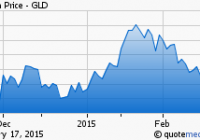
I altered my outlook for gold on Christmas Day, moving from a short view held from September 5 to a long view at what turned out to be perfect inflection. Since marking highs in January, gold and the GLD have again given way. The catalyst working against gold has been a strengthening relative dollar value, I believe greatly on concerns about the euro and Greece’s disruption to it. I see the Greece issue being resolved favorably near-term, and I believe the relative weakness that will follow for the dollar will again lift gold and the GLD. While some risks exist against my view, I see most of those either balanced or priced into the value of gold and the GLD at current levels. On Christmas Day 2014, I ended my short opinion on gold and gold relative securities with the publication of this report, Gold Outlook for 2015 – Buy & Hold Here . I also suggested the best way to play a reversal in gold was through the Market Vectors Gold Miners (NYSE: GDX ). But I never got on the record with my SPDR Gold Trust (NYSE: GLD ) followers, some of whom may not be aware of my positive turn. At this point, after a pull-back from a high price point of above $125 in January, and currently trading at roughly $115, I see current value marking a near-term bottom in the SPDR Gold Trust , and can suggest purchase of the gold security again. I believe gold prices should stabilize and rise from here, as the value of the dollar gives way against major foreign currencies. Though I see some risk that capital could flow heavily into U.S. equities, and potentially draw from gold investments over the short-term, I see gold and the GLD security good to go long-term. Even as the Fed raises interest rates this year, I still anticipate the dollar will give way and allow gold to go higher long-term, as Fed transparency has greatly priced this fact into the dollar already. 3-Month GLD Chart at Seeking Alpha The chart here shows the early year run up of gold from lows marked at the end of 2014, before giving way again more recently this year. I ended my negative outlook for gold initiated on September 5, 2014, and turned to a positive perspective for the commodity on Christmas Day. I just about perfectly captured the inflection point you see in the chart above in doing so, similar to how I did at the start of 2014 and in September of 2014. But since marking highs in January, gold and the SPDR Gold Trust have backed off a bit. This report marks my first published article on gold and relative securities since my early calls to buy and serves as an important reassurance to metals investors about my long-term view from this level. Today, trading near $115, the SPDR Gold Trust suffers from the recent strength of the dollar gained on the euro and yen. Against the yen, a recession in Japan and extraordinary central bank steps in that nation allowed the dollar some room to grow. Against the euro, the economic deceleration of Europe and the extraordinary actions of the European Central Bank (ECB) did the same. But the question raised about Europe more recently, due to the disruptive elections in Greece and its new government’s push for alterations to its bailout agreement, have given an extra lift to the dollar this year. Fear of a Greece exit from the eurozone has been overblown, in my opinion, and has been the thesis for a slew of investment recommendations I’ve made recently for and against other securities. For instance, I see the PowerShares DB US Dollar Bullish ETF (NYSE: UUP ) dropping to $24 soon. That move would come on relative dollar weakness, which would also lift gold up again. Relative Securities YTD TTM SPDR S&P 500 (NYSE: SPY ) +2.2% +16.3% PowerShares DB US Dollar Bullish +3.2% +16.0% SPDR Gold Trust +1.6% -9.1% iShares Silver Trust (NYSE: SLV ) +3.9% -25.2% Market Vectors Gold Miners +8.4% -22.5% As it pertains to the SPDR Gold Trust and gold prices, I believe that when the Greece question is answered favorably, possibly as early as today (Friday February 20th) and surely by February 28th, the dollar will start to give way to the euro. The dollar has already shown signs of wanting to do so and U.S. interest rates have likewise risen from recent lows. However, the saga has continued and the catalyst for a move is still chained, with pent-up energy waiting for a true and definite resolution. The dollar has had other reasons to give way recently. Japan just reported that it has formally exited recession, though the Bank of Japan remains likely to stick to its extraordinary easing strategy near-term. Europe is seeing signs of economic improvement as well, and many of its markets have already enjoyed a rally, with only Greece and Spain lagging due to political uproar. The recent peace accord in Ukraine offers hope that some geopolitical stability may be in the offing. All these developments support my thesis along with the catalyst I see in a Greece resolution. Risks exist against my thesis as well. The U.S. Federal Reserve remains on a path toward raising interest rates, but I believe much if not all of this probability is priced into the dollar and thus gold prices. The Fed has so well telegraphed its moves, thanks to its efforts toward transparency, that few will be surprised when the Fed finally does start to raise rates. And let me remind the reader that interest rates are at historic lows and abnormally low considering the strength of the U.S. economy. At this point, some argue, it is irresponsible not to raise interest rates and that the Fed flirts with future risk of inflation. Secondarily, terrorism in Europe has become a reality and could drive another flight to quality to the U.S. dollar, and thus is a threat against this thesis. However, one might argue that the same risk is likely intensified now for the United States, which is stepping up its own efforts against the Islamic State. Finally, if a Greece resolution occurs, it should also drive a rally in U.S. equities in my opinion. There is risk that gold could serve as a source of capital to fund it. I would argue that U.S. treasuries and other near cash assets are more likely to serve that purpose, especially given gold’s benefit from a weaker dollar. As a result, I see the risks here priced in and/or balanced. I feel comfortable recommending the SPDR Gold Trust at this value, after showing signs of stabilization here at an important technical support which likewise exists for gold here. The world is not a united utopia today, and humans will continue to reach for gold as a default currency against the risk of imperfectly government backed and risky fiat currencies. Gold has increased in use as a reserve currency, increasingly replacing the dollar in many central bank stores, offering indication of what I suggest. The dollar has become overextended in my opinion, due to the Greek scare and the previous weakness of Europe and Japan. However, those factors are now giving way, and the dollar should as well, allowing gold and the SPDR Gold Trust to gain. I follow gold closely and so investors in the sector may find value in following my column . Disclosure: The author is short UUP. (More…) The author wrote this article themselves, and it expresses their own opinions. The author is not receiving compensation for it (other than from Seeking Alpha). The author has no business relationship with any company whose stock is mentioned in this article.