Tag Archives: undefined

The Liquidity Curse

Is the liquidity premium turning into a discount? Traditionally, investors have been willing to pay a premium for stock liquidity. This premium appears to be turning into a discount. Could this phenomenon last? Historically, market participants have been willing to pay a premium for liquidity. In the equity market, in the hypothetical situation of two otherwise identical stocks, the one with the better trading liquidity would be expected to command a premium over the less liquid stock. In other words, everything else being equal, a stock that is easier to trade (one with better liquidity, i. e., more trading volume) would be expected to be awarded a higher valuation multiple than the less liquid alternative. Frequent readers are well aware that I am a strong fan of Warren Buffett. He has repeatedly noted how perverse it is that investors treat stocks so differently from real estate, simply because stocks are a much more liquid investment. Paraphrasing Mr. Buffett, he recently remarked how absurd it would be if a homeowner liquidated his or her home just because a neighboring home was sold at a discount versus its fair value. Homeowners do not track the theoretical value of their homes on a daily basis, and their investment psychology is not affected by the price fluctuations in their homes anywhere near to the extent that they are when they see the price swings in their stock holdings. Thus, Mr. Buffett often reminds us that, in the short term, the equity market functions as a voting machine, whereas in the long run, it is more like a weighing machine. That is one of the key reasons behind the success of long-term equity investing. In the long run, the stock market weighs the cash flow generating ability of the underlying equities, whereas in the short term, fads and popularity tend to determine the price at which a particular stock trades at specific point in time. The implied discrepancy is what often creates wonderful buying opportunities in very desirable equities for the long term. How could trading liquidity ever be a bad thing? In the short run , better stock liquidity can certainly work against a stock price. Particularly in severe market-wide corrections (or if a specific stock is heavily owned by leveraged traders), a liquid stock may suffer disproportionately in the short term as traders take advantage of the relatively high liquidity to raise cash. This is when particularly attractive entry points are often created for long-term investors, but also why I advocate that such investors never use margin debt to increase their exposure to stocks. Owning stocks on a leveraged basis does potentially expose market participants to a sort of ‘liquidity curse’. One may receive a margin call and be forced to liquidate a particular stock in a sudden market correction. But other than that, trading liquidity should always be considered a positive characteristic in a stock, in my view. Still, and perhaps because investors seem to be increasingly shunning volatility, it appears almost as if the historical liquidity premium may be turning into a discount, and that the liquidity curse may be becoming more widespread and more of a permanent feature across equities! Much has been written lately about the millennials. The so-called millennial generation does seem generally less open to equity investing than previous generations were at the time they were in the age range of millennials today. Having seen their parents go through the burst of the TMT bubble and the global financial crisis may have traumatized millennials enough to generally shun investing in publicly traded equities, at least for the time being. That said, investing in private equity seems much more currently popular. This is reflected both in the staggering valuations now prevalent in a number of late-stage venture investments, as well as in the growing popularity of ‘crowdfunding’. More investors than in the past, perhaps bolstered by young people including millennials, seem to be increasingly comfortable tying up their funds in illiquid investments. Equity is equity, and that which is not traded in the public markets is almost by definition riskier than publicly traded stocks, even everything else being equal. Thus, it would seem as if more people are choosing venture capital and private equity at the expense of the public markets, at least implicitly preferring trading illiquidity. One hypothesis I have for this phenomenon is that it is less traumatic for those investors not to know exactly how much a particular equity investment they own is worth at a particular point in time, just as is the case in real estate.
Are Rate-Sensitive ETFs Suggesting Economic Weakness Ahead?

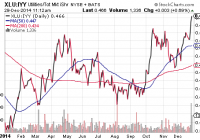
I am baffled by the economic acceleration certainty that nearly every respected voice has endorsed. In spite of the rosiest government data on jobs and GDP, which ETF asset classes proved most resilient in a month of volatile price movement? Utilities and REITs. The more the public is being told about the inevitability of rate increases, the greater the momentum for proxies like XLU and VNQ. Lost in the bull market euphoria is the reality that economists have been dead wrong about the direction of asset prices, particularly bond prices. Last December, when 55 of the most prestigious economists across a wide range of institutions had been polled by Bloomberg about where the 10-year yield (3.0%) would end the year, each of the 55 professionals anticipated higher rates. The average of those estimates? 3.41%. And yet, the 10-year will finish the year closer to 2.25%. That is one heck of an astonishing miss for the entire professional community. This December, polling of economists has produced an average forecast for the 10-year yield at 3.0% by the close of 2015. In other words, they expect intermediate term rates will climb in 2015, and yet, the projections merely approximate where 2013 ended. Even if the recent crop of poll respondents are correct this time around, what does this “non-normalization” of rates tell us about the highly touted strength of the U.S. economy? For all the hoopla, I am baffled by the economic acceleration certainty that nearly every respected voice has endorsed. Will Q4 gross domestic product (GDP) be as robust as the 5% in Q3? Not likely. Will Q1 2015 be better than the average of 2.1% sub-par growth that has existed each year since the Great Recession ended? Probably not. For one thing, lower bond yields have been warning U.S. investors that the world’s stagnation alongside regional recessions will eventually weigh down the U.S. It is one thing to pretend that the U.S. is a self-contained economic island, yet quite another thing to ignore the reality that close to 50% of corporate profits come from overseas. Moreover, there are a variety of potential crises that could sap the world (and yes, the U.S.) of economic demand, from a disorderly slowdown in China to an emerging market credit collapse to a second iteration of a euro-zone break-up scare. Need proof that scores of investors remain unconvinced by the notion that all is perfect in stock-land? In spite of the rosiest government data on jobs and GDP – in spite of strong retail sales as well as consumer confidence readings – which ETF asset classes proved most resilient in a month of volatile price movement? Utilities and REITs. Are The Bets On Lower Rates Still Continuing? MOM% SPDR Select Sector Utilities (NYSEARCA: XLU ) 9.0% iShares DJ Utilities (NYSEARCA: IDU ) 8.7% Vanguard Utilities (NYSEARCA: VPU ) 8.6% iShares Cohen Steers Realty Majors (NYSEARCA: ICF ) 4.2% Vanguard REIT (NYSEARCA: VNQ ) 4.2% SPDR DJ REIT (NYSEARCA: RWR ) 4.1% iShares DJ Total Market (NYSEARCA: IYY ) 1.0% If an investor is looking for modest growth in an area less tied to the economy, he/she may journey to the consumer staples segment or the health care sector. They are frequently identified as “non-cyclicals” since they represent things we need in good times and bad. And if an investor is looking for more total return in areas less tethered to economic well-being, he/she often travels to utilities and REITs. The exception to that rule? If rates are expected to rapidly rise across the yield curve, an investor would tend to shy away from the rate sensitivity associated with utilities and REITs. That’s not happening. In fact, the more the public is being told about the inevitability of rate increases, the greater the momentum for proxies like XLU and VNQ. The price-ratios for XLU:IYY as well as VNQ:IYY are at or near their highest points of 2014. I am not advocating that investors abandon economically sensitive stock assets let alone chase yield-sensitive stock segments. On the other hand, just as I recommended throughout 2014, I believe it makes sense to remain committed to longer-term bonds in funds like iShares 10-20 Year Treasury (NYSEARCA: TLH ) as well as lower volatility stocks across the sector spectrum. One of my largest client holdings, iShares USA Minimum Volatility (NYSEARCA: USMV ), is diversified across all of the economic sectors; the top 3 segments are health care, financials and information technology. What makes USMV particularly attractive in the current environment? The equities have lower volatility properties relative to the U.S. market at large, offering the possibility that losses during declining markets will be less dramatic. Similarly, gains in rising markets will emanate from exposure to strong economy stock sectors as well as weaker economy stock sectors. Click here for Gary’s latest podcast. Disclosure: Gary Gordon, MS, CFP is the president of Pacific Park Financial, Inc., a Registered Investment Adviser with the SEC. Gary Gordon, Pacific Park Financial, Inc, and/or its clients may hold positions in the ETFs, mutual funds, and/or any investment asset mentioned above. The commentary does not constitute individualized investment advice. The opinions offered herein are not personalized recommendations to buy, sell or hold securities. At times, issuers of exchange-traded products compensate Pacific Park Financial, Inc. or its subsidiaries for advertising at the ETF Expert web site. ETF Expert content is created independently of any advertising relationships.

How Strong Is Schwab U.S. Large-Cap Value ETF SCHV? I’m Considering It As A Core Holding

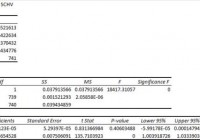
Summary I’m taking a look at SCHV as a candidate for inclusion in my ETF portfolio. The risk level is great, though the high correlation to SPY shouldn’t be a surprise. The ETF has fairly decent yields and a great composition of companies. I’m not assessing any tax impacts. Investors should check their own situation for tax exposure. Investors should be seeking to improve their risk adjusted returns. I’m a big fan of using ETFs to achieve the risk adjusted returns relative to the portfolios that a normal investor can generate for themselves after trading costs. I’m working on building a new portfolio and I’m going to be analyzing several of the ETFs that I am considering for my personal portfolio. One of the funds that I’m considering is the Schwab U.S. Large-Cap Value ETF (NYSEARCA: SCHV ). I’ll be performing a substantial portion of my analysis along the lines of modern portfolio theory, so my goal is to find ways to minimize costs while achieving diversification to reduce my risk level. What does SCHV do? SCHV attempts to track the total return of the Dow Jones U.S. Large-Cap Value Total Stock Market Index. At least 90% of funds are invested in companies that are part of the index. SCHV falls under the category of “Large Value”. Does SCHV provide diversification benefits to a portfolio? Each investor may hold a different portfolio, but I use (NYSEARCA: SPY ) as the basis for my analysis. I believe SPY, or another large cap U.S. fund with similar properties, represents the reasonable first step for many investors designing an ETF portfolio. Therefore, I start my diversification analysis by seeing how it works with SPY. I start with an ANOVA table: (click to enlarge) The correlation is about 96%. That’s simply too high to provide a very meaningful diversification benefit. I measure risk with the standard deviation of daily returns. It isn’t perfect, but it works fairly well for my purposes and seems to hold up over time. Because the correlation is very high, the standard deviation of returns will be a fairly significant factor. Standard deviation of daily returns (dividend adjusted, measured since January 2012) The standard deviation is great. For SCHV it is 0.7027%. For SPY, it is 0.7300% for the same period. Since SPY usually beats other ETFs in this regard, I’d look at that standard deviation level as being fairly favorable. Of course, since SPY and SCHV hold several of the same companies a high correlation was pretty much a given. Since the Value side of the index should have more stability and less risk, the findings are in line with my expectations. Mixing it with SPY I also run comparisons on the standard deviation of daily returns for the portfolio assuming that the portfolio is combined with the S&P 500. For research, I assume daily rebalancing because it dramatically simplifies the math. With a 50/50 weighting in a portfolio holding only SPY and SCHV, the standard deviation of daily returns across the entire portfolio is 0.7128%. The value side of the index (which SCHV is tracking) has been outperformed by the growth side of the portfolio. I would expect that to usually happen during a bull market. When a bear market occurs, I would expect the value side to hold up a little better. Since I believe in being fairly defensive about protecting capital, the value side is more appealing to me. Why I use standard deviation of daily returns I don’t believe historical returns have predictive power for future returns, but I do believe historical values for standard deviations of returns relative to other ETFs have some predictive power on future risks and correlations. Yield & Taxes The distribution yield is 2.33%. The SEC 30 day yield is 2.52%. I’m pretty comfortable with this ETF as an investment for retirees so far. In my opinion, it is a fine investment for younger investors as well. I have quite a while to go before retirement, but I still like healthy dividend yielding companies. Investors concerned about tax consequences should seek advice from someone knowledgeable about their tax situation. Expense Ratio The ETF is posting .07% for an expense ratio. This is great expense ratio. I treat the expense ratio as a very important metric when considering an investment. I want diversification, I want stability, and I don’t want to pay for them. Market to NAV The ETF is at a .02% premium to NAV currently. In my opinion, that’s not worth worrying about. It is practically trading right on top of NAV. However, premiums or discounts to NAV can change very quickly so investors should check prior to putting in an order. Largest Holdings The portfolio isn’t really top heavy. There are no holdings over 4%, but I still could go for slightly more diversification. With so many companies over 2%, the low standard deviation speaks to the stability of the companies within the ETF. (click to enlarge) I love having Exxon Mobil (NYSE: XOM ) as the top holding in the portfolio. I want exposure to gas because high gas prices can slow down the rest of the economy. In my opinion, it is hard to make an argument for any portfolio (under modern portfolio theory) that does not contain at least some exposure to gas prices. In my opinion, XOM is a reasonably safe way to get that exposure. You may notice Chevron is also in there. I think that is great as well. I don’t want to hold just one of the major gas companies. In my opinion, this is a fairly solid lineup. I’m still uncomfortable with Verizon (NYSE: VZ ) because I don’t like that industry in the current environment. However, at less than 2%, I have no problem with including it in a long term ETF position. When the industry becomes attractive again, it should be a great company to hold. Conclusion I’m currently screening a large volume of ETFs for my own portfolio. The portfolio I’m building is through Schwab, so I’m able to trade SCHV with no commissions. I have a strong preference for researching ETFs that are free to trade in my account, so most of my research will be on ETFs that fall under the “ETF OneSource” program. I’m finding SCHV pretty attractive and will consider giving it a niche in my portfolio. The size of the position depends on if I decided to use it as a core holding in place of SPY or SCHB. In that scenario, it could end up with a position as large as 20 to 25%. Otherwise, I would probably aim for something around 10%. Before I make a final decision I’ll need to run some analysis on complete potential portfolios. One way or another, my complete portfolio will include strong exposures to large cap U.S. companies and to heavy dividend paying companies.