Tag Archives: setpageviewname

Market Vectors Rolls Out A Spin-Off ETF

The niche ETF concept has been at the top of every issuer’s mind lately. There is hardly any scope for plain vanilla products in this rapidly growing industry. Moreover, these unique investing options give investors a scope to play the various areas of the market in basket form, using strategies that are usually hard to reproduce in a regular-themed portfolio. Probably, inspired by this sentiment, Market Vectors recently rolled out a spin-off ETF. The Market Vectors Global Spin-Off ETF (NYSEARCA: SPUN ) in Focus The fund tracks the Horizon Kinetics Global Spin-Off Index and comprises approximately 87 multi-cap securities belonging to the developed world. The universe of companies eligible for inclusion in the Index includes those that have been spun off. As per the summary prospectus , “for each company, an early entry at the start of the spin-off cycle aims to exploit valuation disconnects caused by selling pressure and pricing inefficiencies. A long-term hold seeks to capture periods of improved operating efficiency.” The fund does not appear to be concentrated on the top 10 holdings as no stock accounts for more than 1.64% of the basket. Among individual holdings, Global Brands Group Holding Ltd, Prothena Corp Plc (NASDAQ: PRTA ) and Indivior Plc ( OTCPK:INVVY ) occupy the top three positions in the fund, which has a net expense ratio of 0.55%. In terms of sector allocation, the ETF has double-digit allocation each in Consumer Discretionary, Financials and Industrials with 25.2%, 19% and 18.5%, respectively. Geographically, the fund is heavy on the U.S. with more than 65% exposure while the U.K. (6.5%) and Australia (5.5%) come in as the distant second and third. How Does it Fit in a Portfolio? In a spin-off, a company detaches certain assets to make a separate company and ‘spins off’, or hands out shares in that entity to the current shareholders. The most usual cause of a spin-off procedure is that the stock price of a big diversified company is unable to reciprocate the fair value of all its branches of operations. These could actually be among one of the top performing assets in the market. This is true for SPUN which actually reflects the full-phase of the separated companies. The issuer noted that such entities normally underperform in the earlier phase of their life-cycle due to the absence of historical performances, dearth of analyst coverage, inferior peer comparisons and market cap issues. However, over the long term, these entities trend to perform better on availability of historical results and the consequent perfection in the analysts’ reports. Better management often makes these lucrative bets. Thus, from the long-term perspective, the fund might be well liked by investors. ETF Competition The coast is clear for this newly launched ETF as it has to compete with just one ETF namely the Guggenheim Spin-Off ETF (NYSEARCA: CSD ) . Otherwise there is no meaningful player in this space. This fund tracks the Beacon Spin-off index which looks to focus on about 40 companies that have been spun-off within the past 30 months, but not before six months prior to the applicable rebalancing date. The fund charges 66 bps in fees (net) which much lower than the newly ETF. Thus, from the expense ratio point of view, SPUN scores a point over CSD. Moreover, CSD has moderately heavy concentration risk with the top four holdings taking 5% to 6% each. Thus, we see no hurdle for SPUN in garnering investors’ money. Article originally published on Zacks.com

Despite Legal Troubles, PG&E In Best-Case Business Environment Long Term

Summary PG&E is coming off a rough patch with some legal troubles. The interest rate environment is favorable, and PG&E is heavily leveraged. PG&E’s cost of production has declined due to the low cost of energy. Experts have mixed opinions on the stock, but are more bullish long-term. The low interest rate environment coupled with low energy prices is a best case environment for Pacific Gas & Electric (NYSE: PCG ). The utility can use low interest rates to roll over their existing debt and use low energy prices to hedge costs of production at a historically low rates. Not all is rosy, the utility must navigate a complex and tangled legal environment, and placate concerns regarding energy grid security. Even through all these complications, PCG must continue to look forward and embrace innovation if it hopes to achieve its 2020 mandate that 33% of all power is from renewable sources. If PG&E can navigate the risks and take advantage of this favorable business environment, the company should continue to lead the U.S. utility sector. Market Overview PG&E Corporation is a public utility holding company, which means it is subject to regulatory oversight and must provide the regulatory body access to their records and books. The regulatory environment is tangled and complex, different sections of PCG’s business are regulated by one or more of these regulatory bodies: The CAISO , FERC , NRC , CPUC , and CEC . From FERC, which regulates the interstate transmissions of electricity and natural gas, to CEC, which handles energy policy and planning for the state of California. Regulation is central to a utility company like PG&E, even product pricing is done through a ratemaking process with regulators. Ratemaking is when a public utility company, like PCG or FERC, exchange information about the cost of energy production, operating expenses, and regulatory policy goals. Then the two agree on a price rate for energy which will cover all of these costs and provide a ‘fair’ rate of return. The market for energy is not competitive and is centralized is because of the large capital investment required for energy infrastructure and for real-time regulatory oversight. The government would have a difficult time regulating thousands of small electricity companies and it is possible policy demands for infrastructure would not be met. See here for more about how the California energy system works. Business Overview PG&E was founded in 1905 and continues to lead the United States as the largest utility company. The utility currently employees 22,581 people and operates mostly in northern California. The utility is diversified across many energy sectors, with nuclear generation facilities, combined cycle gas turbine electricity generators, wind power installations, natural gas pipeline and even energy storage. PG&E is a legal monopoly because of the strategic advantages of scale in the public utilities sector. Because PG&E is defined as a public utility company, many of its business choices are monitored closely or mandated by the federal and state governments. When making business changes, PG&E must move very deliberately in order to move in step with policy makers. Recently PG&E has been mandated to provide 33% of all energy from renewable sources by 2020. As you can see below, the Utility still has to acquire more renewable resources to achieve the mandate. Further the regulatory bodies have placed a growing target for energy storage. (click to enlarge) PG&E is heavily leveraged in the credit markets, because energy infrastructure is capital intensive and the payoff over long time horizons. Due to the Utility’s stability for more than a century, PG&E has been able to demand favorable terms for credit. Further, PG&E’s main products, consumer natural gas and electricity, are tied to the prices of oil and natural gas. These two energy markets are near historic lows and PG&E should be able to hedge their energy costs for the next few years at favorable prices today. (click to enlarge) Growth Plan (From the Company’s 10-K ) Managing Legal risks: The Utility has many legal risks which are outlined in the Risk section below, it is vital that the Utility effectively manage these legal disputes or future growth could be inhibited. Renewable Power Initiatives: California law requires the Utility to gradually increase the amount of renewable energy to at least 33% of their annual retail sales by 2020. Natural Gas Pipeline: During 2014 the Utility completed its system wide replacement of 847 miles of iron pipelines with plastic pipe. Energy Storage: California law has established initial energy storage targets for the Utility. The Utility currently has 80.5 MW of energy storage which meets the target. The target is expected to increase over the next few years. Additional Transmission: The Utility plans to complete a new transmission line connecting the Gates and Gregg substations. The new line is expected to reduce the number and duration of power outages, improve voltage in the area and increase economic activity in the area. Additional Distribution: In October 2014, the Utility began operations at the first of three new electric distribution control centers. These centers will utilize Smart Grid technologies for added stability to the grid. Risks (From the Company’s 10-K ) Enforcement matters, investigations, regulatory proceedings: The environment for legal risk for PCG is sizable, with a federal criminal prosecution of the Utility. Additionally the rates and tariffs which PCG can charge customers is set by the government through a legal process. Liquidity and Capital Requirements: Since PCG has been around more than a century their credit rating stable, however, the inability to continue to attract favorable lending rates would greatly reduce the profit of PCG. Operations and Information Technology: There are broad array security and cybersecurity risks which come with operating a large utility company. The majority of these risks deal with containment of large accidents, adverse weather preparation and sensitive data protection. Environmental Factors: Both the macro economic environment as well as the physical environment have large impacts on the performance of PCG. Extremely hot summers cause more demand which strains the electricity grid, while extremely cold winters strain the natural gas network. PCG must continue to upgrade the infrastructure of the Utility in order to mitigate these environmental risks. Competition From New Technology: The Utility is subject to increased competition due to the increasing viability of distributed generation and energy storage technologies. The levels of self-generation of electricity by customers (mainly solar) and the use of customer net energy metering, which allows self-generating customers to receive bill credits at the full retail rate, are increasing. Expert Opinion (click to enlarge) Analyst opinion has moved from negative three years ago, to positive in the last year. The mean price target for PCG is $57 per share, which currently gives PCG stock an upside of approximately 10%. Analysts have moved down their EPS estimates over the last 90 days, which is a bearish sign for the stock’s near-term value. However, PCG has a tendency to surprise investors with its EPS announcements. In conclusion, analysts are uncertain about the near-term prospects of PCG, but they are bullish regarding the long-term value of the company. Current Events PG&E recognized by CIO magazine as a CIO 100 Award Winner Gas pipeline explosion near Fresno, CA, which led to a payout of $1.6 billion . A recent blackout in Berkeley, CA. Conclusion PG&E is a utility that is going through a near-term rough patch, but is well positioned to take advantage of long-term trends in the energy industry. Since PG&E requires credit to invest in energy infrastructure, the current low interest rates environment is useful for refinancing current loans and starting new projects at attractive credit rates. Further PG&E benefits from a low cost energy environment which allows them to hedge their costs of production at attractive rates. While PG&E is well positioned, the future growth of PG&E is dependent upon the Utility’s ability to mitigate risks. There are significant risks to growth which PG&E must overcome and manage if they wish to continue to lead the Utility sector. PG&E is exposed to a few major legal cases which could negatively impact the company. Further, the company must integrate renewable energy resources into the grid while maintaining stability. Analysts are aware of these risks and are divided regarding the future price of PG&E. In conclusion, PG&E the largest utility in the U.S. and is well positioned to take advantage of two major market trends if it can manage the risks. The utility should continue to lead the sector and is a buy if an investor is looking for dividend capture and stable growth in the U.S. utility space. Disclosure: The author has no positions in any stocks mentioned, and no plans to initiate any positions within the next 72 hours. (More…) The author wrote this article themselves, and it expresses their own opinions. The author is not receiving compensation for it (other than from Seeking Alpha). The author has no business relationship with any company whose stock is mentioned in this article.
The Case For Considering The Australian Equity Market

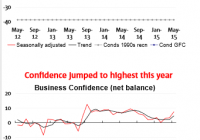
Summary Australia had record high business confidence on low AUD and consumption boost. Labor market continued to grow in a sustained manner along with the housing and credit markets. This might be the time to buy into Australian equities as both internal and external conditions merged to form bullish condition. Australia might be iconic to the average Americans as the land of the kangaroos but it has more to offer than tourism. The Australian economy is on the steady path of recovery as seen in the record high of business confidence, recovering labor market and better credit condition. This represents a great opportunity to gain exposure to the Australian market for this recovery had been ongoing since the beginning of this year. Australia had been blessed with its proximity to the emerging Asia, strong reserves of minerals and other raw materials and a dovish central bank that cut rate twice this year as a precaution. As a result, the recovery in Australia took hold and through months of consistent performance, it is now deeply rooted as the latest May data would show. However the Australian stock market remains discounted as market confidence was shaken by the weaker than expected US and Chinese economic data. This is now changing as the US and Chinese economies are on the mend as seen in recent articles. Record High Business Confidence We shall first delve into the May survey of business sentiment as conducted by the National Australia Bank (NAB). Business confidence went up from +3 in April sharply to +7 in May as all business sector (except mining) had a better outlook on business conditions. This +7 reading of business confidence is the record high this year. Source: NAB Business conditions were lifted by the twin effects of the lower AUD and supportive budget released this year. The recent low 2% interest rates by the Reserve Bank of Australia (NYSE: RBA ) also helped in the credit conditions for the housing market and business lending. Consumption and consumer confidence have also staged a steady recovery. These conditions had led non mining businesses as a whole to revisit their reluctance towards capital expenditure and to invest for the future. The manufacturing industry led the recovery on the tailwinds of the lower AUD while the mining industry continued to contract on reduced Chinese demand. Forward looking indicators such as new orders are also pointing towards the right direction for future growth. The overall trend is clear towards greater business confidence for Australia. Strengthening Australian Labor Market The next piece of good news for the Australian economy is the improving labor market as reported by the Australian Bureau of Statistics ( ABS ) for May 2015. The major good news is that the Australian economy had added 42,000 new jobs in May and this is resulted in the lowering of the unemployment rate from 6.1% to 6.0%. (click to enlarge) The reduction of the mining sector had resulted in the net increase in Australian unemployment rate as seen in the chart above. However this had been largely reversed since January 2015. The improving economy had been able to absorb the increasing workers made redundant as mining companies cut back on production. This improvement is all the more remarkable because this reduction is done without any corresponding reduction in the overall employment rate as seen in the table below. In other words, the unemployment rate came down not because of more discouraged workers as was the case in the US 5 years back in 2010. The unemployment came down because the labor pool expanded and more people are now working. (click to enlarge) Source: ABS In fact, the labor participation rate crept up by 0.2% over a 1 year period as the labor pool expanded to 11.75 million and 64.7% of Australians are gainfully employed. This means that Australian have greater income as a whole and would naturally consume more in the future. Housing And Credit Market Lastly we can look at the status of the Australian housing market. Bubbles are formed when housing are purchased for the purpose of speculation instead of dwelling. This, along with lax credit conditions, is the root cause of the US housing bubble, which burst in 2007. The Australian regulators are mindful of this painful episode and they had recently cracked down on runaway housing prices especially on foreign purchase of property for ‘investment’ purposes. This has resulted in the majority of purchase being used for residential purposes. In May, out of $32 billion worth of housing commitments, $19 billion is for owner occupation while $13 billion is for the purpose of investment. In other words, a good 59% of new housing being built in Australia will be occupied by owners and they are not likely to bid prices up to excessive levels in hopes of flipping it for profit as soon as regulation permits. (click to enlarge) Source: ABS The strength of the Australian housing market can also be seen in the upwards momentum of both the value and number of housing commitment. This is supported by modest and sustained increase in loans as seen in the chart below. (click to enlarge) The chart shows that the credit market in Australia had been rising for 3 consecutive months in a row. Conclusion If we were to put the recent domestic conditions of better business confidence, labor condition, housing and credit market in May together with the recovering economic conditions in the 2 largest economy in the world, this would signal the path towards a sustained economic recovery for Australia is now under way. This would mean this current price of $22 might the low price for the iShares MSCI Australia ETF (NYSEARCA: EWA ) which is the broad based representation of the best of Australian equity. The conditions are ripe for the bottoming out of Australian equities as both internal and external conditions coincide for a strong and sustained economic recovery. Disclosure: The author has no positions in any stocks mentioned, and no plans to initiate any positions within the next 72 hours. (More…) The author wrote this article themselves, and it expresses their own opinions. The author is not receiving compensation for it (other than from Seeking Alpha). The author has no business relationship with any company whose stock is mentioned in this article.