Tag Archives: seeking

Betting Against Japan: The Straddle Of The Century

Japan has accumulated an enormous and growing debt load. The Japanese Central Bank’s bond buying may prevent a crisis. The yen is likely to continue weakening. Investors can profit from the JCB’s moves. Japan emerged from the ashes of World War II to becoming one of the largest economic powers in the world by the 1980s. By creating high quality products and making highly publicized corporate purchases, Japan was both respected and feared by competing economic powers. Japan’s economic advancement came to an abrupt end when the Japanese market crashed in the late 1980s and never truly recovered. The once mighty power is now heavily indebted and dealing with a declining population and a declining economy. A crisis is possible, but like with crises of the past, a major Japanese economic event can become a great opportunity, particularly with the right investments. The debt load of the Japanese government stands at just under 1.2 quadrillion yen ($10.1 trillion), greatly exceeding their 484 trillion yen ($4.07 trillion) economy and the 96 trillion yen budget ($812 billion), with projected revenue at only 54.5 trillion yen. This is a precarious financial position, and at a 4.5% interest rate, the projected revenues would only cover debt service. But because the Japanese Central Bank (JCB) is such a large buyer of Japanese government bonds, the interest rate for a 10-year bond stands at under 0.5% as of the time of this writing. Given that this 1.2 quadrillion yen is a debt level unlikely to be paid off, hyperinflation or default would appear to be the only realistic options for addressing the debt. To counter a possible collapse, the JCB started buying larger amounts of bonds than the Japanese government was creating. It’s likely the JCB plans to buy up a large percentage of the outstanding bonds ( it owns about 16% now ) and simply write off the bonds, and hence, that portion of Japanese government debt. If this were to work without destroying the economy, the Japanese government strengthens its financial position by returning to sustainable debt levels. If it fails and Japanese bonds rise to double or even triple digit interest rates, default becomes a possibility. Another possible scenario involves weakening the yen. This has been seen in earnest since 2012 and born of the JCB’s larger levels of aggressive stimulus. The JCB created more yen and pumped the currency into the economy, sending the Nikkei to highs not seen since the 1990s. The price of this stimulus has been a greatly devalued yen falling from 76 to the dollar in early 2012 to the low 120s in early 2015 . Experts such as Kyle Bass predict the yen will fall beyond 140 to the dollar by year-end and further beyond this year. The potential danger of this approach is that more yen chasing the same amount of goods will devalue the yen to the point that investors lose confidence in the currency. In addition to making Japanese consumers poorer, the devalued currency could also lead to higher interest rates that also make the government debt load untenable. Investors can protect themselves from this horrifying yet plausible scenario with a different take on the straddle bet, one based on different vehicles instead of up or down bets on the same investment. In this case, it would be a position betting against Japanese government bonds (the JGBS ETF is the easiest way to accomplish this) coupled with a second bet against the value of the Japanese yen (versus a precious metal or a currency such as the US Dollar). If the JCB can successfully write off a large amount of government debt, investors can still profit from what’s likely to be substantial yen devaluation. If the worst case bond crash occurs, investors can profit or at least protect themselves from what would be a devastating economic event. The once-mighty Japanese economy now finds itself in a situation where the JCB struggles to maintain economic strength. An economic collapse would be the most devastating occurrence to hit Japan since their loss in World War II, and a catastrophic blow to a world economy where Japan exerts wide influence. However, this situation also presents a great opportunity for the prepared investor. Whether the high debt resolves itself through a dramatic collapse or by the JCB engineering a large-scale debt write off, bets on a weaker yen and higher interest rates will likely bring investors outsized returns and possibly protection in a crisis. Disclosure: The author is long JGBS, GYEN. (More…) The author wrote this article themselves, and it expresses their own opinions. The author is not receiving compensation for it (other than from Seeking Alpha). The author has no business relationship with any company whose stock is mentioned in this article.
Dominion Resources Is Boosting Returns To Shareholders, But Is It A Buy?

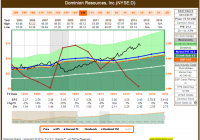
The utility sector is generally known as a collection of high yield, slow growth companies. Dominion Resources has been a top performer in the sector with an attractive growth rate and dividend yield. Dominion Resources recently announced a boost to the dividend and guided for a higher payout ratio going forward. This article will discuss the current valuation levels for the company and determine if it is worth adding to my dividend growth portfolio. As an avid reader of the dividend growth investing strategy on Seeking Alpha, it’s apparent that many investors using this method have a fond appreciation for utility companies in their portfolios. The consistency of earnings and reliable nature of a long-term, slow and steady growth rate make these companies a great cornerstone for long-term buy and hold investors. One utility that is a great example of this slow and steady growth is Dominion Resources (NYSE: D ). Here is the company description from Dominion’s website: Dominion is one of the nation’s largest producers and transporters of energy, with a portfolio of approximately 24,600 megawatts of generation, 12,400 miles of natural gas transmission, gathering and storage pipeline and 6,455 miles of electric transmission lines. Dominion operates one of the nation’s largest natural gas storage systems with 949 billion cubic feet of storage capacity and serves utility and retail energy customers in 12 states. Dominion has a long history of providing outstanding total returns for investors. The company has a 10-year dividend growth rate of 6.3%, a 10-year earnings growth rate of 4.5%, and during that time has provided investors with 12.4% annual total returns with dividends reinvested. While the past has been great, the future may be even better. On February 9th, the company announced an 8% increase in the quarterly dividend from $0.60 to $0.6475 per share, and stated its intentions to increase the dividend payout ratio from a range of 65-70% of earnings to 70-75% through the end of the decade. Dominion also held its Investor and Analyst Meeting on February 9th, with management providing an overview of operations and expectations for the future. During this meeting presentation, management provided guidance for 6-7% earnings growth and 8% dividend growth through 2020, both of which exceed rates seen over the last decade. With a current yield of around 3.55%, investors buying for the long term can lock in an attractive yield growing at a high rate for a utility company. However, in the short term, the stock appears to be trading at a rich valuation compared to historical levels. (click to enlarge) Compared to a normal PE of 16.2 over the last decade, the current ratio of 21.3 would indicate that shares are trading at a 30% premium to normal values. The current yield shown has not yet updated to the newly announced dividend rate, but the 3.55% yield at that payout is still low compared to historical levels. Much of this premium being paid by the market is due to U.S. Treasuries trading at historically low levels, which is driving income seeking investors into equities as they search for yield. I discussed this in a recent article covering the utility sector , and a similar situation is being seen in the REIT sector as well. This trend has been reversing in recent weeks, as the Treasury rate has rebounded and the utility sector, as shown by the Utilities Select Sector SPDR ETF (NYSEARCA: XLU ), has sold off. 10 Year Treasury Rate data by YCharts Circling back to Dominion, it appears that the share price was driven up by macro factors, as the sector traded higher on the weaker Treasury rate. With that rate appearing to be normalizing, there could be some continued short-term pain for Dominion investors. Dominion is a great company with multiple drivers leading to continued growth. I think it deserves a spot in my portfolio as a core holding, but the valuation appears stretched at current prices. This is a company I hope to own, and it has been added to my watch list for my dividend growth portfolio . I will be looking for an entry point at around $65, which would provide a dividend yield of 4% that would pair quite nicely with an 8% dividend growth rate going forward. Disclosure: The author has no positions in any stocks mentioned, and no plans to initiate any positions within the next 72 hours. (More…) The author wrote this article themselves, and it expresses their own opinions. The author is not receiving compensation for it (other than from Seeking Alpha). The author has no business relationship with any company whose stock is mentioned in this article. Additional disclosure: I am a Civil Engineer by trade and am not a professional investment adviser or financial analyst. This article is not an endorsement for the stocks mentioned. Please perform your own due diligence before you decide to trade any securities or other products.

Pareto Portfolio Update

Significant returns can be made even holding a small number of stocks. Avigilon is up 43% since December 24, 2014. 80/20 investing isn’t for everyone, but it is for those like me who believe that less is more. Choose a few great companies, watch your portfolio like a hawk, and you’ll do well. I first wrote about the Pareto Portfolio on December 26, 2014. My belief is that an investor does not need to have a large number of stocks in his/her portfolio in order to have significant market beating returns. In fact, I believe that having less stocks in my portfolio will help me to invest and make returns far better than many other investors based on the 80/20 principle. My portfolio is much easier to follow and control and this makes my life easier. To date, you’ll see how the portfolio has performed since December 24th. I also have some updates on selling, purchasing and dividends/interest received within the portfolio. Stock Shares Price at 2014/12/24 Price at 2015/02/13 Change Avigilon Corp. (OTCPK: AIOCF ) 290 17.25C 24.67C +43% Cisco (NASDAQ: CSCO ) 125 32.89C 36.64C +11.4% Coach(NYSE: COH ) 100 42.9791C 49.61C +15% Dream Office REIT ( OTC:DRETF ) (T.D/UN) 811 24.76C 27.13C +9.5% Pembina Pipeline (NYSE: PBA ) 90 41.58C 40.39C -2.9% The portfolio has performed extremely well, led by Avigilon Corporation, which has gained 43% since its close on December 24th of last year. Following are the changes I made in the portfolio between then and February 13th. Sold all 100 shares of Coach on 2015/01/12 @ 45.3856C. In addition to the 33.38C in Coach dividends received on 2014/12/29, the total gain was 6%. Purchased 106 more units of Dream Office REIT on 2015/01/16 @ 26.72. Dream Office REIT Interest on 2015/01/20 of 130.66C, of which 129.14C of this was automatically reinvested through Dream’s DRIP for an addition of 5 units to my total, which now sits at 811 units. Pembina Pipeline dividend on 2015/01/16 of 13.05C. This was not reinvested. Cisco dividend on 2015/01/21 of 24.95C. This was not reinvested. I sold Coach on the news that the company was going to purchase Stuart Weitzman. I’m not convinced that purchasing this company with its cash is the best idea. So far, the stock price movement has proven me wrong. Time will tell. Cisco released its FQ2 results last Wednesday and beat analysts’ expectations. A number of analysts have increased their price targets due to the forward guidance by the company. I’m very comfortable to continue holding CSCO. The company also increased its dividend by 11%. Avigilon will release its FQ4 and 2014 full-year results after the close of markets on 2015/03/03. I’m expecting great results, as are many who are invested in and/or follow this company. This company is growing extremely fast and doing so profitably. Its cameras and video surveillance system was used to secure this year’s Super Bowl in Phoenix . Pembina Pipeline and Dream Office REIT continue to perform very well, and analysts have significantly higher price targets than the shares are trading at presently. Both also offer nice yields of 4.3% and 8.2%, respectively. If you’re going to invest using the 80/20 style, you need to make good choices, focus on just a few companies, and then watch your portfolio like a hawk. Don’t be afraid to take profits nor be afraid to sell if you think you have a valid reason to do so. I don’t believe you need 30, 40, or 50 stocks to significantly outperform the market. I believe that less is more. Have a great week everyone! Disclosure: The author is long AIOCF, CSCO, PBA. (More…) The author wrote this article themselves, and it expresses their own opinions. The author is not receiving compensation for it (other than from Seeking Alpha). The author has no business relationship with any company whose stock is mentioned in this article. Additional disclosure: I am also long T.D.UN (Dream Office REIT)