Tag Archives: seeking-alpha

A Conservative Way To Invest In An Energy Rebound

Summary BCX shares have been depressed after a recent closed-end fund merger because of selling by previous shareholders of BQR. BCX is trading at a 15% discount to NAV. BCX owns stocks with strong balance sheets which will be survivors if the energy bust continues. BCX uses an option writing strategy to reduce risk. Recent increase in VIX means higher options premiums and potential increases in the distribution rate. Many investors have been looking for a good way to benefit from a “bounce” in the energy sector. There are certainly big gains in store if you buy highly leveraged small cap energy stocks and if oil and gas prices quickly recover their losses. But there is also a risk that oil prices will stagnate for quite some time which would lead to many bankruptcies or restructurings in the energy sector. A safer way to invest in an energy rebound is to buy a diversified fund that mainly holds strongly capitalized large cap energy stocks that also hedge using an option over-writing strategy. There is one closed-end fund that currently trades at a 15% discount that fits into this category. The BlackRock Resources & Commodities Strategy Trust (NYSE: BCX ) seeks high current income and current gains, with a secondary objective of capital appreciation. The fund normally invests at least 80% of its total assets in equity securities issued by commodity or natural resources companies, or derivatives linked to commodity/natural resource companies. The fund generally invests in a portfolio of equity securities and utilizes an option over-writing strategy in an effort to seek total return performance and enhance distributions. On December 8, 2014, a three way fund merger was completed where BCF and BQR were merged into BCX. I believe that one cause for the currently wide discount to NAV is that some of the old shareholders of BQR are unhappy with the merger and have been selling their shares of BCX acquired via the merger. I wrote an article on BQR (Blackrock EcoSolutions) about a year ago. The fund was marketed as investing in companies that are “environmentally friendly”. A few weeks ago, I received a message from one of my Seeking Alpha readers who said he bought BQR as a long term investment because he liked their socially conscious investments and good dividend. Shortly after the merger was completed, he looked at his brokerage account and could no longer find BQR. After some digging, he realized it was replaced by BCX. In his words- “If it wasn’t so real I would think this is a cruel joke. Eco Solutions was replaced by Big Oil”. Distributions for BCX vary over time and were reduced late last year because of drops in the underlying portfolio value. The fund currently pays a monthly distribution of $0.0771. Because of weakness in the energy sector, tax loss selling and other selling by prior BQR/BCF shareholders, this may be a good time to buy BCX for bottom fishers or contrarian investors. The discount to NAV is -15.32% which is well above the six month average discount of -13.87%. The 6 month discount Z-score is -1.47, which means that the discount to NAV is about 1.5 standard deviations below the average discount over the last six months. The one year discount Z-score is also attractive at -1.46. Because of the relatively high distribution rate of 9.72% and high discount to NAV, you get to recapture a decent amount of the discount every year. Buying BCX at the market price and receiving NAV from a distribution is equivalent to a gain of 18% on those shares. Multiply this by the distribution rate and you get a discount capture “alpha” of about 1.75% per year. This is more than the annual expense ratio of 1.25%, so adjusted for discount capture, BCX has a negative expense ratio and the fund pays you to own it. Distributions for BCX vary over time and were reduced late last year because of drops in the underlying portfolio value. The fund currently pays a monthly distribution of $0.0771. But if there is a recovery in the energy sector, we could easily see distributions increase dramatically. The recent increase in options volatility, with the VIX above 20, should also benefit funds like BCX that use an options overlay strategy and could lead to a higher distribution rate as they capture the higher option premiums. BCX is more liquid than most other closed-end funds. It trades about $4.5 million a day and usually has a bid-asked spread of only a penny. In summary, BCX is currently a good holding for a patient investor who wants to participate in the energy sector, but wants to get paid a generous distribution while waiting for a rebound. There is good chance of a rebound in the NAV along with a narrowing of the discount within the next year. Top Industry Sector Holdings (12/31/2014) Energy 33.4% Agriculture 31.2% Mining 22.8% Other 10.5% Cash + Derivatives 2.0% Top 10 Holdings (12/31/2014) Exxon Mobil (NYSE: XOM ) 5.92% Chevron (NYSE: CVX ) 5.69% Monsanto (NYSE: MON ) 4.32% Conoco Phillips (NYSE: COP ) 3.89% Royal Dutch Shell (NYSE: RDS.A ) (NYSE: RDS.B ) 3.72% Rio Tinto (NYSE: RIO ) 3.40% Weyerhauser (NYSE: WY ) 2.56% Potash Corp. of Sask. (NYSE: POT ) 2.49% CF Industries (NYSE: CF ) 2.44% Syngenta (NYSE: SYT ) 2.41% Market Cap Breakdown (12/31/2014) Large Cap (> 10 bill) 79.2% Mid Cap (2-10 bill) 13.2% Small Cap ( < 2 bill) 5.5% Cash + Derivatives 2.0% Geographic Breakdown (as of 12/31/2014) United States 67.0% Canada 10.1% United Kingdom 9.2% Switzerland 2.5% Hong Kong 2.3% Cash + Derivatives 2.0% Norway 1.7% France 1.0% Japan 0.9% Australia 0.8% Ticker: BCX BlackRock Resources & Commodities Trust Pays monthly distributions Total Net Assets= $1,112 million Total Common assets= $1,112 million Monthly Distribution: $0.0771 ($0.9252 annual) Annual Distribution (Market) Rate= 9.72% Fund Baseline Expense ratio= 1.25% Discount to NAV= -15.23% Portfolio Turnover rate= 62% Effective Leverage: None Average Daily Volume: 469,000 shares Average $ Volume: $4,500,000 % Overwritten by Options= 23.82% Type of Options= Single Stock
Adaptive Asset Allocation: Which Day Of The Month Is Best To Trade?

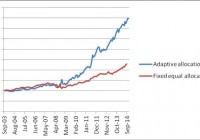
Summary The performance of adaptive asset allocation is sensitive to the day of the month when transactions are executed. The performance is better if the trades are executed around the end/beginning of the month than close to the middle of the month. The day of month effect is consistent for ETFs and related mutual funds. We obtained similar effects on (SPY, TLT), (VTI, AGG), (FSTMX, FTBFX), and (VTSMX, VBMFX) pairs. In a couple of recent articles , we demonstrated that a very simple and well-diversified portfolio may be made up of two instruments, one representing the total stock market and the other the total bond market. These portfolios are quite robust and achieve decent returns using simple strategies such as rebalancing and momentum-based adaptive allocation. At the suggestion of some readers, we investigate the effect of the day of month on the performance of the momentum-based adaptive asset allocation strategy. From many possibilities, I selected the following four portfolios: one built with SPY and TLT, the second with iShares and Vanguard ETFs, the third with Vanguard mutual funds, and the fourth with Fidelity mutual funds. ETFs portfolio: iShares 20+ Year Treasury Bond ETF (NYSEARCA: TLT ) and SPDR S&P 500 Trust ETF (NYSEARCA: SPY ). ETFs portfolio: iShares Core Total US Bond Market ETF (NYSEARCA: AGG ) and Vanguard Total Stock Market ETF (NYSEARCA: VTI ). Mutual funds portfolio: Vanguard Total Bond Market Index Fund (MUTF: VBMFX ) and Vanguard Total Stock Market Index Fund (MUTF: VTSMX ). Mutual funds portfolio: Fidelity Total Bond Market Index Fund (MUTF: FTBFX ) and Fidelity Spartan Total Stock Market Index Fund (MUTF: FSTMX ). For purposes of comparison, we simulate these portfolios from December 2003 to December 2014, a total of eleven years. The time period of the study was selected based on the availability of historical data of the investment instruments; AGG was created in September 2003. The data for the study were downloaded from Yahoo Finance on the Historical Prices menu for the eight tickers, SPY, TLT, AGG, VTI , VBMFX , VTSTX , FTBFX and FSTMX. We use the monthly price data from September 2003 to December 2014, adjusted for stock splits and dividend payments. The article has two parts. In the first part, we present general results for the four portfolios. The second part presents the effect of varying the day of the month when the trading is done. Part I. General Results The first study was done on the SPY + TLT. In it, we compare the results obtained with the following two strategies: (1) A portfolio with 50% SPY and 50% TLT without rebalancing. This portfolio is called “fixed allocation”. (2) A portfolio that is, at all times, invested 100% in either SPY or TLT. The switching, if necessary, is done monthly at the closing of the last trading day of the month. All the funds are invested in the instrument with the highest return over the previous 3 months. This portfolio is called “adaptive allocation”. The data below shows the investment results over 11 years (132 months). The first line is a buy-and-hold on SPY, the second is a buy-and-hold on TLT, the third is buy-and-hold of an initial investment of 50% in SPY and 50% in TLT, while the fourth line is adaptive allocation on SPY and TLT based on a look back of 3 months. Table 1. SPY + TLT portfolios January 2004-December 2014 Total Return% CAGR% Max DD% SPY 130.4 7.88 -50.79 TLT 126.6 7.72 -21.81 Fixed Allocation 128.5 7.76 -18.68 Adaptive Allocation 347.0 14.58 -17.13 The equity curves for the fixed and adaptive allocation of the SPY + TLT portfolios are shown in Figure 1. (click to enlarge) Figure 1. Equities of SPY + TLT portfolios Source: This chart is based on EXCEL calculations using the adjusted monthly closing share prices of securities. The second study compares the four pairs using the momentum-based adaptive allocation. The trading is done at the month’s closing prices. The results are given in Table 2. Table 2. Adaptive allocation of four portfolios January 2004-December 2014 Total Return% CAGR% Max DD% SPY + TLT 347.0 14.58 -17.13 VTI + AGG 241.6 11.82 -13.03 VTSMX + VBMFX 243.4 11.87 -13.81 FSTMX + FTBFX 214.8 10.99 -20.29 The equity curves for the three portfolios with adaptive allocation are shown in Figure 2. The Vanguard mutual fund was omitted because it virtually overlaps with the Vanguard ETF portfolio. (click to enlarge) Figure 2. Equities of portfolios with adaptive allocation Source: This chart is based on EXCEL calculations using the adjusted monthly closing share prices of securities. Part II. Day of Month Trading Results The study was done using the daily historical prices of the eight instruments. Because the results were very similar for the four pairs, we report mostly the results for the SPY + TLT pair only. The switching between bond and stock funds was done, if necessary, on the same day of the month. The look back period was three months, comparing prices on the same day of the month, but for three months apart. The day of the month is indicated by a variable called “shift”. Shift takes values between -16 and 6. Here shift=6 means the 6th trading day of the month, shift=0 means the last trading day of the month, shift=-1 means the trading day before the last trading day, etc. The equity curves for the SPY + TLT portfolio for three different trading days and with adaptive allocation are shown in Figure 3. As can be seen, the trading day of the month has a significant effect on the results. Trading on the last day of the month is better than trading on the 6th day of the month, but a little worse than trading seven days before the end of the month. These results are related to the specific historical data and cannot be generalized. (click to enlarge) Figure 3. Equities of the SPY + TLT portfolios with adaptive allocation Source: This chart is based on EXCEL calculations using the adjusted daily closing share prices of securities. To illustrate better the variability of the performance of adaptive allocation with the trading day of the month, we show the scatter plots of CAGR and DD versus the shift values from -16 to 6. (click to enlarge) Figure 4. CAGR% of the SPY + TLT portfolios with adaptive allocation Source: This chart is based on EXCEL calculations using the adjusted daily closing share prices of securities. As can be seen in Figure 4, CAGR varies very little for shift values from -5 to 5, but decreases substantially for shift values outside this range. (click to enlarge) Figure 5. DD% of the SPY + TLT portfolios with adaptive allocation Source: This chart is based on EXCEL calculations using the adjusted daily closing share prices of securities. As can be seen in Figure 5, DD varies very little for shift values from -16 to 4, but increases somewhat for shift=6. Conclusions The day of the month when the trading is done affects the performance obtained applying the adaptive asset allocation strategy. The performance is better if the trades are executed around the end/beginning of the month, than close to the middle of the month. The day of month effect is consistent for ETFs and related mutual funds. It may be useful to extend this study to various portfolios with instruments from other asset classes.

Arctic Cold Brought Up UNG – For A Short Time

Summary Colder-than-normal weather brought up the price of UNG. EIA still estimates this year’s natural gas price to remain lower than last year’s. This week’s extraction from storage is estimated to be higher than the 5-year average. The recent news of possible Arctic weather in the coming week pushed up back up the price of United States Natural Gas (NYSEARCA: UNG ) to pass $16 at one point. Since then, however, its price resumed its descent. The price of UNG ended last week at $15.69 – representing a 4.6% gain, week over week. Despite the recent rally in UNG, it’s still 16% down in the past month. The cold snap drove up the U.S. consumption by nearly 7%, week over week. Most of this gain was in the residential/commercial sectors. Despite the low prices of natural gas, the U.S. natural gas output is still up by roughly 10% for the year. If prices were to remain low, however, this could eventually curb down the growth rate in the natural gas output in the coming quarters. But the main issue revolves around the potential changes in the demand for natural gas mainly in the residential/commercial sectors. Over the next couple of weeks, the temperatures mainly in the Northeast and Midwest are projected to be lower than normal. In the west coast temperatures are expected to be higher than normal. Conversely, this week, the current outlook for the heating degrees days shows lower than normal levels. Nonetheless, it seems that the low temperatures are likely to keep driving up the demand for natural gas for heating purposes. Let’s turn to the latest from the natural gas storage. Last week’s Energy Information Administration update showed a 236 Bcf extraction from storage – this was 46 Bcf higher than the 5-year average. But it was also 51 Bcf below last year’s extraction. Source: EIA This week’s extraction from storage is likely to be, again, higher than the 5-year average. Keep in mind, last week’s deviation from normal temperatures was, on average, -4.29. The lower-than-normal temperatures may result in higher than normal withdrawal. Even though the changes in storage provide an indication for the changes in the demand and supply for natural gas on a weekly scale, as I pointed out in the past, the relation between the prices changes in UNG and shifts in storage tend to have a low correlation. This is mostly on a week-to-week examination. On broader scale, however, lower extractions from storage tend to keep UNG down and vice versa. Looking forward, if the extractions from storage were to remain roughly 10% lower than the 5-year average, this could bring the natural gas storage in line with the 5-year average by the time the injection season commences. This is shown in the chart below. Source: EIA The EIA also estimates that the natural gas inventories will be roughly in line with the 5-year average by the end of March 2015. On a yearly scale, the EIA still expects natural gas prices to remain low in 2015 – the annual average price is estimated at $3.44; this is roughly 22% lower than the average yearly price in 2014. The uncertainty in the weather forecasts in the next couple of weeks could lead to big swings in the price of UNG – as was the case in recent weeks. Nonetheless, if temperatures don’t fall below current estimates, this could result in UNG resuming its descent. For more see: Has the Weakness in Oil Fueled the Decline of UNG?