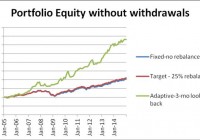
Summary American Century offers a set of diversified mutual funds which can be successfully used for construction of investment portfolios with good withdrawal rates. A set of just three mutual funds, a bond, an equity growth, plus an equity value fund generates good returns with relatively low risk. From January 2005 to December 2014, an American Century portfolio with fixed allocation could produce a safe 5% annual withdrawal rate and 2.15% annual increase of the capital. Same portfolio with rebalancing at 25% deviation from the target allowed a safe 5% annual withdrawal rate and achieved 2.21% compound annual increase of the capital. Same portfolio with momentum-based adaptive allocation could have produced a safe 12% annual withdrawal rate and 3.51% annual increase of the capital. This article belongs to a series of articles dedicated for investing in various mutual fund families. In previous articles we reported our research on Fidelity , Vanguard , and T Rowe Price mutual fund families. The current article does the same for American Century family of mutual funds. The series of these articles is aimed at a broad spectrum of investors. They may be useful to small individual investors as well as to any large institution managing retirement accounts. We report the performance of the portfolios under two scenarios: (1) no withdrawals are made during the time interval of the study, and (2) withdrawals at a fixed rate of the initial investment are made periodically. Since this is the fourth family of mutual funds for which we are building an investment portfolio for retirement, we elaborate here upon the general methodology we use. The set of funds selected for building the portfolio should satisfy the following criteria: (1) It should include at least one bond fund. (2) It should include a few equity funds, generally between two to five. Those funds should have enough similarity and diversity. As an example, we may select one value and one growth fund. (3) Historically, the funds selected should have performed better than most other funds in their category. Applying these principles, we selected three mutual funds for inclusion in a portfolio of American Century mutual funds. They are the following: American Century Government bond fund (MUTF: CPTNX ) American Century Heritage fund (MUTF: TWHIX ) American Century Value fund (MUTF: TWVLX ) As in the previous articles, three different strategies are considered: (1) Fixed asset allocation. The portfolio is initially invested 50% in the bond fund and 50% equally divided between the two stock funds, without rebalancing. (2) Target asset allocation with rebalancing. The portfolio is initially invested 50% in the bond fund and 50% equally divided between the two stock funds and is rebalanced when the allocation to any fund deviates by 25% from its target. (3) Momentum-based adaptive asset allocation. The portfolio is at all times invested 100% in only one fund. The switching, if necessary, is done monthly at closing of the last trading day of the month. All money is invested in the fund with the highest return over the previous 3 months. The data for the study were downloaded from Yahoo Finance on the Historical Prices menu for three tickers: CPTNX, TWHIX, and TWVLX. We use the monthly price data from January 2005 to December 2014, adjusted for dividend payments. The paper is made up of two parts. In part I, we examine the performance of portfolios without any income withdrawal. In part II, we examine the performance of portfolios when income is extracted periodically from the accounts. Part I: Portfolios without withdrawals In table 1 we show the results of the portfolios managed for 10 years, from January 2005 to December 2014. Table 1. Portfolios without withdrawals 2005 – 2014. Strategy Total increase% CAGR% Number trades MaxDD% Fixed-no rebalance 103.55 7.30 0 -24.61 Target-25% rebalance 109.82 7.63 4 -22.03 Momentum-Adaptive 330.90 15.73 35 -13.97 The time evolution of the equity in the portfolios is shown in Figure 1. (click to enlarge) Figure 1. Equities of portfolios without withdrawals. Source: This chart is based on EXCEL calculations using the adjusted monthly closing share prices of securities. From figure 1 it is apparent that the rate of increase of the adaptive portfolio is substantially greater than the rate of the fixed and target allocation portfolios. Part II: Portfolios with withdrawals Assume that we invest $1,000,000 for income in retirement. We plan to withdraw monthly a fixed percentage of the initial investment. That amount is increased by 2% annually in order to account for inflation. In table 2 we show the results of the portfolios managed for 10 years, from January 2005 to December 2014. Money was withdrawn monthly at a 5% annual rate of the initial investment plus a 2% inflation adjustment. Over the 10 years from January 2005 to December 2014, a total of $535,920 was withdrawn. Table 2. Portfolios with 5% annual withdrawal rate 2005 – 2014. Strategy Total increase% CAGR% Number trades MaxDD% Fixed-no rebalance 24.03 2.15 0 -28.78 Target-25% rebalance 22.68 2.21 4 -27.04 Momentum-Adaptive 210.05 11.98 35 -16.41 The time evolution of the equity in the portfolios is shown in Figure 2. (click to enlarge) Figure 2. Equities of portfolios with 5% annual withdrawal rates. Source: This chart is based on EXCEL calculations using the adjusted monthly closing share prices of securities. To illustrate the effect of the withdrawal rates on the evolution of the capital we report simulation results for two strategies: fixed target with rebalancing and momentum-based adaptive asset allocation. In Table 3 we report the results of simulations of the fixed target portfolio with the following withdrawal rates: 0%, 5%, 6%, 8%, and 10%. The time evolution of the equity in the portfolios is shown in Figure 3. To illustrate the advantage of the adaptive allocation strategy and the effect of withdrawal rates on the evolution of the capital, we give in Table 3 the results of simulations for the following withdrawal rates: 0%, 5%, 10%, and 12%. Table 3. Adaptive Portfolios with various annual withdrawal rates 2005 – 2014. Withdrawal rate % Total increase% CAGR% MaxDD% 0 330.90 15.73 -13.97 5 210.05 11.98 -16.41 10 89.54 6.60 -20.24 12 41.20 3.51 -22.23 The time evolution of the equity in the portfolios is shown in Figure 3. (click to enlarge) Figure 3. Equities of momentum-based portfolios with various annual withdrawal rates. Source: This chart is based on EXCEL calculations using the adjusted monthly closing share prices of securities. Conclusion The set of three American Century mutual funds, selected for this study, perform well for all three strategies and generate sustainable returns at relatively low drawdowns. Between 2005 and 2015, the fixed target allocation with rebalancing was able to sustain withdrawal rates of up to 6% annually. The adaptive allocation algorithm was able to sustain withdrawal rates up to 13% annually without any decrease of capital. We must admit here that the performance of the portfolio selected in this article is by no means the best possible. Without doubt, there may be other selections that would have performed better. On the other hand, past performance does not guarantee future results. Finding the best portfolio even for a specified past time interval is a great undertaking. All we can do is to strive toward finding one of the best, not really the best. Same philosophy applies into selecting the family of funds. In an article at the end of the series we will present a comparative study of their relative performance. Disclosure: The author has no positions in any stocks mentioned, and no plans to initiate any positions within the next 72 hours. (More…) The author wrote this article themselves, and it expresses their own opinions. The author is not receiving compensation for it (other than from Seeking Alpha). The author has no business relationship with any company whose stock is mentioned in this article. Additional disclosure: This article is the fourth in a sequence on investing in mutual funds for retirement accounts. To help the reader compare the past performance of various mutual fund families, I selected a benchmark 10-year time interval starting on 1 January 2005 and ending on 31 December 2014. The article was written for educational purposes and should not be considered as specific investment advice.