Tag Archives: seeking-alpha

Are You Playing The Stock Market’s Favourite Game?

One of the most popular questions that a business channel anchor or an analyst asks a company’s management is – “What’s your EPS estimate for the next quarter and year?” For those who are not aware, EPS is the short form of ‘earnings per share’ and is calculated by dividing a company’s earnings/profits by its total number of shares. During my initial days as a stock market analyst, even I was guilty of asking similar questions about earnings, though all I wanted to hear from the managements was their long-term outlook (like for 3-5 years) and not for the next quarter or year. The truth is that the entire investment community is undeniably fixated on the EPS. All business newspapers, magazines, channels, and experts freely talk about quarterly earnings, EPS growth, and price to earnings multiples. The interesting part is that the stock market also reacts to the earnings numbers. Anyways, people’s fascination with earnings estimates is not terribly puzzling. In fact, it is perfectly rational in a market dominated by agents responsible for other people’s money but also looking out for their own interests. But what such obsession with earnings does is that it leads investors to believe that this one number strongly influences, if not totally determines, stock prices. This is despite the fact that EPS is not the most appropriate number to use for valuing a company. There are several shortcomings of earnings, like: Earnings do not show whether the company is utilizing its capital profitably or not. Earnings exclude the incremental investments that a company makes in its working capital and fixed capital that are so important to support its growth. Different companies can use different accounting principles to calculate earnings, so a comparison cannot be drawn between two companies. It is easy for companies to manipulate earnings by either inflating revenues or deflating expenses. However, notwithstanding these shortcomings of earnings, most experts love playing the earnings expectations game. The fact is that it’s just the wrong expectations game to play. A Game of ‘Winks and Nods’ It is hoped that the case for the unreliable link between short-term earnings and shareholder value is sufficient to discourage investors from participating in the popular earnings expectations game. This is simply because it is the wrong expectations game for investors who seek superior long-term returns. This is true not only because of the shortcomings of earnings but because of the way the game is played. The earnings expectations game is simply a ritual dance between management and analysts. In fact, the former chief of the US stock market regulator Securities and Exchange Commission (SEC), Arthur Levitt, called it a ‘game of winks and nods’. In Expectations Investing , the authors Michael Mauboussin and Alfred Rappaport write: Analysts have to guess how much a company will earn each quarter. But a company is allowed to provide the analysts with clues, or so-called guidance, about what it thinks earnings will be. This guidance number usually shows up as the consensus estimate among analysts. If the company’s actual earnings meet or just beat the consensus, both the company and the analysts win: the stock goes up, and everyone looks smart. The game might not sound so hard, but it requires a lot of cooperation. Companies are under enormous pressure to achieve the consensus earnings estimates while analysts rely on those same companies to help them form their earnings expectations in the first place. You might wonder how companies participate in this game. Well, companies generally have two ways to play it out. One, to manage the expectations of investors and stock market, companies guide analysts to a number that they can beat. And two, in order to beat expectations easily, they are very conservative with respect to their near-term prospects. In simple terms, a company would feed the analysts by telling them that it expects to earn Rs 100 (USD 1.61) as EPS or earnings per share in the next quarter. Analysts would take this number, do some calculation around it, and arrive at their own expectation of an EPS number that is somewhat close to Rs 100 (USD 1.61). They would then feed the market and investors on this expected EPS number, say Rs 95 (USD 1.53) per share. The market and investors would then start to believe this number. Then, when the quarter ends and the company releases its earnings report, it would say that its EPS during the quarter stood at Rs 100 (USD 1.61) per share. Remember, this was the same number the company had revealed to analysts earlier, which the analysts had chewed to spit out the Rs 95 (USD 1.53) per share number to investors. Now, since the company has announced Rs 100 (USD 1.61) EPS against the market’s ‘expectations’ of Rs 95 (USD 1.53), the analysts call it an ‘outperformance’. The ultimate result is that investors also start to take this as an outperformance and are willing to pay a higher price for the stock. The stock rises. You got the game, didn’t you? Anyways, there might be a case when this company faces a situation where investors are expecting a higher EPS (say Rs 110 or USD 1.77), and it finds it difficult to earn that much during the quarter. What it can do in such an instance is simply use some accounting tricks to achieve that magical EPS number of Rs 110 (USD 1.77), and thus ‘meet expectations’. Now the question is – how involved and interested are managements in this earnings expectations game? Well, here is a Harvard Business Review report that throws light on this… Privately, corporate chief financial officers admit that they would like to spend less time and effort satisfying Wall Street’s demands for continuous, predictable growth. But they feel they don’t have much choice, because the cost of disappointing the Street is so high. You see, the quarterly earnings management has become a sort of talisman for companies and for those who analyze them, invest in them, or audit them. However, the fact remains that this game causes more harm than amusement. When managers are focused on meeting or beating short-term earnings expectations, it distorts their decision making. A large part of the management’s attention is focused on keeping the analysts and markets happy. What is more, a lot of companies willingly borrow profits from the future to make things look good in the present (how they do this is a subject of another discussion). This entire scheme also reduces stock analysis and investing to a guessing contest. A large part of a stock analyst’s job is just to keep figuring out what the sales, or expenses, or simply profits are going to be in the next 1-2 quarters. Ultimately, it undermines the faith that most investors have on the stock market because, every quarter, they are served some fiction, and become part of the cynicism that surrounds the meeting or beating of expectations. Play it Safe! Just notice the next time companies announce their quarterly results. You will find most of them either meeting expectations or beating expectations! But, now you know how this entire game of ‘earnings expectations’ is fixed. What you can do to safeguard yourself against the fixers is to separate companies that are genuinely working towards better long-term performance from those that skillfully manage short-term expectations and earnings. And how do you do that? Just stick with companies having good businesses , safe balance sheets, and clean managements at helm. Always remember, there’s a great appeal in the word ‘earnings’. So, you have to be very very careful and not fall into the earnings expectations trap. In fact, here’s a new definition of EPS that you can start using from today. It’s Expectations Per Share …and the wrong kind of expectations!
‘The Wisdom Of Insecurity’ In The Stock Market

Over the past few years, the idea of “passive investing” has increasingly resonated with the general public. Money has rushed out of actively-managed mutual funds and into index funds at a rapid rate. Most recently, the passive investing ethos has grown so strong it now reminds me of some hard-core religions that take an unwaveringly literal interpretation of their founding texts. In the case of passive investing, these founding texts are the “efficient-market hypothesis” (EMH) and “modern portfolio theory” (MPT). Created and developed by ingenious men with noble intentions, these theories put forth wonderful arguments for the wisdom of the crowd and the incredible value of diversification, among others. Like most religious texts, however, the main problems arise in their interpretation and implementation. As Alan W. Watts explains in The Wisdom Of Insecurity , “the common error of ordinary religious practice is to mistake the symbol for reality, to look at the finger pointing the way and then to suck it for comfort rather than follow it.” Investors, too, must think critically about the effectiveness of these theories when it comes to practical application rather than take them literally on blind faith. It pays to remember that blind faith in these sorts of mathematical models leads even nobel prize winners to disastrous results. As my friend Todd Harrison likes to say, ” respect the price action but never defer to it .” Clearly, there is value in understanding and incorporating the ideals of these theories. There is also danger in simply deferring to them because the costs of their shortcomings can, at times, overwhelm the benefits of their wisdom. Like the Long-Term Capital boys learned, as soon as you really need to lean on them they vanish like a cheap magic trick. Where these theories go wrong in their practical application is that they both assume there are only rational participants in the markets. While the crowd may be right most of the time, there are clearly times when the crowd is not rational (note the preponderance of manias throughout the history of finance). In fact, the proprietors of these models have acknowledged this Achilles’ heel themselves. The most successful professional investors like Warren Buffett, Paul Tudor Jones, John Templeton, George Soros and Jim Rogers, know this well. Their methodologies are even built upon the idea that an intelligent investor can get ahead by taking advantage of those times the crowd becomes irrational, the antithesis of the EMH and MPT. So saying you believe in passive investing is fine and, in fact, I’ll grant it’s better than most of the alternatives. It will work great most of the time. But know that, just like some fanatics deny evidence that disproves the idea that cavemen and dinosaurs coexisted, you are denying the overwhelming evidence that suggests its foundations are simply not to be relied upon during those rare times when market participants abandon rational thought for panic or euphoria. Make no mistake, those selling this idea of passive investing are selling a very good product. I firmly believe it’s a large step above most of the alternatives out there, more so in the case of those selling it at a minimal cost . But I fear investors are also being sold a false sense of security today. I believe investors passively buying equities today are doing so under one of two false assumptions. They either believe that future returns will look something like they have over the past 40 years or that because the market is totally efficient it’s currently priced to deliver risk-adjusted returns that are acceptable given the current low-yield environment. The first assumption is something I have called the ” single greatest mistake investors make ” and it’s a trap even the Federal Reserve admits it regularly falls into. The second assumption runs into the problem of the evidence which suggests there is a very good likelihood returns from current prices will be sub-par , if not sub-zero over the next decade. And the reason returns are likely to be poor going forward is investors have pushed prices to levels that nearly guarantee it. In my view, passive investors have irrationally relied upon the idea that the market is rational, and therefore attractively priced, in pouring money into equity index funds, sending equity values to heights never before seen (on median valuations) virtually guaranteeing themselves they’ll be disappointed. Just because the future of the stock market is bleak doesn’t mean investors should ignore these facts or have them withheld from them. Ignorance may be bliss but it is not a valid investment methodology. Those with a religious sort of belief in passive investing and its main tenets need not abandon it to acknowledge its limitations. In fact, a little insecurity would go a long way for the growing hoard of passive investors in today’s market.

3-Year Trailing Returns: Momentum And Mean Reversion In Developed Markets

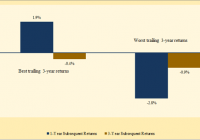
By Baijnath Ramraika, CFA Ben Inker, in GMO’s 4Q 2014 quarterly letter , suggests that there is significant valuation disparity among developed markets with U.S. markets getting a much higher valuation in relation to others. He suggests that given this disparity, it makes more sense to invest in the bad and ugly countries as against the good-looking U.S. In that same letter, Ben shows that it is better to be a contrarian. As evidence, he shows that those developed markets which had the strongest relative performance over the past three years, tend to underperform over the next one- and three-year periods. On the other hand, the worst performing developed markets over the past three years, tend to outperform over the next one- and three-year periods. Wanting to verify, I setup a similar process based on the all-stock developed market indexes that I discussed in one of my earlier articles . The objective was to check the relative investment performance of investing in strongest versus weakest performing developed markets over the past three years. To achieve this, I used country indexes calculated in dollar terms. At the end of every year, I calculated the annualized trailing 3-year return for every country. This return was compared to the average return of all developed market countries to derive relative out(under)performance. Each country was then ranked based on its trailing 3-year relative performance with five best and worst performing countries chosen for further analysis. Figure 1 shows the average 1-year and 3-year subsequent annualized excess returns for the best and worst five countries. It is important to note that the time frame of this study is 1995 to 2014. With three years of past performance as the selection criteria, the study begins at end of the year 1997. Figure 1 (click to enlarge) Trailing 3-year performance as a predictor for forward returns Clearly, my numbers are not in sync with what Ben Inker found in his analysis. There are several possible reasons for this difference. For one, the time period of my study may be different than the time period used by Ben. Secondly, while my study utilizes all stock indices, it is possible that indices used by Ben are somewhat narrower in representation. Keeping the different result aside, what Figure 1 suggests is that there is some momentum persistence, at least in the near term. The best performing five countries continued to outperform over the next year while the worst performing five countries continued to underperform over the next year. However, as is evident by the difference between 1-year and 3-year subsequent annualized returns, there seems to be some mean reversion taking place in year 2 and 3. Figure 2 shows this mean reversion. Figure 2 (click to enlarge) Mean reversion takes hold in the second and third year As is seen, countries with the best 3-year trailing performance experience negative relative performance in the second and the third year, i.e., momentum persists over the one-year period with mean reversion taking over after that. In summary, both momentum and mean reversion have an effect on subsequent investment returns. However, their effects are felt in different time frames.