Tag Archives: seeking-alpha

Oil ETFs Slide Again: More Pain In Store?

After smooth trading in May and June, oil resumed its decline and trapped in the nastiest downward spiral in July joining the broader selloff in commodities amid the growing global glut and the China slowdown. In fact, U.S. crude oil lost nearly 21% in July, which was the worst month since October 2008. The rout worsened in the first session of August with crude plunging as much as 5% on Monday to around $45.17 per barrel. On the other hand, Brent oil dropped to below $50 per barrel for the first time since January. Inside the Recent Slump The brutal trading on Monday can be attributed to the increase in the number of rig counts, weak China manufacturing data, and downbeat U.S. economic data on manufacturing and construction spending that suggests tepid oil demand growth around the world. China manufacturing activity unexpectedly fell to a two-year low in July, adding to worries on the world’s second-largest economy. Meanwhile, U.S. manufacturing also slipped in July and consumer spending advanced at its slowest pace in four months in June, indicating that the world’s largest economy is losing momentum yet again. Coming to the supply side, the Organization of Petroleum Exporting Countries (OPEC) is pumping up maximum oil in the recent past buoyed up by higher output from Iraq and Saudi Arabia. It is currently producing about 32 million barrels a day against its target of 30 million barrels a day. Additionally, Iran, the world’s fourth-largest reserve holder with 158 billion barrels of crude oil, is gearing up to boost its production immediately after sanctions are lifted, which is expected in late November. As per Iran’s oil minister, Bijan Namdar Zanganeh, production will likely increase by 500,000 barrels a day within a week after relaxation in sanctions and by 1 million barrels a day within a month. Further, oil production in the U.S. has been on the rise and is hovering around its record level. ETF Impact Terrible trading has been felt in the ETF world as well, sending oil ETFs tracking the futures contract in deep red from a one-month look. In particular, the iPath S&P GSCI Crude Oil Index ETN (NYSEARCA: OIL ) stole the show tumbling 19.6%, followed by over 17% declines in the United States Oil Fund (NYSEARCA: USO ) ), the iPath Pure Beta Crude Oil ETN (NYSEARCA: OLEM ) and the United States Brent Oil Fund (NYSEARCA: BNO ) . Two of the most popular leveraged oil ETFs – the ProShares Ultra Bloomberg Crude Oil ETF (NYSEARCA: UCO ) and the VelocityShares 3x Long Crude Oil ETN (NYSEARCA: UWTI ) – dropped 46.4% and 33%, respectively, in the same time frame. The former provides twice the return of the daily performance of the Bloomberg WTI Crude Oil Subindex while the latter delivers thrice the returns of the S&P GSCI Crude Oil Index Excess Return. Both indices consist of WTI crude oil futures contracts. What Lies Ahead? With deteriorating demand/supply dynamics, the prospect of an oil price rebound in the second half looks faded. In fact, there is a clear sign that oil price might revisit its previous low of the year, pushing the oil ETFs further down. This is especially true as speculators betting on rising oil prices have fallen sharply in recent weeks. Hedge funds reduced their net-long position in WTI to the lowest level in five years for the week ended July 28, according to the U.S. Commodity Futures Trading Commission data. Further, money managers also cut their bullish bets on Brent by 37,527 contracts for the same week, representing the biggest decline since July 2014, as per data from the ICE Futures Europe exchange. That being said, inverse ETFs have been on the tear over the past one month with the VelocityShares 3x Inverse Crude ETN (NYSEARCA: DWTI ) , the ProShares UltraShort Bloomberg Crude Oil ETF (NYSEARCA: SCO ) and the PowerShares DB Crude Oil Double Short ETN (NYSEARCA: DTO ) gaining 68.4%, 42.2% and 30.9%, respectively. As a result, investors bearish on oil could make a short-term play on these ETFs for big gains in a short span, especially if the “trend remains a friend” in this corner of the investing world. Link to the original article on Zacks.com
Best And Worst Q3’15: Information Technology ETFs, Mutual Funds And Key Holdings

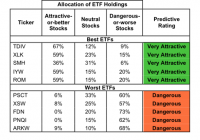
Summary Information Technology sector ranks second in Q3’15. Based on an aggregation of ratings of 28 ETFs and 129 mutual funds. TDIV is our top-rated Information Technology ETF and ROGSX is our top-rated Information Technology mutual fund. The Information Technology sector ranks second out of the 10 sectors as detailed in our Q3’15 Sector Ratings for ETFs and Mutual Funds report. It gets our Neutral rating, which is based on an aggregation of ratings of 28 ETFs and 129 mutual funds in the Information Technology sector as of July 9, 2015. See a recap of our Q2’15 Sector Ratings here . Figures 1 and 2 show the five best and worst-rated ETFs and mutual funds in the sector. Not all Information Technology sector ETFs and mutual funds are created the same. The number of holdings varies widely (from 23 to 397). This variation creates drastically different investment implications and, therefore, ratings. Investors seeking exposure to the Information Technology sector should buy one of the Attractive-or-better rated ETFs or mutual funds from Figures 1 and 2. Figure 1: ETFs with the Best & Worst Ratings – Top 5 (click to enlarge) * Best ETFs exclude ETFs with TNAs less than $100 million for inadequate liquidity. Sources: New Constructs, LLC and company filings Figure 2: Mutual Funds with the Best & Worst Ratings – Top 5 (click to enlarge) * Best mutual funds exclude funds with TNAs less than $100 million for inadequate liquidity. Sources: New Constructs, LLC and company filings The First Trust NASDAQ Technology Dividend Index ETF (NASDAQ: TDIV ) is the top-rated Information Technology ETF and the Red Oak Technology Select Fund (MUTF: ROGSX ) is the top-rated Information Technology mutual fund. Both earn a Very Attractive rating. The ARK Web x.0 ETF (NYSEARCA: ARKW ) is the worst-rated Information Technology ETF and The Rydex Internet Fund (MUTF: RYINX ) is the worst-rated Information Technology mutual fund. ARKW earns a Dangerous rating and RYINX earns a Very Dangerous rating. 527 stocks of the 3000+ we cover are classified as Information Technology stocks. Cisco Systems, Inc. (NASDAQ: CSCO ), a previous Stock Pick of the Week, is one of our favorite stocks held by TDIV and earns our Very Attractive rating. Since 2005, Cisco has grown after-tax profit ( NOPAT ) by 6% compounded annually. Cisco earns a top-quintile return on invested capital ( ROIC ) of 16% and has steadily become a free cash flow machine, generating $9.5 billion on a trailing-twelve month (TTM) basis. Fears of Cisco’s demise in a new age of technology have long kept the stock undervalued. At its current price of ~$28/share, Cisco has a price to economic book value ( PEBV ) of 0.9. This ratio implies the market expects Cisco’s profits to permanently decline by 10%. However, if Cisco can grow NOPAT by 5% compounded annually over the next decade , the stock is worth $36/share – a 28% upside. Proofpoint Inc. (NASDAQ: PFPT ) is one of our least favorite stocks held by ARKW and earns our Dangerous rating. Proofpoint is similar to many of our recent Danger Zone picks in that it touts high revenue growth but negative profits. From 2012-2014, Proofpoint grew revenue by 23% compounded annually. On the other hand, NOPAT declined from -$19 million to -$47 million. On a TTM basis, which includes 1Q15 results, NOPAT has fallen to -$52 million. Proofpoint’s pre-tax (NOPBT) margins are -26% and the company currently earns a bottom-quintile ROIC of -53%. The stock price has benefited from the hype surrounding cyber security companies and is now significantly overvalued. To justify its current price of $63/share, Proofpoint must immediately achieve 6% NOPBT margins (similar to peer Fortinet (NASDAQ: FTNT )) and grow revenues by 30% compounded annually for the next 16 years . If you want to be in a stock that benefits from the growth in cyber security, we recommend this recent stock pick of the week. Figures 3 and 4 show the rating landscape of all Information Technology ETFs and mutual funds. Figure 3: Separating the Best ETFs From the Worst ETFs (click to enlarge) Sources: New Constructs, LLC and company filings Figure 4: Separating the Best Mutual Funds From the Worst Mutual Funds (click to enlarge) Sources: New Constructs, LLC and company filings D isclosure: David Trainer and Max Lee receive no compensation to write about any specific stock, sector or theme. Disclosure: I/we have no positions in any stocks mentioned, and no plans to initiate any positions within the next 72 hours. (More…) I wrote this article myself, and it expresses my own opinions. I am not receiving compensation for it. I have no business relationship with any company whose stock is mentioned in this article.