Tag Archives: seeking-alpha

Best And Worst Q3’15: Telecom Services ETFs, Mutual Funds And Key Holdings
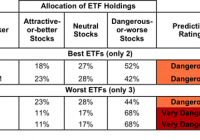
Summary Telecom Services sector ranks seventh in Q3’15. Based on an aggregation of ratings of six ETFs and 12 mutual funds. PBS is our top-rated Telecom Services ETF and FWRLX is our top-rated Telecom Services mutual fund. The Telecom Services sector ranks seventh out of the 10 sectors as detailed in our Q3’15 Sector Ratings for ETFs and Mutual Funds report. It gets our Dangerous rating, which is based on an aggregation of ratings of six ETFs and 12 mutual funds in the Telecom Services sector. See a recap of our Q2’15 Sector Ratings here. Figure 1 ranks all five ETFs and Figure 2 ranks the five best and worst mutual funds in the sector that meet our liquidity standards. Note that even the best Telecom Services ETFs fail to earn an Attractive-or-better rating. Not all Telecom Services sector ETFs and mutual funds are created the same. The number of holdings varies widely (from 23 to 55). This variation creates drastically different investment implications and, therefore, ratings. Investors should not buy any Telecom Services ETFs or mutual funds because none get an Attractive-or-better rating. If you must have exposure to this sector, you should buy a basket of Attractive-or-better rated stocks and avoid paying undeserved fund fees. Active management has a long history of not paying off. Figure 1: ETFs with the Best & Worst Ratings – Top 5 (click to enlarge) * Best ETFs exclude ETFs with TNAs less than $100 million for inadequate liquidity. Sources: New Constructs, LLC and company filings The SPDR S&P Telecom ETF (NYSEARCA: XTL ) is excluded from Figure 1 because its total net assets are below $100 million and do not meet our liquidity minimums. Figure 2: Mutual Funds with the Best & Worst Ratings – Top 5 (click to enlarge) * Best mutual funds exclude funds with TNAs less than $100 million for inadequate liquidity. Sources: New Constructs, LLC and company filings The Rydex Series Telecommunications Fund (MUTF: RYMIX ) (MUTF: RYMAX ) (MUTF: RYCSX ) is excluded from Figure 2 because its total net assets are below $100 million and do not meet our liquidity minimums. The PowerShares Dynamic Media Portfolio ETF (NYSEARCA: PBS ) is the top-rated Telecom Services ETF and the Fidelity Select Wireless Portfolio (MUTF: FWRLX ) is the top-rated Telecom Services mutual fund. PBS earns a Dangerous rating and FWRLX earns a Neutral rating. The ProShares Ultra Telecommunications ETF (NYSEARCA: LTL ) is the worst-rated Telecom Services ETF and the Rydex Telecommunications Fund (MUTF: RYTLX ) is the worst-rated Telecom Services mutual fund. Both earn a Very Dangerous rating. 43 stocks of the 3000+ we cover are classified as Telecom Services stocks, but due to style drift, Telecom Services ETFs and mutual funds hold 55 stocks. Inteliquent Inc. (NASDAQ: IQNT ), on the Most Attractive Stocks List in July , is one of our favorite stocks held by Telecom Services ETFs and mutual funds and earns our Very Attractive rating. Since 2007, Inteliquent has grown after-tax profit ( NOPAT ) by 24% compounded annually. In addition to strong profit growth, the company improved its return on invested capital ( ROIC ) to 28% from 11% in 2012. Despite the strong underlying business performance, IQNT remains undervalued. At its current price of $18/share, Inteliquent has a price to economic book value ( PEBV ) ratio of 1.1. This ratio implies that the market expects NOPAT to grow by 10% from its current level. If Inteliquent can grow NOPAT by 7% compounded annually for the next decade, the stock is worth $24/share today – a 33% upside. Cincinnati Bell, Inc. (NYSE: CBB ) is one of our least favorite stocks held by Telecom Services ETFs and mutual funds and earns our Very Dangerous rating. Over the past five years, Cincinnati Bell’s NOPAT has declined by 19% compounded annually. Even worse, Cincinnati Bell has failed to create shareholder value by failing to generate positive economic earnings for 11 consecutive years. Despite years of poor business fundamentals, CBB is overvalued. To justify its current price of ~$4/share, Cincinnati Bell must grow NOPAT by 9% compounded annually for the next 12 years. Owning this stock and, ergo, betting on the company to pull off such an extended turnaround given its recent struggles is quite risky. Figures 3 and 4 show the rating landscape of all Telecom Services ETFs and mutual funds. Figure 3: Separating the Best ETFs From the Worst ETFs (click to enlarge) Sources: New Constructs, LLC and company filings Figure 4: Separating the Best Mutual Funds From the Worst Mutual Funds (click to enlarge) Sources: New Constructs, LLC and company filings D isclosure: David Trainer, Kyle Guske II, and Max Lee receive no compensation to write about any specific stock, sector or theme. Disclosure: I/we have no positions in any stocks mentioned, and no plans to initiate any positions within the next 72 hours. (More…) I wrote this article myself, and it expresses my own opinions. I am not receiving compensation for it. I have no business relationship with any company whose stock is mentioned in this article.

Energy ETF PSCE Hits New All-Time Low

For investors looking for momentum, the PowerShares S&P SmallCap Energy Portfolio ETF (NASDAQ: PSCE ) is probably on their radar now. The fund just touched a new record low, and shares of PSCE are down roughly 61% from their 52-week high price of $49.57/share. But is more pain in store for this ETF? Let’s take a quick look at the fund and the near-term outlook on it to get a better idea on where it might be headed: PSCE in Focus PSCE focuses on the energy segment of the U.S. market, holding 33 stocks in its basket. It is a small cap-centric fund with key holdings in the energy equipment & services and exploration & production segments. The fund charges investors 29 basis points a year in fees, and has its top holdings in PDC Energy (NASDAQ: PDCE ), Exterran Holdings (NYSE: EXH ) and Carrizo Oil & Gas (NASDAQ: CRZO ) (see: all the Energy ETFs here ). Why the Move? The Energy sector has been an area to watch lately as oil price resumed its decline and got trapped in the nastiest downward spiral joining the broader sell-off in commodities amid growing global glut and the China slowdown. Additionally, the latest downbeat economic data from both the U.S. and China led to the concerns over tepid oil demand growth. More Pain Ahead? Currently, PSCE has a Zacks ETF Rank #4 (Sell), suggesting its continued underperformance in the coming months. Further, many of the segments that make up this ETF have the worst Zacks Industry Ranks. So there is still some downside risk signaling caution, and investors should wait until the sector bottoms out before jumping into this ETF. Original Post Share this article with a colleague

Why Most Quantitative Investing And Trading Systems Fail

By Baijnath Ramraika, CFA “Invert, Always Invert.” – Carl Gustav Jacob Jacobi, German Mathematician “Hundreds of studies have shown that wherever we have sufficient information to build a model, it will perform better than most people.” – Daniel Kahneman (as you read this statement, don’t forget to consider the implication of the word “sufficient”) “Roger Federer plays tennis using Wilson racquets. I use Wilson racquets. Does that make me Roger Federer?” – Paraphrasing a friend of ours. In an interesting post, the fund manager Dominique Dassault talked about a time when he was fascinated with quantitative black box trading systems. As he was talking to a leading quantitative portfolio manager about quantitative systems, the portfolio manager said something that surprised Dassault: While quantitative algorithms may work for a while, even for a long while, eventually, they all just completely blow up. When asked about the reasons for the blow up, here is what the he had to say: Because despite what we all want to believe about our own intellectual uniqueness, at its core, we are all doing the same thing. And when that occurs a lot of trades get too crowded… and when we all want to liquidate (these similar trades) at the same time… that’s when it gets very ugly. Dominique went on to offer a good summary of what quantitative managers are doing, including low-enforced backtest volatility, high leverage and increased concentration of risk. All have a very logical rationale. However, at the core of this problem is a much more basic issue: logical fallacy. Defining quality – The quantitative way Most, if not all, quantitative systems are designed by selecting factors that were present in successful investments/trades over the selected backtest period. Typically, a system developer will pick up a host of factors and run simulations in order to identify which factors were associated with better investment returns. To further expound upon this process, let’s consider the case of quality as an investment factor. This has received a lot of attention from academics as well as developers of quantitative investment strategies. It is the latest fad in the jungle of investment factors. Most quantitative strategies that promise to utilize quality as the dominant selection factor employ returns on capital or some variation of it. This is driven by the finding that companies that generated higher returns on capital have been associated with higher subsequent investment returns. Of course, as quantitative managers try to step over each other in an effort to showcase the superiority of their system, most of them gravitate towards significantly more complex systems, introducing a multitude of factors in their models. The idea that a high-quality business generates higher returns on capital passes the muster of commonsense as well. Let’s say that the average return on capital of all businesses is 10%. What this means is that when you invest $100,000 in a business, on average, you will expect to earn US$10,000 from your investment. But what if the business that you invested your $100,000 was earning you $15,000 instead? Most quantitative systems, as they define quality currently, will likely conclude that we have a high-quality business on our hands. The fallacy of the converse Clearly, for a business to be considered superior, it needs to generate returns on capital that are greater than the average business. While this statement, if correct, establishes that all high-quality businesses are associated with high returns on capital, it does not follow that all businesses that earn high returns on capital are high-quality businesses. But that’s exactly what most quantitative systems are likely to conclude. As high returns on capital are likely to be present in every high-quality business, the quantitative system will likely conclude that every business that earns excess returns on capital is a high-quality business. This argument is not very different from saying that because I play using Wilson racquets, I am Roger Federer! This kind of an argument construction falls in the trap of fallacy of the converse, also known as affirming the consequent . Consider the following argument form: If dog, four legs (another way of saying that dogs have four legs). Four legs (I found something with four legs). Therefore, dog (this thing is a dog). Obviously, this is an invalid argument. Not everything that has four legs is a dog. Similarly, not every company that is earning returns on capital in excess of cost of capital is a high quality business. High returns on capital – A necessary but not sufficient condition As Daniel Kahneman said, wherever we have “sufficient” information to build a model, it will perform better than most people. We posit a key question here: While ability to earn higher returns on capital is a necessary condition for the presence of a high-quality business, is it a sufficient condition? Before you jump to a conclusion, we thought it instructive to share with you the business experience of Baijnath’s father. Back in the 1970s, in a small town of northern India, the elder Mr. Ramraika started a business selling clothes. His industry showed up in his business performance, and he was quickly able to earn returns on capital that were well above the cost of capital. The necessary condition of high returns on capital was met. But did he have a high-quality business? Over the next few years, the business landscape changed. Attracted by the success of businessmen like the elder Ramraika, many more entrepreneurs entered the business, using either their own capital or borrowings. The same town which had about five such businesses in the ’70s now houses more than 100 such businesses. So while the target customer base increased by a factor of three, the number of competitors increased more than 20-fold! Not surprisingly, the end result of this process was sub-par returns for everyone involved. What happened? Why did the number of competitors mushroom? The answer lies in the absence of barriers to entry. The barriers to entry, if there were any, were surmountable. It was possible for other entrepreneurs to enter the business. As additional capital flowed in, returns on capital were driven down. Clearly, it was not a high-quality business. It was a business that was enjoying a temporary competitive advantage that emanated from a demand-supply mismatch. A situation that had an over-rectification as capital flowed to reap the perceived excess rewards. Avoiding the fallacy of the converse: Invert, always invert The key issue here is that most quant systems seek out factors that were associated with trades/investments that generated superior investment returns. Such a process ignores Jacobi’s insight, “Invert, Always Invert.” It is as important, if not more so, to understand those cases that shared the same characteristics but did not work well. For example, if one were to study the fate of the elder Ramraika’s business, it would be abundantly clear that the lack of entry barriers drove returns on capital down. This insight leads to the conclusion that excess returns on capital is not a “sufficient” condition. For the business to be able to sustain the excess returns, barriers to entry need to be present, and they need to be strong. Conclusion Be careful before jumping to yet another conclusion. Much like the error with accepting returns on capital as the sufficient condition, if you conclude that barriers to entry is the sufficient condition, you will be falling prey to the same fallacy. If barriers to entry are present, but they do not lead to higher returns on capital, a business is still not high-quality. Judging the presence or absence of barriers to entry is best handled by qualitative, human judgement, while judging the superiority of returns on capital is best handled by the machine. The underlying cause of eventual failure of most quantitative investing and trading strategies has to do with how the factors are identified. Those that apply Jacobi’s suggestion and focus on sufficiency of conditions in their model definitions will carry much lower risk of system failure. This article first appeared on Advisor Perspectives .