Tag Archives: pro

What Does History Tell Us About Consolidated Edison’s Valuation?

Shares of Consolidated Edison have previously traded at a valuation comparable to today’s mark. This article looks at what happened then, noting that while the P/E ratios are similar, today’s dividend yield is lower. In the end it comes down to your expectations, but it appears as though shares of ED are exchanging hands at the upper end of their historical range. Shares of Consolidated Edison (NYSE: ED ) increased in price by about 19% during 2014 — moving from $55.28 at the beginning of the year to $66.01 at year-end. If you add in dividends received, equating to $2.52 per share , your total return would have been roughly 24% — a full 10% higher than the S&P 500 index (NYSEARCA: SPY ). Despite the strong underlying business, this wouldn’t be something that you would expect moving forward. Utilities don’t routinely provide market-beating returns, at least not year-in and year-out. During the past 12 months the company reported earnings per share of $4 . With today’s share price around $68, this translates to a P/E ratio nearing 17, a dividend yield of 3.7% and payout ratio of 63%. The valuation approached similar levels during 2012 and 2013, but really you have to go back to 2007 to make a reasonable historical comparison — one or two years of history isn’t as telling as eight might be. At the end of 2006 the company reported adjusted earnings per share around $3 . During March of 2007, shares were changing hands around $51 resulting in a trailing P/E ratio near 17 — much like today. The dividends declared that year equaled $2.32, for a dividend yield of 4.6% and a payout ratio near 80%. Today the dividend yield and payout ratio is lower, but has a similar earnings multiple. So how did things end up for the investor of 2007, partnering with the company at a higher valuation and lower dividend yield than what was recently available? As previously mentioned, the stock price went from $51 to $66 — a 29% total increase or an annual increase of about 3%. Here’s a look at the dividends received: 2007 = $1.74 2008 = $2.34 2009 = $2.36 2010 = $2.38 2011 = $2.40 2012 = $2.42 2013 = $2.46 2014 = $2.52 Note that this particular investor would have missed a dividend payment in 2007 due to the March purchase date. In total you would have collected $18.62 per share in dividends for a total value of roughly $85 or a 6.8% annualized compound return. Earnings per share grew by nearly 4% over this time, while the dividend grew by just over 1% per year. Shares would have traded at roughly the same beginning and end P/E, which means the return was a function of earnings growth and an above average dividend. If the company is able to grow earnings and dividends by a similar amount moving forward, you might expect returns to be in the 6% to 8% range — quite reasonable for a slow growing utility with a steady eddy dividend. However, these assumptions are based on the same historical growth and the same future earnings multiple. Let’s look at different possibilities to get a better feel for where shares to stand today. Although Consolidated Edison has previously traded with a similar valuation as it does today — call it 17 times trailing earnings — it hasn’t traded much higher than this, at least not in the last few decades. So it wouldn’t be especially prudent to suggest that shares might trade at 22 times earnings next year or something of the sort. It’s possible, sure, but that wouldn’t be a particularly cautious expectation. Instead, you might imagine that an earnings multiple closer to 14 or 15 would be more appropriate — as has been the historical norm. Analysts are expecting intermediate-term earnings growth to be in the 2% to 3% range — let’s call it 3%. While the dividend could grow at a faster rate, the company’s recent history isn’t especially impressive in this regard. For illustration, let’s use a dividend growth rate of 2%. If the dividend per share were to grow by 2% annually, this could mean collecting 20% of your original investment in the form of dividends within five years. However, 3% earnings growth and future P/E of 15 would mean that the share price would effectively stagnant. As such, your total return expectation would be entirely dependent on the dividend resulting in roughly 4% returns on an annualized basis. Of course all of this is speculation — Consolidation Edison could grow much faster or even slower in the future. However, using information like this can better prepare you for making financial expectations. In a reasonably rosy “good case” an investor of today could see total annual returns in the 6% to 8% range. These returns are dependent on shares either trading with a higher than normal P/E ratio or else seeing the business perform better than expected. Your base case would be 3% to 5% yearly returns, effectively collecting the dividend payment along the way. This payment would be expected to grow — as it has for the last 40 years — albeit at a relatively slow pace. Finally, a downside case — say 1%-2% earnings growth and a 14 P/E — might indicate yearly returns of just 1%-2%. Whether or not today’s price is “too high” for Consolidation Edison is up to you, but keep in mind that its more difficult to “grow out of overpaying” for a slower growth utility. What does history tell us about Consolidated Edison’s current valuation? By starting with a higher earnings multiple, it’s possible to see reasonable returns in the future but not altogether prudent to expect them.
Middlesex Water: 42 Years Of Dividend Growth

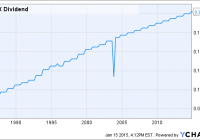
The shares currently sport a yield of about 3.5%. Utilities are notorious for being a great defensive play. Estimates for 2015 point to continued strong growth. Middlesex Water (NASDAQ: MSEX ) is a lightly followed water utility company based in New Jersey. The company operates in NJ as well as a couple of the surrounding states providing water related services. I found Middlesex while looking for attractive yields that are sustainable. Middlesex most definitely meets both of those traits. The company is worth a deeper look and at least an add to a watchlist. So the obvious first, the yield is nice at 3.5%. The company has had dividend growth for the past 42 years according to Dividend.com , most recently announcing an increase this past November. This increase puts the annual dividend at 77 cents a share with a current payout ratio of about 70%. While this may seem a bit high I don’t believe with a utility company like Middlesex it is something to be concerned with especially with the history of payments the company has. Below is the chart of the quarterly dividend growth since the late ’80s. Clearly other than the one disruption, which was for one quarter, there is a consistent uptrend. MSEX Dividend data by YCharts The company’s growth in general looks pretty as well. Both revenue and earnings have seen nice increases over the past few years and this trend also looks to be continuing. Year Revenue EPS 2013 $114.85M $1.03 2014 $117.29M(Est) $1.12 2015 $121.77M(Est) $1.19 (Sources for data and estimates: FT.com ) Using the estimates we see between 2013 and 2015 revenue is expected to increase another 6%, and EPS are expected to rise another 15.5%. EPS in 2015 of $1.19 would point to a payout ratio close to 64%, which means it will obviously practical for the dividend to be increased again. The great part about Middlesex is the fact that it is a great defensive play. There has been a crazy amount of noise that we are fast approaching a bear market with many companies way overvalued. I can’t argue with that last part. There are plenty of companies in this market overvalued. I also can’t say if there is a bear market coming or if there will just be a short-term correction. I do know that history tells us whatever the economic environment is Middlesex still performs well. The market has been up and down dozen of times in the past 42 years. Middlesex was still able to increase its dividend all those years. The fact is that water and water-related services will never go out of style. The barriers to entry are high so Middlesex doesn’t need to be overly concerned about competition as well. For a company that has done business since 1897 I don’t foresee any major problems anytime soon. In conclusion, I think Middlesex is a great play in a potentially rocky market. The yield is attractive at these levels and if the shares drop back a little more I think it would be a extremely good opportunity to pick some up. This year the company will celebrate its 118th birthday and likely increase its dividend for a 43rd year. Additional disclosure: Always do your own research before investing. Now that you’ve read this, are you Bullish or Bearish on ? Bullish Bearish Sentiment on ( ) Thanks for sharing your thoughts. Why are you ? Submit & View Results Skip to results » Share this article with a colleague

Consumer Discretionary ETF: XLY No. 7 Select Sector SPDR In 2014

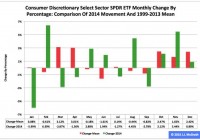
Summary The Consumer Discretionary exchange-traded fund finished seventh by return among the nine Select Sector SPDRs in 2014. The ETF was relatively weak in the first and third quarters, absolutely strong in the second and fourth quarters. Seasonality analysis of Q1 is a mixed bag, but my data interpretation points to a middle-of-the-pack performance. The Consumer Discretionary Select Sector SPDR ETF (NYSEARCA: XLY ) in 2014 ranked No. 7 by return among the Select Sector SPDRs that partition the S&P 500 into nine pieces. On an adjusted closing daily share-price basis, XLY advanced to $72.15 from $65.91, a gain of $6.24, or 9.47 percent. Thus, it behaved worse than its sibling, the Utilities Select Sector SPDR ETF (NYSEARCA: XLU ) and parent proxy, the SPDR S&P 500 Trust ETF (NYSEARCA: SPY ) by -19.27 and -4.00 percentage points, respectively. (XLY closed at $70.51 Tuesday.) XLY ranked No. 2 among the sector SPDRs in the fourth quarter, when it led SPY by 3.74 percentage points and lagged XLU by -4.54 points. And XLY ranked No. 3 among the sector SPDRs in December, when it performed better than SPY by 1.15 percentage points and worse than XLU by -2.68 points. Figure 1: XLY Monthly Change, 2014 Vs. 1999-2013 Mean (click to enlarge) Source: This J.J.’s Risky Business chart is based on analyses of adjusted closing monthly share prices at Yahoo Finance . XLY behaved about the same in 2014 as it did during its initial 15 full years of existence based on the monthly means calculated by employing data associated with that historical time frame (Figure 1). The same data set shows the average year’s weakest quarter was the third, with an absolutely large negative return, and its strongest quarter was the fourth, with an absolutely larger positive return. Generally consistent with this pattern last year, the ETF had a very small gain in Q3 and a very large gain in Q4. Figure 2: XLY Monthly Change, 2014 Versus 1999-2013 Median (click to enlarge) Source: This J.J.’s Risky Business chart is based on analyses of adjusted closing monthly share prices at Yahoo Finance. XLY performed worse in 2014 than it did during its initial 15 full years of existence based on the monthly medians calculated by using data associated with that historical time frame (Figure 2). The same data set shows the average year’s weakest quarter was the third, with a relatively large negative return, and its strongest quarter was the fourth, with an absolutely large positive return. It also shows there is no historical statistical tendency for the ETF to explode in Q1. Figure 3: XLY’s Top 10 Holdings and P/E-G Ratios, Jan. 13 (click to enlarge) Note: The XLY holding-weight-by-percentage scale is on the left (green), and the company price/earnings-to-growth ratio scale is on the right (red). Source: This J.J.’s Risky Business chart is based on data at the XLY microsite and Yahoo Finance (both current as of Jan. 13). To me, many of XLY’s component companies appear mispriced, either by a little or by a lot (Figure 3). I discussed one of them in “Amazon.com: The Most Overvalued Profitable Company In The S&P 500, Still” a while ago. Since then, Amazon (NASDAQ: AMZN ) has slipped back to unprofitability from profitability, but it remains overvalued. However, the facts on the S&P 500 consumer-discretionary sector reported by S&P Senior Index Analyst Howard Silverblatt Dec. 31 seem to be at variance with my opinions about it: He calculated its P/E-G ratio as 1.15, the lowest level of any of the index’s 10 sectors. Harrumph. The valuation issue aside, XLY’s prospects may be brighter now than they were six months ago: Among the Select Sector SPDRs, the ETF might be the biggest beneficiary of the collapse in the crude-oil commodity market, where the CME Group front-month futures price per barrel fell to $45.89 Tuesday from $107.26 June 20, a tumble of $61.37, or 57.22 percent, according to the U.S. Energy Information Administration . (The contract settled at $48.48 Wednesday, the CME Group reported.) Therefore, I would be completely unsurprised should XLY be a middle-of-the-pack performer among the sector SPDRs this quarter. Disclaimer: The opinions expressed herein by the author do not constitute an investment recommendation, and they are unsuitable for employment in the making of investment decisions. The opinions expressed herein address only certain aspects of potential investment in any securities and cannot substitute for comprehensive investment analysis. The opinions expressed herein are based on an incomplete set of information, illustrative in nature, and limited in scope. In addition, the opinions expressed herein reflect the author’s best judgment as of the date of publication, and they are subject to change without notice.