Tag Archives: portfolio

How I Dodged A -69.3% Bullet With A Checklist And 3 Important Lessons To Take Away
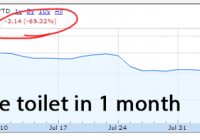
Summary SFX Entertainment has terminated their going private bid. The warnings signs that made me stay away. An updated checklist to avoid these types of situations. Phew. By learning from past mistakes, sticking with experience and following solid advice from books and gurus, it all helped me dodge a -69.3% bullet. Here’s what I mean. At the end of June, I wrote about a special situation involving SFX Entertainment (NASDAQ: SFXE ) where the founder was aiming to take his company private. And here’s what happened. (It was just announced that the deal has now been terminated dropping a further 20% making it -74.6% as of today.) The spread when I first looked at it was at 14%. A spread greater than 10% shows that the market doesn’t fully trust the deal. I know from a few painful experiences where I focused too much on the upside and bit off a big position, only to see the deal get canceled at the last moment. The deal for SFX Entertainment hasn’t been canceled. However, the go shop period has been extended, the buyout offer is to likely to be lowered and the company doesn’t provide enough information to investors. The special committee and its advisors will entertain offers for the entire Company as well as assets not central to the Company’s core business through at least October 2, 2015. Sillerman has agreed to cooperate with the special committee to obtain the best available offer for the Company’s shareholders. The October 2 date was chosen to allow potential bidders and their financing sources to have visibility into the Company’s performance during its peak festival season, thus providing a full and accurate picture of the Company’s results and prospects. To facilitate potential offers during this period, all “no-shop” restrictions and the related breakup fees provisions applicable to the Company under the merger agreement will no longer apply, enabling potential bidders to freely evaluate the Company in light of the recent substantial decline in its share price. Any new transaction will be evidenced by a new definitive agreement as the existing merger agreement is no longer effective. – Source No wonder it’s down so much in a little more than a month. They don’t all end up like this though. There have been plenty of going private acquisitions with a wide spread that went through successfully. Buffett has said that missing out on opportunities was been one of his biggest mistakes. If that’s the case, then dodging blowups like this is a huge success. But how? Simple. Using a checklist like this saved my bacon. Make sure both parties have done their due diligence – Pass Financing and regulator approval is complete – Pass (now a Fail) Get preliminary shareholder sentiment or controlling shareholder approval – Uncertain Obtain regulator (SEC, FCC, any and all) approval – N/A Get final shareholder approval at a meeting called for that purpose – TBD Check to see that insiders are continually vesting or buying shares – Pass On the surface, there are more passes than fails for SFXE, but because the importance increases as I move down the checklist. Number 6 was the big hold up. Without a clear green light by all shareholders, management and the special committee, it’s risky to put money down. Additional Criteria to be Added to the Checklist Based on the events that took place, I’m adding a couple of new checks to my checklist. Is management trustworthy? Is the upside and downside risk asymmetric? Is Management Trustworthy? There are plenty of managers that execute like a surgeon. But with SFXE, there are warning flags visible in the way the company is managed and how it communicates to investors. Plus, when a CEO publicly flips the bird and grabs his crotch , I tend to lose trust in their actions and judgment. Management should also have a history of doing what they say. There are a lot of managers who are showman types. After all, they are the face of the company and it is their job to sell, sell, sell. A method to check this is by comparing a few annual letters. Go through and highlight what they say they will do, and check the following letters to see whether it was accomplished, or whether it shows up in the numbers. The numbers won’t lie. Is the Upside Downside Risk Asymmetric? Special situations operate on a timeline, usually within a year. Due to a short time frame, the tradeoff is that your profit potential is small. So it makes it even more important to go after the high certainty opportunities and ignore the ones with bad odds. It’s a lot safer and easier to go after a very highly certain 1-2% return in a month using a large amount of money, compared to using a small amount of money for the 10% uncertain ones. When Google (NASDAQ: GOOG ) (NASDAQ: GOOGL ) announced in 2912 that it was buying Motorola Mobility, the spread was a little under 2% at the time. I put down a large amount of cash to maximize my returns over a very short period in order to make up for the small profit potential. Keep doing this with the good ones and you’ll build up your returns. Buffett didn’t achieve 30% annually during his prime by simply assigning a massive portion of this portfolio to Coca Cola (NYSE: KO ) and American Express (NYSE: AXP ) and then sitting on it. No. He spent a lot of his time on special situations and other active areas to increase his returns one brick at a time. The Updated Special Situations Checklist OK. Adding the two new checks, here’s the updated checklist I’ll be using for special situations going forward. Make sure both parties have done their due diligence Check management of both parties are trustworthy (NEW) Financing and regulator approval is complete Get preliminary shareholder sentiment or controlling shareholder approval Obtain regulator (SEC, FCC, any and all) approval Get final shareholder approval at a meeting called for that purpose Check to see that insiders are continually vesting or buying shares Verify upside and downside risk is asymmetric by assigning potential upside to downside returns (NEW) 3 Important Lessons to Take Away This year, it seems like I’m parroting the same thing, but the lessons I got from SFXE is clear. 1. It’s more important to focus on protecting the downside I didn’t like the 14% upside versus 24% downside. Seeing the stock price now, you can see how the downside turned out to be larger. 2. Don’t get greedy Even if you did go long SFXE, if you kept it to a small position, less than 1% of your portfolio, it didn’t damage your returns or portfolio compoundability. Losing money is bad because it makes it harder for your money to work because you’re chopping it off at its knees. I said earlier that I put a large amount into the Motorola merger, but that was because it was a highly certain transaction with very little possibility of failure. But I didn’t sell my other positions to free up cash to go all in. I used what was available and didn’t put in more than what made sense. 3. Manage risk The best investors and traders have one thing in common. They are obsessed with minimizing risk by going after asymmetric bets and taking advantage of inefficiencies. This may sound similar to points 1 and 2, but managing risk involves position sizing, seeing how things fit in your portfolio, being emotionless, not falling for obvious behavioral fallacies, being able to cut losses, admitting faults and more. But for the purpose of this article, adjust your sizing based on the odds and don’t overdo it. Disclosure: I/we have no positions in any stocks mentioned, and no plans to initiate any positions within the next 72 hours. (More…) I wrote this article myself, and it expresses my own opinions. I am not receiving compensation for it. I have no business relationship with any company whose stock is mentioned in this article.
SPDR Barclays Capital High Yield Bond ETF: Great Yields And An Intelligent Portfolio

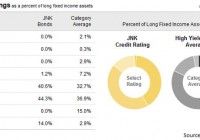
Summary The SPDR Barclays Capital High Yield Bond ETF is a junk bond fund that offers a fairly strong yield, around 6%. One concern is that 14% of the debt is not rated. The exposure to debt that is not rated may be an acceptable trade-off for the strong yields as long as the portfolio managers are doing their own due diligence. The maturities look fairly reasonable and holdings are not highly concentrated, so the overall portfolio construction looks solid. Investors should be using more than junk bonds in their investment portfolio. Correlation to the S&P 500 is a problem for junk bond ETFs. The SPDR Barclays Capital High Yield Bond ETF (NYSEARCA: JNK ) is a pretty good bond fund for exposure to securities ranging from BB to “Not Rated,” though nothing in the portfolio is actually rated anything less than B. The credit ratings won’t be stellar on a junk bond fund and the fund sure doesn’t try to hide it. Their ticker symbol of JNK is simply a play on “junk.” Every buy should know going in that they are buying credit sensitive debt securities. Credit Quality The allocation here seems is perfectly reasonable with the exception that a large amount of not rated bonds is slightly concerning: (click to enlarge) While I would like to have ratings on all or almost all of the debt being held, I can see how having debt that is not rated may be an advantage in producing higher yields if the portfolio managers are willing to do the due diligence to determine what the most likely rating would be if it were rated. In my opinion, this is an acceptable trade-off when most funds have weak yields and JNK is yielding around 6%. In a normal interest rate environment investors may expect materially higher yields, but in the weak yield environment we are all living through, this is one of the higher yielding debt options. Holdings I prepared the following chart showing the largest debt holdings of JNK. (click to enlarge) No problems are jumping out at me. Nothing was over .6% of the portfolio and within the top 10 I don’t see any duplication of the same issuers so I have no reason to expect a concentration of credit risk with individual issuers. Since about 14% of the portfolio was non-rated, it felt more important to double check for any large holdings that might be attributed to one non-rated company. Maturities I grabbed another chart to show the maturity ranges across the portfolio: (click to enlarge) The maturity profile for the SPDR Barclays Capital High Yield Bond ETF looks good for a junk bond fund. However, I must admit that the tiny allocations to the very long-term debt are interesting. Yes, there are generally lower than the category averages but I assume that the category averages may be influenced by a few funds classified into the category that have different investing strategies. Simply put, this is a little strange because it feels like the managers by operating outside of their area of expertise (evaluating short-term credit sensitive debt). On the other hand, these longer securities may simply be bargains they came across while doing their regular work. With it being such a small percentage of the portfolio, I don’t think it is worth worrying about. On the whole, JNK gets a solid rating on providing some diversification across the maturities without becoming too dispersed. There is not one “right” answer about how to structure the maturities, but I like the arrangement shown here. Risk The biggest risk factor from a portfolio standpoint that came up for me was a strong correlation (over 70%) in monthly returns with the S&P 500. Since one purpose of the bond portion of the portfolio is to provide diversification, it is a strike against junk bond funds that they tend to move with the market. That is a problem that should be impacting most junk bonds though, not a risk unique to JNK. When comparing JNK to other junk bond funds, this should not be held against it. Expense Ratio The expense ratio isn’t awful at .40%, however, I still want to keep looking for options where the ratio is lower. Given the relatively low yields on bonds currently and the need to buy junk bonds to get a solid yield, it really hurts to give up a significant portion of the assets to the expense ratio each year. Conclusion If an investor is looking at the role of the bond fund in their portfolio, it would be wise to consider having multiple bond funds if the first one is going to be investing in junk bonds. This kind of fund can offer some diversification benefits to investors, but it would be most productive in a portfolio that combines it with a few other bond funds with different duration exposures and higher credit ratings to enhance the diversification benefits that bonds bring to the investor’s portfolio. When it comes simply to selecting which junk bond fund an investor should use, JNK seems like a decent choice. I’ve still got quite a few funds to consider, but I’m not seeing any major failings here so far. I’m looking for a similar ETF with a very low expense ratio to really stand out as a junk bond fund champion. Disclosure: I/we have no positions in any stocks mentioned, and no plans to initiate any positions within the next 72 hours. (More…) I wrote this article myself, and it expresses my own opinions. I am not receiving compensation for it (other than from Seeking Alpha). I have no business relationship with any company whose stock is mentioned in this article. Additional disclosure: Information in this article represents the opinion of the analyst. All statements are represented as opinions, rather than facts, and should not be construed as advice to buy or sell a security. Ratings of “outperform” and “underperform” reflect the analyst’s estimation of a divergence between the market value for a security and the price that would be appropriate given the potential for risks and returns relative to other securities. The analyst does not know your particular objectives for returns or constraints upon investing. All investors are encouraged to do their own research before making any investment decision. Information is regularly obtained from Yahoo Finance, Google Finance, and SEC Database. If Yahoo, Google, or the SEC database contained faulty or old information it could be incorporated into my analysis.

I Love This ETF: Vanguard Emerging Markets Government Bond Index ETF

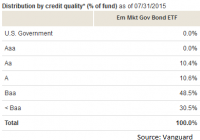
Summary VWOB offers investors exposure to the bond market for government debt in emerging markets. The portfolio has some substantial credit risk, but the yields and duration are solid. When the ETF is combined with other investments in a diversified portfolio, the low correlation is very attractive. I see this as a very solid holding for 3% to 5% of the portfolio. The Vanguard Emerging Markets Government Bond Index ETF (NASDAQ: VWOB ) is a very interesting bond fund. As I’ve been searching for appealing bond funds, I’ve found some of my favorites are from Vanguard. Given my distaste for high expense ratios, it should be no surprise that the Vanguard products would be appealing. After looking through the portfolio, I think the holdings are fairly reasonable for an investor wanting to regularly keep part of their portfolio in a bond fund. However, using only VWOB for bond exposure in a portfolio would be a very unwise decision. VWOB is designed to be an incredible supporting bond fund within a portfolio that already contains other bond investments. Quick Introduction The Vanguard Emerging Markets Government Bond Index ETF is showing a yield to maturity of 5.5% and an average duration of 5.7 years. Given the short duration on the portfolio and the very attractive yield on the bonds, it should be no surprise that the portfolio is carrying a substantial amount of credit risk. The emerging market governments don’t carry stellar credit ratings and there is definitely a material amount of risk in using the bond ETF as an investment. Credit Quality The following chart breaks down the credit quality of the issues being held in the portfolio. Clearly, a substantial portion of the holdings has fairly notable defects in their credit rating; however, the portfolio still offers investors diversification for their portfolio that can be very difficult to acquire in other ways. Emerging Markets and Other The holdings are primarily labeled as Emerging Markets; however, there is also a substantial allocation to a category labeled simply as “Other.” Investors should recognize that areas like Europe have zero allocation in the portfolio. See the chart below: The reason the allocations are so important is this exposure suggests that the portfolio’s correlation with other international bond funds might not be as high. That means even if the ETF is fairly volatile by itself, there could be some very substantial benefits to using it within a highly diversified portfolio that includes equity securities and bond funds allocated to different sectors, regions, and durations. Maturities I grabbed another chart to show the effective maturity on the securities: The maturity profile for the Vanguard Emerging Markets Government Bond Index ETF is fairly reasonable for an investor trying to get a solid diversification across the yield curve. There is a notable amount of exposure to the long-term bonds and the 5- to 10-year range. On the other hand, there is very little exposure to the shortest part of the yield curve. For optimal diversification, an investor may want to include other funds that target the shorter rate part of the yield curve. Risk Measuring returns and statistics since June of 2013 indicates that the portfolio is fairly stable for being invested in emerging markets. The annualized volatility of returns was 5.9%. For comparison, the annualized volatility on the S&P 500 for that period was 11.3% and the annualized volatility for the Vanguard FTSE Emerging Markets ETF (NYSEARCA: VWO ) was 18.3%. Correlation The fund really starts to shine when we consider the correlation in returns between VWOB and other bond funds that the investor might use for a larger portion of their exposure. Look at the correlation matrix below for a comparison: The Vanguard Total International Bond ETF (NASDAQ: BNDX ) is significantly less volatile than VWOB, but the correlation to BNDX is only 28%. BNDX, unlike VWOB, carries a heavy emphasis on Europe, which is entirely absent from the VWOB portfolio. In my opinion, these two ETFs held together in a portfolio are significantly better than either one alone due to the low correlation. Conclusion As far as bond ETFs go, the Vanguard Emerging Markets Government Bond Index ETF is a fairly solid option. An investor that failed to diversify into multiple funds would be taking more risk than necessary to realize returns, but when VWOB is used to enhance the diversification of the portfolio, it is an exceptional ETF. There are only two weaknesses in the entire ETF. One is that the expense ratio of .34% is higher than I want to pay and the other is that the ETF isn’t on the free-to-trade list for Schwab accounts. For investors that have free trading on VWOB through their brokerage and are willing to rebalance their portfolios to take advantage of the low correlations, it would seem that VWOB should be a natural choice for a small portion of the portfolio. My estimate is that the ETF would be a great holding at around 3% to 5% of the total portfolio value. Disclosure: I/we have no positions in any stocks mentioned, and no plans to initiate any positions within the next 72 hours. (More…) I wrote this article myself, and it expresses my own opinions. I am not receiving compensation for it (other than from Seeking Alpha). I have no business relationship with any company whose stock is mentioned in this article. Additional disclosure: Information in this article represents the opinion of the analyst. All statements are represented as opinions, rather than facts, and should not be construed as advice to buy or sell a security. Ratings of “outperform” and “underperform” reflect the analyst’s estimation of a divergence between the market value for a security and the price that would be appropriate given the potential for risks and returns relative to other securities. The analyst does not know your particular objectives for returns or constraints upon investing. All investors are encouraged to do their own research before making any investment decision. Information is regularly obtained from Yahoo Finance, Google Finance, and SEC Database. If Yahoo, Google, or the SEC database contained faulty or old information it could be incorporated into my analysis.