Tag Archives: nreum

Implications Of Sector Performances For 2015 Using Parametric Analysis
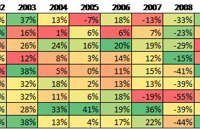
Over the past 16 years, on average, the top ranked sector had a return of 29% which is 9% points higher than the second performing sector. The spread from the top performing sector versus the bottom has consistently been 30% points or more and on average it was 40% points higher. Being a top third sector for four consecutive years has historically meant a drop in ranking of 4 spots. 2015 will be the year Health Care will mean-revert (XLV)(VHT). It is commonly known that things tend to move to the mean over time. What appears to be an aberration in the data from one observation is likely corrected in repeated observations. Virtually any repeated measurements of random data will converge to a bell-shaped curve. In statistics, this is called the central limit theorem (CLT). More specifically, the theorem suggests that the arithmetic mean of a sufficiently large sample of random iterations will be normally distributed. Whether the theory is fully understood or not, investors have been using the theorem to understand and make implications about the range of different market sector performances. If one sector has performed well in one year and outperformed the rest, it is anticipated that it will mean-revert at some point and underperform. This expectation of future performance is an application of the CLT. Note a major assumption behind this theorem is that the observations (in this case, sector total returns) must be independent and identically distributed. The assumption of independence has been a common topic of debate and we will avoid it here. This study looks at total returns for 9 US sectors using SPDR ETFs available for the past 16 years (1999 to 2014). A brief summary table of performances by year is given below: (click to enlarge) Looking at 2014, Utilities was the top performer followed by Health Care. Energy was the only sector below zero. From a 16-year compounded standpoint, Energy was the top with a 350% return which is 300% points above Technology and Financial sectors over the same time period. Next, is an analysis of comparable returns, sorting by rank. The table below is the same data with the performances ranked by year. For example, the #2 ranked sector in 2006 had a 19% total return. On average, the top ranked sector had a return of 29% which is 9% points higher than the second performing sector. The spread from the top performing sector versus the bottom has consistently been 30% points or more and on average it was 40% points higher. The standard deviation of returns across sectors in a given year has ranged from 4% (in 2006) to as high as 25% (in 2000). (click to enlarge) (click to enlarge) Parametric Scenario Analysis: I thought it would be interesting to evaluate a few scenarios and what it meant in the following year to help make some implications for 2015. First a quick summary on the current situation: Utilities and Health Care (NYSEARCA: XLV )(NYSEARCA: VHT ) were the top sectors in 2014, with Materials and Energy at the bottom Health Care has been a top performing sector: in the top 2 in both the prior two years and in the top 3 the all of the past 4 years Materials has been a laggard sector: a bottom 2 performer in the previous two years I first evaluated over the prior 15 years, what happened on average to the sector ranking in the following year. I did not look at absolute performance. For the top performing sector, the average ranking dropped the most to 5.9 in the following year. Similarly, the lowest performing sector increased the most in rank on average to 5.4. Next I looked at scenarios over consecutive periods. How has a sector performed after 2-4 years of excessive outperformance or underperformance? For example, I tracked the number of scenarios where a sector was the worst performer for 3 years in a row and what happened the following year (it happened once with Technology sector in 2000-2002 and in 2003 it rebounded to be the top performer). Some interesting findings over 1999-2013: A sector has never been the top performer for 3 consecutive years, nor has a sector ever been in the bottom third for four consecutive years A sector has been the worst performer for two consecutive years on 4 different occasions A sector in the bottom third for three consecutive years increased in rank by nearly 5 Implications for 2015: 1. Utilities and Health Care were the top sectors in 2014, with Materials and Energy at the bottom. History would suggest a reversion to the mean with Utilities being the worst impacted and the Energy benefiting. 2. Health Care has been a top performing sector: in the top 2 in both the prior two years and in the top 3 the all of the past 4 years Being a top performer for two years has not historically shown serious detrimental effects in the following year, however being a top third sector for four consecutive years has historically meant a drop in ranking of 4 spots. History would suggest Health Care will mean-revert. 3. Materials has been a laggard: a bottom 2 performer in the previous two years The prior 8 times this happened, the average ranking increased, but only to the 5th ranked sector. One more year in the bottom third would more conclusively imply outperformance on a historical standpoint.
FEU Provides Appealing Exposure To Europe

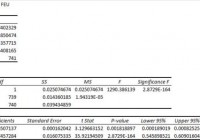
Summary I’m taking a look at FEU as a candidate for inclusion in my ETF portfolio. The correlation with SPY isn’t bad, and the overall risk level for a portfolio seems respectable. The expense ratio is a little bit high and the diversification is weak. I’ll keep FEU on the list as a possibility. I’m not assessing any tax impacts. Investors should check their own situation for tax exposure. Investors should be seeking to improve their risk adjusted returns. I’m a big fan of using ETFs to achieve the risk adjusted returns relative to the portfolios that a normal investor can generate for themselves after trading costs. I’m working on building a new portfolio and I’m going to be analyzing several of the ETFs that I am considering for my personal portfolio. One of the funds that I’m considering is the SPDR STOXX Europe 50 ETF (NYSEARCA: FEU ). I’ll be performing a substantial portion of my analysis along the lines of modern portfolio theory, so my goal is to find ways to minimize costs while achieving diversification to reduce my risk level. What does FEU do? FEU attempts to provide results which are comparable (before fees and expenses) to the total return of the STOXX Europe 50 Index. FEU falls under the category of “Europe Stock.” Does FEU provide diversification benefits to a portfolio? Each investor may hold a different portfolio, but I use the SPDR S&P 500 Trust ETF (NYSEARCA: SPY ) as the basis for my analysis. I believe SPY, or another large cap U.S. fund with similar properties, represents the reasonable first step for many investors designing an ETF portfolio. Therefore, I start my diversification analysis by seeing how it works with SPY. I start with an ANOVA table: (click to enlarge) The correlation is about 80%, which is great for Modern Portfolio Theory. The lower correlation makes it much easier to mix the ETF into a portfolio and take advantage of the benefits of diversification. My goal is risk adjusted returns, and my method is minimizing risk. Standard deviation of daily returns (dividend adjusted, measured since January 2012) The standard deviation is moderately high, but not terrible. For FEU it is 1.0080%. For SPY, it is 0.7300% for the same period. SPY usually beats other ETFs in this regard, and the low correlation with SPY makes the higher standard deviation acceptable. So far, the ETF is look fairly solid in my first pass. Mixing it with SPY I also run comparisons on the standard deviation of daily returns for the portfolio assuming that the portfolio is combined with the S&P 500. For research, I assume daily rebalancing because it dramatically simplifies the math. With a 50/50 weighting in a portfolio holding only SPY and FEU, the standard deviation of daily returns across the entire portfolio is 0.8250%. If an investor wanted to use FEU as a supplement to their portfolio, the standard deviation across the portfolio with 95% in SPY and 5% in FEU would have been .7343%. In my opinion, the standard deviation across the portfolio looks fine with a moderate position in FEU. In my opinion, a reasonable exposure based on the deviation is probably in the 5 to 10% range. Anything over 20% gets too risky. Average Volume The average volume was recently around 65,000 shares per day. That isn’t high, but it is enough that I would be comfortable holding the shares and believe the liquidity was good enough for the statistical values for correlation to be reliable. Why I use standard deviation of daily returns I don’t believe historical returns have predictive power for future returns, but I do believe historical values for standard deviations of returns relative to other ETFs have some predictive power on future risks and correlations. Yield & Taxes The distribution yield is 5.40%. The SEC yield is 2.64%. That’s a fairly strong yield, though I’d caution investors to research the source of the yields and the tax implications for their individual situation. I’m not a CPA or CFP, so I’m not assessing any tax impacts. Expense Ratio The ETF is posting .29% for an expense ratio. I want diversification, I want stability, and I don’t want to pay for them. The expense ratio on this fund is higher than I want to pay for an equity fund, but it isn’t enough to disqualify the ETF from consideration. Market to NAV The ETF is at a .81% premium to NAV currently. Premiums or discounts to NAV can change very quickly so investors should check prior to putting in an order. I wouldn’t want to pay a premium greater than .1% when investing in an ETF, unless I could find a solid accounting reason for the premium to exist. I certainly won’t be paying a .81% premium to buy into FEU without finding a solid reason for the premium. Largest Holdings The diversification is fairly weak. Given that the name included “Europe 50,” investors should expect the diversification to be weak. However, modern portfolio theory still says the overall level of risk introduced to the portfolio through a small to moderate position (5 to 10%) is acceptable. (click to enlarge) Conclusion I’m currently screening a large volume of ETFs for my own portfolio. The portfolio I’m building is through Schwab, so I’m able to trade FEU with no commissions. I have a strong preference for researching ETFs that are free to trade in my account, so most of my research will be on ETFs that fall under the “ETF OneSource” program. I’ll keep FEU on my list as a possibility for exposure to Europe as part of my international diversification. If I entered into a position in FEU it would be with a limit order that refused to pay the premium to NAV. Since the NAV could change suddenly, I’d have to do single day limit orders to reduce my risk of paying more than NAV. Additional disclosure: Information in this article represents the opinion of the analyst. All statements are represented as opinions, rather than facts, and should not be construed as advice to buy or sell a security. Ratings of “outperform” and “underperform” reflect the analyst’s estimation of a divergence between the market value for a security and the price that would be appropriate given the potential for risks and returns relative to other securities. The analyst does not know your particular objectives for returns or constraints upon investing. All investors are encouraged to do their own research before making any investment decision. Information is regularly obtained from Yahoo Finance, Google Finance, and SEC Database. If Yahoo, Google, or the SEC database contained faulty or old information it could be incorporated into my analysis. The analyst holds a diversified portfolio including mutual funds or index funds which may include a small long exposure to the stock.

US Value Stocks: Rewriting The Market’s Playbook

Summary The traditional playbook that investors have used to navigate market cycles has become outdated. Certain sectors usually become inexpensive after the type of market run that we’ve experienced during the past few years. But investors are chasing yield, which has kept certain stocks expensive. Invesco’s US Value complex includes three broad strategies, each with a distinct approach to evaluating companies. Looking into 2015, we highlight where each approach is seeing the most attractive opportunities. By Kevin Holt The traditional playbook that investors have used to navigate market cycles has become outdated. Certain sectors usually become inexpensive after the type of market run that we’ve experienced during the past few years. But, because interest rates are so low, investors are chasing yield. That has kept certain stocks expensive when you wouldn’t normally expect them to be, based on past cycles. At the same time, other sectors look attractive when they would normally be out of favor. For example, when you look at market history, value investors would not typically want to own financials at this point in the cycle. However, as we enter 2015, I believe financials have very attractive valuations, along with a surplus of capital that I expect to be returned back to shareholders in the form of increased dividends and/or stock buybacks. Overall, I believe the quality of the financials sector is the best we’ve seen in at least a decade, and see this story playing out over the course of the next four or five years. On the other hand, I believe that broadly, the consumer staples and telecommunications sectors are either fairly valued or expensive, as investors have driven up valuations in their search for yield. However, as bottom-up stock pickers, all of our value managers are focused on finding value opportunities wherever they may be – even within sectors that may be overvalued as a whole. Invesco’s US Value complex includes three broad strategies. There are many ways to be successful and intellectual independence is a core value across our teams. Each strategy has a distinct approach to evaluating companies. Looking into 2015, here is where each approach is seeing the most attractive opportunities: Our relative value strategies look for companies that are inexpensive relative to their own history. In this space, we have a particular interest in energy stocks as we enter the new year. Often, market volatility can lead to value opportunities, as quality companies get swept up in the sell-off. The oil markets experienced significant volatility toward the end of 2014 that may result in such opportunities. Our deep value strategies look for companies that are trading at a discount to their intrinsic value. In this space, our managers are also emphasizing energy stocks as well as financials, for the reasons stated above. Our dividend value strategies closely evaluate companies’ total return profile, emphasizing appreciation, income and preservation over a full market cycle. Through this lens, they are finding stock-specific opportunities within the consumer area. Our dividend managers have a high confidence in the durability of margins and of free cash flow generation for their holdings over the next two to three years, and believe that expectations for top-line recovery embedded in street estimates are conservative. So, while 2015 may feel like a very different year for the markets, our approach is the same as ever – across all three value sleeves, and across large-, mid- and small-cap stocks, we’re looking for opportunities that fit our philosophy, no matter what the typical market playbook says. Important information A value style of investing is subject to the risk that the valuations never improve or that the returns will trail other styles of investing or the overall stock markets. Common stocks do not assure dividend payments. Dividends are paid only when declared by an issuer’s board of directors and the amount of any dividend may vary over time. Stocks of small and mid-sized companies tend to be more vulnerable to adverse developments, may be more volatile, and may be illiquid or restricted as to resale. The information provided is for educational purposes only and does not constitute a recommendation of the suitability of any investment strategy for a particular investor. Invesco does not provide tax advice. The tax information contained herein is general and is not exhaustive by nature. Federal and state tax laws are complex and constantly changing. Investors should always consult their own legal or tax professional for information concerning their individual situation. The opinions expressed are those of the authors, are based on current market conditions and are subject to change without notice. These opinions may differ from those of other Invesco investment professionals. NOT FDIC INSURED MAY LOSE VALUE NO BANK GUARANTEE All data provided by Invesco unless otherwise noted. Invesco Distributors, Inc. is the US distributor for Invesco Ltd.’s retail products and collective trust funds. Invesco Advisers, Inc. and other affiliated investment advisers mentioned provide investment advisory services and do not sell securities. Invesco Unit Investment Trusts are distributed by the sponsor, Invesco Capital Markets, Inc., and broker-dealers including Invesco Distributors, Inc. PowerShares® is a registered trademark of Invesco PowerShares Capital Management LLC (Invesco PowerShares). Each entity is an indirect, wholly owned subsidiary of Invesco Ltd. ©2014 Invesco Ltd. All rights reserved. blog.invesco.us.com