Tag Archives: nreum

Spike In eBay Shares On Q4 Earnings Puts These ETFs In Focus

The e-commerce giant eBay Inc (NASDAQ: EBAY ) came out with Q4 results after the closing bell on January 21. Overall, the mood was optimistic on an earnings beat and restructuring initiatives, though a sales-miss restrained investors from full-hearted optimism on the stock. Net income in the fourth quarter rose to $0.81 from $0.66 per share a year earlier, based on Zacks data. This beat the Zacks Consensus Estimate of $0.77, which excludes stock options and non-recurring expenses. Net revenues of $4.92 billion fell shy of the estimate of $4.97 billion but grew 9% year over year. Revenues were primarily volume driven. eBay’s Marketplaces segment generating revenues from the sale of goods available on eBay properties, recorded a 1% jump in net transaction revenues. However, as expected, pricing was an issue for the company which is why on the margin front, the e-commerce giant clearly underperformed. The non-GAAP operating margin was down 150 bps to 29.2% in the quarter. Restructuring procedure is on with the e-commerce player. eBay’s plan to spin off the PayPal business will be completed in the second half of 2015 and the online marketplace announced that it would lay off 7% of its workforce in the first quarter. The company also announced it has entered into a standstill agreement with Carl Icahn, who is the company’s largest activist shareholder . Weak Guidance Though the story was decent so far, the guidance took a beating. The company expects net revenues in the range of $4.35-$4.45 billion, failing the analysts’ projection of $4.71 billion, per Bloomberg . The company’s non-GAAP earnings per share are guided in the range of $0.68-$0.71. The company expects net revenues of $18.60-$19.1 billion for the full year and non-GAAP earnings per diluted share of $3.05-$3.15. Market Impact The company’s streamlining initiatives might have given its stock a boost post earnings. The stock gained 3.5% after hours on January 21. The results have put some ETFs with considerable exposure to eBay in focus. These funds are highlighted below: PowerShares Nasdaq Internet Portfolio (NASDAQ: PNQI ) This fund follows the Nasdaq Internet Index, giving investors exposure to the broad Internet industry. The fund holds about 94 stocks in its basket with AUM of $248 million while charging 60 bps in fees per year. The in-focus eBay occupies the second position with an 8.37% allocation. In terms of industrial exposure, Internet software and services make up for more than two-thirds of the basket, followed by Internet retail. PNQI has lost nearly 2.2% so far this year (as of January 21, 2015). First Trust Dow Jones Internet Index (NYSEARCA: FDN ) This is one of the most popular and liquid ETFs in the broad tech space with AUM of over $1.96 billion and average daily volume of more than 250,000 shares. The fund tracks the Dow Jones Internet Index and charges 57 bps in fees per year. In total, the fund holds 41 stocks in its basket with the in-focus eBay taking the third spot with a 5.53% share. From a sector look, information technology accounts for about 70% of the portfolio while consumer discretionary makes up 22%. The ETF is down about 2.9% year to date. Market Vectors Wide Moat ETF (NYSEARCA: MOAT ) This ETF follows the Morningstar Wide Moat Focus Index and provides equal-weighted exposure to 21 U.S. securities that have a unique sustainable competitive advantage in their respective industries. Here, eBay occupies the tenth position in the basket, accounting for 5% of total assets. The product is pretty spread out across various sectors with energy, information technology and consumer discretionary taking double-digit allocation. The fund has accumulated $898 million in its asset base and sees good volume of about 200,000 shares a day. Its expense ratio comes in at 0.49%. The fund has added nearly 5% so far this year. Bottom Line eBay currently carries a Zacks Rank #4 (Sell) with poor fundamentals. However, investors should note that Internet commerce segment – the industry eBay operates in – presently resides in the top 23% allocation of Zacks Industry Rank. The company itself is also striving hard to turn around by adopting every possible measure. All these point to a moderately bullish long-term outlook. So, investors counting on the long-term potential in the space can consider the recent rally in eBay shares as a start to the wining trend. However, an ETF approach may be better; at least it can cover up eBay’s short-term weakness with some other components’ strength.
Europe’s QE Experiment: Adding Stock ETF Exposure And Hedging Against The Unforeseen

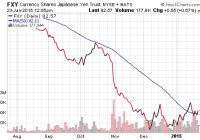
The scope and size of the European Central Bank’s latest stimulus effort has delighted the worldwide investing community. The countries/regions that are in the process of actively weakening their currencies are seeing the greatest pop in near-term equity prices. All of the safer haven currency proxies have gained ground in 2015, whereas the overwhelming majority of global growth-oriented currency ETFs are hittng 52-week lows. The scope (current euro-zone member nations) and size ($1.1 trillion euros) of the European Central Bank’s latest stimulus effort has delighted the worldwide investing community. In fact, many began betting on a monumental quantitative easing “project” the minute that Europe registered year-over-year deflation of -0.2% for the month of December. This can be seen in dollar-denominated ETF performance since the start of the 2015. The Anticipation Game: Investors Bet On Most Recent “QE” Beneficiaries Approx YTD% iShares Currency Hedged MSCI Germany ET F (NYSEARCA: HEWG ) 8.5% Deutsche X-trackers MSCI Europe Hedged Equity ETF (NYSEARCA: DBEU ) 4.3% WisdomTree Korea Hedged Equity ETF (NASDAQ: DXKW ) 0.9% WisdomTree Japan Hedged Equity ETF (NYSEARCA: DXJ ) 0.3% SPDR S&P 500 Trust ETF (NYSEARCA: SPY ) 0.0% The outperformance by Germany as well as Europe over less recent “quantitative easers” is worthy of note. It tells us that the countries/regions that are in the process of actively weakening their currencies – the ones that are actively lowering the costs of servicing their sovereign debt by the most significant amounts via ultra-low yields – are seeing the greatest pop in near-term equity prices. Indeed, the vast majority of currency ETFs are hitting 52-week lows. The ones that are not? The safer haven currency proxies which include the CurrencyShares Swiss Franc Trust ETF (NYSEARCA: FXF ), the CurrencyShares Japanese Yen Trust ETF (NYSEARCA: FXY ), the PowerShares DB USD Bull ETF (NYSEARCA: UUP ) and SPDR Gold Trust ETF (NYSEARCA: GLD ). All of these safer haven currency proxies have gained ground in 2015, whereas the overwhelming majority of global growth-oriented currency ETFs are hittng 52-week lows. Safer Haven Proxies Are Flourishing, Global Growth Proxies Are Languishing Approx YTD % FXF 13.5% GLD 9.1% UUP 4.8% FXY 1.7% CurrencyShares Australian Dollar Trust ETF (NYSEARCA: FXA ) -2.5% CurrencyShares British Pound Sterling Trust ETF (NYSEARCA: FXB ) -3.6% CurrencyShares Canadian Dollar Trust ETF (NYSEARCA: FXC ) -6.3% CurrencyShares Euro Trust ETF (NYSEARCA: FXE ) -7.0% For those who do not understand why the yen strengthens in risk-off environments, you may need a refresher on the “carry trade.” Investors borrow the low yielding yen to invest in higher yielding assets or higher appreciating assets. However, there is a serious consequence for playing the game at the wrong time; specifically, the yen rise in value when institutions and hedge funds rapidly sell stocks, higher-yielding bonds and higher-yielding currencies to avoid paying back loans in a more expensive yen. The Japanese currency can rise rapidly and the reverse carry trade can take on a life of its own. During January’s volatility in U.S. stock assets, FXY has crossed above its 50-day moving average. If the risk off volatility has truly run its course due to the European Central Bank’s mammoth QE promise and the Bank of Japan’s existing promises, FXY should stabilize rather than climb. Conversely, additional gains for FXY would suggest additional unwinding of the yen carry trade as well as a high probability of heavy volume selling of stock assets. The potential for the carry trade to unwind and the yen’s historical record as a safer haven currency is the reason for its inclusion in the FTSE Custom Multi-Asset Stock Hedge Index. This index that my Pacific Park Financial colleague and I created with FTSE-Russell- the one that many are already calling “MASH” – holds the franc, yen, dollar and gold. It also owns long maturity treasuries, zero coupon bonds, inflation-protected securities, munis, German bunds and Japanese government bonds. Year-to-date, the FTSE Custom Multi-Asset Stock Hedge Index is up 4.5%. Shouldn’t investors just play market-based securities in a way that has worked so well during the Federal Reserve’s QE3? The shock-and-awe, 1.5 trillion dollar, open-ended, bond-buying bazooka that gave U.S. stocks double-digit percentage gains in 2012, 2013 and 2014? After all, the European Central Bank (ECB) is proffering $1.1 trillion euros into 2016. The problem in the comparison between these programs is that 80% of the sovereign bonds are being bought by the national central banks and not the the ECB itself. This means that each country (e.g., Austria, Belgium, France, Germany, Greece, Italy, Spain, etc.) is responsible for its own default risk. It follows that I might be willing to add a fund like HEWG to my barbell portfolio , alongside several existing components such as the iShares S&P 100 ETF (NYSEARCA: OEF ), the Health Care Select Sect SPDR ETF (NYSEARCA: XLV ) and the Vanguard Dividend Appreciation ETF (NYSEARCA: VIG ). I might be a bit more skeptical of the i Shares Currency Hedged MSCI EAFE ETF (NYSEARCA: HEFA ), simply because of the drag of extreme debtors on the periphery of Europe (e.g., Spain, Portugal, Greece, etc.). By the same token, I have slowly increased exposure over the last three months to a number of existing holdings on the other side of the barbell. They include GLD, the i Shares 10-20 Year Treasury Bond ETF (NYSEARCA: TLH ), the Vanguard Extended Duration Treasury ETF (NYSEARCA: EDV ) and, more recently, FXY. Remember, multi-asset stock hedging does not mean that your dynamic hedging loses when riskier stock assets win. On the contrary. Both sides of the barbell tend to perform in late-stage bulls. Disclosure: Gary Gordon, MS, CFP is the president of Pacific Park Financial, Inc., a Registered Investment Adviser with the SEC. Gary Gordon, Pacific Park Financial, Inc, and/or its clients may hold positions in the ETFs, mutual funds, and/or any investment asset mentioned above. The commentary does not constitute individualized investment advice. The opinions offered herein are not personalized recommendations to buy, sell or hold securities. At times, issuers of exchange-traded products compensate Pacific Park Financial, Inc. or its subsidiaries for advertising at the ETF Expert web site. ETF Expert content is created independently of any advertising relationships.

RWE – Recovery Postponed, Indefinitely?

RWE has warned earnings will not as expected bottom out in 2015. It will also struggle with its debt target. The announced strategic moves are not enough short term relief. Political risk is high with major pieces of legislation in a controversial debate, namely capacity markets and climate legislation. RWE is the most exposed within the peer group. As power markets in Europe get taken over by new structures, volatility and earnings risk, energy system infrastructure is a better investment proposition. RWE’s ( OTCPK:RWEOY ) earnings warning weighs stronger short term than its strategic moves. The company will continue to struggle with weak commodities and high leverage in 2015, despite the DEA sale. It may embark onto some rescuing of value through power plant sales, but it does not have the potential to deliver a similar strategic boost to E.ON. RWE is at the heat of the political storm that still has high potential to deliver more unpleasant surprises. Infrastructure and the private sector, conversely, might be beneficiaries. There are signs that private investors with longer strategic horizon are circling around distressed assets. They will gain a more important part in a decentralized energy market. Asset rotation will be a feature. My view of increasing M&A activity remains underpinned. RWE is not out of the woods yet; investors who were hoping for earnings stabilization as indicated by the company in April 2014 may be disappointed. Management has warned on earnings , saying that the earnings trough may not occur in 2015 yet. Consensus has not bottomed out for 2015 yet and it may still come down. Power prices are the unsurprising cause of the problem. Futures are pointing nowhere to a meaningful enough recovery, and the broader commodities environment is not any more supportive. RWE more than any of its peers, needs significant commodity recovery. In tandem with the above comes relentless balance sheet stress. I find little chance of material decrease of leverage. The Urenco sale will not come through short term. The CEO has further confirmed that leverage falling to 3x net debt/Ebitda by 2016 will be “extremely difficult to achieve”. I estimate just short of 4x for 2016. Attention will swiftly return to risk to the dividend. RWE may rescue some value through selling its power stations that are unprofitable abroad as announced this week. That is clearly a strategy to mitigate cash losses. It would bring minor debt reduction. Some of the company’s plant is new and competitive technology. The bulk of the RWE’s mothballing and closure programme is less than 20 years old, some plants are not even three years from commissioning. That concerns particularly gas. It is sensible that management looks to maximise value of otherwise potentially stranded assets. But, a power plant cannot be displaced and sold into another location like other capital assets. High quality and well performing equipment may still find a market value in locations with tighter reserve margins and new build demand. The CEE region comes to mind. There is also an active secondary plant market also in Asia. There will clearly be a loss of value for RWE. Investors should not hold up high hopes of significant earnings contributions from the process. Signaling power to the political powers may be stronger than actual earnings impact. Infrastructure investors have begun to look at power generation with a view of power price recovery over the long term. The prospect for capacity payments may underpin that kind of activity. Germany is uncertain on that note, but plenty of European countries putting into place capacity markets could keep M&A activity up. All of RWE’s strategic moves could in the end amount to a similar outcome to E.ON’s corporate split. The company has been vocal about reducing the share of generation to 5% of earnings. Most recently, the CFO has now said it no longer rules out a similar move even though management decided against it in 2012. RWE is in a different situation to E.ON ( OTCQX:EONGY ), in that it cannot bring as diversified a generation park into any potential new co. Merging renewables into a “genco” may remedy to a point. But in that case management would have to have a clear strategy about how it would pursue downstream brand equity and service/product packing for which renewables exposure is important. A split co will also not have the same upstream and oil and gas diversification as E.ON. That would make a genco or “upstreamco” resemble much more of a bad bank than in the case of E.ON. Importantly, it would in my view have to raise capital in order to fund the nuclear liabilities that the genco would inherit. RWE might embark onto greater strategic change beyond its already announced transformational steps. That would be a positive. But with the chances increasing that more steps are taken, so does the probability of a capital increase. I see significant potential for large parts of RWE’s business going private. Meanwhile, the debate over capacity payments rages on. The Economy Minister’s has again repeated he is opposed to capacity payments , which is out of line with market expectations. The political debate bears high potential for disappointment. My preferred exposure in all of this is infrastructure, engineering and market backbone. Editor’s Note: This article discusses one or more securities that do not trade on a major exchange. Please be aware of the risks associated with these stocks.