Tag Archives: management

11 Stocks Plus Cash Saw $24,000 Grow To Over $1 Million
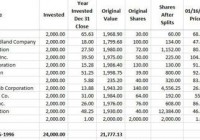
Summary Start in 1985 with a $2,000 investment in cash. Make one $2,000 investment at the end of the year from 1986 through 1996. Investments are assumed to be made in an IRA to shelter from taxes. The first $2,000 was invested in cash to pay for commissions and other fees. The average investor can save a tidy sum for retirement. It takes some luck, perseverance, and a buy and hold approach. The portfolio constructed would generate $22,400 in dividends for 2015. The portfolio was constructed by entering stock symbols into a spreadsheet in random order. The model assumed a $2,000 a year investment from 1985 through 1996 or 12 years. The first – year investment of $2,000 was invested in cash to account for commissions and other fees. The results are not actual results, but hypothetical results. Dividends that would have been earned on investments have been ignored or assumed to have been invested in stocks that blew up and went to zero ($0.00). The results generated most likely are influenced by a survivor basis. Nevertheless, the exercise proved useful. Data was obtained from company websites and or Yahoo Finance. The performance results are handicapped by not accounting for dividends paid since purchase nor assuming they are reinvested. The portfolio results presented are conservative to consider a worst case rather than an unrealistic best case. This is part one. The second part will cover the years 1998 through 2014. The model portfolio is shown below. (click to enlarge) Chart of the stock performance since inclusion into the model portfolio is shown below. Kellogg (NYSE: K ) K data by YCharts Archer Daniels Midland (NYSE: ADM ) ADM data by YCharts Starbucks (NASDAQ: SBUX ) SBUX data by YCharts The Home Depot (NYSE: HD ) HD data by YCharts Exxon Mobil (NYSE: XOM ) XOM data by YCharts Stryker (NYSE: SYK ) SYK data by YCharts Caterpillar (NYSE: CAT ) CAT data by YCharts Charles Schwab (NYSE: SCHW ) SCHW data by YCharts JPMorgan (NYSE: JPM ) JPM data by YCharts Wal-Mart (NYSE: WMT ) WMT data by YCharts Microsoft (NASDAQ: MSFT ) MSFT data by YCharts Bottom line: With a little luck and experience, it is possible for a modest investment to grow into a nice nest egg. What do you think? Disclosure: The author is long ADM, SYK, SCHW, JPM, MSFT. (More…) The author wrote this article themselves, and it expresses their own opinions. The author is not receiving compensation for it (other than from Seeking Alpha). The author has no business relationship with any company whose stock is mentioned in this article. Are you Bullish or Bearish on ? Bullish Bearish Neutral Results for ( ) Thanks for sharing your thoughts. Submit & View Results Skip to results » Share this article with a colleague

Why Lululemon Founder Chip Wilson’s Departure Is Good For The Company

Summary Lululemon Athletica founder Chip Wilson has recently announced his departure from the yoga apparel company he founded and built. Lululemon stock declined over 1% on the news. While Wilson has been a good corporate executive for Lululemon for most of its history, his presence has been more of a liability in recent years. Lululemon is now better able to attempt putting the past behind them, which will be a positive catalyst for the stock. Earnings trends and a reasonable valuation are likely to push the stock upward in the future. Canadian yoga-apparel maker Lululemon Athletica (NASDAQ: LULU ) founder Chip Wilson has recently announced his departure from the company he founded and built. In response to the news, Lululemon stock declined over 1%. Is this decline indicative of a harder future for Lululemon, or should investors view this development as a positive for the company and for shareholders? Wilson’s Accomplishments Chip Wilson’s tenure at Lululemon has been marked with a series of notable achievements. After all, he is the man who started off the whole company from a small location in Vancouver, Canada, in 1998, and has since then expanded the company into a global brand with a loyal customer base, with 250 stores across the world. Wilson’s entrepreneurial spirit and long-term focus are commendable in an era where many are only concerned about the short-term. Lululemon broadened its reach and its customer base under Wilson at impressive rates. Wilson left as executive in 2012 to take some time off from daily management of the firm, but returned in 2013 to help bring back Lululemon from a downturn in sales and a controversy over the quality of its clothes. Unfortunately for Lululemon, this controversy proved to be a devastating event for the company’s PR image and its financial standing, as well as the reputation of the company’s CEO. Wilson’s Stumblings In Recent Years While Wilson did help Lululemon recover from a crisis after he came back, he has had his share of mishaps in recent years that have infuriated customers and had significant negative effects on the company’s financial performance. The most noteworthy of these mishaps is the aforementioned scandal regarding Lululemon’s pants. Wilson has been a lightning rod of controversy after insinuating that quality problems with Lululemon pants were related to customers’ body types, seemingly blaming consumers for the problems with see-through pants. This led to an incredibly awkward and, what many consider a misguided, 50-second apology video that he posted on YouTube – not to the consumers he offended, but to Lululemon workers. So, Why Is Lululemon Better Off Overall? While Lululemon is indeed losing a key figure in its development into a global brand, I believe the team replacing him is more than capable of managing the company without him, as seen in the past couple years when Wilson has taken smaller and smaller roles. After rescuing the company from crisis, Wilson is leaving the company in the competent hands of Lululemon’s core team. This core team has been operating well under a less influential Wilson. The company is being left in pretty good shape, as seen from IAEResearch: Lululemon has revised its fourth quarter earnings guidance upwards – the company now expects its net revenues to be in the range of $595 -600 million as compared to previous range of $570-585 million for the quarter. This increased top line growth is based on the comparable sales increase of around 6-7% on a constant dollar basis as compared to the previous total comparable sales increase of low single digits on a constant dollar basis. The company also expects a rise in its bottom line growth and increased its diluted earnings per share range to 71 – 73 cents for the fourth quarter as compared to previous EPS guidance range of 65 – 69 cents. Wilson’s departure and the subsequent drop in Lululemon’s stock price may be a good entry point for a stock with a niche yoga pants market, increased earnings guidance, high margins, high net operating cash flow that has increased by 79.50% since the same quarter last year, and a reasonable valuation. The stock’s P/E ratio TTM of 40 is a good benchmark for future growth and is right at Lululemon’s historically average P/E ratio TTM. Also, Lululemon’s valuation is less ambitious than Under Armour’s (NYSE: UA ) 86 P/E ratio, meaning that the stock has more room to run without hitting a ceiling of stagnating growth. Lululemon’s operating cash flow is also substantially higher than the industry average growth rate of 56.32%. To be frank, Wilson’s departure can only be good for Lululemon, as his continued presence would have been a continual source of irritation for consumers and shareholders alike. Wilson’s continued presence at the company is only bound to be a sore point with customers who were riled with Wilson’s supposedly insensitive comments. After helping the company get back on its feet, Wilson feels now is the best time for him to leave, and there probably isn’t a better time to do so. Despite Wilson’s accomplishments, the sour taste of the pants scandal remains in some customers’ mouths, and it’s in Lululemon’s best interests for Wilson to leave at this time, as he essentially has done all he can do for the firm. Disclosure: The author has no positions in any stocks mentioned, and no plans to initiate any positions within the next 72 hours. (More…) The author wrote this article themselves, and it expresses their own opinions. The author is not receiving compensation for it (other than from Seeking Alpha). The author has no business relationship with any company whose stock is mentioned in this article.

Investing In Africa With ETFs

ETFs have penetrated niche asset classes, such as frontier markets equity. This includes Africa, with EZA, AFK, and NGE. In illiquid, under-researched markets, ETFs don’t offer the same diversification and market return matching as in the US. Particularly in Africa, ETFs may not be adequate as a replacement for individual securities but can serve to gain additional diversification. Case in point: the Nigeria focused ETF NGE. Is there an app for that? A few years ago that was a fun and only slightly rhetorical question, as we traded in our flip phones for smart phones and our PCs were catching flak from the tablet takeover. Today no one asks, because he answer is unequivocally “yes.” In similar fashion, a present day investor might ask: is there an ETF for that? Increasingly, that is a rhetorical question as well. Mostly, that is a good thing. Exchange Traded Funds (ETFs) have leveled the playing field by democratizing access to asset classes and markets traditionally only accessible to sophisticated investors such as endowments and pension funds. But if ETFs sometimes sound too good to be true, it is because they are. Where they excel is in traditional asset classes where a passive, low-cost basket of stocks is generally a better alternative to an actively managed, less transparent, less tax efficient portfolio. The risk lies in the fact that ETFs are not a cure for illiquidity, market inefficiency, and increased correlation between asset classes. As investors in Africa we at Africa Capital Group have looked at several ETFs including iShares MSCI South Africa (NYSEARCA: EZA ), Market Vectors Africa (NYSEARCA: AFK ), and Global X MSCI Nigeria (NYSEARCA: NGE ). I wanted to focus particular attention on NGE, because investors are well served to take a careful look under the hood. If investing in Nigeria were as simple as equating high GDP growth rates and favorable demographics to a rising tide that lifts all stocks, than NGE would be your fund. The reality however, is more complex: 1) NGE is not that diversified. The top holding, Nigerian Breweries, comprises nearly 20% of the fund and the top 10 names comprise nearly 75%. 2) Almost 50% of the fund is invested in banks. Granted, the financial sector plays an outsized role in the economy relative to developed market, but still, 50% is a lot. 3) Illiquidity + Illiquidity ≠ Liquidity. Just by wrapping Nigerian stocks in a crisp US-traded ETF you have not solved the illiquidity problem of the underlying securities. As long as demand and supply for the ETF shares is relatively balanced, the ETF’s share price should be able to stay close to its NAV. However, that does not mean that the NAV can’t be dragged down by investors outside of the ETF demanding liquidity in the market place during a downturn. Furthermore, if US investors on their own decide to dump NGE in some sort of a risk-off frenzy, than the ETF might be forced to sell shares of the underlying securities, thus demanding liquidity in the Nigerian market, which will come at a cost. 4) My last point, and the one I feel strongest about, is that sub-Saharan Africa might actually be one of the few places on Earth where active, bottom-up investing still makes sense. You cannot sit in an office in New York with a Bloomberg terminal and know everything you need to know about Africa. It takes traveling there, to appreciate that Africa is not a uniform place of war, poverty, and disease. Information flow is light, research is scarce, and liquidity is low in all but the biggest names. In other words: ideal circumstances for “boots on the ground” and active management. An ETF approach to these markets will not capitalize on the advantage that can be had by discriminating between stocks with good prospects and those without. In summary, I am a believer in ETFs, but I am less convinced that they can be used as a one-stop-shop to gain access to African stocks. Perhaps they can be added to a portfolio of individual stocks for further diversification, but, in my view, they do not suffice as a standalone solution. Disclosure: The author is long EZA. (More…) The author wrote this article themselves, and it expresses their own opinions. The author is not receiving compensation for it. The author has no business relationship with any company whose stock is mentioned in this article.