Tag Archives: management

Dividend Growth And Value Investors Should Own ITC As A Core Holding
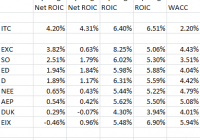
ITC Holdings’ management has earned the highest S&P Quality rating for 10-yr consistence in earnings and dividend growth. No easy feat. Substantially higher Net ROIC, higher allowed ROIC, and a growing regulated asset base are driving earnings and dividend growth higher as well. The current dip is a buying opportunity. The market has not been kind to utility stocks recently, and the current sell-off is offering a few attention-grabbing opportunities. ITC Holdings (NYSE: ITC ) is a company that offers top-ranking management with a record of accomplishment in generating industry-leading investment returns. Add projected annual dividend growth in the 10% to 13% range, along with forward PEG valuations more reminiscent of growth companies than slow growth utilities, and most investors should take notice. S&P Capital IQ offers a rating of 10-yr consistency in earnings and dividend growth known as its Quality Rating and firms are grouped from A+ to D, with B+ being considered average. Of the 500 stocks followed by S&P IQ with a Quality Rating, only 47 carry the A+ rating, and ITC is one of this elite group. ITC has an S&P Credit rating of A- while the industry average is BBB+. Keep in mind the company has been public for only 10 years and would have just qualified for inclusion into the Quality Ratings. One component of management excellence is generating shareholder returns based on total capital deployed that are both higher than its peers and are comfortably above their cost of capital. ITC has generated a 6-yr average return on invested capital ROIC of 6.4% and is higher than the industry average of between 4.5% and 5.0%. More impressive is the low cost of capital at a weighted average cost of capital WACC of just 2.2%, making Net ROIC an impressive 4.2%. While many may see this as small potatoes, investors should compare ITC’s Net ROIC with some bigger, more familiar names, such as those in the spreadsheet below for Exelon (NYSE: EXC ), Southern Company (NYSE: SO ), Consolidated Edison (NYSE: ED ), Dominion Resources (NYSE: D ), NextEra (NYSE: NEE ), American Electric Power (NYSE: AEP ), Duke Energy (NYSE: DUK ), and Edison International (NYSE: EIX ): Source: Guiding Mast Investments, fastgraphs.com, thatswacc.com As shown, ITC management is under-appreciated by most investors for their ability to generate Net ROIC substantially above their peers. One of the keys to ITC’s success is the structural nature of its business focus. ITC is the largest publicly traded electric transmission company with 15,000 miles of FERC-regulated power lines. The subtle difference is the FERC and not individual state utility commissions regulate ITC’s assets, and the FERC has a higher allowed ROE than most states. The chart below from the Edison Electric Institute outlines the progression of lower state allowed ROE since 1990: As shown, the average state-allowed ROE has declined over the past 30 years, and has plateaued at around 10% since 2006. A national energy goal has been the upgrade of the electric grid and the interconnection of new solar and wind generating capacity in areas not historically power generation-oriented. Grid infrastructure investment has been encouraged through offering higher returns on investment dollars, and ITC’s focus has been on those higher return margins. The FERC allows returns in the 10.5% to 11%+ range. To encourage smaller companies, regulated returns offer an additional return incentive of about 1% if the assets are owned by independent firms like ITC. It is estimated that ITC’s long-term allowed ROE will be in the 11.5% range. There is opposition to the higher returns offered by FERC-regulated projects, and last year rates were reduced in the Northeast from as high as 13.4%. With the success of this reduction, consumer advocates are pushing for the formula to apply nationally, and this will negatively affect ITC’s allowed returns with an anticipated allowed ROE reduction from 12.75% to 11.5% by 2016. However, this decline in allowed returns will be offset by a larger network of regulated assets. ITC’s growing asset base and the large quantity of future project opportunities will drive earnings and dividend growth for the next several years. ITC has grown earnings by a three-year average of 12% and raised its dividend by 10%. The consensus is for earnings to continue its 10% to 12% growth rate. The payout ratio is a low 31%, offering management the option to raise dividends faster than earnings growth. Management has targeted mid- to high-30% for a comfortable payout ratio. Last year, the dividend was raised by 14%. ITC is a capital expansion story. Current assets are around $7.1 billion with annual capital expansion budgets of $800 million a year. Operating cash flow will fund a growing portion as ocf increases from $630 million this year to an estimated $770 million in 2018. More information on their cap ex expansion is available in the June 2015 Investor’s Meeting presentation pdf. ITC’s share price has been declining recently due to two factors, general weakness of the utility sector after a lengthy time of outperformance and concerns over the potential for a reduction in allowed ROE. ITC’s share price has followed its peers up and down over the past year until March. At that point, there is a divergence where ITC declined faster than the utility sector. ITC is down about 30% from its high, while the averages are down about 15% and since March, utility stocks have been declined about 5%, while ITC is down 17%. Over the past 12 months, utility stocks are about flat, while ITC is down about 12%. With a 52-wk range of $30.66 and $44.00, the current $32.65 is closer to the low. Another culprit is lower-than-expected first quarter earnings. Analysts were expecting eps of $0.50, but management disappointed by 6% at $0.47. This is a repeat of the previous quarter shortfall of 4%. Management’s guidance for EPS this year is $2.00 to $2.15, with a midpoint of $2.08. Next year’s EPS is estimated at $2.18 to $2.20. Below is the Fastgraph for ITC going back to its IPO in 2005. (click to enlarge) On a forward PEG basis, ITC is trading at a substantial discount to its peers. As described in a previous article , the average forward PEG ratio for the utility sector is 3.2, the average forward P/E is 15.7 and the average EPS growth rate is 4.8%. ITC compares with a forward 2016 PEG of 1.4 based on a 2016 P/E of 15.3 and EPS growth of 11%. While EPS growth is estimated at twice the sector’s growth, ITC’s share prices currently offer no premium valuation. However, in reviewing ITC’s P/E history, it seems it usually trades closer to a P/E of 22 than to 16. If ITC recovers its footing and resumes its premium P/E, it is conceivable share prices could climb to $42 to $48 for patient investors. While the current yield is below the sector average at 2.0%, a high dividend growth rate should overtake the sector average within a few years. The current weakness should be considered a buying opportunity for dividend growth investors and value investors alike. Management has shown its ability to deliver outstanding fundamental returns to shareholders, and the stock warrants a place as a core position in a portfolio. Use this dip to your advantage. Author’s Note: Please review disclosure in Author’s profile. Disclosure: The author is long ITC, AEP, D, EXC, SO. (More…) The author wrote this article themselves, and it expresses their own opinions. The author is not receiving compensation for it (other than from Seeking Alpha). The author has no business relationship with any company whose stock is mentioned in this article.

Tuttle Tactical ETF Touts Combination Of Capital Gains And Yield

By DailyAlts Staff In today’s low-interest rate environment, coupon payments alone are unlikely to be enough to meet the objectives of yield-hungry investors. Income investors need a combination of yield and capital gains, going forward, and that’s exactly what the Tuttle Tactical Management Multi-Strategy Income ETF (NASDAQ: TUTI ) is designed to provide. In addition to current income, the Tuttle Tactical Management Multi-Strategy Income ETF is designed to provide tactically managed exposure to the markets. Launched jointly by ETF Issuer Solutions and Tuttle Tactical Management on June 10, the former is the ETF’s advisor and the latter is the sub-advisor. Tuttle CEO Matthew Tuttle is the fund’s portfolio manager. “The need for income investing strategies that can allocate tactically in the face of increasingly complex market conditions is clear,” said Mr. Tuttle, in a June 10 press release announcing the new ETF’s launch. “We believe that this ETF is debuting at a critical time for income-minded investors.” The Tuttle Tactical Management Multi-Strategy Income ETF will follow a rules-based investment approach using Tuttle Management’s four uncorrelated tactical models: Income Relative Momentum , which uses monthly relative strength to select one or more income ETPs; Dividend Counter-Trend , which invests in dividend-paying stocks when markets are trending lower intraday, and cash when markets are trending higher intraday; Dividend Tactical Fundamental Earnings , which invests in dividend ETPs when markets are trending higher on weekly models, while earnings are trending downward; and in cash when the reverse is true; and Dividend Absolute Momentum , which invests in dividend ETPs when markets are trending higher on weekly models, and in cash when markets are trending lower, in accordance with their relative strength. These models are based on Tuttle’s investment philosophy, which holds that markets move in recognizable short-term trends and countertrends; but that over the intermediate term, strong asset classes tend to stay strong, while weak asset classes tend to continue in weakness; and over the even-shorter term, markets are dominated by short-term disruptions and other noise. Tuttle’s models attempt to capture gains associated with these outlooks over varying time spans. “The bond market remains challenging for investors, and we know that interest rates will rise,” said Mr. Tuttle. “There is no doubt that the industry appetite for tactical solutions has picked up.” Mr. Tuttle also cited “strong interest” in his firm’s first ETF, the Tuttle Tactical U.S. Core ETF (NASDAQ: TUTT ), which debuted in February. William J. Smalley, President of ETF Issuer Solutions noted that ETF’s success in saying his firm is “very happy to have added TUTI to our listing of featured managers.” The expense ratio for the fund is 1.28%, inclusive of a 0.90% management fee. For more information, download a pdf copy of the fund’s prospectus .

My Favorite Utility Stock: 41 Consecutive Years Of Increased Dividends

Summary Utility stocks are getting beaten down, mostly due to fears of rising interest rates. However, I continue to favor well-run regulated utilities, which should be fine even if interest rates rise. This is because they can achieve favorable rate outcomes to ensure steady growth. Consolidated Edison offers the best mix of growth, an attractive valuation, and high yield. If I could only buy one utility stock, it would be ConEd. Utility stocks are getting sold indiscriminately right now, mostly because of the prospect of higher interest rates. Investors are fearing that once the Federal Reserve starts hiking interest rates, utility stocks will suffer from rising costs of capital. I believe this fear is overblown, especially as it pertains to the regulated utilities. Regulated utilities should be fine, even with higher rates, because they are able to pass through regular rate increases to cover their higher costs. Rather than getting overly panicked about interest rates, it’s more important to assess the health of an underlying business, which I believe is a truer indicator of whether a stock will perform well long term. Utilities are selling off now, but the downside risk is limited, because their underlying businesses are vitally important to society. People always need to keep the lights on. Electricity is basically a matter of national security, which makes it hard for me to believe the best utility stocks will suffer greatly, even if interest rates rise from here. As a result, I believe income investors can use the recent dip in utility stock prices as a buying opportunity. Valuations look attractive, and dividend yields are elevated, thanks to the falling stock prices. My favorite in the entire utility sector is a regulated utility with a strong business, attractive valuation, high dividend, and a long history of dividend growth: Consolidated Edison (NYSE: ED ). The Best Mix Of Growth And Yield Consolidated Edison has increased its dividend for 41 years in a row, which is very impressive. At its recent closing price, the stock yields 4.5%, which is also impressive. This is a higher yield than many other popular utility stocks, including American Electric Power (NYSE: AEP ), which yields 3.9%, or Exelon Corporation (NYSE: EXC ), which yields 3.6%. This gives ConEd an edge for income investors. Admittedly, ConEd doesn’t match Southern Company (NYSE: SO ), which yields 5%, but I believe investors should avoid Southern Company for fundamental reasons. Southern Company is struggling, because of problems at its massive Kemper project. Kemper is a massive lignite coal facility, which is amounting to a money pit for the company. Last year, Southern took $536 million in after-tax charges related to increased costs at Kemper. The year before that, the extra costs totaled $729 million. The total price tag for Kemper is projected to reach $5 billion, which is significantly higher than the $2 billion initially anticipated. Continued cost overruns are weighing on Southern, which posted a 15% decline in earnings per share last quarter . Meanwhile, ConEd is displaying the slow-and-steady growth that is more typically associated with utilities. ConEd’s earnings per share grew 2% last quarter , thanks to higher rates, as well as lower operating and maintenance expenses. Looking back further, ConEd grew EPS by 3% last year . These aren’t huge growth rates of course, but utilities aren’t relied upon for growth. ConEd’s growth is more than enough to continue paying its dividend, as well as providing modest dividend increases each year. Plus, ConEd expects 2015 to be another successful year. The company raised full-year guidance after its first-quarter earnings report. ConEd expects to earn $3.97 per share at the midpoint of its forecast, which would represent 6.5% growth from 2014. This is a very strong growth rate for a utility. Moreover, even when interest rates do begin to rise, ConEd will be able to navigate the rising-rate environment because it has a manageable level of debt. According to ConEd’s 10-K , ConEd’s interest payments total $662 million this year, $1 billion over the following two years, and then just $878 million the two years after that. ConEd’s interest payments over the next four years are manageable, given the company’s steady profitability. Last year, alone, ConEd earned $1.1 billion in net income. Its profits are more than enough to meet its debt obligations as well as continue to reward shareholders with earnings and dividends. Lastly, ConEd is my favorite utility because I believe it is attractively valued in relation to its peer group, especially considering its growth is higher than many of its competitors. ConEd trades for 15 times earnings. That is on par with AEP, and is a lower valuation than both Southern Company and Duke Energy (NYSE: DUK ), which each trade for 18 times EPS. The “Goldilocks” Utility Stock It seems that not all utility stocks are created equal. While some like Southern Company and Duke Energy appear slightly overvalued, ConEd trades for a discounted P/E. Meanwhile, ConEd’s dividend yield is higher than certain utility stocks, such as AEP and Exelon. For these reasons, I believe ConEd is the Goldilocks utility stock. Its valuation, underlying growth, and dividend yield are just right. That’s why if I were could only buy one utility stock right now, it would be ConEd. Disclosure: The author has no positions in any stocks mentioned, and no plans to initiate any positions within the next 72 hours. (More…) The author wrote this article themselves, and it expresses their own opinions. The author is not receiving compensation for it (other than from Seeking Alpha). The author has no business relationship with any company whose stock is mentioned in this article.