Tag Archives: load

‘Savvy Senior’ IRA Generates 10% Cash Income In 2014, But Market Value…Well, Don’t Ask!

Summary Be careful what you wish for! I always write that I only care about INCOME, and not so much about how the market values my portfolio (i.e. the “income factory”). In 2014, that’s what I got: great income (10% cash yield) but negative 6% capital appreciation. The good news: Current yield (and re-investment rate) is up to 11%. Lots of good bargains out there. And I wouldn’t worry about rising rates or inflation spoiling the party. Last year – 2014 – put to the test my claim that I focus on the income stream my IRA portfolio produces and try not to worry about how the market values the “factory” – i.e. the investment portfolio – that produces that income stream. Because of my emphasis on high yielding investments (an average portfolio yield of over 10%), my investments, mostly closed end funds, got hammered this past quarter as high yield loans and bonds and similar investments sold off amid fears of a combination of higher interest rates, plunging oil prices, global recession, and a worsening credit environment, among other things. Despite annual dividend income of 10%, my total return for the year was just under 4%. That means, of course, that without the dividend income my portfolio would actually have dropped in market value by 6%. The good news, of course, is that the 10% in actual cash I received in dividends last year has been compounded – reinvested in additional assets – so that the earnings stream from my IRA portfolio is now 10% greater than it was a year ago . And because many of the assets have been marked down by the market from what they were a year ago, the average yield on the portfolio (i.e. what I’m reinvesting new money at ) is now almost 11%. By comparison, had I invested, for example, in the S&P 500, I would have collected dividends of just slightly over 2%, so my income “factory” would be 2% bigger than it was a year ago, instead of 10% bigger. However, the market would be valuing the portfolio at 11.5% more than 12 months ago. So the overall return on the S&P 500 portfolio would have been 11.5% in capital appreciation plus 2.2% in dividends collected, for a total return of 13.7%. So the trade-off between my “cash flow focused” investment approach and a more conventional equity-oriented strategy turned out to be: · For my “ultra high yield” portfolio, 10% in actual cash income and an income stream going into 2015 that is 10% larger than it was a year ago, but a portfolio that actually dropped 6% in market value (before the dividends were added back), versus · For the S&P 500, 2.2% in actual cash income and an income stream that would therefore only be 2.2% larger today than it was a year ago (assuming the dividends were reinvested), but along with it there would be market appreciation (i.e. paper profit) of 11%. There are plenty of good arguments in favor of both approaches, (1) maximizing total return, versus (2) maximizing and compounding cash income, and of course there are a myriad of other hybrid strategies in between, as well. Readers of my past articles know that I prefer maximizing, compounding and growing the cash distribution from the portfolio, and not worrying too much about the vagaries of how the market values the investment “factory” from time to time. Investors have to pick the approach that works for them in terms of (1) meeting their long-term goals, and (2) allowing them to sleep well at night. For me, knowing my income stream is compounding continually at a nice 9 to 10% rate, regardless of what the market does, allows me to sleep great. Besides, it is nice – if you were a retiree – not to have to liquidate holdings (“sell part of the factory”) each year in order to generate cash to live on. Here are the changes I made to the portfolio during the 4th quarter. As the US stock market got higher and higher later in 2014, while the global economy didn’t seem to have gotten the same memo and appeared to be lagging, I shifted my thinking even more to the idea that safer, more predictable “equity” returns (i.e. 9 -10% or so) were available in the credit markets than in the equity markets. I became even more convinced of this as I saw investors as a whole moving away from high yielding credit markets (bonds and loans), bringing prices down and yields up (and increasing discounts on many credit and income-focused closed end funds.) So if you review my portfolio (below), you’ll see some lightening up in a few equity-oriented funds, and some increase in my position in the high yield bond and senior loan fund space. In particular, I added a major position in Pimco Strategy Fund II PFN ) , which seemed like a good buy with so many people down on Pimco after Bill Gross’s departure, despite what seems like a great continuing line-up of managers and funds. In PFN’s case, the 9.5% yield and almost 3% discounted price for a fund that has the flexibility to be opportunistic in buying high yield bonds, floating rate loans and other income securities looks pretty good to me. Its recent distributions have been all income (no ROC), which I also like. Of course, I continue to hold its sister fund, Pimco Dynamic Credit Income Fund (NYSE: PCI ), as a major holding. It’s another go-anywhere fund, with a 9.2% distribution and currently available at a 10% discount to NAV. I also added to my holdings of Ares Multi-Strategy Credit Fund (NYSE: ARMF ), another go-anywhere fund with a nice distribution (9.3%), a discount over 10% and distributions covered by current income. In addition, I added the loan fund managed by the same group, Ares Dynamic Credit Allocation Fund (NYSE: ARDC ). A distribution of 8.8% covered by current income, a discount over 12%, and a focus on secured loans and high yield bonds. Nice income, good discount, solid assets, experienced managers. That’s the sweet spot, as far as I’m concerned. Another recent addition was Cohen & Steers Ltd Duration Preferred Income Fund (NYSE: LDP ). Attractive distribution (over 8%) at a nice 10% discount. Thanks to Morgan Myrmo for the tip! In the somewhat more exotic credit and ultra-high yield space that I use to boost my overall portfolio yields, there are four primary investments. I made some re-allocations within the group, although I increased the size of the group as a whole. It includes the following holdings: · Oxford Lane Capital (NASDAQ: OXLC ) is a unique closed end fund that holds equity in numerous collateralized loan obligations (“CLOs”), which are virtual banks. They provide highly leveraged, potentially volatile returns in the teens or higher (or lower), depending on credit experience, interest rate movements and a host of other technical, hard-to-monitor factors. (For more info, see the various other articles on Seeking Alpha, including this recent one ) For a while it was the only real game in town for retail closed end fund investors who wanted to make the mid-teen yields that CLOs can provide. With the arrival of Eagle Point Credit (NYSE: ECC ) last year, investors have an option, so I have reduced some of my OXLC exposure and added ECC. · ECC’s distribution, so far, is only about 10-11% versus OXLC’s 14-15%, but the assets held by both are similar and I suspect that ECC’s management is starting out modestly with a yield they feel confident they can deliver, but there may be some upside to it as they move forward. · In addition, during the last two quarters I have added two leveraged exchange traded notes (“ETNs”) to the portfolio, the UBS ETRACS Leveraged REIT (NYSEARCA: MORL ) and its sister ETN the UBS ETRACS Leveraged CEF (NYSEARCA: CEFL ). These two notes (issued by Swiss banking giant, UBS, so you do carry the credit risk of UBS, along with the other risks) are based on an index of REITs and an index of closed end funds, respectively, but leveraged two times. At today’s prices, they are each yielding in excess of 20%. The market risk of the two indices (i.e. the REIT market and the closed end fund market) tanking does not concern me too much from an income perspective (i.e. they are both well diversified and, even if the market prices of the index components drop, I am not so worried about the income stream from their dividends drying up). The other major risk is that the cost of leverage could go up (it is currently peanuts to a big institutional borrower like UBS), which would reduce the income boost from the leverage. For reasons mentioned below, and in a separate article I hope to publish soon, I do not consider near or medium term increases in interest rates (or inflation, which drives interest rates up) to be a big risk. · For information about these two ETNs, please refer to the articles by Lance Brofman here on Seeking Alpha, which help to make these somewhat opaque investments more transparent for many readers (including me). The latest ones are here and here . A word on interest rate risk. Sharply higher interest rates could certainly derail a high yield fixed income strategy like mine. For a number of reasons, I do not foresee interest rates and inflation rising very rapidly: · “Wage push” inflation is over for a long time to come, as a result of the globalization of our economy. Whether it is morally right or not, management of most companies will move jobs overseas at the drop of a hat if they see a cost advantage in doing so. We are currently in the midst of a long term “leveling” of wages between the developed world and the less developed world. As long as there are competent, educated people in less-developed countries willing to do jobs for less than developed market workers, there will not be the “wage push” inflation of 20-30 years ago. “Al Bundy” could work in a shoe store 25 years ago and make enough to own a home and raise a family. Those jobs are gone and will stay gone until people in shoe stores or making shoes or doing whatever are making the same wage all around the world. · Meanwhile, those who do have specific skills or do jobs that can’t (for economic, social or political reasons) be replicated from thousands of miles away – so-called “knowledge workers,” or management who call the shots and set their own pay, etc. – will continue to make more and more in relation to everyone else, so the gap between the top and the bottom rungs of the economic ladder will continue to increase. This means there will continue to be more money going to the top, to people who don’t spend it all and therefore save and invest it. So the liquidity glut will continue, with lots of money chasing investment opportunities. (That’s why so many companies keep buying in their own stock.) This will also help keep a lid on interest rates. · These are some of the reasons why you are starting to see as much concern being expressed recently in the press about deflation as you do about inflation. · All this tells me that a steady income stream of about 10%, compounding and running out as far as the eye can see, will look pretty attractive, given an environment where inflation and interest rates will most likely be well contained. As always, I appreciate the help of the legion of Seeking Alpha analysts and contributors who provide me with so many interesting investment ideas and candidates. I hasten to add, once again, that I am merely reporting what I do with my own money and why. I’m not suggesting anyone else should necessarily do the same thing. But hopefully it is thought provoking and interesting. Happy New Year!! Here’s the portfolio, as of January 6, ranked by the percentage contribution to total income of each holding: “Savvy Senior” IRA Portfolio – 1/6//2015 Name Symbol Current Yield CEF Premium/ Discount Portfolio Income % This Holding Comment Third Avenue Focused Credit Fund TFCIX 11.10% NA 10.79% Pimco Dynamic Credit Income Fund PCI 9.20% -10.15% 7.05% UBS ETRACS Leveraged CEF CEFL 20.95% NA 6.69% Increased Cohen & Steers Closed End Opportunity Fund FOF 7.90% -8.93% 5.54% Eaton Vance Limited Duration EVV 8.67% -11.11% 4.91% Eaton Vance Risk Managed Diversified Equity Income Fund ETJ 10.30% -10.19% 4.06% Oxford Lane Capital Corp. OXLC 15.85% -2.57% 4.02% Reduced Eaton Vance Tax Managed Global Buy Write Fund ETW 10.45% -9.04% 3.98% Reduced Eaton Vance Tax Managed Global Diversified Income Fund EXG 10.24% -7.57% 3.69% Reduced Nuveen Real Asset Inc & Growth Fund JRI 8.49% -4.47% 3.62% Pimco Income Strategy Fund II PFN 9.56% -2.71% 3.41% New UBS ETRACS Leveraged REIT MORL 20.40% NA 3.16% Wells Fargo Advantage Global Dividend Fund EOD 9.81% -9.73% 2.93% Increased Nuveen Preferred Income Oppty Fund JPC 8.06% -10.10% 2.88% Increased Ares Multi Strategy Income Fund ARMF 9.34% -12.19% 2.85% Increased Calamos Global Dynamic Income Fund CHW 9.38% -6.48% 2.38% First Trust Inter. Duration Pfd & Inc FPF 8.73% -6.68% 2.22% First Trust Specialty Financial Oppty Fund FGB 8.90% 5.16% 2.11% Increased John Hancock Pref Income HPI 8.17% -5.56% 1.99% Reduced Brookfield Total Return Fund HTR 9.41% -8.59% 1.89% Increased Eagle Point Credit Co. EEC 10.83% 1.96% 1.87% New TICC TICC 15.14% NA 1.85% Brookfield High Income Fund HHY 10.12% 7.80% 1.75% Increased Apollo Tactical Income Fund AIF 8.82% -12.63% 1.69% BlackRock Multi-Sector Income Trust BIT 8.33% -12.76% 1.69% Increased Credit Suisse High Yield DHY 10.43% -3.15% 1.62% Reduced Ares Dynamic Credit Allocation Fund ARDC 8.82% -12.63% 1.49% New Wells Fargo Advantage Income Oppty Fund EAD 9.36% -8.38% 1.38% Western Asset High Income Fund HIX 10.15% -3.45% 1.31% Increased Black Rock Debt Strategies Fund DSU 7.83% -12.38% 0.89% Reduced THL Credit Senior Loan Fund TSLF 8.36% -9.13% 0.80% New Voya Natural Resources Equity Income Fund IRR 12.37% -10.90% 0.77% New VOYA Global Advantage Fund IGA 9.98% -8.41% 0.65% First Trust Strategic High Income Fund FHY 9.89% -7.44% 0.58% Cohen & Steers Ltd Duration Pref Income Fund LDP 8.13% -10.60% 0.57% New Medley Capital Corp. MCC 16.09% NA 0.41% John Hancock Premium DividendFund PDT 7.84% -11.55% 0.36% Special Opportunities Fund SPE 9.49% -7.52% 0.14% New Avenue Income Credit Strategies ACP 0% Eliminated Fifth Street Financial Corp. FSC 0% Eliminated Nuveen Equity Premium Advantage Fund JLA 0% Eliminated New Mountain Finance Corp. NMFC 0% Eliminated Pennant Park Investment Corp. PNNT 0% Eliminated Prospect Capital Corp. PSEC 0% Eliminated Cohen & Steers REIT & Pfd Fund RNP 0% Eliminated THL Credit inc. TCRD 0% Eliminated Weighted Average Yield 10.99% 100%
Bill Gross Cautious On Rate Hike In 2015: 2 Investment Grade Bond Funds To Buy

According to the ‘Bond King’ or bond investor extraordinaire William Hunt ‘Bill’ Gross, the good times may be over and many asset prices may drop in 2015. Record-low rates have failed to spur enough economic growth, according to Gross, and he believes the Fed may not be in a position to hike rates until late this year, if it at all does. “With the dollar strengthening and oil prices declining, it is hard to see even the Fed raising short rates until late in 2015, if at all,” said Gross, who is now in charge of the Janus Unconstrained Bond Fund. In an investment outlook for the Janus Capital Group, Inc. (NYSE: JNS ), Gross said investors would look for alternatives to risky assets. Gross Warns of ‘Minus Signs of Returns’ Gross seemed extremely cautious on 2015. Global economic growth is not enough even after years of low rates, and this may lead investors to seek alternatives to risky assets. The fact that borrowing costs are still stuck at near zero even after over half a decade of the end of the recession shows investors’ lack of confidence in the economic strength. “Be cautious and content with low positive returns in 2015. The time for risk taking has passed,” said Gross. He added, “At some future date … asset returns in many categories may turn negative.” This year has already begun on a dismal note for the benchmarks, registering their biggest declines to begin a year since 2008. The Dow, S&P 500 and Nasdaq are down 2.6%, 2.8% and 3.1%, respectively, year to date. However, 2014 too had begun with losses for these benchmarks. Gross however supports holding high-quality assets that have stable cash flows. He said that investors’ focus on “Treasury and high-quality corporate bonds, as well as equities of lightly levered corporations with attractive dividends and diversified revenues both operationally and geographically.” Debt Supercycle? Bill Gross warned of “minus signs in front of returns for many asset classes” at the end of 2015. The creation of cheap money by the central banks might face a troubled end. Gross believes that the realization of the debt supercycle approaching an end would show the markets’ gains as ‘debt-fueled sugar high,’ reported The Wall Street Journal. The recent years of the Bull Run was sparked by low rates and accelerated credit growth. Gross states that the central banks have countered challenges by rounds of credit creation and low rates. Gross said: The power of additional and cheaper credit to add to economic growth and financial-asset bull markets has been underappreciated by investors since 1981…Investors have continued to assume that monetary (and at times fiscal) policy could contain the long-term business cycle. However, Gross believes that the debt supercycle is nearing its end. It ends “when yields, asset prices and the increasing amount of credit place an unreasonable burden on the balancing scale of risk and return.” Growth Concerns Global economic growth concerns surfaced in 2015, with the Eurozone particularly posting dismal growth numbers. Japan too had entered a technical recession. Chinese economic data was shaky as well. However, the U.S. has outperformed these major economies and reported 5% growth in the third quarter of 2014. Gross believes that the growth rates in developed and developing nations are failing as a lot of capital is put into “risk-free” capital markets instead of the real economy. Now, there are concerns about Greek exiting the euro. The latest turmoil comes while the oil prices have slumped below $50 a barrel. These factors have combined to send the U.S. markets tumbling by the worst margins to start a year since 2008. Fed’s Stance In the Fed statement following the two-day policy meeting last month, the central bank sounded positive regarding economic growth and also mentioned that they will show some patience before hiking interest rates. The Fed stated: Based on its current assessment, the committee judges that it can be patient in beginning to normalize the stance of monetary policy. Investment Grade Bond Funds to Benefit A low interest rate environment is favorable for investments in bond funds. This stems from the fact that market value of a bond is inversely proportional to the interest rates. The primary forms of bond risk include default risk and the interest rate risk. The latter is obviously the most important these days. Meanwhile, global government bond yields dropped to a new low recently. 10-year U.S. Treasury note yield was down to 1.964% on Tuesday, the lowest since May 2013. Gross warns that investors “do not look, therefore, for economic growth to be the magic elixir for 2015.” He suggests, “Investors should be flexible and consider more liquid securities. Fixed income with shorter maturities is one starting place.” Investors agreeing with Gross’ views may thus look for investing in Investment Grade Bond funds. Bill Gross suggests “high-quality corporate bonds.” Here we will suggest 2 Investment Grade Bond Funds that carry a Zacks Mutual Fund Rank #1 (Strong Buy) as we expect the funds to outperform its peers in the future. The funds have decent 1-year return. They also have beta of less than 1. Funds having betas within this range will show less volatility than the broader markets. BlackRock Total Return Services (MUTF: MSHQX ) seeks total return that outperform Barclays Capital U.S. Aggregate Bond Index. Over 90% of the fund’s assets are invested in varied fixed-income securities such as corporate bonds and notes, mortgage-backed securities, asset-backed securities, convertible securities, preferred securities and government obligations. It mostly invests in investment grade fixed-income securities. It is a feeder fund, investing in a corresponding “master” portfolio. The fund has a one-year return of 8.3% and carries a Zacks Mutual Fund Rank #1 (Strong Buy). It has a one-year beta of 0.94. It carries an expense ratio of 0.76% as compared to category average of 0.86%. Nuveen Core Plus Bond A (MUTF: FAFIX ) seeks to provide current income along with limited risk to capital. It invests the majority of its assets in bonds. These include U.S. government securities that may include zero coupon securities, residential and commercial mortgage-backed securities, and corporate debt obligations among others. The fund has a one-year return of 5.2% and carries a Zacks Mutual Fund Rank #1 (Strong Buy). It has a one-year beta of 0.92. It carries an expense ratio of 0.77% as compared to category average of 0.86%.

In Search Of Income: Covered Call CEFs (Part II – Specific Funds)

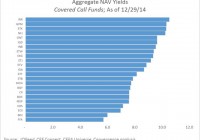
Summary There are 20+ covered call CEFs that Convergence Investments considers potentially investable. Funds can be measured and should be evaluated based on income generation, NAV performance, valuation, and a variety of other factors. We currently find BDJ, ETJ, and NFJ to be well balanced, attractive funds worthy of investor consideration. Our previous article profiled and analyzed the sector of closed-end funds that utilize covered call strategies. Please refer to that article for a background description on the sector as a whole. This article will dig deeper into specific recommendations of especially attractive covered call CEFs for income-seeking investors to consider. Universe of Included Funds The Convergence investing universe consists of more than 475 closed-end funds across all available equity and bond sectors, after filtering for funds that we consider not investable for a variety of reasons (the most common being size/liquidity, NAV transparency). The covered call segment consists of the following closed-end funds: BlackRock Enhanced Equity Dividend Trust (NYSE: BDJ ) BlackRock International Growth & Income Trust (NYSE: BGY ) BlackRock Global Opportunities Equity Trust (NYSE: BOE ) BlackRock Enhanced Capital & Income Fund (NYSE: CII ) Eaton Vance Enhanced Equity Income Fund (NYSE: EOI ) Eaton Vance Enhanced Equity Income Fund II (NYSE: EOS ) Eaton Vance Risk-Managed Diversified Equity Income Fund (NYSE: ETJ ) Eaton Vance Tax-Managed Buy-Write Opportunities Fund (NYSE: ETV ) Eaton Vance Tax-Managed Global Buy-Write Opportunities Fund (NYSE: ETW ) Eaton Vance Tax-Managed Diversified Equity Income Fund (NYSE: ETY ) Eaton Vance Tax-Managed Global Diversified Equity Income Fund (NYSE: EXG ) First Trust Enhanced Equity Income Fund (NYSE: FFA ) GAMCO Natural Resources Gold & Income Trust (NYSE: GNT ) Guggenheim Enhanced Equity Income Fund (NYSE: GPM ) ING Global Advantage & Premium Opportunity Fund (NYSE: IGA ) ING Global Equity Dividend & Premium Opportunity Fund (NYSE: IGD ) Cohen & Steers Global Income Builder (NYSE: INB ) Voya Natural Resources Equity Income Fund (NYSE: IRR ) Madison Covered Call & Equity Strategy Fund (NYSE: MCN ) Madison Strategic Sector Premium Fund (NYSE: MSP ) NFJ Dividend & Premium Strategy Fund (NYSE: NFJ ) Columbia Seligman Premium Technology Growth Fund (NYSE: STK ) Evaluating Investment in Covered Call Funds There are many qualitative and quantitative factors that prospective investors can consider when evaluating a closed-end fund. Convergence Investments summarizes these many factors into six dimensions useful for comparing and choosing investments: Distribution Yield – How much – and what type(s) – of distribution (aka “yield”) does the fund offer? How likely is it that the fund can maintain or increase this distribution in future? NAV Performance – How has a sector’s or individual fund’s NAV changed in the recent past? What is the outlook for future NAV trends? Valuation – Where is the current market price relative to current NAV for a fund or sector? How does this premium (or discount) to NAV compare to the past and to other fund categories? Risk – What level and type of risk is an investor bearing to earn distributions and potential capital gains? Stewardship – Does a fund have strong management? Are its management fees reasonable? Does the board have shareholder-friendly policies in place? Tradability – How readily can we take a position (long or short) in a particular fund? What are the liquidity (market cap, average daily volume) and trading costs (average spreads, short borrow fees) involved? Distribution Yield Significant distribution yields are among the top motivators for closed-end fund investors. While there are many nuances to fund distributions, including how they’re generated and how sustainable they appear to be, the top-line yield number drives much of the sentiment and investor behavior. Generally, funds within the segment offer a NAV yield* of between 6 and 10%. However, investors seeking superior yield within the this sector may give special consideration to NFJ, STK, GPM, or IRR, all of which boast distribution yields of greater than 10% of NAV. *Note that numbers quoted here are calculated as a percentage of NAV rather than market price to provide a more accurate measure of the income generated from portfolio assets. Investors holding closed-end funds at a discount to NAV will earn yields greater than the NAV yields. For instance, a fund trading at a 10% discount will have a price yield of 10/9 ths or 1.11x the NAV yield. (click to enlarge) Seasoned CEF investors know that distribution rates (often referred to as “yield”) are not all created equal. The source of distributions matters as much as the size of distributions in determining the attractiveness of the income stream generated by a given fund. In the case of covered call CEFs, return of capital (ROC) is quite common and, in our view, is usually a positive – or at least neutral – feature of a fund. Please see our previous article for further explanation. The below chart ranks each covered call fund by the estimated** effective tax rate on distributions in the past 12 months for a hypothetical taxpayer based on the allocation of each fund’s distributions to the four buckets of distributions: ROC, long-term gains, short-term gains, or income. The author is not a tax expert. This analysis is for illustrative purposes only and does not constitute tax advice. It’s somewhat surprising how widely the effective tax rates vary for the funds, at least in the current period. Note that ROC distributions have the effect of lowering cost basis and thus trigger increased capital gains upon eventual sale of the fund. Certain funds, such as GNT, may have low effective tax rates in part because they have declined substantially in NAV so may be selling positions at a capital loss. However, other funds like EXG which have also eroded NAV in the past year and purport to be tax managed, had distributions taxed at effective rates of upwards of 40% in this hypothetical case. Categorization of distributions can change dramatically from year to year so do not treat this analysis as anything other than an illustration of the importance of carefully monitoring changes to the taxation status of your funds’ distributions. (click to enlarge) **This estimate assumes a California married-filing-jointly household with AGI of $400,000 with tax rates as follows: ROC is tax free (note: ROC reduces cost basis and will trigger increased taxable gains upon sale of the fund) Long-term gains are taxed at 29.1% (15% federal, 10.3% state, 3.8% NII) Short-term gains and income are taxed at 47.1% (33% federal, 10.3% state, 3.8% NII) NAV Performance Investors disagree about how to interpret recent increases in net asset value. Momentum-oriented investors may see this as a trend likely to continue while mean reversion investors may see exactly the opposite. Convergence generally views recent increases in NAV as a positive factor at both the sector and fund level because we believe that sentiment-driven fund flows tend to play out over months and quarters, not days and weeks. We also view increasing NAV as an indicator of manager skill and of protection against cuts to a fund’s distribution. Covered call funds have varied widely in the past 12 months with some funds like GNT, IRR, and BGY falling more than 15% in the past year while others like STK, FFA, and EOS have grown NAV by 5+ percent. (click to enlarge) Valuation A major reason to invest in closed-end funds rather than ETFs or traditional mutual funds is the possibility for informed investors to take advantage disconnects between fund price and fund NAV, often referred to as the fund’s premium or discount. We seek to purchase funds at sizeable discounts, and ideally at discounts beyond that which is normal relative to history and/or relative to a fund’s peers in category. Purchasing at a discount offers two attractions. First, purchasing at a discount enhances yields since an investor can own the rights to the income generated from a hypothetical $10 of net assets with only $9 of investment. Second, for investors willing to actively manage their holdings, funds purchased at particularly wide discounts can be sold at narrower discounts – or even premiums – for capital gains that enhance the total returns from a fund. Note: Convergence follows the convention of representing all premiums (price > NAV) as a positive number and all discounts (price < NAV) as a negative value. Among the funds in this sector all but two trade at discounts to NAV, and several including MSP, BOE, MCN, BDJ, BGY, and IGD, trade at double-digit discounts. It's worth noting that deep discounts have not always been the rule in this fund category, with the group in aggregate priced at a premium to NAV as recently as mid-2010. (click to enlarge) Risk There are no free lunches. Covered call CEFs offer high single-digit or even double-digit yields to investors as compensation for the various risks that investors are being asked to take. Covered call CEFs most significantly expose investors to equity market risk, measured by "beta" to the broader S&P 500 index. We believe this metric is most useful when comparing day-to-day measurements of NAV, rather than price, vs. the broader market to accurately measure how much market risk the portfolio itself is exposed to. While all funds in the category have a beta less than 1.0 (i.e., are relatively less sensitive to market volatility than an S&P 500 index fund), certain funds such as ETJ, IRR, and MSP carry beta factors below 0.7 and may be suited to investors looking to avoid equity market risk. (click to enlarge) A second type of risk to which covered call CEF investors are exposed is concentration risk , or the lack of diversification within the portfolio's holdings. To some investors, concentration in a single sector (e.g., Financials) may be a feature rather than a bug. Seligman's STK, after all, is a top performing fund in part because it's concentrated in technology stocks. However, most investors will prefer diversification to concentration. The below chart illustrates each fund's concentration of holdings in seven major sectors and ranks (from top to bottom) concentration, calculated in a manner similar to the Herfindahl Index from the field of antitrust law. Almost all funds in the category are well diversified but investors should be aware that IRR, STK, and GNT all carry specific investment mandates that must be suited to their needs and beliefs. (click to enlarge) Expenses Expense ratios are almost universally accepted as an important criteria in fund selection. However, the unique structure of closed-end funds makes the calculation of relevant expense ratios non-trivial. Convergence favors using a measure of management fees, excluding cost of leverage, as a percent of gross assets instead of the typically higher ratio that complies with "40 act" reporting requirements. In our opinion, the ability of CEFs to use leverage with borrowing costs far below what we would pay a broker is to our benefit and cost of capital borrowed for investors' benefit should not be a strike against fund managers. Further, we believe that measuring the expense ratio we pay to fund managers per dollar of portfolio assets they are managing is a more fair way of measuring value-for-money when comparing fees among CEFs or when comparing CEFs to unlevered structures like mutual funds and ETFs. All funds in this category charge fees of between 0.8% and 1.25% per annum, which we believe to be reasonable in consideration of the relatively active nature of covered call strategies. (click to enlarge) Liquidity Liquidity, or how easily an investor is able to find a willing counter-party to a buy or sell transaction, is a metric whose importance varies greatly by individual investor. On one extreme, an investor purchasing only a few hundred shares of a fund with intentions of holding for months or years should care very little about liquidity. However, investors trading in moderate to large quantities, and with intentions of medium to short holding periods, should begin to consider fund liquidity as an important hidden cost to investment. Funds including MSP and MCN are illiquid enough that even relatively modestly sized trades may represent a meaningful share of daily market volume. Investors should exercise caution with lower liquidity funds, potentially limiting total investment and scaling in/out of positions in small volumes. (click to enlarge) Conclusion As this article has outlined, there are many dimensions on which you may compare funds. However, we highlight three funds of interest based on their across-the-board attractiveness. BlackRock Enhanced Equity Dividend Founded 10 years ago, the current management has been in place since 2010. Its portfolio of holdings can be characterized as blue chip. Recent changes in the source of distributions from ROC to income and more recently back to primarily ROC may have contributed to the discount to NAV to widen to a very attractive 12%. We believe the stewardship is strong with management fees below 1% and absence of a managed distribution policy. It offers a dividend reinvestment plan which has all dividends and distributions reinvested in shares unless otherwise directed. EV Risk-Managed Diversified Equity This fund distributes an annualized 10%+ monthly based on a NAV which is discounted nearly 12% in current trading, though recent performance has lagged behind peers. Unlike many of its peers, recent distributions have been largely characterized as income rather than ROC. It has a funds reinvestment policy that, unless the shareholder directs otherwise, all distributions will be reinvested. As is typical of the segment, it carries no leverage. Its holdings are fully invested in large US equities. AllianzGI NFJ Dividend Interest & Premium This fund seeks to pay current income while producing capital appreciation. It distributes at a rate of 11% which has recently been characterized primarily as ROC so as to minimize tax impact. It has a history of trading near NAV, making the current ~8% discount to NAV an attractive entry point. The fund is somewhat concentrated in financials (23%) and energy (14%) which may explain the recent widening of discount. Over 10% of assets are in foreign stocks. Management fees are slightly less than 1% and its historically successful portfolio managers have been in place since the fund's inception in 2005. Additional disclosure: Convergence Investment Management may recommend various securities included within this article for inclusion for individual client portfolios. These recommendations may change at any time and are specific to the individual client's objectives and risk tolerance.