Tag Archives: load

Protect Profits By Implementing A Risk Reduction Strategy
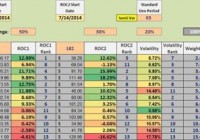
Improve Returns by Staying Out of Trouble. The Importance of Implementing a Circuit Breaker. Is It Working? Back-Testing Issues Explored. Portfolio return and risk are bound together, but there is a way to minimize losses most investors endure in long bear markets of the type experienced in 2008 and early 2009. How does it work? The sample portfolio described below is made up of ten randomly selected dividend aristocrat stocks plus the Vanguard Total Stock Market ETF (NYSEARCA: VTI ), and two treasury ETFs, the iShares 20+ Year Treasury Bond ETF ( TLT) and the iShares 1-3 Year Treasury Bond ETF ( SHY). VTI and TLT are included as references for equity and bond performance levels. SHY is critical as it is the “circuit breaker” ETF. In other words, reduce portfolio draw-down by staying away from securities that under-perform SHY. Investors will populate the ranking spreadsheet with their own holdings. The sample portfolio holds stocks and ETFs for demonstration purposes only. SHY is the exception as it serves as the ranking cutoff ETF. In the sample portfolio below, an investor holding these securities would sell off Johnson & Johnson ( JNJ), AT&T (NYSE: T ), Coca-Cola (NYSE: KO ), and Chevron (NYSE: CVX ) as these four stocks are ranked below SHY based on three metrics (these three metrics are defined in greater detail in prior Seeking Alpha articles ): Performance over the past 91 calendar days. Performance over the past 182 days. Volatility as measured by a semi-variance calculation. The investing model is as follows. Sell securities that are under-performing SHY based on a performance and volatility ranking model. Purchase the top ranked securities. Depending on how much one wishes to concentrate the portfolio the number of securities will vary. I prefer to work with ETFs so I will rank 10 to 15 Exchange Traded Funds and purchase two to five of them so long as they are ranked above SHY. If no securities are ranked above SHY, then hold the cash in a money market or invest in SHY as it is a low volatile security. (click to enlarge) I’m frequently asked, how well does this model perform when back-tested? Any investment model, when back-tested, is prone to all sorts of uncertainty. Here are a few that quickly come to mind. Stocks and ETFs are purchased throughout the trading day whereas back-tests use closing day prices. Price differences over a multi-year study add significant uncertainty into the final performance results. Many investors use limit orders so it may be days before a limit order is struck and there are times when the order is never placed. The start and end dates of a back-test has a major impact on the end performance results. When using ETFs for back-testing, many do not have years of historical data, thus crippling the results. In the above rankings, how many securities are selected for investment? If two work best in the study how can one be sure it will work out best going forward? Many back-tests “over curve-fit” only to deceive the reader. Is the model an anomaly that will disappear as more investors use it? Staying out of trouble has yet to be fully tested as this model has only been operational for less than one year. Nevertheless, the results are positive when working with ETFs that cover broad indexes such as U.S. REITs, Commodities, Gold, International Bonds, U.S. Bonds, U.S. Equities, International REITs, etc. I am tracking the performance of eleven portfolios, each with a different launch date. Each portfolio is reviewed every 33 days and the reviews are scattered throughout the month. Portfolios are analyzed to see if the performance at the end of each week is trending up or down based on the performance six weeks ago. For nearly every portfolio, those trends are positive. While results are reported each week, only trends over many months will answer the question – is this a valid risk reducing model? A “good” bear market will also help to answer the question.

Junior Gold Miners Outperforming Other Asset Classes In 2015

Precious Metals and Junior Miners May Be Bottoming. Gold is breaking above critical 200 day moving average. Positive Trend Change in Gold? Oil and Copper Collapsing unable to deter gold rally. Stick to high quality gold mining assets in stable mining jurisdictions. For weeks I have been predicting that precious metals and the junior gold miners would bottom and outperform in January. Now gold (NYSEARCA: GLD ) is breathtakingly breaking above the key 200 day moving average and breaking four month highs as the World looks to gold as a safe haven. The intermediate to long term trend may be turning positive for gold and silver (NYSEARCA: SLV ) and unfortunately the amateur investor has already panicked out or may be covering their shorts. (click to enlarge) This breakout in gold could end the lower high pattern or downtrend. Sentiment is changing from negative to positive. Already for weeks , I highlighted the positive momentum in the junior gold miners (NYSEARCA: GDXJ ) despite the new low in December. This divergence usually signals an interim bottom and turning point. A few weeks ago precious metals and the shares were hitting new lows. The amateur investor panicked out. I told my subscribers to hang on and buy more at the bottom. Now the Junior Gold Miners are up over 14% since the beginning of the year outperforming the S&P500 (NYSEARCA: SPY ) and US dollar (NYSEARCA: UUP ). Despite oil and copper (NYSEARCA: JJC ) collapsing along with equities, precious metals and mining stocks (NYSEARCA: GDX ) appear to be bottoming and showing great relative strength. Right now, gold as a safe haven may be where the action is greatest. The US dollar may peak as investors realize that the US economy is still far from recovered. The oil and copper collapse is giving a loud shout to investors that the global economy is nowhere near recovery and looks more like the 2008 Financial Armageddon. One of the few things that can maintain its purchasing power in this sort of market is gold. Believe it or not another yellow metal which has held up well despite the 50% correction in oil is uranium. I told my subscribers at the end of 2014 that smart investors should be defensive against the overbought equities with inverse S&P500 ETFs such as Proshares Short S&P 500 (NYSEARCA: SH ) or a short financial fund (NYSEARCA: SEF ) and go long gold and junior gold miners in this sort of chaotic environment. The banks are sitting on major energy losses, while the S&P500 is made up largely of energy stocks and companies who profit off of emerging economies. It is way overbought and we could witness a powerful crash in equities that mirror the oil crash. I believe mining assets with real potential could come back into favor. I am accumulating hoping that within the next decade we could see a major run higher in this sector. Eventually, the trillions of debt will be paid back with devalued US dollars. Rising interest rates and inflation could pick up in 2015 especially in the US benefiting our beaten down wealth in the earth sector. Real gold mining assets in stable jurisdictions will go up in value. It is only a matter of time and patience. I like the junior gold miners especially the explorers now in Nevada and Quebec. Governments can print another trillion dollars by pressing a button at the printing press. This can’t be done in the gold exploration business. It takes years and a lot of divine blessing to find a million ounces of gold. Investors may now be able to believe this as gold breaks above the 200 day moving average. Now that you’ve read this, are you Bullish or Bearish on ? Bullish Bearish Sentiment on ( ) Thanks for sharing your thoughts. Why are you ? Submit & View Results Skip to results » Share this article with a colleague

GDF Suez Shares Should Get Re-Rated

GDF Suez is uniquely positioned to capture the benefits of changing energy markets. Its vertical integration mitigates against the fallout from commodities, especially in LNG. The shares should see a re-rating as management delivers growth ahead of the sector. One of my core names for exposure to the mega trends of energy. The positioning of GDF Suez in global energy across various value chains is unique. Management has highlighted an area of strength and taken the next strategic step in the current energy cycle: Return to growth. That should see a positive reaction and lead to a re-rating of the shares. GDF Suez has highlighted its areas of strength for growth , Asia, Middle East and Africa. The company is building these as core growth regions. That makes sense given its already strong position in those regions and above average growth. Looking through current weakness, energy demand growth will likely exceed 7% CAGR to the end of the decade (source: IEA). Management also has proactively moved to the post deleveraging phase by committing to new growth. The company targets growth capex of Eur6.5-7.5bn for 2014-18. It is looking to dedicate about 20-30% of growth capex spend to Asia, Africa, and the Middle East. With that, GDF Suez stands out, not only amongst European utilities who are undergoing slow and painful transitions in order to identify new growth opportunities. It also stacks up very well against the global oil and gas sector that is struggling to deliver reserve growth whilst cash flows are strained by weak commodities. Asia, Africa, the Middle East are regions of strong new growth so it makes sense that they are at the core for GDF Suez. IPP, LNG and energy services are the key growth businesses, in line with its tested strategy. The company’s target regions account for over 80% of global energy growth over the next 20 years. The latest guidance implies power capacity growth in the above target regions of 6% CAGR, 2P reserves growth of 8.8% CAGR and energy services revenue growth of 7.9% CAGR to 2020 on the target areas. The regions currently account for c 7% of Ebitda. Visibility on growth is very good. The pipeline provides for 30% power capacity growth to 2020. I would only consider capacity under construction at this stage, which is just short of 1GW. The IPP model is tried and tested and merchant risk very low. GDF Suez has a very good track record of securing PPA’s at good conditions and in strong local partnerships. I expect that and the strong execution capability to continue to as the basic earnings driver. E&P reserves growth of 5-7% is at the high end of the sector, and the gas focus in line with the broader sector. But I see GDF Suez better hedged than the average of the E&P sector, because of its vertical presence all the way through the chain. With that, I think it stands a better chance of profitable reserves conversion to earnings growth to 2020. LNG is a risky sector at this moment. Asian demand weakness and weak oil prices are leading to price falls. Over-capacity is creeping into the market. New capacity build risks not meeting its hurdle rates. Suez currently has a feasibility study under way for an Indonesian LNG terminal. There I see risk of delay. The same goes for the floating LNG terminal project in India. I also see risk of lower utilization of the US terminals. The US Cameron liquefaction terminal may escape the heart of the storm, it won’t come to market before 2018. But the company’s vertically globally integrated business provides for mitigation. Pricing risk for the Japan and Taiwan LNG contracts is in my view relatively low as they were concluded at very tight pricing in the first place. Eventually, gas demand in Asia will recover. On average, the IEA estimates demand growth of 4%pa to 2035 with corresponding infrastructure investment requirement. The industry estimates over USD 100bn of liquefaction and storage capex requirement alone. And for that, the company’s positioning across upstream, infrastructure and power generation is second to none. The changing structure of energy markets with distributed generation, renewables and gas/power convergence are all playing to the company’s strength. The energy services business will be a major beneficiary and additionally deliver strong synergies to these new growth businesses. It will also be a growth driver in its own right in China and a door opener for other business development. GDF Suez has a unique advantage through the combination of its IPP, global gas and energy services business. That is in my view the true attraction of the company. Sentiment will likely be cautious on commodities, but should increasingly return to reflect the early move and strong position on long term growth. This is one of my core names for exposure on the global energy mega trends. The shares trade on a 20% discount to the European utilities sector and offer a well supported 5% yield. Editor’s Note: This article discusses one or more securities that do not trade on a major exchange. Please be aware of the risks associated with these stocks.