Tag Archives: lists

A Look At The Breakdown In Alternative Income ETFs
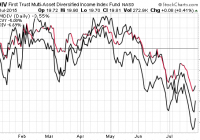
Summary Income investors are often obsessed with the search for yield despite the typical conservative nature of their demographic. Once considered taboo, asset classes such as junk bonds, MLPs, mortgage REITs, and other high yield investments are now common place in many of the portfolios. Now we are starting to see slow signs of decay in junk bond prices as spreads widen and risk appetites in credit securities pull back. Income investors are often obsessed with the search for yield despite the typical conservative nature of their demographic. The half decade of zero returns in safe assets such as CDs and savings accounts has created a reach for yield that has stretched the boundaries of sound portfolio discipline. Once considered taboo, asset classes such as junk bonds, MLPs, mortgage REITs, and other high yield investments are now common place in many of the portfolios that I review. The seemingly one-sided demand has helped generate relatively solid returns and uncommonly low volatility over the last several years as well. Now we are starting to see slow signs of decay in junk bond prices as spreads widen and risk appetites in credit securities pull back. This same pattern has been exacerbated in alternative income funds with overweight positions in non-traditional income fields with juicy yields. As an example, the First Trust Multi-Asset Diversified Income Index ETF (NASDAQ: MDIV ) carries 80% of its portfolio in preferred stocks, junk bonds, real estate, and MLPs. The remaining 20% is in traditional dividend paying stocks. This ETF has a current 30-day SEC yield of 6.36%, which any income investor would tell you is phenomenal when 10-Year Treasury bonds are paying just 2.25%. Yet like most things in life, there is no free lunch in the income world. A reach for yield carries with it higher concomitant risk of capital loss through credit contraction, deleveraging, interest rate cycles, and other exogenous factors. Before today’s bounce, fund’s like MDIV were trading near their lows of the year despite the relatively sideways price action of traditional broad-based equity benchmarks. This decoupling of high yield and alternative assets from the major stock market indices should be viewed through a cautionary lens. I’m not trying to pick on MDIV by any means. A look at other similar funds in this class include the Guggenheim Multi-Asset Income ETF (NYSEARCA: CVY ) and the Global X Super Dividend U.S. ETF (NYSEARCA: DIV ). These ETFs contain many of the same fundamental holdings and are showing similar trends of sliding prices. A look inside specific sector funds such as the ALPS Alerian MLP ETF (NYSEARCA: AMLP ) and the iShares Mortgage Real Estate Capped ETF (NYSEARCA: REM ) confirms the weakness as well. So how does a retiree or income investor maintain their purchasing power while still maintaining a solid grasp on dividends? The first step is evaluating your exposure to these riskier income assets by determining how much of your portfolio they represent. If its less than 10%, then you are likely not as concerned about the recent volatility. Yet, if they represent 25% of your portfolio or more, you may want to consider taking action to create a more balanced asset allocation. Those with an overweight position in high yield investments that find themselves uncomfortable during this drawdown may want to consider cutting back their exposure. This could include temporarily adding back to cash or moving to more traditional assets such as dividend paying stocks or higher quality bonds. The trade off of course is that you may not receive the same monthly or quarterly income that you are accustomed to. Nevertheless, the ability to sleep well at night knowing that your capital is not susceptible to wild swings may assuage that temporary concern. Picking which asset class to move the funds to will likely depend on the makeup of the other positions in your portfolio. You may end up pairing multiple asset classes together to smooth out volatility and further diversify portfolio. Remember that it’s ok to step away from strict income investments in order to focus on capital preservation or total return. If you do move to cash, make sure that it is a temporary transition that is not going to leave you with a significant chunk of money on the sidelines for an extended period of time. One of the biggest mistakes I see investors make is having too much cash on hand for years and years without a sound game plan to put it back to work. Putting Thoughts Into Action I recently took at step away from high yield investments for my Strategic Income clients and added to a high quality mix of stocks in the iShares MSCI USA Minimum Volatility ETF (NYSEARCA: USMV ). This transition expanded the modest equity sleeve of my portfolio into an index that is continuing to maintain a steady uptrend. While the move actually lowered the overall yield of the portfolio, it positioned us for a bounce higher in the broader stock market and reduced the credit volatility that was acting as a drag on returns over the last two months. Despite this move, I haven’t completely abandoned the alternative income theme altogether. My income portfolio is still holding the iShares U.S. Preferred Stock ETF (NYSEARCA: PFF ), which has maintained a steady price trend despite the volatility in interest rates. Moving forward, I will be closely evaluating how these investments comingle together and making additional adjustments as necessary. Changes of this nature are not always easy when an investment is falling in price. You never know if you are picking the right spot or going to get whipsawed in the wrong direction. That is why I strive to change the portfolio incrementally in order to avoid falling into the trap of over commitment to a single outcome. Disclosure: I am/we are long USMV, PFF. (More…) I wrote this article myself, and it expresses my own opinions. I am not receiving compensation for it. I have no business relationship with any company whose stock is mentioned in this article. Additional disclosure: David Fabian, FMD Capital Management, and/or clients may hold positions in the ETFs and mutual funds mentioned above. The commentary does not constitute individualized investment advice. The opinions offered herein are not personalized recommendations to buy, sell, or hold securities.

More Interest Rate Hedged ETFs Come To Market

Bond ETFs could take a hit in a rising interest rate environment. BlackRock’s iShares launches two new interest rate hedged bond ETFs. A look at the iShares Interest Rate Hedged Emerging Markets Bond ETF and Interest Rate Hedged 10+ Year Credit Bond ETF to generate yields and hedge against higher rates. With Treasury yields rising in anticipation of the Federal Reserve potentially boosting interest rates later this year, issuers of exchange traded funds continue to meet advisors and investors for alternative fixed income exposure with interest rate hedged ETFs. BlackRock’s (NYSE: BLK ) iShares, the world’s largest ETF issuer, doubled the size of its interest rate hedged ETF lineup with the debuts of iShares Interest Rate Hedged Emerging Markets Bond ETF (NYSEArca: EMBH ) and the iShares Interest Rate Hedged 10+ Year Credit Bond ETF (NYSEArca: CLYH ) . Both are actively managed funds. Unlike traditional bond ETFs, the rate-hedged bond ETFs try to mitigate the negative effects of a rising rate environment through shorting Treasury futures to match the overall duration of their diversified bond holdings. Looking further out, these types of hedged-bond ETFs could provide suitable exposure to the fixed-income market in a rising interest environment, especially as the Federal Reserve plans on hiking rates sometime later this year. The iShares Interest Rate Hedged 10+ Year Credit Bond ETF “seeks to provide exposure to long-term U.S. investment grade bonds while mitigating interest rate risk by holding CLY (iShares 10+ Year Credit Bond ETF) and short positions in interest rate swaps,” according to iShares . Nearly two-thirds of CLYH’s bond holdings have maturities of 20 years or more with another 16% having maturities of 15 to 20 years. Forty-six of the new ETF’s holdings are rated BBB with another 33% rated A and 10.4% carrying AA ratings. The iShares Interest Rate Hedged Emerging Markets Bond ETF holds the iShares J.P. Morgan USD Emerging Markets Bond ETF (NYSEArca: EMB ) , the largest emerging markets bond ETFs, short positions in interest rate swaps. EMB is a popular yield play with a 30-day SEC yield of 5.04%, according to iShares data , but an effective duration of 7.24 years makes the ETF vulnerable to hawkish changes in Fed policy. EMBH helps alleviate that concern with an effective duration of just 0.22 years. “iShares interest rate hedged ETFs are the industry’s first actively managed interest rate hedged products that can potentially benefit from the established liquidity of existing bond funds. By holding shares of EMB and CLY in combination with interest rate swaps, EMBH and CLYH provide easy access to cost effective potential solutions for investors who are attempting to mitigate interest rate risk,” according to iShares. iShares introduced its first rate hedged ETFs in May 2014, the iShares Interest Rate Hedged Corporate Bond ETF (NYSEArca: LQDH ) and the iShares Interest Rate Hedged High Yield Bond ETF (NYSEArca: HYGH ) . Tom Lydon’s clients own shares of EMB. Disclosure: I/we have no positions in any stocks mentioned, and no plans to initiate any positions within the next 72 hours. (More…) I wrote this article myself, and it expresses my own opinions. I am not receiving compensation for it. I have no business relationship with any company whose stock is mentioned in this article.

Here’s Why I Am Staying Away From California Water Service Group

Summary California Water Service Group is a water utility serving California, Washington, New Mexico and Hawaii. California Water Service Group generated free cash flow in only two of the past 19 years. California Water Service Group possesses a high amount of long-term debt. It’s important for long-term investors to develop a guide for doing their investment research. Over the years, I have developed questions to guide me in my thinking when researching the publicly traded universe. Today, let’s talk about California Water Service Group (NYSE: CWT ). 1.) What does the company do? When you buy shares in a company you effectively become part owner of that company. Therefore, it’s important for an investor to understand what a company sells. California Water Service Group sells water. The company operates mainly on the west coast in states such as California, Washington, New Mexico and Hawaii. It operates regulated and non-regulated businesses. 2.) What do the fundamentals look like? Investors should also look for companies that grow revenue and free cash flow over the long term, retaining some of that cash for reinvestment back into the business and for economic hard times. Excellent revenue and free cash flow growth serve as catalysts for superior long-term gains. California Water Service Group expanded its revenue and net income 32% and 63%, respectively, over the past five years (see chart below). CWT Revenue (TTM) data by YCharts California Water Service Group operates in a highly regulated business which constrains operations. Also, drought conditions make operating a water utility difficult. Moreover, the company has only been free cash flow positive in two of the past 10 years, according to Morningstar. Large amounts of capital expenditures exceed operating cash flow due to the capital intensive nature of the business. Capital maintenance of this nature leaves little room for expansion and tangible capital returns to shareholders in the form of dividends, which can contribute heavily to any stock market return. I like to see companies expand their free cash flow over the long term. This gives an indication that a company can stand on its own two feet. California Water Service Group sports a lousy balance sheet by my standards. In the most recent quarter, the company possessed $33.3 million in cash and equivalents, which equates to a mere 5.4% of stockholders’ equity. I always like to see companies with cash amounting to 20% or more of stockholders’ equity to get them through tough times. California Water Service Group’s long-term debt amounts to 68% of stockholders’ equity. I like to see companies keep long-term debt at 50% of stockholders’ equity or less. Operating income only exceeded interest expense by three times in FY 2014. The rule of thumb for safety lies at five times or more. Like most utilities, California Water Service Group does pay a dividend. However, its dividend sustainability doesn’t hold water. I like to see companies pay out less than 50% of their full-year free cash flow in dividends, retaining the remainder for other things. Last year, California Water Service Group ran a free cash flow deficit, meaning that the dividend came from sources other than free cash flow. Currently, the company pays its shareholders $0.67 per share per year and yields 2.9% annually. California Water Service Group’s sub-par fundamentals only translated into 48% total return for the company’s shareholders vs. 114% for the S&P 500 as a whole (chart below). CWT Total Return Price data by YCharts 3.) How much management-employee ownership is there? Investors should always look for businesses where the managers and/or employees own a lot of stock in the company. Managers with a great deal of stock in the company will take better care to maximize company profits, which will enhance share price and their personal wealth along with the wealth of shareholders. According to California Water Service Group, company executives each own less than 1% of the company’s stock. This isn’t too big of a deal, this just mean that management lacks the extra incentive provided by huge ownership of the company. 4.) How does its “Report of Independent Registered Public Accounting Firm” stack up? Every year a company employs external auditors to audit financial statements and evaluate whether the company maintains adequate financial controls. At the conclusion of the audit, you want to see a letter from auditors with the language “unqualified” or “fairly presents”, which generally means that the financial statements and internal systems in constructing them were clean or adequate. If you see “qualified” or “adverse” in the auditing letter’s language, then deeper issues in a company’s financial statements may exist. According to California Water Service Group’s latest auditing statement, the financial statements were presented fairly and the company maintained adequate internal controls. 5.) What types of risk does it have? It’s always important for investors to weigh the various risks such as exposure to political risk in parts of the world where war is the norm, competitive positioning, and market price risk. California Water Service Group operates exclusively in the United States, which means political risk resides in the minimum range. California Water Service Group represents an infrastructure stock, meaning there is little or no competition in its service area. The barriers to entry reside in the high range due to regulatory and capital hurdles to entering the business. However, drought conditions could increase regulatory scrutiny and the introduction of more exotic accounting. California Water Service Group’s market price risk actually resides in the low range. The company’s P/E ratio clocks in at 18 vs. 19 for the S&P 500 as a whole, according to Morningstar. 6.) What does its forward analysis look like? Just because California Water Service Group is a needed water utility doesn’t mean that it’s risk free. I prefer to see companies generate free cash flow on their own and possess a margin of safety in terms of interest cost coverage. Regulatory conditions combined with high capital maintenance will make it difficult for the company to generate free cash flow, which represents the life blood of things like superior capital gains and dividend increases. I am keeping my investment dollars away from this company. Disclosure: I/we have no positions in any stocks mentioned, and no plans to initiate any positions within the next 72 hours. (More…) I wrote this article myself, and it expresses my own opinions. I am not receiving compensation for it (other than from Seeking Alpha). I have no business relationship with any company whose stock is mentioned in this article.