Tag Archives: investing ideas

Duke Energy: Dividend Increase Coming – What Investors Should Expect

Summary Income investors flock to utilities for stable, high dividend yields. One of the most popular utility stocks is Duke Energy, which has paid dividends for 89 consecutive years. Duke should announce a dividend increase within the next few weeks. Management has a stated dividend policy relating to the company’s payout ratio, which can guide investor expectations. This article will outline what investors can reasonably expect when Duke Energy increases its dividend. Investors who buy utility stocks presumably do so for their strong dividend payments. Indeed, well-run utility stocks displayed a tremendous ability to pay dividends quarterly like clockwork, and even raise those dividends over time. They can do this because of their steady business models. After all, people will always need to heat their homes and keep the lights on, regardless of what the broader economy is doing. This results in a very reliable and consistent stream of profits, year after year. Within the next several days, it’s likely Duke Energy (NYSE: DUK ) will raise its dividend for shareholders. After yet another successful year, it’s that time once again for Duke to bump up its cash payout. The company typically increases its dividend in late June or early July, meaning another increase is coming soon. With all this in mind, here’s what Duke Energy investors should expect to receive in terms of a dividend increase. Slow And Steady Wins The Race Duke Energy fits the mold of a classic “widows-and-orphans” utility. It produces steady, albeit unspectacular, earnings growth, which then fuels modest dividend growth from year to year. Last year , Duke grew adjusted earnings by 4.3% year over year, to $4.55 per share. One reason for Duke’s earnings growth is that it is aggressively cutting costs in the aftermath of its acquisition of Progress Energy in 2012. Since then, Duke has realized approximately $550 million in operating and maintenance cost savings. Another key factor behind Duke’s success is that it operates a large regulated business. Among utilities, I favor the regulated operators, because regulated utilities frequently achieve favorable rate outcomes. This provides them with steady rate increases from year to year, which virtually ensures rising revenue. In fact, Duke’s regulated business was the major reason for its very strong performance in the first quarter . Duke grew adjusted EPS by 6% in the first quarter 2015, year over year, which represented a meaningful acceleration from its earnings growth in 2014. Duke’s regulated utility business led the way, with 5% earnings growth. This is a significant driver for Duke since its regulated business represents 85% of its total profits. Going forward, Duke expects to have another successful year in 2015. Management forecasts full-year adjusted earnings to reach $4.55 per share-$4.75 per share. This would represent as much as 4.3% earnings growth year over year. Last year, Duke Energy raised its dividend on July 1. The year before, the increase was announced on June 25. Therefore, investors should expect the company to increase its dividend very soon. Reasonable Expectations For A Dividend Increase Duke Energy has a long history of paying and raising its dividend. It has paid a dividend for 89 consecutive years and has increased its dividend for seven years in a row, since the spinoff of Spectra Energy in 2007. Duke Energy seeks to keep its dividend payout ratio at between 65%-70% of its adjusted diluted earnings per share. In 2014, Duke Energy raised its payout by 2%. The company projects a similar level of earnings growth this year as last year, so investors should reasonably expect a similar dividend increase as well. With all this in mind, I would expect Duke Energy to increase its quarterly dividend by 2% to $0.81 per share. Annualized, Duke’s dividend would reach $3.24 per share. This would represent 69% of Duke’s adjusted earnings per share expectations for 2015, at the midpoint of its forecast, and would fall right in-line with management’s stated dividend payout ratio policy. Duke Energy: Attractive Sector Pick Another 2% dividend raise this year, to $3.24 per share, would send Duke’s dividend yield up to 4.6% based on its recent $70 stock price. That’s a very attractive yield, both on an absolute basis, as well as in relation to many of Duke’s industry peers. For example, American Electric Power (NYSE: AEP ) yields 4%, while another close competitor, Exelon Corporation (NYSE: EXC ), yields just 3.8%. This makes Duke a very attractive pick within the utility sector. It’s true that Duke Energy’s payout still wouldn’t match up with all of its industry peers. However. Southern Company (NYSE: SO ) yields 5.2% right now. But I’ve written previously about why I believe investors should avoid Southern Company as it is encountering some significant fundamental business challenges. In conclusion, Duke Energy had a successful 2014, is off to another strong start this year, and if all goes according to plan, should pass along another dividend increase to shareholders very soon. For income investors looking for a stable, secure high-yield investment opportunity, Duke Energy should be on your radar. Disclosure: I/we have no positions in any stocks mentioned, and no plans to initiate any positions within the next 72 hours. (More…) I wrote this article myself, and it expresses my own opinions. I am not receiving compensation for it (other than from Seeking Alpha). I have no business relationship with any company whose stock is mentioned in this article.
PPL Remains On Track Despite Spin-Off

When a company spins off part of its business, it may look like shareholders lost money, but in most cases, it’s just a technical adjustment. PPL’s stock hasn’t “fallen,” per se, but instead PPL shareholders now own a portion of newly-created Talen Energy, a stake of which they can do with what they want. After the spinoff, PPL management reaffirmed its 2015 ongoing EPS guidance of $2.05-$2.25, as well as its expected earnings CAGR of 4%-6% through at least 2017. Certainly there’s been a lot of share-price noise at PPL as of late, but the firm continues to execute, and we still like the utility. By Kris Rosemann PPL Corp’s (NYSE: PPL ) shares have been adjusted lower recently, as the firm officially completed the spinoff of its energy supply business June 1. The move finalizes PPL’s transition to a focus on regulated utilities in the US and UK. PPL’s spinoff, now trading under the name Talen Energy Corporation (Pending: TLN ), also includes the addition of RJS Power of Riverstone Holdings. As previously announced , all of the common stock of Talen Energy will be distributed pro rata to PPL shareholders. PPL shareholders received ~.1249 shares of Talen Energy common stock for each share of PPL owned as of May 20. Fractional shares were not issued; instead they were aggregated and sold in the open market, with the cash proceeds distributed pro rata to PPL shareholders. The affiliates of Riverstone Holdings will receive common shares of Talen Energy in compensation for RJS Power, resulting in their owning 35% of Talen Energy. PPL shareholders will own 65%. After the spinoff, PPL management reaffirmed its 2015 EPS from ongoing operations guidance of $2.05-$2.25, as well as its expected compound annual earnings growth rate of 4%-6% through at least 2017. The firm expects substantial rate base growth in the coming years, projecting a CAGR of 7% through 2019, though we note currency headwinds from its UK operations will continue to negatively impact earnings in the near term. Management also stated as recently as February of this year that it expects dividend growth potential to become realizable following the spinoff. The dividend potential of Talen Energy remains to be seen, but the assets that make up the company generated $4.3 billion in revenue in 2014. The newly-created firm will boast a competitive cost structure and the financial agility to pursue additional growth options. At its inception, Talen’s generation capacity of about 15,000 megawatts will be primarily located in the Mid-Atlantic and Texas, two of the largest and most competitive energy markets in the US. Its generation mix is approximately 43% natural gas or oil, 40% coal, 15% nuclear, and 2% hydroelectric. The energy-generating plants will continue to be operated and maintained by the same employees before the spin off, and the firm’s leadership team is partially comprised of former PPL leadership. The drop in PPL’s share price should not come as a surprise, and intuitively, it makes sense. Though at face value it appears that PPL shareholders suffered a decline in the value of their position, the spinoff is a net-neutral one in the sense that the value lost by PPL shareholders in the market will be realized by the receipt of new Talen stock and cash distributions. Our opinion of PPL is relatively unchanged following the spinoff, and we maintain the company is still one of the best-performing utility companies available. We see no need to adjust our holding of PPL in the Dividend Growth Portfolio, though we may view the new shares of Talen Energy as a source of cash. Our fair value estimate already reflects the anticipated spinoff. We value shares of PPL at $30 each at the time of this writing. Disclosure: I/we have no positions in any stocks mentioned, and no plans to initiate any positions within the next 72 hours. (More…) I wrote this article myself, and it expresses my own opinions. I am not receiving compensation for it (other than from Seeking Alpha). I have no business relationship with any company whose stock is mentioned in this article. Additional disclosure: PPL is included in the Dividend Growth Newsletter portfolio.

Xcel Energy Is Entering A Bear Cycle

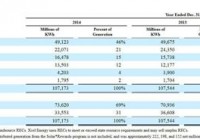
Summary EPA regulations are making coal generation facilities more costly to operate than ever before this is hurting XEL’s bottomline. Natural gas markets are fluctuating, and XEL’s stock price is inversely related. Summer is a seasonal low for natural gas prices, and as NG prices rise, XEL will fall. Xcel is a public utility company that is entering a bear cycle. While the Company pays a solid dividend which yields around 4% , its the revenues are stagnating. The Company has seen average residential electricity rates rise from 10.84 cents in 2012 to 11.89 cents in 2014. As these rates rise higher, solar and distributed generation become more economically attractive. Further, the price for Xcel’s energy is unlikely to decline in the near future, as the Company will have to upgrade its coal-fueled facilities to keep up with government regulation. Additionally Xcel’s stock price is inversely correlated to the natural gas market, when natural gas goes up, Xcel goes down. So if you believe as I do, that natural gas prices will increase over the next few years, Xcel is a sell. Company Positioning: from the 10-K Xcel Energy (NYSE: XEL ) is a holding company with subsidiaries engaged in the utility business. These subsidiaries are wholly owned public utilities that serve electric and natural gas customers in portions of Colorado, Michigan, Minnesota, New Mexico, North Dakota, South Dakota, Texas and Wisconsin. (click to enlarge) from the 10-K Coal is Xcel’s largest fuel input for electricity generation, it represents 46% of Xcel’s portfolio. Natural gas is the second largest with 21% of Xcel’s portfolio. The third largest is wind, with 15%. The Company has decreased its exposure to natural gas generation with approximately a -2% decrease from 23% of the portfolio in 2013 to 21% in 2014. (click to enlarge) from the 10-K As you can see from the table above, Xcel’s two major fuel sources , coal and nuclear, have low costs. Risk Management: from the 10-K (click to enlarge) from the 10-K Stagnating Electric Sales: If Xcel wants to make more revenue, it needs to increase electric sales across the board. It is a worry that there is a decline in growth of residential customers. Additionally Large C&I and Small C&I markets have stagnated. If this continues, Xcel will have difficulty growing. Environmental Regulations: The EPA is pursuing a regulatory path which will make it more costly to own and operate coal plants. These plants will have to be upgraded to stay inline with regulations. The Fluctuating Price for Natural Gas: The natural gas markets have finally leveled off after their long bear decline. Xcel has to effectively hedge against possible rising natural gas price levels to offset its fuel and supply costs. Dividends: (click to enlarge) from dividend.com (click to enlarge) from dividend.com XEL’s dividend historically ranges between $0.2 – $0.4 per share, however for three quarters of 2003 the dividend was not awarded at all. The period in 2003 is the only period which the stock has not paid dividends. The yield of the dividends are typically around 4%. Expert Opinions: (click to enlarge) from Yahoo Finance The median price estimate for XEL is $37 per share which gives the stock a 15.66% upside at its current price of $31.99. The stock has a beta of 0.34 which implies that the stock’s price is loosely related to the general market price. from Yahoo Finance XEL’s growth revenue is expected to slow down by 1% to 3.1% during 2016 year-over-year. Additionally, the Company’s EPS is expected to grow by 5.8% year-over-year. from Yahoo Finance The quarterly earnings growth for XEL was -41.8% year-over-year. Further quarterly revenue growth fell by -7.50% year-over-year. These are not good signs for a public utility company, whose revenues are dependent upon rate-making policy. Natural Gas Market: XEL has a negative correlation of -0.51 with United States Natural Gas Fund (NYSEARCA: UNG ) over a three year period. Summer is traditionally the season low pricing period for natural gas, as winter gets closer and closer we should begin to see the buyers enter to the market to hedge for winter exposures. Look for a seasonal up turn in natural gas markets as we near the end of summer. Recent News: White House recognizes Minneapolis and Xcel Energy for Web tool to help building owners track energy efficiency. Xcel Energy to begin inspecting transmission lines by helicopter Xcel Energy will use drone technology to protect and improve energy reliability and safety Xcel Energy named No. 1 utility wind provider for 11th consecutive year Conclusion: Xcel’s relationship with natural gas prices is really the major factor in recommending a sell of this stock. The natural gas market has been whip-sawing for the past year and considering we are currently near natural gas seasonal low, and with the adoption of LNG technology; natural gas seems poised for a climb. Xcel’s dividend is a healthy 4%, but they have cut the dividend in the past when the company hit hard times. There is little bright side to speak of, with quarterly revenue declines of -7.5% year-over-year and a total yearly revenue growth of only 3.1%. Further, the experts do not have a solid consensus regarding the future price of the stock. I recommend reducing exposure to XEL because of its risk associated with the natural gas market. Disclosure: I/we have no positions in any stocks mentioned, and no plans to initiate any positions within the next 72 hours. (More…) I wrote this article myself, and it expresses my own opinions. I am not receiving compensation for it (other than from Seeking Alpha). I have no business relationship with any company whose stock is mentioned in this article.