Tag Archives: income

Utilities Sector and Stocks Analysis from Seeking Alpha

Utilities Sector and Stocks Analysis from Seeking Alpha © seekingalpha.com. Use of this feed is limited to personal, non-commercial use and is governed by Seeking Alpha’s Terms of Use (http://seekingalpha.com/page/terms-of-use). Publishing this feed for public or commercial use and/or misrepresentation by a third party is prohibited. SeekingAlpha.com http://seekingalpha.com NRG Energy Is Ready For A Turnaround http://seekingalpha.com/article/3288025-nrg-energy-is-ready-for-a-turnaround?source=feed_sector_utilities 3288025 Sun, 28 Jun 2015 02:25:13 -0400 SCTY VSLR NRG Simple Investment Ideas PNM Resources: Potential Headwinds Diminish A Compelling Value Argument http://seekingalpha.com/article/3285845-pnm-resources-potential-headwinds-diminish-a-compelling-value-argument?source=feed_sector_utilities 3285845 Sat, 27 Jun 2015 08:45:43 -0400 PNM Tristan R. Brown Duke Energy: Dividend Increase Coming – What Investors Should Expect http://seekingalpha.com/article/3287375-duke-energy-dividend-increase-coming-what-investors-should-expect?source=feed_sector_utilities 3287375 Fri, 26 Jun 2015 19:40:14 -0400 DUK Bob Ciura Pepco-Exelon Merger: OPC-DC’s Position Raises Questions As To Agency’s Effectiveness, Relevancy http://seekingalpha.com/article/3287225-pepco-exelon-merger-opc-dcs-position-raises-questions-as-to-agencys-effectiveness-relevancy?source=feed_sector_utilities 3287225 Fri, 26 Jun 2015 16:51:06 -0400 EXC POM Transcend Event Driven Research PPL Remains On Track Despite Spin-Off http://seekingalpha.com/article/3287185-ppl-remains-on-track-despite-spin-off?source=feed_sector_utilities 3287185 Fri, 26 Jun 2015 16:35:55 -0400 TLN PPL Valuentum AES Corporation – A Long-Term Bet http://seekingalpha.com/article/3287175-aes-corporation-a-long-term-bet?source=feed_sector_utilities 3287175 Fri, 26 Jun 2015 16:34:41 -0400 AES Himanshu Gupta Xcel Energy Is Entering A Bear Cycle http://seekingalpha.com/article/3287135-xcel-energy-is-entering-a-bear-cycle?source=feed_sector_utilities 3287135 Fri, 26 Jun 2015 16:05:09 -0400 XEL Calder H. Lamb NiSource Is Overvalued And Speculative http://seekingalpha.com/article/3286025-nisource-is-overvalued-and-speculative?source=feed_sector_utilities 3286025 Fri, 26 Jun 2015 09:24:36 -0400 NI Benjamin Clark DTE Energy: Bearish Sentiment And Solid Earnings Potential Make This Utility Look Undervalued http://seekingalpha.com/article/3283005-dte-energy-bearish-sentiment-and-solid-earnings-potential-make-this-utility-look-undervalued?source=feed_sector_utilities 3283005 Fri, 26 Jun 2015 08:04:21 -0400 DTE Tristan R. Brown What’s The Matter With Utilities Stocks? http://seekingalpha.com/article/3284665-whats-the-matter-with-utilities-stocks?source=feed_sector_utilities 3284665 Thu, 25 Jun 2015 16:18:21 -0400 XLU Adam Freedman Duke Energy – Repositioning Business http://seekingalpha.com/article/3284365-duke-energy-repositioning-business?source=feed_sector_utilities 3284365 Thu, 25 Jun 2015 14:57:01 -0400 DUK Equity Watch Ameren Corporation: Creating Stable Income Streams At Less Risk Than The Market http://seekingalpha.com/article/3284145-ameren-corporation-creating-stable-income-streams-at-less-risk-than-the-market?source=feed_sector_utilities 3284145 Thu, 25 Jun 2015 14:33:48 -0400 AEE Calder H. Lamb Southern Co. And Exelon – ‘Why Don’t You Try Me’ http://seekingalpha.com/article/3283915-southern-co-and-exelon-why-dont-you-try-me?source=feed_sector_utilities 3283915 Thu, 25 Jun 2015 13:35:02 -0400 EXC SO George Fisher German Government Provides Relief For RWE- But That Won’t Turn The Share Price http://seekingalpha.com/article/3283305-german-government-provides-relief-for-rwe-but-that-wont-turn-the-share-price?source=feed_sector_utilities 3283305 Thu, 25 Jun 2015 09:37:42 -0400 EONGY RWEOY Catharina Hillenbrand-Saponar Brookfield Infrastructure Partners: World Class Infrastructure Assets And Undervalued With Solid Growth Prospects http://seekingalpha.com/article/3283105-brookfield-infrastructure-partners-world-class-infrastructure-assets-and-undervalued-with-solid-growth-prospects?source=feed_sector_utilities 3283105 Thu, 25 Jun 2015 08:35:20 -0400 BAM BIP Caiman Valores Warm Weather In Q1 Didn’t Diminish Portland General Electric’s Long-Term Outlook http://seekingalpha.com/article/3278635-warm-weather-in-q1-didnt-diminish-portland-general-electrics-long-term-outlook?source=feed_sector_utilities 3278635 Wed, 24 Jun 2015 14:39:04 -0400 POR Tristan R. Brown NRG Could Be The Green Victim Of Green Energy http://seekingalpha.com/article/3275575-nrg-could-be-the-green-victim-of-green-energy?source=feed_sector_utilities 3275575 Tue, 23 Jun 2015 16:03:51 -0400 ENB NEE NRG Dana Blankenhorn In A Rising Natural Gas Market Dynegy Is Worth Considering http://seekingalpha.com/article/3278015-in-a-rising-natural-gas-market-dynegy-is-worth-considering?source=feed_sector_utilities 3278015 Tue, 23 Jun 2015 11:28:50 -0400 DYN Calder H. Lamb Growth And Upside Potential Highlight American Electric Power’s Bullish Credentials Going Forward http://seekingalpha.com/article/3277855-growth-and-upside-potential-highlight-american-electric-powers-bullish-credentials-going-forward?source=feed_sector_utilities 3277855 Tue, 23 Jun 2015 10:58:36 -0400 AEP Equity Watch Wisconsin Energy’s 3.93% Yield: A 5-Year High http://seekingalpha.com/article/3273675-wisconsin-energys-3_93-percent-yield-a-5-year-high?source=feed_sector_utilities 3273675 Tue, 23 Jun 2015 04:31:32 -0400 TEG WEC Dividend Sleuth
PHK: Is It Time To Get Out While You Still Can?

Summary Pimco High Income Fund’s premium has fallen from over 50% to around 30%. The net asset value isn’t the issue, investor perception is. I strongly recommend investors reconsider their position here before it’s too late. Pimco High Income Fund (NYSE: PHK ) is a risky investment. Although the fund has a solid performance history and has steadily paid dividends through even the “worst of times,” it trades at an extreme premium over net asset value, or NAV. It’s easy to give short shrift to that little issue when times are good, it’s harder to ignore when the tide starts to shift. And just such a shift may be taking place right now. OK, it’s got a good record I’m not going to argue that PHK is a poorly run fund. Quite the contrary, it is a well run fund. For example, over the trailing 10-year period through May, the fund’s annualized NAV total return was around 11%. Total return includes reinvested distributions. That puts the fund in the top tier of its Morningstar peers. It’s performance over the trailing three- and five-year periods were even more impressive, at 19% and nearly 18%, respectively. Equally important, the fund’s distribution has been maintained through thick and thin. That includes through the disastrous 2007 to 2009 recession that led to distribution cuts throughout the CEF industry. I have concerns with the level of the distribution , at nearly 13% based on market price and 19% based on NAV, but that doesn’t diminish the consistency with which the dividend has so far been paid. So, yes, PHK has been a well run fund. If this were an open-end mutual fund the discussion would stop right there. But it isn’t, it’s a closed-end fund. Supply and demand Closed-end funds trade on supply and demand, which means their prices can vary from their net asset values. When investors are enamored of a CEF, they bid the shares up close to or above the NAV. When investors are less sanguine they push CEFs to discount prices – often very deep discount prices. This isn’t news to anyone who follows CEFs. PHK has been a market darling. It started the year with around a 50% premium over NAV. That’s massive and only exists because of investor sentiment. Investors at the start of the year were willing to pay $1.50 for $1 worth of assets. I have suggested a couple of times that this is a big risk. That stance had garnered a mixture of agreement and hostility. Those who disagree with my concerns basically suggest that the fund is so good that it deserves the premium pricing. Looking at more recent performance, however, suggests exactly why such a rich premium is a huge risk. Over the trailing three months through June 23rd, PHK’s market price return was a decline of over 18%. That’s a rough stretch to have lived through, even if the dividend has remained stable. And while investors can argue that impressive share price gains over the years means those losses are only taking back house money that misses the point. You see, PHK’s NAV return was a positive 5.5% over that same span. And since PHK’s NAV performance was positive during this span, it’s hard to suggest that the market price performance had anything to do with the fund’s NAV performance. It seems pretty clear to me that a significant number of investors have soured on the fund. Yes, there have been changes in the number of shares of PHK that are sold short . That, presumably, should ease negative sentiment. But, in the long run, this is noise. The short interest is a symptom of the bigger issue, which is the extreme overvaluation. A warning shot If you still own PHK, look at this swift reversal of fortune as a warning shot. Could the premium go right back up to 50%? Yes. Will it? Who knows. The drop, however, is clear evidence that investor perceptions are shifting. The value of a PHK share is still roughly 30% lower than where the shares trade today. In other words, there’s still plenty of downside left before it reaches NAV. Don’t underestimate that risk. Disclosure: I/we have no positions in any stocks mentioned, and no plans to initiate any positions within the next 72 hours. (More…) I wrote this article myself, and it expresses my own opinions. I am not receiving compensation for it (other than from Seeking Alpha). I have no business relationship with any company whose stock is mentioned in this article.

Dividend Growth And Value Investors Should Own ITC As A Core Holding

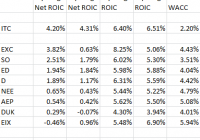
ITC Holdings’ management has earned the highest S&P Quality rating for 10-yr consistence in earnings and dividend growth. No easy feat. Substantially higher Net ROIC, higher allowed ROIC, and a growing regulated asset base are driving earnings and dividend growth higher as well. The current dip is a buying opportunity. The market has not been kind to utility stocks recently, and the current sell-off is offering a few attention-grabbing opportunities. ITC Holdings (NYSE: ITC ) is a company that offers top-ranking management with a record of accomplishment in generating industry-leading investment returns. Add projected annual dividend growth in the 10% to 13% range, along with forward PEG valuations more reminiscent of growth companies than slow growth utilities, and most investors should take notice. S&P Capital IQ offers a rating of 10-yr consistency in earnings and dividend growth known as its Quality Rating and firms are grouped from A+ to D, with B+ being considered average. Of the 500 stocks followed by S&P IQ with a Quality Rating, only 47 carry the A+ rating, and ITC is one of this elite group. ITC has an S&P Credit rating of A- while the industry average is BBB+. Keep in mind the company has been public for only 10 years and would have just qualified for inclusion into the Quality Ratings. One component of management excellence is generating shareholder returns based on total capital deployed that are both higher than its peers and are comfortably above their cost of capital. ITC has generated a 6-yr average return on invested capital ROIC of 6.4% and is higher than the industry average of between 4.5% and 5.0%. More impressive is the low cost of capital at a weighted average cost of capital WACC of just 2.2%, making Net ROIC an impressive 4.2%. While many may see this as small potatoes, investors should compare ITC’s Net ROIC with some bigger, more familiar names, such as those in the spreadsheet below for Exelon (NYSE: EXC ), Southern Company (NYSE: SO ), Consolidated Edison (NYSE: ED ), Dominion Resources (NYSE: D ), NextEra (NYSE: NEE ), American Electric Power (NYSE: AEP ), Duke Energy (NYSE: DUK ), and Edison International (NYSE: EIX ): Source: Guiding Mast Investments, fastgraphs.com, thatswacc.com As shown, ITC management is under-appreciated by most investors for their ability to generate Net ROIC substantially above their peers. One of the keys to ITC’s success is the structural nature of its business focus. ITC is the largest publicly traded electric transmission company with 15,000 miles of FERC-regulated power lines. The subtle difference is the FERC and not individual state utility commissions regulate ITC’s assets, and the FERC has a higher allowed ROE than most states. The chart below from the Edison Electric Institute outlines the progression of lower state allowed ROE since 1990: As shown, the average state-allowed ROE has declined over the past 30 years, and has plateaued at around 10% since 2006. A national energy goal has been the upgrade of the electric grid and the interconnection of new solar and wind generating capacity in areas not historically power generation-oriented. Grid infrastructure investment has been encouraged through offering higher returns on investment dollars, and ITC’s focus has been on those higher return margins. The FERC allows returns in the 10.5% to 11%+ range. To encourage smaller companies, regulated returns offer an additional return incentive of about 1% if the assets are owned by independent firms like ITC. It is estimated that ITC’s long-term allowed ROE will be in the 11.5% range. There is opposition to the higher returns offered by FERC-regulated projects, and last year rates were reduced in the Northeast from as high as 13.4%. With the success of this reduction, consumer advocates are pushing for the formula to apply nationally, and this will negatively affect ITC’s allowed returns with an anticipated allowed ROE reduction from 12.75% to 11.5% by 2016. However, this decline in allowed returns will be offset by a larger network of regulated assets. ITC’s growing asset base and the large quantity of future project opportunities will drive earnings and dividend growth for the next several years. ITC has grown earnings by a three-year average of 12% and raised its dividend by 10%. The consensus is for earnings to continue its 10% to 12% growth rate. The payout ratio is a low 31%, offering management the option to raise dividends faster than earnings growth. Management has targeted mid- to high-30% for a comfortable payout ratio. Last year, the dividend was raised by 14%. ITC is a capital expansion story. Current assets are around $7.1 billion with annual capital expansion budgets of $800 million a year. Operating cash flow will fund a growing portion as ocf increases from $630 million this year to an estimated $770 million in 2018. More information on their cap ex expansion is available in the June 2015 Investor’s Meeting presentation pdf. ITC’s share price has been declining recently due to two factors, general weakness of the utility sector after a lengthy time of outperformance and concerns over the potential for a reduction in allowed ROE. ITC’s share price has followed its peers up and down over the past year until March. At that point, there is a divergence where ITC declined faster than the utility sector. ITC is down about 30% from its high, while the averages are down about 15% and since March, utility stocks have been declined about 5%, while ITC is down 17%. Over the past 12 months, utility stocks are about flat, while ITC is down about 12%. With a 52-wk range of $30.66 and $44.00, the current $32.65 is closer to the low. Another culprit is lower-than-expected first quarter earnings. Analysts were expecting eps of $0.50, but management disappointed by 6% at $0.47. This is a repeat of the previous quarter shortfall of 4%. Management’s guidance for EPS this year is $2.00 to $2.15, with a midpoint of $2.08. Next year’s EPS is estimated at $2.18 to $2.20. Below is the Fastgraph for ITC going back to its IPO in 2005. (click to enlarge) On a forward PEG basis, ITC is trading at a substantial discount to its peers. As described in a previous article , the average forward PEG ratio for the utility sector is 3.2, the average forward P/E is 15.7 and the average EPS growth rate is 4.8%. ITC compares with a forward 2016 PEG of 1.4 based on a 2016 P/E of 15.3 and EPS growth of 11%. While EPS growth is estimated at twice the sector’s growth, ITC’s share prices currently offer no premium valuation. However, in reviewing ITC’s P/E history, it seems it usually trades closer to a P/E of 22 than to 16. If ITC recovers its footing and resumes its premium P/E, it is conceivable share prices could climb to $42 to $48 for patient investors. While the current yield is below the sector average at 2.0%, a high dividend growth rate should overtake the sector average within a few years. The current weakness should be considered a buying opportunity for dividend growth investors and value investors alike. Management has shown its ability to deliver outstanding fundamental returns to shareholders, and the stock warrants a place as a core position in a portfolio. Use this dip to your advantage. Author’s Note: Please review disclosure in Author’s profile. Disclosure: The author is long ITC, AEP, D, EXC, SO. (More…) The author wrote this article themselves, and it expresses their own opinions. The author is not receiving compensation for it (other than from Seeking Alpha). The author has no business relationship with any company whose stock is mentioned in this article.