Tag Archives: georgia

Too Far, Too Fast? Market Professionals Reflect Evolving Smart-Money Opinion

How good have their forecasts been? Figure 1 is the record of five years of daily forecasts for ProShares UltraPro Dow30 ETF (NYSEARCA: UDOW ), an ETF that holds derivative securities which are intended to magnify the daily percentage price changes in the DJIA index by a factor of 3 times, either up or down. Figure 1 tells what the Market-makers daily hedging-implied forecasts for UDOW over the past 5 years have produced as net profits for a wide range of imbalances between upside and downside prospects. Those imbalances are measured by the Range Index [RI] which tells what percentage of the whole forecast range lies below the market quote at the time of the forecast. Figure 1 also indicates how often the forecasts were able to produce a profitable outcome, operating in a realistic, time-constrained portfolio management discipline. Click to enlarge So what did MMs see earlier, see now? Here is the current picture of probable coming UDOW prices, along with similar once-a-week forecasts over the past 2 years. Figure 2 (used with permission) The vertical lines of Figure 2 are the price range forecasts for UDOW implied by the MM community’s hedging actions to protect firm capital exposed during buyer~seller balancing to “fill” volume trades. The forecast of 5 weeks ago was from a then-price of $46.54 and a Range Index of -11. Now it has a quote of $64.72 and a Range Index of 57. A week ago the price of $59.49 carried a RI of 51. Figure 1 suggests that buys of UDOW at today’s RI level of 57 in the past might produce only a +2% payoff from here, instead of the upwards of +12% that had been experienced by -11 Range Index forecasts earlier. The +2% prospect is reinforced by the row of data in Figure 2 as the actual payoff experience achieved in 108 of the 1261 days for which UDOW forecasts were available. Forecasts that had RIs of around 57. The current forecast is more optimistic than past experience; it projects a potential gain of +5.6% Odds for reaching the current payoff prospect remain high, with priors producing a profit in 84 of every 100 among the 108 experiences. The fact that gains better than three times the earlier forecast’s average payoff already have been experienced makes one wonder if the “other shoe might drop” any time now and markets might start to back off. To ease such concerns, it is appropriate to know as UDOW prices were rising during this past week, its MM expectations rose faster. The outlook gains pulled back RIs which on a couple of days were at 68. Continued rising expectations, at a gain rate faster than prices, will put strength under a continued market price rise, albeit at a slower pace. Failure to do so may signal weakening market enthusiasm. We’ll have to see what happens. It can be monitored on blockdesk.com., along with expectations for the VIX index and VIX-based ETFs. Disclosure: I/we have no positions in any stocks mentioned, and no plans to initiate any positions within the next 72 hours. I wrote this article myself, and it expresses my own opinions. I am not receiving compensation for it (other than from Seeking Alpha). I have no business relationship with any company whose stock is mentioned in this article.
3 Things I Think I Think – Financial Crisis Edition

Here are some things I think I am thinking about: Warren Buffett on the financial crisis, investing with a sound premise & silly Congressional ideas. 1 – What Caused the Financial Crisis according to Warren Buffett? The National Archives released documents related to the Financial Crisis late last week. Among them were some interviews with Warren Buffett on the crisis. I noticed that, aside from being nerdy white guys, the only thing I might have in common with Buffett is that we both believe the cause of the financial crisis was, well, just about everybody: I think the primary cause was an almost universal belief, among everybody ‑ and I don’t ascribe particular blame to any part of it – whether it’s Congress, media, regulators, homeowners, mortgage bankers, Wall Street ‑ everybody ‑ that houses prices would go up. ” I’ve described this several times over the last 7 years and every time I do it, I seem to catch a bunch of flak from people with a political bone to pick. And every time I see someone trying to place sole blame on “the government” or “Wall Street” or “house flippers” or whoever, I am reminded of how common fallacies of composition are in the financial world. We don’t see things in totality. We see what we want to see inside of the big picture so we can confirm what we already believe. This just leads to a lot of narrow-minded thinking that causes more arguments than objective analysis. 2 – Investing with a False Premise. One comment I disagreed with (at least partly) was Buffett quoting Ben Graham on investing with a false premise: ” You can get in a whole lot more trouble in investing with a sound premise than with a false premise .” I don’t know about that. If you’ve read my paper on the monetary system or portfolio construction , you’ve probably noticed that this is the primary thing I am trying to avoid when analyzing the economy – false premises. There are so many myths and misconceptions about money that you can get into a lot of trouble buying into these ideas. Whether it’s flawed concepts like the money multiplier, crowding out, being a permabull/bear, dividend investing for safe income, “beat the market” or whatever. Starting with a sound premise is an intelligent way to improve the odds that you’ll succeed going forward. Of course, you have to maintain some rationality within this context. Extremists get killed in the financial markets because they tend to go all in on what they believe. Believing that house prices never go down was obviously irrational (and I had that argument with a lot of people back in 2005/6), but the fact that asset prices usually go up is not an unsound premise from which to start because the economy usually expands and people tend to become more productive over time. So, in this example, being a rational optimist always beats being a perma pessimist AND a perma optimist. 3 – Let’s talk about that silly balanced budget idea. One myth that just never dies is this idea that the US government is going bankrupt and needs to tighten its belt so we avoid impending crisis. I’ve spent an inordinate amount of time debunking this myth over the last decade, but I wanted to congratulate a group of economists for fighting back against a truly stupid idea – a federal balanced budget amendment. Mark Thoma linked to this letter yesterday highlighting the dangers of a balanced budget amendment. I’ll just point out two facts: First, one of the most powerful economic policies we have in place is what’s called automatic stabilizers. This is the tendency for the budget deficit/surplus to expand and contract naturally to offset economic conditions. So, during a recession, government deficits rise because spending naturally increases due to things like unemployment benefits while tax receipts decline. This leads to more income to the private sector and a flow of net financial assets that helps offset the decline. And the exact opposite happens during booms thereby cushioning against the risk of booms. If we had a balanced budget amendment in place, the economy would likely be a lot more volatile because these stabilizers would be gone. Second, the federal government plays an important role in ensuring that our states don’t turn into Greece. As I’ve explained before , since the states have balanced budget amendments, they are constrained by a true solvency constraint. The states, like Greece, have real limits on how much debt they can issue. But since the US states run trade surpluses/deficits against one another with no foreign exchange rebalancing then the poor states are always exporting more dollars than they’re importing. They can borrow to offset this, but there’s a Congressionally mandated limit to this borrowing. So, where does the income come from that helps avoid inevitable insolvency and occasional financial crisis? You guessed it – it comes from the federal government who takes more from the rich states and redistributes it to the poor states. It sounds like socialism, but it’s actually saving capitalism from itself. And it works beautifully in the case of a single currency system by helping us avoid the debacle of a situation that is Europe….

Does Market Volatility Favor Active Management?

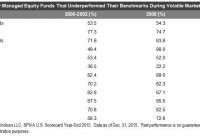
By Aye Soe Twice a year, S&P Dow Jones Indices releases the SPIVA U.S. Scorecard. The scorecard measures the performance of actively managed equity and fixed income funds across various categories. Since the initiation of the report in 2002, the results have consistently shown that managers across most categories overwhelmingly underperform on a relative basis against their corresponding benchmarks over a medium-to-long-term investment horizon. The Year-End 2015 SPIVA U.S. Scorecard reveals little surprise. The second half of 2015 was marked by significant market volatility, which was brought forth by plunging commodity prices, a strengthening U.S. dollar, growing global concerns over Chinese economic growth, and the subsequent devaluation of the Chinese renminbi. Market volatility, in theory, favors active investing, because managers can tactically move out of their positions at their discretion and park themselves in cash. Passive investing, on the other hand, has to remain fully invested in the market. Investors in actively managed strategies should therefore realize fewer losses during periods of heightened volatility, all else being equal. Given this theoretical background, recent volatility in the market has supporters of active investing proclaiming that active management is back in favor. However, over a decade of experience in publishing the SPIVA Scorecard has painfully taught us that active funds don’t always perform better than their passive counterparts during those precise periods in which active management skills seem to be called for. Exhibit 1 compares the performance of actively managed equity funds across the nine style boxes during the 2000-2002 bear market, the financial crisis of 2008, and 2015. As the data clearly show, there is no consistent pattern across most of the categories. Large-cap value managers appear to be the only exception to the losing trend, outperforming their benchmark in both bear markets. Again in 2015, mid-cap value is the only winning equity category, with the majority (67.65%) of them outperforming the S&P MidCap 400® Value . Disclosure: © S&P Dow Jones Indices LLC 2015. Indexology® is a trademark of S&P Dow Jones Indices LLC (SPDJI). S&P® is a trademark of Standard & Poor’s Financial Services LLC and Dow Jones® is a trademark of Dow Jones Trademark Holdings LLC, and those marks have been licensed to S&P DJI. This material is reproduced with the prior written consent of S&P DJI. For more information on S&P DJI and to see our full disclaimer, visit www.spdji.com/terms-of-use .