Tag Archives: function

The Drop In How Many U.S. Stocks Equaled 1 Greek Economy?
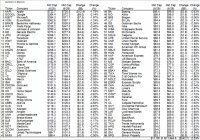
The article shows that the capitalization change of a small number of large-cap U.S. stocks equaled the entire annual output of the Greek economy. This effort is in part to frame the impact Greek turmoil is having on U.S. assets. A qualitative discussion of whether this capitalization change is warranted is included. The title of this article asks readers to guess the number of U.S. stocks whose reduction in market capitalization on Monday was equivalent to the size of annual Greek economic output. The answer: 86 To come up with the figure, I compared the gross domestic product of the Greek economy from the World Bank to the capitalization change of the largest components of the S&P 500 (NYSEARCA: SPY ) by market capitalization until the change in value equated to the Greek GDP of $242B. I had some notable takeaways from this data that I wanted to share with readers. The question for market participants is whether these moves are justified. If the value of an asset is its future cash flows discounted back to the present, then the reduction in domestic equity prices on Monday was either a function of an expectation of lower future cash flows and/or a higher discount rate. The former, lower future cash flows, seems unlikely to have had a large impact given the limited trade between the U.S. and Greece and the fact that the Greek economy is roughly the size of the Minneapolis-area economy. The negative translation effect of broader global cash flows earned by these U.S. companies from a strengthening U.S. dollar would have had a proportionately larger impact. That means that the re-pricing of risky assets is more likely a function of a higher discount rate. The interest rate component of the discount rate fell on Monday as U.S. rates rallied on a flight-to-quality bid signaling that an “equity risk premium” applied to U.S. equities increased to move the discount rate higher. While the outcomes from a potential “Grexit” remain uncertain and difficult to analyze, the transmission mechanism for broader global contagion seems equally uncertain. The potential financial sector link, which roiled equity markets in 2012 given the amount of Greek debt held by European banks at the time, appears to have been muted by a rotation of Greek debt from bank balance sheets to official creditors, enhanced stability mechanisms, European quantitative easing, and much lower yields in the periphery. While the odds of a disorderly outcome in Europe are certainly rising, investors must handicap how much of a risk premium on global assets is justified. While we are likely to continue to see heightened volatility in the near term, if the Greek drama was responsible for the entirety of the move on these 86 companies, I believe that the impact has been overstated already. Disclaimer : My articles may contain statements and projections that are forward-looking in nature, and therefore inherently subject to numerous risks, uncertainties and assumptions. While my articles focus on generating long-term risk-adjusted returns, investment decisions necessarily involve the risk of loss of principal. Individual investor circumstances vary significantly, and information gleaned from my articles should be applied to your own unique investment situation, objectives, risk tolerance, and investment horizon. Disclosure: I am/we are long SPY. (More…) I wrote this article myself, and it expresses my own opinions. I am not receiving compensation for it (other than from Seeking Alpha). I have no business relationship with any company whose stock is mentioned in this article.
Will UNG Resume Its Descent?

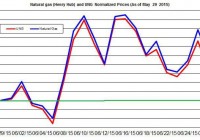
The price of UNG is up for the month on account of stronger demand in the power sector. Despite warmer weather, the cooling degree days are expected to reach normal levels this week. The normal cooling degree days could suggest the demand for natural gas in the power sector will cool down. The recent natural gas report showed the injection to storage was 75 Bcf, which was slightly lower than market expectations. Moreover, the latest buildup was below the 5-year average and last year’s injection. This news has provided a short-term boost for the shares of the United States Natural Gas ETF (NYSEARCA: UNG ) during last week. The price of UNG is slightly up for the month, but it will require a stronger demand for natural gas to bring UNG further up. For now, this scenario doesn’t seem likely. Before reviewing the latest developments in the natural gas market, shares of UNG continue to underperform natural gas prices: The impact of the roll decay on the price of UNG is demonstrated in the chart below (the prices are normalized to the end of last month). As you can see, the price of UNG rose by only 3.5% during June, while the Henry Hub by nearly 5%, i.e. a 1.5 percentage point difference. (click to enlarge) Source of data taken from EIA and Google finance According to the weekly EIA report , this week’s injection was the first time for this season to be below the 5-year average buildup. As of last week, the storage was 38% higher than the level recorded last year and 1.4% above the 5-year average. (click to enlarge) Source of data taken from EIA From the supply side, production picked up – it rose by 1%, week over week. And it’s up by 5.5% compared to last year. Based on the latest update by Baker Hughes , the number of gas rigs slightly rose by 5 to 228 rigs. Nonetheless, U.S. consumption also grew by 2.4% last week and was up by 8.5% for the year. Most of the growth in demand came in the power sector – 6.1%. This gain was partly offset by lower consumption in the industrial and residential/commercial sectors. Looking forward towards the next two weeks, the weather is expected to heat up mostly in the coastal line, including West, Northeast and South Atlantic, but the temperatures are projected to be lower than normal for this time of the year in parts of the Midwest. Despite the expected higher than normal temperatures in parts of the U.S., the cooling degree days are estimated to be only slightly higher than normal – this could suggest the rise in consumption in the power sector will slowdown. This could explain why the markets estimate this week’s injection will be close to the 5-year average buildup of 75 Bcf. The natural gas market slightly heated up in the past few weeks, but over the short run the power sector isn’t expected to heat up. Thus, the demand isn’t likely to pressure up the price of natural gas. For UNG, this could mean another pullback in its price. For more see: On the Contango in Natural Gas Market Disclosure: I/we have no positions in any stocks mentioned, and no plans to initiate any positions within the next 72 hours. (More…) I wrote this article myself, and it expresses my own opinions. I am not receiving compensation for it (other than from Seeking Alpha). I have no business relationship with any company whose stock is mentioned in this article.

How Does VXUP/VXDN’s Corrective Distribution Work?

It’s now clear that the AccuShares Spot CBOE VIX Up Shares ETF (NASDAQ: VXUP )/the AccuShares Spot CBOE VIX Down Class Shares ETF (NASDAQ: VXDN ) naysayers were right – the actual behavior of these funds is nowhere close to Accushares’ claim that ” VXUP and VXDN are the first securities to offer direct “spot” exposure to the CBOE Volatility Index (VIX). ” Accushares has said nothing publicly about the poor behavior of the funds. Their only response has been to move up the “go live” date of their Corrective Distribution process. This is a desperation move. Apparently not understanding what has happened to them they are rushing to use the last weapon at their disposal to fix their horrible tracking error (as high as 18%) relative to the VIX. This move will reduce their tracking problem for less than a day and add yet another complexity to these already complicated and broken funds. Accushares’ Corrective Distribution (CD) is intended to reduce any ongoing differences between VXUP/VXDN’s Net Asset Value (NAV) and its market price. I don’t know what specific scenarios they were targeted with in this process, but I’m guessing they were worried about a slow, progressive creep in the market prices versus the NAV. The CD is triggered if there are 3 consecutive days where the tracking error (difference between NAV and closing price) is 10% or greater. To be a valid closing price the last trade must occur within 30 minutes of market close. When the CD is triggered it doesn’t occur immediately, it’s scheduled to accompany the next monthly Regular Distribution or a Special Distribution if that occurs first. A Special Distribution is triggered by a greater than 75% rise in the VIX compared to the reference VIX value established at the beginning of the monthly cycle. Accushares did not expect frequent CDs to be required; in the prospectus they state: “The Sponsor expects that Corrective Distributions will be infrequent, and may never occur.” It’s likely they will occur on a near monthly basis. When there is a significant gap between the VIX’s value and VIX futures prices (which is most of the time) the VXUP/VXDN tracking error will be large. See this post for a near real time accounting of these errors. With a combined Regular Distribution and Corrective Distribution three things occur: The NAV of the higher valued fund is set to equal the NAV of the lower valued fund. A dividend is issued that compensates the holders of the higher valued fund for the drop in NAV value. The dividend is either in cash or an equal number of VXUP/DN shares with a net value equal to the cash dividend. Accushares issues a new complementary share to every shareholder. If you have VXUP, you will get VXDN shares and vice versa. This is the Corrective Distribution mechanism. Since Accushares can’t create assets out of thin air, they must compensate for the newly doubled number of shares outstanding by dropping their value by half (or do a 2:1 reverse stock split). The effect of the Corrective Distribution is not obvious. Working through an example is a good way to understand it. Imagine that a CD has been triggered and that a Regular Distribution is about to occur. You own 1,000 shares of VXUP. Let’s assume that the market price of VXUP is $27.5, the VXUP NAV is $25, and that the VXDN NAV is $22 at market close right before the distribution. You would receive a dividend of $3/share due to the resetting of VXUP’s $25 NAV value down to VXDN’s ending cycle value of $22. You would also receive 1,000 shares of VXDN. The new NAV value would be $22/2 = $11/share because Accushares doubled the number of shares outstanding. Before the CD the VXUP shares in your account were worth $27.5 X 1,000 = $27.5K. After the Regular/Corrective Distribution your account has: Your net account value drops to $25K – your $2.5K premium over NAV has disappeared. Any premium over the closing NAV value is wiped out by the CD. The next day VXUP will likely trade at a multiple percentage points over NAV, but your VXDN shares will likely be trading at a symmetrical discount from NAV, so the net value of your shares will remain at around $22K. Accushares has essentially cashed out your account at the NAV price – no premium for you… No diligent shareholder will willingly take this sort of loss, nor short seller pass up this opportunity for profit; the market will ensure the value of these funds converges near to NAV the eve of the distribution. From an entertainment value perspective, there will be a couple of things to watch once the CD mechanism becomes effective: Will traders attempt to prevent CDs from happening? Imagine a scenario where some groups are trying to prevent a CD from happening by selling, or short selling shares, while others hoping to profit from a CD are buying shares hoping to keep the tracking error above 10%. How low will the tracking errors go before the CD date? Short sellers would tend to drive the tracking errors to zero, but the about to expire VIX futures values will be decaying rapidly at that point, so significant intra-day profits might still be available to arbitrageurs on the last days of trading. The net effect of the CD will be to complicate and disrupt an already difficult situation. It won’t fix the funds. What Accushares should do is eliminate the Corrective Distribution. Once broken is better than twice broken. Disclosure: None