Tag Archives: function

SEC Enhancing Regulatory Monitoring Of Asset Managers

by Ron D’Vari The asset management industry is evolving rapidly and so are the regulatory environment and tools that govern and support it. The larger managers had thought they had received a reprieve by the Financial Stability Oversight Council’s decision not to designate individual asset management firms as Systemically Important Financial Institutions (SIFIs), but instead focusing its attention on potential risks within asset managers’ activities and products they offer. As a result, the giant asset managers are spared from Federal Reserve. In an apparent response to that, the SEC is increasing focus on the asset management industry. In a speech on December 11, SEC Chair Mary Jo White referenced new initiatives to address portfolio composition risks and operational risks of asset managers. Portfolio composition risks include liquidity and leverage risks of a fund’s holdings and operational risks encompassing inadequate or failed internal processes and systems. The heightened SEC monitoring will include expanded data reporting and enhanced controls on risks related to portfolio composition and liquidity management. A more comprehensive approach will be taken to monitor the risks associated with the increasingly complex nature of fund holdings and the use of derivatives. Additionally, the SEC will be looking into “transition planning” and stress testing, both market and operationally. Asset managers will be expected to safeguard against the impact on investors of a market stress event or when an investment adviser is no longer able to serve its clients. There has been a significant increase in the use of derivatives by funds in general. More and more, fund managers are using derivatives to adjust or obtain exposure to a market sector more efficiently. However, the risks of implied leveraged exposures and potential illiquidity in derivative instruments can be opaque or underestimated. As a result, management of liquidity and redemption and the use of derivatives in widely distributed mutual funds, ETFs and separately managed accounts are becoming key areas of focus by the SEC. The SEC staff will be watching for significant risks of inadequate controls in those areas, to the funds and their investors, as well as potential impact on the overall financial system. Asset managers will be required to manage risks of not being able to meet redemptions under stressful market scenarios. This means that not only the giant managers have to meet enhanced composition and liquidity regulatory requirements; the entire asset management industry needs to. Now that you’ve read this, are you Bullish or Bearish on ? Bullish Bearish Sentiment on ( ) Thanks for sharing your thoughts. Why are you ? Submit & View Results Skip to results » Share this article with a colleague

American Electric Power Retains Attractiveness For Dividend Seekers

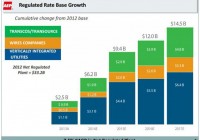
Summary AEP could sell competitive energy operations if weakness continues to persist in the segment’s performance despite long-term pricing agreements. AEP’s capital expenditures will fuel rate based and bottom-line growth in coming years. Stock’s dividend yield of 3.6% is backed by its cash flows. American Electric Power (NYSE: AEP ) has remained an admired investment option for dividend-seeking investors due to its high dividend yield, which is backed by its cash flows. Also, the company is expected to experience healthy earnings growth in the future, driven by capital expenditure that AEP is making to expand its transmission operations. The company expects to experience regulated rate base growth of 7.5% on average until 2017. Separately, AEP has been considering several options to address challenges faced by its competitive energy operations, including the sale of competitive assets, which will positively affect its bottom-line numbers growth. Earnings growth due to the expansion of regulated energy operations will improve bottom-line growth, and hence strengthen cash flows, which will support dividend growth for AEP in the coming years. Therefore, I believe AEP will deliver a healthy financial performance in 2015, which will positively affect the stock price. Healthy Growth Outlook AEP has made the correct strategic decision to address challenges faced by the company in the competitive energy segment; the company’s competitive energy operations have been adversely affected due to low and volatile forward power prices. AEP is looking for a reliable long-term price agreement to stabilize revenues for the segment. And if the long term pricing agreement does not help AEP address challenges faced by the segment, I believe the company will choose to sell its competitive energy assets. The company recently announced that Goldman Sachs will assist AEP in considering options for its competitive energy operations. AEP’s director of external communication, McHenry said, “We haven’t made a decision about whether or not we’re going to sell them, we’re looking at a variety of options.” Duke Energy (NYSE: DUK ) and PPL Corp. (NYSE: PPL ) are among the leading U.S. utility companies that have sold their competitive energy assets due to the ongoing challenges. Along with its efforts to improve competitive energy operations, AEP has been making capital expenditures to grow it regulated operations, which will improve its top and bottom-line growths in the future. The following table shows the capital expenditures that AEP expects to incur from 2015-2017. 2015 2016 2017 Capital Expenditure ($ -billions) $4.4 billion $3.8 billion $3.9 billion Source: Yahoo Finance Also, the company’s regulated rate base growth is expected to increase at an average rate of 7.5% until 2017, due to the capital expenditures it has been making. The increase in regulated operations will also positively affect the stock price. The following chart shows the rate base growth for AEP from 2013-2017. Source: Company Reports Also, the company has been focusing on reducing its costs. AEP has been working to manage and reduce its operational and maintenance costs, which will help offset the weak results of competitive energy operations and support its long-term bottom-line growth. EPS growth for the company is expected to remain in a range of 4%-6% in the long term, as shown below in the chart. Also, the company is expecting its operating earnings for 2014 to in a range of $3.40-$3.50 per share. Source: Company Reports Healthy Dividends The company has been sharing its success with shareholders through dividends. The company offers a dividend yield of 3.60%, which is backed by its cash flows. Also, the company has consistently increased dividends at an average rate of 4% from 2005-2014. The following chart shows the dividend increases for AEP over the years. Source: Company Reports The following table shows the dividend payout ratio and dividend coverage for AEP from 2012-2014 (Dividend coverage = Operating Cash Flows/Dividends). 2012 2013 2014 Dividend Payout Ratio 60% 60% 55% Dividend Coverage 4.1x 4.5x 4x Source: Calculations and Companies Reports As the company has been making efforts to improve its operations through increasing regulated energy operations, its cash flows will be positively affected, which will help AEP increase its dividends at a healthy pace in the coming years. Due to its safe and healthy dividends, the stock remains a good investment option for dividend-seeking investors. Conclusion As competitive energy operations remain weak, AEP has been taking the correct strategic decisions to improve its performance. There is a possibility that AEP might choose to sell its competitive energy operations, if the weakness continues to persistent in the segment’s performance despite long-term pricing agreements. The capital expenditures that AEP is making will fuel its rate base and bottom-line growth in the coming years. And the stock’s dividend yield of 3.6%, backed by its cash flows, makes it a good investment option for dividend-seeking investors. Due to the aforementioned factors, I am bullish on AEP.

Bill Gross Cautious On Rate Hike In 2015: 2 Investment Grade Bond Funds To Buy

According to the ‘Bond King’ or bond investor extraordinaire William Hunt ‘Bill’ Gross, the good times may be over and many asset prices may drop in 2015. Record-low rates have failed to spur enough economic growth, according to Gross, and he believes the Fed may not be in a position to hike rates until late this year, if it at all does. “With the dollar strengthening and oil prices declining, it is hard to see even the Fed raising short rates until late in 2015, if at all,” said Gross, who is now in charge of the Janus Unconstrained Bond Fund. In an investment outlook for the Janus Capital Group, Inc. (NYSE: JNS ), Gross said investors would look for alternatives to risky assets. Gross Warns of ‘Minus Signs of Returns’ Gross seemed extremely cautious on 2015. Global economic growth is not enough even after years of low rates, and this may lead investors to seek alternatives to risky assets. The fact that borrowing costs are still stuck at near zero even after over half a decade of the end of the recession shows investors’ lack of confidence in the economic strength. “Be cautious and content with low positive returns in 2015. The time for risk taking has passed,” said Gross. He added, “At some future date … asset returns in many categories may turn negative.” This year has already begun on a dismal note for the benchmarks, registering their biggest declines to begin a year since 2008. The Dow, S&P 500 and Nasdaq are down 2.6%, 2.8% and 3.1%, respectively, year to date. However, 2014 too had begun with losses for these benchmarks. Gross however supports holding high-quality assets that have stable cash flows. He said that investors’ focus on “Treasury and high-quality corporate bonds, as well as equities of lightly levered corporations with attractive dividends and diversified revenues both operationally and geographically.” Debt Supercycle? Bill Gross warned of “minus signs in front of returns for many asset classes” at the end of 2015. The creation of cheap money by the central banks might face a troubled end. Gross believes that the realization of the debt supercycle approaching an end would show the markets’ gains as ‘debt-fueled sugar high,’ reported The Wall Street Journal. The recent years of the Bull Run was sparked by low rates and accelerated credit growth. Gross states that the central banks have countered challenges by rounds of credit creation and low rates. Gross said: The power of additional and cheaper credit to add to economic growth and financial-asset bull markets has been underappreciated by investors since 1981…Investors have continued to assume that monetary (and at times fiscal) policy could contain the long-term business cycle. However, Gross believes that the debt supercycle is nearing its end. It ends “when yields, asset prices and the increasing amount of credit place an unreasonable burden on the balancing scale of risk and return.” Growth Concerns Global economic growth concerns surfaced in 2015, with the Eurozone particularly posting dismal growth numbers. Japan too had entered a technical recession. Chinese economic data was shaky as well. However, the U.S. has outperformed these major economies and reported 5% growth in the third quarter of 2014. Gross believes that the growth rates in developed and developing nations are failing as a lot of capital is put into “risk-free” capital markets instead of the real economy. Now, there are concerns about Greek exiting the euro. The latest turmoil comes while the oil prices have slumped below $50 a barrel. These factors have combined to send the U.S. markets tumbling by the worst margins to start a year since 2008. Fed’s Stance In the Fed statement following the two-day policy meeting last month, the central bank sounded positive regarding economic growth and also mentioned that they will show some patience before hiking interest rates. The Fed stated: Based on its current assessment, the committee judges that it can be patient in beginning to normalize the stance of monetary policy. Investment Grade Bond Funds to Benefit A low interest rate environment is favorable for investments in bond funds. This stems from the fact that market value of a bond is inversely proportional to the interest rates. The primary forms of bond risk include default risk and the interest rate risk. The latter is obviously the most important these days. Meanwhile, global government bond yields dropped to a new low recently. 10-year U.S. Treasury note yield was down to 1.964% on Tuesday, the lowest since May 2013. Gross warns that investors “do not look, therefore, for economic growth to be the magic elixir for 2015.” He suggests, “Investors should be flexible and consider more liquid securities. Fixed income with shorter maturities is one starting place.” Investors agreeing with Gross’ views may thus look for investing in Investment Grade Bond funds. Bill Gross suggests “high-quality corporate bonds.” Here we will suggest 2 Investment Grade Bond Funds that carry a Zacks Mutual Fund Rank #1 (Strong Buy) as we expect the funds to outperform its peers in the future. The funds have decent 1-year return. They also have beta of less than 1. Funds having betas within this range will show less volatility than the broader markets. BlackRock Total Return Services (MUTF: MSHQX ) seeks total return that outperform Barclays Capital U.S. Aggregate Bond Index. Over 90% of the fund’s assets are invested in varied fixed-income securities such as corporate bonds and notes, mortgage-backed securities, asset-backed securities, convertible securities, preferred securities and government obligations. It mostly invests in investment grade fixed-income securities. It is a feeder fund, investing in a corresponding “master” portfolio. The fund has a one-year return of 8.3% and carries a Zacks Mutual Fund Rank #1 (Strong Buy). It has a one-year beta of 0.94. It carries an expense ratio of 0.76% as compared to category average of 0.86%. Nuveen Core Plus Bond A (MUTF: FAFIX ) seeks to provide current income along with limited risk to capital. It invests the majority of its assets in bonds. These include U.S. government securities that may include zero coupon securities, residential and commercial mortgage-backed securities, and corporate debt obligations among others. The fund has a one-year return of 5.2% and carries a Zacks Mutual Fund Rank #1 (Strong Buy). It has a one-year beta of 0.92. It carries an expense ratio of 0.77% as compared to category average of 0.86%.