Tag Archives: etfs

Lipper Fund Flows: Domestic Equity Funds Lose While Markets Gain Ground

By Jeff Tjornehoj Stock markets rebounded this past week after Greece came back to the bargaining table with its creditors and acceded to even harsher demands than it had rejected a week earlier and after stocks in China appeared to slow their freefall. For the fund-flows week ended July 15, the Dow Jones Industrial Average climbed 535 points to end above 18,000 and regained ground it had lost over the prior three weeks of the Greek debt drama. Equity mutual fund investors withdrew an estimated $4.4 billion net for the week. Not surprisingly, they pulled money from domestic equity mutual funds (-$1.6 billion), which have been out of favor much of this year. Equity exchange-traded funds (ETFs) saw net inflows of $3.6 billion, although investors may have been taking profits, selling off financial services products (-$1.6 billion). The week’s biggest individual equity ETF recipient was the S PDR S&P 500 Trust ETF ( SPY , +$4.4 billion ) , while huge selling hit the F inancial Select Sector SPDR ETF ( XLF , -$1.5 billion ) and the iShares MSCI EAFE ETF ( EFA , -$975 million ) . Bond mutual fund investors continued to redeem shares of funds in Lipper’s High Yield Funds classification, which had net outflows of $272 million, while ETF investors in the same classification added a net $1.5 billion. Overall, taxable bond mutual funds saw net inflows of $473 million for the week. Mutual fund investors pulled some cash out of Core Bond Funds (-$234 million) and added a scant $97 million to Core Plus Bond Funds. Bond ETF investors pushed $2.2 billion into their accounts to create combined (mutual funds and ETFs) net inflows of $2.6 billion. The week’s top destinations for bond ETF investors were the iShares iBoxx $ High Yield Corporate Bond ETF ( HYG , +$1.0 billion ) and the SPDR Barclays Capital High Yield Bond ETF ( JNK , +$420 million ) . Municipal bond mutual fund investors pulled $75 million from their accounts for the eleventh weekly net outflows in a row. Money market funds saw net outflows of $9.4 billion, of which institutional investors pulled $9.3 billion and retail investors redeemed $100 million. Share this article with a colleague
Best3x4 Variable Asset System With Minimum Volatility Stocks Of The S&P 500

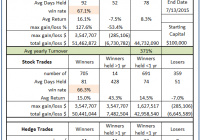
Summary This model can hold 3 to 12 stocks, at variable weightings, selected by a ranking system from a minimum volatility stock universe of the S&P 500. The model has 12 equally weighted slots; a very high ranked stock could occupy a maximum of 4 slots, that is a nominal 33% weighting of the model’s total assets. When adverse stock market conditions exist, the model reduces stock holdings by 35% and invests the proceeds in SDS. The backtest produced a simulated average annual return of about 36% from Jan-2000 to end of June-2015 with a maximum draw-down of minus 22%. The Minimum Volatility Stock Universe of the S&P 500 Minimum volatility stocks should exhibit lower drawdowns than the broader market and show reasonable returns over an extended period of time. It was found that a universe of stocks mainly from the Health Care, Consumer Staples and Utilities sectors satisfied those conditions. This minimum volatility universe of the S&P 500 currently holds 117 large-cap stocks (market cap ranging from $4- to $277-billion), and there were 111 stocks in the universe at the inception of the model, in Jan-2000. Trading Rules The ranking system employed is the same as for our Best8(S&P500 Min-Volatility) system, but the trading system differs in regard to the hedge used and some additional sell rules. The model assumes that stocks are bought and sold at the next day’s average of the Low and High price after a signal is generated. Variable slippage of about 0.12% of a trade amount was taken into account to provide for brokerage fees and transaction slippage. Buy Rules: Some of the largest market cap stocks are exclude from being selected. Sell Rules: Rank Keep the weight of a position in a slot to +10% and -15% of the nominal weight. Realized Trades Analysis An analysis of all the realized trades is shown in Table 1. There were 749 winning trades out of 1116, resulting in a win rate of 67.1%. The average yearly turnover was about 370%. On average a position was held for 78 days. Holdings The models can potentially hold a maximum of 12 different stocks, and a minimum of 3 different stocks. As of July 15 it held 8 different stocks with various weights as shown in Table 2. Performance In the figures below, the red graph represents the model and the blue graph shows the performance of benchmark SPY. The backtest period was 15.5 years, from January 2000 to June 2015. Figures 1 to 5 show performance comparisons: Figure 1: Performance 2000-2015 with market-timing and hedging with long SDS. The model uses a hedge ratio of 35% of current holdings during down-market conditions. (Note: The inception date of SDS was Jul-2006. Prior to this date values are “synthetic”, derived from the S&P 500.) Annualized Return= 36.1%, Max Drawdown= -21.8%. Figure 2: Performance 2000-2015 without hedging. Annualized Return= 34.2%, Max Drawdown= -22.9%. Figure 3: Performance 2000-2015 without hedging and market timing. Annualized Return= 27.8%, Max Drawdown= -49.8%. Figure 4: Performance Jan-2000 to Jun-2015 . Annualized Return= 39.7%, Max Drawdown= -21.5%. Figure 5: Performance Jul-2014 to Jun-2015. Total Return= 58.8%, Max Drawdown= -7.3%. This can be directly compared with our Best12(NYSEARCA: USMV )-Trader model’s return of 28.6% for the same time period. (click to enlarge) (click to enlarge) (click to enlarge) (click to enlarge) (click to enlarge) (click to enlarge) (click to enlarge) (click to enlarge) (click to enlarge) (click to enlarge) Figures 6 to 10 show performance details from Jan-2000 to Dec-2014 for the model with hedging and market timing: Figure 6: Performance versus SPY. Over the 15-year period $100 invested at inception would have grown to $9,170, which is 50-times what the same investment in SPY would have produced. Figure 7: 1-year returns. Except for 2006 the 1-year returns were always higher than for SPY. Figure 8: 1-year rolling returns. The minimum 1-year rolling return of the 3-day moving average was -5.8% early in 2007. Figure 9: Distribution of monthly returns relative to SPY. Figure 10: Risk measurements for 15.5-years and trailing 3-year periods. (click to enlarge) (click to enlarge) (click to enlarge) (click to enlarge) (click to enlarge) (click to enlarge) (click to enlarge) (click to enlarge) Following the Model This model can be followed, exclusively, live at iMarketSignals where it will be updated weekly together with our other trading models. It will not be available as a subscription model at Portfolio 123. Disclaimer One should be aware that all results shown are from a simulation and not from actual trading. They are presented for informational and educational purposes only and shall not be construed as advice to invest in any assets. Out-of-sample performance may be much different. Backtesting results should be interpreted in light of differences between simulated performance and actual trading, and an understanding that past performance is no guarantee of future results. All investors should make investment choices based upon their own analysis of the asset, its expected returns and risks, or consult a financial adviser. The designer of this model is not a registered investment adviser.

Vanguard Wellington Fund: Can One Fund Do It All?

VWELX is one of the oldest balanced funds around. It has a great track record of success and is dirt cheap to own. This could be the cornerstone on which you built a portfolio, or even your entire portfolio. Vanguard Wellington Fund (MUTF: VWELX ) dates back to 1929, that puts it among an elite group of funds in the pooled investment world. And, unlike many of Vanguard’s funds, it isn’t an index fund. If you are looking for a single fund to be your portfolio or to be your portfolio’s backstop, this fund should be on your short list. What’s it do? Vanguard Wellington Fund is a balanced fund, placing roughly two-thirds of its assets in stocks and the rest in bonds. Its primary goal is long-term capital appreciation with a moderate amount of income. When selecting securities Wellington Management uses a value approach. In practice that means buying “established large companies” in which earnings, or earnings potential, is not fully reflected in share prices. On the bond side, Wellington Management, “…selects investment-grade bonds that it believes will generate a moderate level of current income.” That’s not very exciting, but the true value of the bond assets is diversification. So boring is good here. How’s that working out? So far, Vanguard Wellington’s done a great job for investors. Over the trailing 15-year period through June, the fund has an annualized total return of roughly 8%, including reinvested distributions. That may not sound all that exciting, but that’s pretty much the point of a balanced fund. Solid, but boring. That 8%, by the way, puts the fund in the top 4% of all similar funds tracked by Morningstar. But the risk/reward trade off deserves more examination than this. For example, over that trailing 15-year period Vanguard Wellington’s standard deviation, a measure of volatility, was roughly 9.5. Compare that to the S&P 500 500 Index’s 15 and you start to see the benefit. Oh, and the S&P returned roughly 4.5% a year annualized over that 15 year span… Now that makes Vanguard Wellington start to look pretty good. And, perhaps the best part, the fund is dirt cheap to own with an expense ratio of just 0.26%. That’s active management for a price that’s not much higher than an index fund. Not a bad deal at all. So what? That brings us back to what you might want to do with this fund. For starters, it’s a fund that’s appropriate for just about any investor to own, aggressive or not. For those who don’t want to bother with the work of investing it could easily be the only fund you every need to buy. A true one and you’re done offering. However, there’s a small problem here if you are looking for income. Vanguard Wellington’s trailing yield is just 2.4%. Unless you have a lot of money, that’s not going to be enough to live on. That leaves two options. First is to set up an automatic withdrawal program so that you get regular checks from the fund. In good times Vanguard Wellington’s gains will more than make up for a modest withdrawal program (say the old rule of thumb 4%). However, in bad years, you’ll be drawing down capital. Despite the fact that past performance is no guarantee of future returns, historically speaking the fund would have more than made up for its lean years. The other option, and perhaps the better choice for more active investors, is to use Vanguard Wellington as your core holding. That means you don’t have to worry too much about the base of your portfolio, allowing you to spend more time finding other investments that can provide you with more income. A core and explore type portfolio structure. And one that would allow you to take on more risk with the explore portion because of the relatively low risk of the core. For example you might pair higher distribution closed-end funds with Vanguard Wellington. In the end, Vanguard Wellington is a great fund. It isn’t right for everyone, but it could have a place in almost any portfolio. That includes being the only holding all the way to being a cornerstone of a more diverse portfolio. If you are trying to simplify, take a moment to look at Vanguard Wellington Fund. Disclosure: I/we have no positions in any stocks mentioned, and no plans to initiate any positions within the next 72 hours. (More…) I wrote this article myself, and it expresses my own opinions. I am not receiving compensation for it (other than from Seeking Alpha). I have no business relationship with any company whose stock is mentioned in this article.