Tag Archives: etfs

One Way To Beat The Market? Be Different!
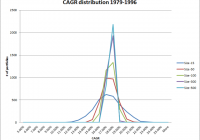
By Yang Xu This study was inspired by Ben Carlson’s blog post a few months ago. Ben highlights Robert Hagstrom’s book “The Warren Buffett Portfolio.” The high level question is the following: How can one beat the market? Answer: To beat the market, you have to be different than the market. One simple way to do this is to hold a small number of stocks. But is this naive approach a good bet? Experiment Setup: Each month, we select the largest 1,000 U.S. stocks to form our universe. We then randomly form portfolios as follows: Portfolio with 15 stocks Portfolio with 50 stocks Portfolio with 100 stocks Portfolio with 300 stocks Portfolio with 500 stocks Every month, we create 3,000 portfolios for each of the 5 perturbations listed above. The idea is to randomly select either 15, 50, 100, 300 or 500 stocks from the universe of 1,000 stocks. However, in order to simulate a large number of possibilities, we create 3,000 portfolios (for all 5 selections above) every month! So on 12/31/1978, we create: 3,000 portfolios of 15 stocks 3,000 portfolios of 50 stocks 3,000 portfolios of 100 stocks 3,000 portfolios of 300 stocks 3,000 portfolios of 500 stocks The portfolio returns are equal-weighted. We repeat this process every month. So in total, we have 3,000 draws of the 5 portfolios across time. Results to the 3,000 draws of the 5 portfolios are shown below: Simulation results (1/1/1979 – 12/31/1996): CAGR by Size of Portfolio (click to enlarge) The results are hypothetical results and are NOT an indicator of future results and do NOT represent returns that any investor actually attained. Indexes are unmanaged, do not reflect management or trading fees, and one cannot invest directly in an index. Additional information regarding the construction of these results is available upon request. Takeaway: Notice that the smaller the portfolio size, the more variance in the portfolio returns (fat tails); the larger the portfolio size, there is less variance in the portfolio returns. Here are the baseline statistics: CAGR buckets by Size of Portfolio The results are hypothetical results and are NOT an indicator of future results and do NOT represent returns that any investor actually attained. Indexes are unmanaged, do not reflect management or trading fees, and one cannot invest directly in an index. Additional information regarding the construction of these results is available upon request. Takeaway: The larger the portfolio, the smaller the chance of high performance. Summary Statistics: The results are hypothetical results and are NOT an indicator of future results and do NOT represent returns that any investor actually attained. Indexes are unmanaged, do not reflect management or trading fees, and one cannot invest directly in an index. Additional information regarding the construction of these results is available upon request. Takeaway: Smaller portfolios have higher highs (max) and lower lows (min), as well as a higher standard deviation. Percentage of Time the Portfolio Beats S&P 500 EW Portfolio: The results are hypothetical results and are NOT an indicator of future results and do NOT represent returns that any investor actually attained. Indexes are unmanaged, do not reflect management or trading fees, and one cannot invest directly in an index. Additional information regarding the construction of these results is available upon request. Takeaway: Smaller portfolios (15, 50 and 100 stocks) can sometimes beat the market (S&P 500 EW). However, the small portfolios lose more often than they win! Let’s examine the results over the second time period. Simulation results (1/1/1997 – 12/31/2014): CAGR by Size of Portfolio (click to enlarge) The results are hypothetical results and are NOT an indicator of future results and do NOT represent returns that any investor actually attained. Indexes are unmanaged, do not reflect management or trading fees, and one cannot invest directly in an index. Additional information regarding the construction of these results is available upon request. Takeaway: Similar to the first half of the sample – the smaller the portfolio size, the more variance in the portfolio returns (fat tails); the larger the portfolio size, there is less variance in the portfolio returns. Here are the baseline statistics: The results are hypothetical results and are NOT an indicator of future results and do NOT represent returns that any investor actually attained. Indexes are unmanaged, do not reflect management or trading fees, and one cannot invest directly in an index. Additional information regarding the construction of these results is available upon request. Takeaway: Smaller portfolios have higher highs (max) and lower lows (min), as well as a higher standard deviation (same as our prior analysis). CAGR buckets by Size of Portfolio The results are hypothetical results and are NOT an indicator of future results and do NOT represent returns that any investor actually attained. Indexes are unmanaged, do not reflect management or trading fees, and one cannot invest directly in an index. Additional information regarding the construction of these results is available upon request. Takeaway: The larger the portfolio, the smaller the chance of high performance (again). Percentage of Time the Portfolio Beats S&P 500 EW Portfolio: The results are hypothetical results and are NOT an indicator of future results and do NOT represent returns that any investor actually attained. Indexes are unmanaged, do not reflect management or trading fees, and one cannot invest directly in an index. Additional information regarding the construction of these results is available upon request. Takeaway: Smaller portfolios (15, 50 and 100 stocks) can sometimes beat the market (S&P 500 EW). However, the small portfolios still lose more often than they win! Conclusion: The results above show that while selecting smaller portfolios of stocks, one can beat the market more often than with a larger portfolio. However, if randomly selecting a smaller portfolio of stocks , the investor will lose more often than they win! Is all hope lost? We also believe that in an effort to beat the market, you have to be different (concentrated portfolios), but also use security selection . We prefer 2 anomalies (Value and Momentum): Security selection based on Value Security selection based on Momentum If trying to beat the market, leverage the security selection models to form your smaller portfolios! Original Post

ETF Deathwatch For July 2015: Old Age Is Not A Free Pass

The ETF Deathwatch membership roll increases by three this month, as nine new names join the list and six leave. The total quantity now stands at 326, consisting of 226 ETFs and 100 ETNs. This equates to 18.7% of all exchange traded products (“ETPs”) being on ETF Deathwatch (20.1% of which are greater than six months in age). The 123 products launched during the preceding six months are automatically excluded from the list because all new funds are given a six-month grace period in order to attract investor interest. There was no predominant investment theme among the nine funds added this month; however, eight of the nine had one factor in common, and that was their relatively old age. The BLDRS Europe 100 ADR (NASDAQ: ADRU ) was launched in November 2002, making it more than 12 years old. It now has the distinction of being the oldest product on the list, at 152 months. Other mature products joining the ranks of ETF Deathwatch this month include CurrencyShares Swedish Krona Trust (NYSEARCA: FXS ) at 108 months, PowerShares DB Silver (NYSEARCA: DBS ) at 102 months, ProShares Ultra SmallCap600 (NYSEARCA: SAA ) at 101 months, Market Vectors Chinese Renminbi/USD ETN (NYSEARCA: CNY ) at 88 months, ETRACS CMCI Long Platinum TR ETN (NYSEARCA: PTM ) at 86 months, CS X-Links Long/Short Equity ETN (NYSEARCA: CSLS ) at 64 months, and Guggenheim MSCI Emerging Markets Equal Country Weight (NYSEARCA: EWEM ) at 55 months. WisdomTree Emerging Markets ex-State-Owned Enterprises (NYSEARCA: XSOE ) has been on the market only seven months, and it is the one exception to the old-age bias of the new members in July. Still, even when including this youngster, the average age of the nine products joining the list is more than seven years. As a result, the average age of all 326 names on Deathwatch increased from 48.3 to 50.3 months, and 105 are now more than five years old. There are a couple of observations that can be gleaned from this data. First, the list is not saturated with newly introduced funds needing more than a six-month grace period as some sponsors have suggested. Second, successfully avoiding ETF Deathwatch for years is not a guarantee of being able to remain off the list. This month’s newcomers can attest to this second point. The average asset level of products on ETF Deathwatch increased from $6.8 million to $6.9 million, but the quantity of products with less than $2 million in assets jumped from 49 to 57. It is clear that a sponsor cannot make money on a fund with $2 million in assets, even with a hefty 1.00% expense ratio. What is not always clear is why sponsors are willing to subsidize these unprofitable products, and how long they will let the losses mount before pulling the plug. Here is the Complete List of 326 Products on ETF Deathwatch for July 2015 compiled using the objective ETF Deathwatch Criteria . The 9 ETPs added to ETF Deathwatch for July: BLDRS Europe 100 ADR CS X-Links Long/Short Equity ETN CurrencyShares Swedish Krona Trust ETRACS CMCI Long Platinum TR ETN Guggenheim MSCI Emerging Market Equal Country Weight Market Vectors Chinese Renminbi/USD ETN PowerShares DB Silver ProShares Ultra Small Cap600 WisdomTree Emerging Markets ex-State-Owned Enterprises The 4 ETPs removed from ETF Deathwatch due to improved health: PowerShares DB Agriculture Double Long ETN (NYSEARCA: DAG ) Deutsche X-trackers MSCI All China (NYSEARCA: CN ) Global X China Industrial (NYSEARCA: CHII ) InfraCap MLP ETF (NYSEARCA: AMZA ) The 2 ETPs removed from ETF Deathwatch due to delisting: ProShares Ultra Australian Dollar (NYSEARCA: GDAY ) Direxion Daily Gold Bull 3x Shares (NYSEARCA: BAR ) Disclosure covering writer: No positions in any of the securities mentioned. No positions in any of the companies or ETF sponsors mentioned. No income, revenue, or other compensation (either directly or indirectly) received from, or on behalf of, any of the companies or ETF sponsors mentioned.

REIT ETFs Worth A Look On Bullish Simon Property Group, Ventas Earnings

With the U.S. economy expanding at a steady clip in the second half and bond yields affably low despite the looming Fed meeting and the prospect of interest rate hike, REITs – known for their high dividend yields – look to be one of the most promising sectors. While this rate-sensitive corner of the investing world face a bump when the Fed enacts a lift-off, a healthy economy and busy activities should back the REIT space over the longer term. This was more so given the decent earnings profile. On July 24, two REIT companies Simon Property Group Inc. (NYSE: SPG ) and Ventas Inc.’s(NYSE: VTR ) reported impressive earnings before the bell and gave cues for an uptrend in the REIT space. Inside Simon’s Q2 Earnings The retail REIT Simon Property’s second-quarter 2015 funds from operations (FFO) of $2.63 per share breezed past the Zacks Consensus Estimate of $2.35 and the prior-year quarter figure of $2.16 per share. Growth in comparable net operating income led the bottom line outperformance. Total revenue in the quarter increased 14.1% year over year to $1.34 billion. Further, it sailed past the Zacks Consensus Estimate of $1.21 billion. Total sales per square feet moved up 2% despite a 40 bps decline in occupancy rate. The guidance was also upbeat as Simon Property ticked up both the lower and upper ends of its 2015 FFO per share guidance to $10.02-$10.07 from $9.65 to $9.75 per share. This is the second time; the company has lifted its 2015 FFO per share guidance. Prior to the Q2 earnings release, the Zacks Consensus Estimate for the same was pegged at $9.77 which spells another around of optimism around the stock. Simultaneously with its earnings release, Simon Property declared a quarterly dividend of $1.55 per share indicating a 3.3% sequential and 19.2% year-over-year increase. The latest dividend will be paid on Aug 31, 2015 to shareholders of record as of Aug 17. The enthusiastic numbers have spread bullishness not only on this REIT giant but also in the broad space. SPG shares added about 1.8% on Friday after this decent announcement. Ventas Q2 Earnings in Detail The health care REIT Ventas’ second-quarter 2015 normalized funds from operations of $1.18 per share came in 6 cents above the Zacks Consensus Estimate of $1.12. The figure comfortably outdid the year-ago quarter figure of $1.16. Total revenue during the quarter totaled $891.3 million, up 18.6% year over year and exceeded the Zacks Consensus Estimate of $863 million. Like Simon, Ventas also raised its guidance. The company upped its 2015 normalized FFO per share outlook to $4.70-$4.76 from $4.67-$4.75 guided earlier. The new outlook marks 5-6% growth in normalized FFO per share from the 2014 level. Prior to the release, the Zacks Consensus Estimate was $4.74 for 2015. Thanks to solid earnings, the stock gained over 2.7% in the key trading session of Friday. ETF Impact The warmth was also felt in the ETF world. REIT ETFs invest considerably in those two stocks with SPG (especially) having widespread presence in the ETF universe. At the time of writing, Simon has a Zacks Rank #3 (Hold) and Ventas has a Zacks Rank #2 (Buy). Let’s discuss SPG and VTR-heavy ETF opportunities that investors might intend to tap following solid earnings. ETFs in Watch The Schwab U.S. REIT ETF (NYSEARCA: SCHH ) a Zacks #3 (Hold) rated ETF, invests 10% of its $1.52 billion assets in Simon. The stock is the fund’s top holding. Ventas is the fund’s sixth holding and occupies 3.77% of the basket. The fund charges 7 bps in fees and gained about 0.5% in the key trading session of July 24. The SPDR Dow Jones REIT ETF (NYSEARCA: RWR ) invests 9.86% of its $3 billion basket in the stock under consideration. Simon takes the top position while Ventus takes the sixth position with about 3.68% exposure. This Zacks #3 (Hold) rated ETF charges 25 bps in fees and added 0.5% on July 24. The iShares Real Estate 50 ETF (NYSEARCA: FTY ) invests 9.33% of its $83.5 million assets in SPG, once again the fund’s first holding. Ventas, the eighth holding of the find, takes 3.5% of the portfolio. The product charges 48 bps in fees and has a Zacks ETF Rank #3. The fund advanced about 0.4% on the day the duo reported Q2 earnings. Investors can also play the optimism in SPG via ETFs like the Guggenheim Wilshire U.S. Real Estate Investment Trust ETF (NYSEARCA: WREI ) and the Vanguard REIT Index ETF (NYSEARCA: VNQ ) . Let’s also mention an ETF which is heavy on VTR. The $262 million- iShares Residential Real Estate Capped ETF (NYSEARCA: REZ ) , puts 7.68% of its weight in VTR, the fifth holding of the fund. Notably, the fund has no exposure in SPG. REZ charges 48 bps in fees and added about 0.6% on July 24. Link to the original article on Zacks.com