Tag Archives: etfs

Asia Pacific Fund: A Conservative And Extremely Undervalued Option

Summary The Asia Pacific Fund currently has extremely low valuation and is trading at a discount of 12.28%. The fund’s investment approach is extremely diversified, making it a conservative means to profit from economic growth in the Asia Pacific Region. The fund’s valuation is more attractive than other exchange traded funds that invest into high growth Asian countries. The Asia Pacific Fund (NYS APB ) is current a very attractive buy, and perhaps one of the best opportunities for investors seeking to take advantage of opportunities offered from discounted closed end funds. The fund invest in listed equity in the Asia Pacific region and is managed by Value Partners Hong Kong Limited. Historical performance of the fund has been positive, and the liquidity risk is negligent; the fund has an average trading volume of 18,562. One current unique opportunity that this fund presents is that it is currently trading at a discount of 12.28% , providing opportunity for those willing to take a long term investment approach. For a fund that invests into Asia, the valuation is extremely low at the moment; the fund currently has a P/E of 7.5. This is exceptionally lower than other exchange traded funds that invest in high growth countries in Asia, such as the Philippines , Vietnam , and Indonesia . The fund takes a very diversified approach to Asia, as the top 10 holdings for the fund only make up 34.1% of the fund. Moreover, geographical diversification within the Asia Pacific region is very strong; the fund invests in China, Hong Kong, South Korea, Taiwan, Singapore, Thailand, Indonesia, The Philippines, and Malaysia. High geographical diversification in a region that is on track to prosper in the future, further attributes to the logic of investing in this fund. These facts, coupled with the fund having low valuation and trading at a discount, provides a conservative and ideal investment opportunity. Fund Performance The fund seeks to track the performance of the MSCI All Countries Asia Ex. Japan Index, and was able to outperform the MSCI Europe and the S&P 500 Composite this year. Performance this year has been substantial, and is on track to continue based on growth projections for the Asia Pacific region. Investors who are willing to take a long term bullish view of Asia can benefit from investment in this fund. 1 Year % 3 Year % 5 Year % 10 Year % Asia Pacific Fund 12.4% 9.9% 16.37% 131.1% MSCI AC Asia Ex Japan 11% 22.9% 37.2% 161.2% S&P 500 Composite 10.4% 46.8% 76.8% 75.2% MSCI Europe -4.4% 33.2% 40.4% 70.1% Source: The Asia Pacific Fund March 31, 2015 Industry Approach The fund invests its assets into a variety of industries, and the majority of its assets are invested in the following industries: Real Estate: 17.6% Banking: 16.8% Consumer Discretionary: 16.1% Industrials 10.1% Consumer Staples: 7.4% Telecommunication Services: 6.2% The industry approach is very diversified, provide a conservative means to access growth in the Asia Pacific region. Holistically, growth in the Asia Pacific region is set to outperform the rest of the world, with 5.5% Per Annum GDP Growth projected for 2015-2016. Specific opportunities can be found in the consumer products industry, as consumption will inevitably increased with the increased economic growth in this region. Moreover, increased economic activity will also be a major catalyst for the real estate industry, particularly in the increased demand for office rentals. Conclusion This fund provides a unique and simplistic opportunity for investors to leverage off of growth in the Asia Pacific Region. The following factors make this fund relatively favorable to other investment approaches in Asia. The fund is trading at a 12.28% discount and has a P/E of 7.54, which is much more attractive than other alternatives in Asia. The only area of concern is the timeframe required to reconcile the fund’s trading price. The fund’s investment approach is extremely diversified, based on the variety of holdings and industries it invests into, as well as its high geographical diversification. Based on my observation of closed end funds and exchange traded funds that invest in Asia, closed end funds often provide more opportunity for investors. A similar case can be found in a previous article mentioning the benefits of the Aberdeen Indonesia Fund (NYSEMKT: IF ), which is trading at a discount of 10.05% . While both funds present ample opportunity, a diversified investment approach may be more suitable, as Indonesia’s growth is also met with inflation and exchange rate movement risks. Disclosure: I/we have no positions in any stocks mentioned, and no plans to initiate any positions within the next 72 hours. (More…) I wrote this article myself, and it expresses my own opinions. I am not receiving compensation for it (other than from Seeking Alpha). I have no business relationship with any company whose stock is mentioned in this article.

A Look At The Breakdown In Alternative Income ETFs

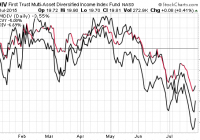
Summary Income investors are often obsessed with the search for yield despite the typical conservative nature of their demographic. Once considered taboo, asset classes such as junk bonds, MLPs, mortgage REITs, and other high yield investments are now common place in many of the portfolios. Now we are starting to see slow signs of decay in junk bond prices as spreads widen and risk appetites in credit securities pull back. Income investors are often obsessed with the search for yield despite the typical conservative nature of their demographic. The half decade of zero returns in safe assets such as CDs and savings accounts has created a reach for yield that has stretched the boundaries of sound portfolio discipline. Once considered taboo, asset classes such as junk bonds, MLPs, mortgage REITs, and other high yield investments are now common place in many of the portfolios that I review. The seemingly one-sided demand has helped generate relatively solid returns and uncommonly low volatility over the last several years as well. Now we are starting to see slow signs of decay in junk bond prices as spreads widen and risk appetites in credit securities pull back. This same pattern has been exacerbated in alternative income funds with overweight positions in non-traditional income fields with juicy yields. As an example, the First Trust Multi-Asset Diversified Income Index ETF (NASDAQ: MDIV ) carries 80% of its portfolio in preferred stocks, junk bonds, real estate, and MLPs. The remaining 20% is in traditional dividend paying stocks. This ETF has a current 30-day SEC yield of 6.36%, which any income investor would tell you is phenomenal when 10-Year Treasury bonds are paying just 2.25%. Yet like most things in life, there is no free lunch in the income world. A reach for yield carries with it higher concomitant risk of capital loss through credit contraction, deleveraging, interest rate cycles, and other exogenous factors. Before today’s bounce, fund’s like MDIV were trading near their lows of the year despite the relatively sideways price action of traditional broad-based equity benchmarks. This decoupling of high yield and alternative assets from the major stock market indices should be viewed through a cautionary lens. I’m not trying to pick on MDIV by any means. A look at other similar funds in this class include the Guggenheim Multi-Asset Income ETF (NYSEARCA: CVY ) and the Global X Super Dividend U.S. ETF (NYSEARCA: DIV ). These ETFs contain many of the same fundamental holdings and are showing similar trends of sliding prices. A look inside specific sector funds such as the ALPS Alerian MLP ETF (NYSEARCA: AMLP ) and the iShares Mortgage Real Estate Capped ETF (NYSEARCA: REM ) confirms the weakness as well. So how does a retiree or income investor maintain their purchasing power while still maintaining a solid grasp on dividends? The first step is evaluating your exposure to these riskier income assets by determining how much of your portfolio they represent. If its less than 10%, then you are likely not as concerned about the recent volatility. Yet, if they represent 25% of your portfolio or more, you may want to consider taking action to create a more balanced asset allocation. Those with an overweight position in high yield investments that find themselves uncomfortable during this drawdown may want to consider cutting back their exposure. This could include temporarily adding back to cash or moving to more traditional assets such as dividend paying stocks or higher quality bonds. The trade off of course is that you may not receive the same monthly or quarterly income that you are accustomed to. Nevertheless, the ability to sleep well at night knowing that your capital is not susceptible to wild swings may assuage that temporary concern. Picking which asset class to move the funds to will likely depend on the makeup of the other positions in your portfolio. You may end up pairing multiple asset classes together to smooth out volatility and further diversify portfolio. Remember that it’s ok to step away from strict income investments in order to focus on capital preservation or total return. If you do move to cash, make sure that it is a temporary transition that is not going to leave you with a significant chunk of money on the sidelines for an extended period of time. One of the biggest mistakes I see investors make is having too much cash on hand for years and years without a sound game plan to put it back to work. Putting Thoughts Into Action I recently took at step away from high yield investments for my Strategic Income clients and added to a high quality mix of stocks in the iShares MSCI USA Minimum Volatility ETF (NYSEARCA: USMV ). This transition expanded the modest equity sleeve of my portfolio into an index that is continuing to maintain a steady uptrend. While the move actually lowered the overall yield of the portfolio, it positioned us for a bounce higher in the broader stock market and reduced the credit volatility that was acting as a drag on returns over the last two months. Despite this move, I haven’t completely abandoned the alternative income theme altogether. My income portfolio is still holding the iShares U.S. Preferred Stock ETF (NYSEARCA: PFF ), which has maintained a steady price trend despite the volatility in interest rates. Moving forward, I will be closely evaluating how these investments comingle together and making additional adjustments as necessary. Changes of this nature are not always easy when an investment is falling in price. You never know if you are picking the right spot or going to get whipsawed in the wrong direction. That is why I strive to change the portfolio incrementally in order to avoid falling into the trap of over commitment to a single outcome. Disclosure: I am/we are long USMV, PFF. (More…) I wrote this article myself, and it expresses my own opinions. I am not receiving compensation for it. I have no business relationship with any company whose stock is mentioned in this article. Additional disclosure: David Fabian, FMD Capital Management, and/or clients may hold positions in the ETFs and mutual funds mentioned above. The commentary does not constitute individualized investment advice. The opinions offered herein are not personalized recommendations to buy, sell, or hold securities.

Stock Market Genius Made Easy: Spinoffs

Summary Empirical evidence would suggest spinoffs outperform the market. Prior research gives us a rough guide to investing in them. You can simplify the process with online tools and/or an ETF. More than 15 years ago, Joel Greenblatt wrote his masterpiece: You can be a stock market genius. Several other contributors here on Seeking Alpha have sung the book praises. I will be brief: If you haven’t read it, do so. (You could even read it for free by signing up for a free month at Scribd ) Among the strategies Greenblatt discusses, investing in spinoff stocks is one of them. A spinoff is when a company takes a division and separates it, creating a free standalone company. The strategy still works, however, the book was written 15 years ago. In this article, I will: Review briefly the papers proving empirical evidence that spinoff stocks tend to outperform. Rehash a few of Greenblatt’s pointers. Explore tools and strategies, which can simplify the process in 2015. The Empirical Evidence A while ago, John Mcconnell and Alexei Ovtchinnikov wrote a paper studying stocks of both parents and subsidiaries straight after a spinoff occurred between 1965 and 2000. They took the approach of buying the stocks straight after the spinoff and holding them for 36 months. They then computed excess returns in comparison with each stock’s industry, and with stocks with similar size. The results were impressive: The subsidiaries generated substantial ex-post alpha, especially within the first two years of holding the stocks. Source: Predictability Of Long Term Spinoff Returns Even after having adjusted the returns to a Fama-French-Carhart four-factor model, the sample still generated ex-post alpha. If you are interested in the nitty gritty details, I strongly suggest you read the paper. Here are a few points concerning the economic reasoning behind spinoff outperformance: Initial overselling of the security: Following a spinoff, the stock tends to be oversold as institutions which are unable to hold the stock for various reasons (They require dividend-paying stocks, they can’t invest in small caps, etc.) sell the stock. Many individual investors might also sell the spinoff because they want to be invested in the parent only. This depressed price creates an opportunity to find value. Better allocation of resources: Splitting a company into two entities allows each company to focus on creating value through their independent businesses. The destruction of the conglomerate discount: It is a well-known fact that the stock market tends to undervalue conglomerates because of the added complexity in analyzing them. Separating entities often creates pure play stocks in two different businesses. It can therefore be expected that this discount corrects within the first years after a spinoff. Or as Mr. Greenblatt says “Sometimes, Capitalism works” : In other words making the managers of each individual company more responsible, more accountable, and more directly incentivized, often plays out nicely. Greenblatt’s Strategy Throughout his career, Greenblatt has used this market inefficiency for personal gain. In his book, he recounts a few reasons why companies spinoff divisions, other than the obvious “to be better appreciated by the market”: To separate a “bad” business, so that the “good” one can show more of its value. Often they might leave the bad business with massive amounts of debt which can create a leveraged bet, for better or for worse. To create value for investors when a business can’t be sold as a whole, at least not at a reasonable price. To avoid being taxed on the sale of the business. Spinoffs are not taxed when the shares are distributed to the shareholders of the parent company. He also gives a rough hand guide to finding interesting spinoff opportunities: Read the WSJ looking out for upcoming spinoffs. (Don’t worry we’re in 2015 now, it needn’t be that hard, more on that later) Once you’ve found an upcoming spinoff, get your hands on the Form 10 also called general form for registration of securities, and look for some of these cues: Institutions don’t want the spinoff. Questions to ask are: Which current institutions hold the stock? What is their mandate? Are they going to be obliged to sell the spinoff? Insiders want it. Here the focus is on management incentives, including stock options. The idea behind these is that they make managers act like shareholders. There has been quite a debate concerning the effectiveness of such options but when combined with the right elements, they should work. Questions to ask are: Are managers going to be compensated with options? How far out of the money are these options? (Far enough is what you are looking for) Who is going to manage the company? How is management talking about the spinoff? (Watch out they may be talking it down to depress the price) Is what they are saying congruent with their various incentives? If not why not? Finally, usual fundamental analysis must be conducted . Questions to ask are: Is a great stock at a cheap price being uncovered? Has a leveraged bet with an interesting risk/return profile been created? Tools And Strategies in 2015 The economic reasoning for spinoff outperformance seems sound, and the empirical evidence of ex-post alpha is robust. If investors can generate alpha through investing in spinoffs what tools and strategies can they use today to simplify the process? Remember, how I mentioned you didn’t need to read the WSJ every day to find spinoff opportunities? As you might have guessed there is now a website on which you can find all upcoming spinoffs as well as all recent spinoffs . It’s a valuable tool which can be used to find interesting opportunities. Granted, you still need to do the hard work of looking up companies and picking your spots, but at least it is a lot easier. Source: Stockspinoffs.com As you can see, they even named it appropriately. I do want to disclose that I have no business with the website, and am only sharing because it’s an interesting tool. It is also useful to use it to see how spinoffs have performed over time. I will use this tool as a warning. NAME data by YCharts I picked three stocks randomly which spun off in August last year. As you can see these stocks aren’t a promise for riches, and investors should keep that in mind. You can’t just throw darts at a list to pick your spinoffs. You have to do the hard work. Or… you can invest in a quant spinoff ETF. Guggenheim Spin-Off ETF (NYSEARCA: CSD ) The Guggenheim Spin-off ETF seeks to reproduce the returns of the Beacon Spinoff Index before fees which will set you back 0.66% a year. The fund is constructed very similarly with weights changing only modestly. Here is a peak at CSD’s top 20 holdings vs. the index. These account for over 75% of the portfolio in both cases. Source: Guggenheim Investments What is interesting is how this index is constructed. Potential Index constituents include all equities trading on major U.S. exchanges of companies that were spun-off during the two year period beginning 30 months prior to reconstitution and ending 6 months prior to reconstitution. This time frame may be extended to compensate for periods where there are too few new spinoffs to populate the index. The Spin-off Index is comprised of up to of the 40 highest-ranking stocks chosen from the universe of spun-off companies. Each company is ranked using a 100% quantitative rules-based methodology that includes composite scoring of several growth-oriented, multi-factor filters, and is sorted from highest to lowest. Up to 40 stocks are chosen and given a modified market cap weighting with a maximum weight of 4.5%. The constituent selection process and portfolio rebalance is repeated semi-annually, however, if there are not enough new Spin-offs to populate the index, a rebalance may be delayed. What this means is that you will own stocks at the earliest 6 months after they have spun off, and they will be removed at most 36 months after the spinoff (Selection process happens semiannually, and stocks can be included if spun off up to 30 months prior to constituent selection). I have not found any information about their so called rule based ranking. Whether this ranking generates value or not might be questionable, but it can’t be worse than simply ranking stocks by market cap, can it? The index gives each of its 40 stocks a maximum weight of 4.5% whereas CSD weights stocks as high as 5%. So here you go, a no hassle, sleep well at night way to get exposure to spinoffs and their inherent inefficiencies through the first years. How has it performed? This year just as bad as the overall market, over time, a lot better. CSD data by YCharts CSD data by YCharts I will be allocating money towards the CSD ETF as soon as the next transfer makes it to my trading account. Conclusion Spinoffs have beaten the market. Empirical evidence proves it. Sound economic reasoning would suggest they might continue to do so. Great results can be attained by picking your spots. You’ll probably do okay with passive exposure. Disclosure: I/we have no positions in any stocks mentioned, but may initiate a long position in CSD over the next 72 hours. (More…) I wrote this article myself, and it expresses my own opinions. I am not receiving compensation for it (other than from Seeking Alpha). I have no business relationship with any company whose stock is mentioned in this article.