Tag Archives: etf-hub

Preferred Stock ETFs For Retirement
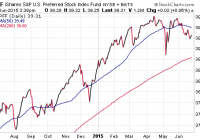
Summary The income investing landscape has certainly shifted in 2015, with many dividend fixtures trading well below their starting point for the year. The backup in interest rates this year has been the primary culprit responsible for rebalancing the scale away from these equity income assets. PFF has managed to remain on a relatively steady course so far this year when compared to other areas of the income-generating universe. The income investing landscape has certainly shifted in 2015, with many dividend fixtures trading well below their starting point for the year. Stalwart asset classes such as REITs, utilities, MLPs, and even dividend paying common stocks have struggled to make positive headway and in some cases are more than 10% off their recent highs. The backup in interest rates this year has been the primary culprit responsible for rebalancing the scale away from these equity income assets. The 10-Year Treasury Note Yield has moved over 40% higher since hitting a low in January and is now firmly situated near 2.40%. Income investors are likely feeling a level of frustration with the lack of progress year-to-date and oversensitivity to interest rates may fuel additional anxiety as they contemplate the looming threat of a Fed rate hike. Nevertheless, one alternative asset class has continued to persevere despite the overarching malaise. The iShares U.S. Preferred Stock ETF (NYSEARCA: PFF ) is a fund I have owned for some time now for my income-seeking clients . PFF has over $13 billion dedicated to over 300 preferred stock holdings and charges an expense ratio of 0.47%. One of the most attractive features of this fund is its current 30-day SEC yield of 5.40%. Income is paid on a monthly basis to shareholders and has historically been very consistent. In addition, PFF has managed to remain on a relatively steady course so far this year when compared to other areas of the income-generating universe. Preferred stocks carry characteristics of both equity and debt, which allow for very low correlations with either asset class. Typically these securities are issued by banks, financial institutions, and real estate companies with long maturity dates. While PFF has been able to escape the wrath of interest rate volatility this year, that doesn’t mean it will hold up under every appreciable change in credit or Treasury-linked securities. This fund experienced a 10% drop in 2013 as changes to quantitative easing programs by the Fed sent shockwaves through the financial markets. The portfolio manager for PFF did an excellent review of its potential weaknesses with respect to interest rates that is worth a read as well. Another ETF in this space that promises a unique dynamic is the PowerShares Variable Rate Preferred Portfolio ETF (NYSEARCA: VRP ). This fund primarily invests in preferred stocks with floating rate or variable coupon components. VRP has an effective duration of 3.86 years and a 30-day SEC yield of 4.92%. In theory, floating rate securities are deemed to be more effecting during periods of rising interest rates because their income component adjusts higher along the way and they typically have shorter durations. Nevertheless, with the relatively short trading history, this strategy has yet to be tested under the rigors of an outsized move in rates. The Bottom Line Preferred stock ETFs can be used for yield enhancement and diversification in the context of a well-balanced income portfolio. However, investors should be aware that as a non-traditional asset class, they may be susceptible to unique risks and price drivers. Keep in mind that the higher yields of preferred stocks should correlate with smaller overall position sizes to avoid becoming overly focused on just one component of these securities. Disclosure: I am/we are long PFF. (More…) I wrote this article myself, and it expresses my own opinions. I am not receiving compensation for it. I have no business relationship with any company whose stock is mentioned in this article. Additional disclosure: David Fabian, FMD Capital Management, and/or clients may hold positions in the ETFs and mutual funds mentioned above. The commentary does not constitute individualized investment advice. The opinions offered herein are not personalized recommendations to buy, sell, or hold securities.

Van Eck’s New ETF Targets Unlocked Spin Off Value

Summary Investor interest in corporate spinoffs is increasing fueled by eBay’s planned spinoff of PayPal and Carl Icahn’s involvement in the process. Currently, this ETF has only one competitor with a similar strategy giving this fund the potential to increase AUM nicely over time. Companies like Occidental Petroleum, Sears, Time Warner and Kimberly-Clark have all spun off business units recently. It’s not the first of its kind but the freshly launched Market Vectors Global Spin Off ETF (NYSEARCA: SPUN ) could be debuting at just the right time to take advantage of the increasing shareholder interest in capturing the intrinsic value that comes with companies spinning off subsidiaries. The most notable corporate spinoff is the one coming this summer – eBay’s (NASDAQ: EBAY ) planned spinoff of PayPal (Pending: PYPL ). eBay itself including PayPal has a market cap of around $75B but analysts are already frothing at the idea of PayPal’s value as an independent company. Needham & Co. came up with an estimate of around $50B . Carl Icahn and Elon Musk agree that PayPal needs to be spun off with Musk saying that PayPal could be worth as much as $100B . You can see why investors are so interested in PayPal’s spinoff. eBay isn’t the only company jumping on the trend. BHP Billiton (NYSE: BHP ), Occidental Petroleum (NYSE: OXY ), Kimberly-Clark (NYSE: KMB ), Chesapeake Energy (NYSE: CHK ), Time Warner (NYSE: TWX ) and Sears (NASDAQ: SHLD ) have all spun off units of their businesses recently. Therefore, the timing may be right for a launch such as this. The index provider, Horizon Kinetics, looks to maintain an equal weighted portfolio and capture value in all stages of the spinoff cycle. According to the fact sheet: For each company, an early entry at the start of the spin-off cycle aims to exploit valuation disconnects caused by selling pressure and pricing inefficiencies. A long-term hold seeks to capture periods of improved operating efficiency. Currently, the fund counts Abbvie (NYSE: ABBV ), Starz (NASDAQ: STRZA ) and Prothena (NASDAQ: PRTA ) among its top holdings. Like most newly launched ETFs, the asset base is small and the trading volume is thin. With assets under management at just $2M and the fund trading only a couple thousand shares a day it may be a while until this fund begins trading efficiently. In the short term, its counterpart, the Guggenheim Spin Off ETF (NYSEARCA: CSD ) might be a slightly better option at with over $500M in AUM and daily volume at almost 50,000 shares. The fund’s net expense ratio of 0.55% seems reasonable and compares favorably to the Guggenheim ETF’s ratio of 0.66%. While the ETF’s mandate aims to build a global portfolio the majority of holdings are still based in the U.S. 67% of the portfolio comes from the United States while Australia and the U.K. are the next largest countries represented at roughly 5% each. Consumer discretionary, financials and industrials are the largest sectors represented and comprise roughly 62% of the portfolio combined. Conclusion The ETF looks to capture an interesting and potentially profitable niche of the market and should be able to garner investor interest over time. The Guggenheim ETF is really the only other one out there with a similar strategy. This ETF may still be a little early in its life cycle to warrant any kind of significant investment but over time it should do fine. Given the fact that it’s primarily a small/mid cap portfolio, fairly concentrated and carries significant business-specific risk, this ETF carries a higher degree of risk and should be added to a broader portfolio appropriately. Longer term, I still like the potential of this fund. Disclosure: I/we have no positions in any stocks mentioned, and no plans to initiate any positions within the next 72 hours. (More…) I wrote this article myself, and it expresses my own opinions. I am not receiving compensation for it (other than from Seeking Alpha). I have no business relationship with any company whose stock is mentioned in this article.

Health Care Provider ETF In Focus On M&A Talks

The merger mania is not showing any sign of slowdown in the health care space. Now, health care insurers, which are facing the double whammy of margin erosion and increased regulatory oversight due to Health Care Reform Act or Obamacare, have stepped up consolidation activities. In fact, the five big managed health care insurers are seeking a series of potential mega-mergers that could change the landscape of the whole managed care industry. M&A Talks in Focus Health insurers – UnitedHealth Group (NYSE: UNH ), Anthem (NYSE: ANTM ), Aetna (NYSE: AET ), Humana (NYSE: HUM ) and Cigna Corp (NYSE: CI ) – have been in some kind of merger talks with each other over the last couple of weeks. The coldest match-up war is between Aetna-Humana and Aetna-UnitedHealth. This is especially true as Aetna made a takeover proposal to Humana last weekend, as per the Wall Street Journal, while on the other hand, UnitedHealth made a preliminary takeover approach to Aetna last week. Meanwhile, Anthem renewed a sweetened offer to acquire Cigna for $54 billion, including debt. The deal includes $184 per share in cash and stock. About 31% would be paid in Anthem shares, which represents 29% premium to Cigna’s average closing price in the past 20 trading sessions, and the rest in cash. The combination could be the industry’s biggest takeover in history and could make Anthem bigger than the industry leader UnitedHealth – and thus the largest U.S. insurer in terms of membership. However, Cigna rejected the proposal citing the bid as “inadequate” and not in the best interests of its shareholders. Both companies have been in talks for months and the latest bid is the second in the last 10 days. The mergers – if these come through – could dampen competition in the managed care industry leading to heavy concentration in the hands of a few. This is because a merger could shrink the top insurers names from five to just three with revenues of over $100 billion each. However, it could enhance operational efficiencies with more revenue opportunities from Obamacare and privatization of Medicare and Medicaid at an adequate margin and return on capital. Given the series of M&A talks in the health insurer corner of the broad health care space, the iShares U.S. Healthcare Providers ETF (NYSEARCA: IHF ) could be worth a look for investors seeking to ride out the surge on the merger wave. IHF in Focus This ETF follows the Dow Jones U.S. Select Healthcare Providers Index with exposure to companies that provide health insurance, diagnostics and specialized treatment. In total, the fund holds 51 securities in its basket. UnitedHealth takes the top spot in the basket with 11.98% share while the other in-focus four firms – AET, ANTM, CI and HUM – are also among the top 10 holdings making up for a combined 24.2% of assets. The fund has amassed $958.6 million in its asset base while volume is moderate at about 81,000 shares per day on average. It charges 43 bps in annual fees from investors and added 4.9% over the past couple of weeks. The product has a Zacks ETF Rank of 1 or ‘Strong Buy’ rating with a Medium risk outlook. Originally published on Zacks.com