Tag Archives: etf-hub

Why Do Individual Investors Underperform?

Bonds, dividend investing, ETF investing, currencies “}); $$(‘#article_top_info .info_content div’)[0].insert({bottom: $(‘mover’)}); } $(‘article_top_info’).addClassName(test_version); } SeekingAlpha.Initializer.onDOMLoad(function(){ setEvents();}); Barry Ritholtz posted a good video discussing whether mutual fund managers are skilled or not. I am not going to discuss the points made in that video, however, it did get me thinking about something. I have found that most mutual funds are closet index funds. That is, the vast majority of mutual funds are not engaged in any sort of strategic asset allocation that differentiates them sufficiently from highly correlated index funds. So, your average XYZ Large Cap fund will tend to have a 85%+ correlation to the S&P 500, but it will charge a much higher fee. Over time this will degrade performance since the mutual fund is basically picking 100-200 stocks inside of a highly correlated 500 stock index and charging you a recurring high fee over time. Vangaurd has shown on multuple occasions that it’s fees, not asset picking skill, that drives underperformance. But what’s interesting about these mutual funds is that even though they can’t beat their index they do tend to beat the average individual investor. This has been well documented in research pieces ( such as this one ), but we also know it’s true thanks to investor surveys like the AAII asset allocation survey. Over the last 30 years AAII has maintained a record of individual investor asset allocations and over this period the average allocation has been: Stock/Stock Funds: 60% Bonds/Bond Funds: 16% Cash: 24% What stands out there is the cash position. Of course, “cash” is a bit of a misnomer in a brokerage account because “cash” is usually just T-Bills. The kicker is, cash (or short-term bonds) has been a big drag on performance over the last 30 years. The AAII investor with an average 24% cash position generated just a 8.4% annualized return relative to a 9.1% return for the average investor who invested that 24% in a bond aggregate (your standard 60/40). And keep in mind that this is before accounting for all the inefficiencies documented in the aforementioned research. The interesting point here is that most professional money managers don’t hold a lot of cash at all times. The latest data from ICI showed that the average equity fund had just 3.5% cash. Since bonds and stocks just about always beat cash over a 30 year period we know that the average individual investor with a 24% cash position MUST, by definition, do worse than even the closet indexing professionals. This doesn’t mean the closet indexers are “skilled”. It just means they benefit from being in the game more. Basically, you can’t score if you aren’t even on the field and while closet indexing mutual funds are worse at scoring than their benchmark, they score more often than individuals because the individuals spend too much time out of the game. So, the question is, why do individual investors tend to hold so much cash? I have a few guesses: Individuals are inherently short-term in their thinking because they know, intuitively, that their financial lives are a series of short-terms inside of a long-term. This short-term perspective is a totally rational reaction to uncertain financial markets. A high cash balance provides the ultimate sense of certainty. This is a silly perspective, however, because informed market participants know that financial asset market returns tend to become more predictable over longer periods of time. This does not mean, however, that we should necessarily apply the textbook idea of the “long-term” to our portfolios as this isn’t always consistent with our actual financial lives. This short-term thinking leads most investors to churn their accounts, pay high fees and pay high taxes. Again, it’s an attempt to create certainty in an inherently uncertain financial world. But the attempt to take control in the short-term generally results in lots of detrimental activity that hurts performance. I tend to be prefer a cyclical timeframe because it captures the best of both worlds – it can be tax and fee efficient without taking the irrational textbook “long-term” perspective. This raises a more interesting question. Can this behavior be fixed? I’m not so certain. In a world where we’re prone to thinking in the short-term the idea of “long-term” and even medium term investing is very difficult for most people to maintain. But what it does show is that more investors need to be aware of their behavioral biases and understand the basic arithmetic of asset allocation . You might not become a global macro asset allocation expert, but you can avoid making many of the short-term mistakes that lead to this disparity in performance. Sources: Share this article with a colleague
2 Hot Sector ETFs Soaring To Rank #1 This Summer

The U.S. stock market has started to feel the heat of summer in some corners. While the S&P 500 and the Dow Jones Industrial Average have seen a lazy summer lull so far, the Russell 2000 Index and Nasdaq Composite Index have been burning with impressive gains of 3.6% and 1.8%, respectively, over the past one month. Increased confidence in the U.S. economy as well as a slower-than-expected Fed rate hike path is boosting specific sector stocks. In particular, financials are soaring on a rising rate environment while technology and health care have been the investors’ darlings when it comes to defensive trading. These sectors are likely to witness strong growth for the rest of summer. In fact, the spread out exposure to all market caps or a definite tilt toward small caps might lead to outsized gains. Additionally, U.S.-focused sectors offer investors with protection from the worst of the global turmoil, especially the looming Grexit fears. That being said, there are number of choices in these sectors but looking at the Zacks ETF Rank could help us to pick the likely best. The system looks to take into account a variety of factors, such as industry outlook and expert surveys; and then apply ETF-specific factors (like expense ratios and bid/ask spreads) in order to find the best funds in each segment. Using this system, we have found a handful of ETFs in the hot sectors that have earned themselves a Zacks ETF Rank #1 (Strong Buy) in the latest ratings update, and could thus outperform. In fact, a couple of funds in their respective sectors have seen their Ranks surging to the top hierarchy from #3 (Hold) and could make great summer picks. iShares U.S. Broker-Dealers ETF (NYSEARCA: IAI ) With the prospect of rising rates later in the year albeit at a slower pace, financials will remain on investors’ hot list for the coming months. This is because rising rates would boost income for banks, insurance companies and discount brokerage firms. Additionally, the more volatile but improving market bodes well for exchanges like ICE (NYSE: ICE ), NYSE or CME (NASDAQ: CME ) and those with large investment portfolios. Given this, the broker-dealers corner of the financial segment looks brighter and one way to tap the bullish trend is with IAI. This fund offers exposure to the U.S. investment banks, discount brokerages, and stock exchange firms by tracking the Dow Jones U.S. Select Investment Services Index. The product currently holds 25 securities with double-digit allocation going to Goldman Sachs (NYSE: GS ) and Morgan Stanley (NYSE: MS ). Other firms hold no more than 8.3% of assets. The ETF has a nice mix of all cap securities with 49% going to large caps, 32% to small caps, and the rest to mid caps. It has a certain tilt toward value securities, which tend to be less volatile and offer nice price appreciation opportunities. The fund has accumulated $354.2 million in AUM while sees good volume of nearly 76,000 shares a day. The product charges 43 bps in fees per year from investors and gained 2.2% over the past one month. PowerShares S&P SmallCap Health Care Portfolio ETF (NASDAQ: PSCH ) This ETF has been the clear winner in the broad health care world, returning nearly 23.5% so far this year and up 4.7% over the past one month. This is primarily thanks to strong earnings, merger frenzy, aging population and the Affordable Care Act or Obamacare. The sector’s non-cyclical nature is an advantage in the current environment, where concerns are spiking on global growth, stretched valuations, Greece crisis and uncertainty regarding rate hike. Apart from these, the concentrated exposure to the small cap health care securities is benefiting PSCH given the gradually improving economy. The fund tracks the S&P Small Cap 600 Capped Health Care Index and holds 72 securities in its basket with each holding less than 4.4% share. From an industry look, about one-third of the portfolio is allotted toward health care equipment and supplies followed by health care providers and services (29.2%) and pharmaceuticals (12.6%). The ETF is unpopular, having amassed $233.8 million in asset base and trading in lower volume of about 19,000 shares per day, while charging a relatively low fee of 29 bps a year. Bottom Line These sector ETFs have been the leaders to start summer and look protected from the global turmoil. Given that this trend will continue for the rest of the season, investors should definitely look at these ETFs or the other funds in the sector that have recently seen their Zacks Rank surging to #1. Originally published on Zacks.com

Best And Worst: Small Cap Blend ETFs, Mutual Funds And Key Holdings

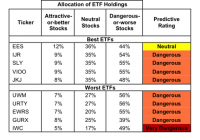
Summary Small Cap Blend style ranks last in Q2’15. Based on an aggregation of ratings of 29 ETFs and 678 mutual funds. EES is our top rated Small Cap Blend ETF and PXQSX is our top rated Small Cap Blend mutual fund. The Small Cap Blend style ranks 12th out of the 12 fund styles as detailed in our Q2’15 Style Rankings report . It gets our Dangerous rating, which is based on an aggregation of ratings of 29 ETFs and 678 mutual funds in the Small Cap Blend style. Figures 1 and 2 show the five best and worst rated ETFs and mutual funds in the style. Not all Small Cap Blend style ETFs and mutual funds are created the same. The number of holdings varies widely (from 24 to 2544). This variation creates drastically different investment implications and, therefore, ratings. Investors seeking exposure to the Small Cap Blend style should buy one of the Attractive-or-better rated ETFs or mutual funds from Figures 1 and 2. Figure 1: ETFs with the Best & Worst Ratings – Top 5 (click to enlarge) * Best ETFs exclude ETFs with TNAs less than $100 million for inadequate liquidity. A total of six ETFs are excluded from Figure 1 because their total net assets are below $100 million and do not meet our liquidity minimums. Figure 2: Mutual Funds with the Best & Worst Ratings – Top 5 (click to enlarge) * Best mutual funds exclude funds with TNAs less than $100 million for inadequate liquidity. A total of five mutual funds are excluded from Figure 1 because their total net assets (TNA) are below $100 million and do not meet our liquidity minimums. The WisdomTree SmallCap Earnings ETF (NYSEARCA: EES ) is our top-rated Small Cap Blend Style ETF and the Virtus Quality Small-Cap Fund (MUTF: PXQSX ) is our top-rated Small Cap Blend Style mutual fund. EES earns a Neutral rating and PXQSX earns an Attractive rating. One of our favorite stocks held by Small Cap Blend funds is The Buckle Inc. (NYSE: BKE ). Buckle is a casual apparel, footwear and accessories retailer. As a retailer, the company has achieved very consistent financial performance. Over the last decade Buckle has grown after-tax operating profit ( NOPAT ) by 17% compounded annually. Buckle’s return on invested capital ( ROIC ) in 2014 was 32%, placing it in the top quintile of all companies we cover. Over the past seven years ROIC has never fallen below 28% indicating a very resilient business franchise. Given its strong fundamentals, The Buckle is currently undervalued. At its current price of ~$47/share, BKE has a price to economic book value ( PEBV ) ratio of 1.0. This ratio implies the market expects Buckle’s NOPAT to never grow from current levels. However if the company is able to grow NOPAT by just 6% compounded annually for the next 10 years the stock is worth $73/share today – a 55% upside. The iShares Micro-Cap ETF (NYSEARCA: IWC ) is our worst-rated Small Cap Blend style ETF and the Chartwell Small Cap Value Fund (MUTF: CWSVX ) is our worst-rated Small Cap Blend style mutual fund. Both earn our Very Dangerous rating. One of our least favorite stocks held by Small Cap Blend funds is Mobile Mini (NASDAQ: MINI ). Since 2009, Mobile Mini’s NOPAT has not grown at all, and in fact has declined by $2 million. The company’s ROIC has not risen either, and at only 4% in 2014, ranks in the bottom quintile of all companies we cover. To top it off, Mobile Mini has not generated positive economic earnings in any year for the last 16 years. However, to justify its current price of ~$43/share, Mobile Mini must grow NOPAT by 13% compounded annually for the next 18 years . A history of stagnant NOPAT coupled with poor profitability make Mobile Mini an overvalued stock. The expectations implied by the current price are just too high given the actual economics of the business. Figures 3 and 4 show the rating landscape of all Small Cap Blend ETFs and mutual funds. Figure 3: Separating the Best ETFs From the Worst ETFs (click to enlarge) Figure 4: Separating the Best Mutual Funds From the Worst Funds (click to enlarge) Sources Figures 1-4: New Constructs, LLC and company filings D isclosure: David Trainer owns BKE. David Trainer and Allen L. Jackson receive no compensation to write about any specific stock, style, style or theme. Disclosure: I am/we are long BKE. (More…) I wrote this article myself, and it expresses my own opinions. I am not receiving compensation for it. I have no business relationship with any company whose stock is mentioned in this article.