Tag Archives: etf-hub

PHK: Is It Time To Get Out While You Still Can?

Summary Pimco High Income Fund’s premium has fallen from over 50% to around 30%. The net asset value isn’t the issue, investor perception is. I strongly recommend investors reconsider their position here before it’s too late. Pimco High Income Fund (NYSE: PHK ) is a risky investment. Although the fund has a solid performance history and has steadily paid dividends through even the “worst of times,” it trades at an extreme premium over net asset value, or NAV. It’s easy to give short shrift to that little issue when times are good, it’s harder to ignore when the tide starts to shift. And just such a shift may be taking place right now. OK, it’s got a good record I’m not going to argue that PHK is a poorly run fund. Quite the contrary, it is a well run fund. For example, over the trailing 10-year period through May, the fund’s annualized NAV total return was around 11%. Total return includes reinvested distributions. That puts the fund in the top tier of its Morningstar peers. It’s performance over the trailing three- and five-year periods were even more impressive, at 19% and nearly 18%, respectively. Equally important, the fund’s distribution has been maintained through thick and thin. That includes through the disastrous 2007 to 2009 recession that led to distribution cuts throughout the CEF industry. I have concerns with the level of the distribution , at nearly 13% based on market price and 19% based on NAV, but that doesn’t diminish the consistency with which the dividend has so far been paid. So, yes, PHK has been a well run fund. If this were an open-end mutual fund the discussion would stop right there. But it isn’t, it’s a closed-end fund. Supply and demand Closed-end funds trade on supply and demand, which means their prices can vary from their net asset values. When investors are enamored of a CEF, they bid the shares up close to or above the NAV. When investors are less sanguine they push CEFs to discount prices – often very deep discount prices. This isn’t news to anyone who follows CEFs. PHK has been a market darling. It started the year with around a 50% premium over NAV. That’s massive and only exists because of investor sentiment. Investors at the start of the year were willing to pay $1.50 for $1 worth of assets. I have suggested a couple of times that this is a big risk. That stance had garnered a mixture of agreement and hostility. Those who disagree with my concerns basically suggest that the fund is so good that it deserves the premium pricing. Looking at more recent performance, however, suggests exactly why such a rich premium is a huge risk. Over the trailing three months through June 23rd, PHK’s market price return was a decline of over 18%. That’s a rough stretch to have lived through, even if the dividend has remained stable. And while investors can argue that impressive share price gains over the years means those losses are only taking back house money that misses the point. You see, PHK’s NAV return was a positive 5.5% over that same span. And since PHK’s NAV performance was positive during this span, it’s hard to suggest that the market price performance had anything to do with the fund’s NAV performance. It seems pretty clear to me that a significant number of investors have soured on the fund. Yes, there have been changes in the number of shares of PHK that are sold short . That, presumably, should ease negative sentiment. But, in the long run, this is noise. The short interest is a symptom of the bigger issue, which is the extreme overvaluation. A warning shot If you still own PHK, look at this swift reversal of fortune as a warning shot. Could the premium go right back up to 50%? Yes. Will it? Who knows. The drop, however, is clear evidence that investor perceptions are shifting. The value of a PHK share is still roughly 30% lower than where the shares trade today. In other words, there’s still plenty of downside left before it reaches NAV. Don’t underestimate that risk. Disclosure: I/we have no positions in any stocks mentioned, and no plans to initiate any positions within the next 72 hours. (More…) I wrote this article myself, and it expresses my own opinions. I am not receiving compensation for it (other than from Seeking Alpha). I have no business relationship with any company whose stock is mentioned in this article.
Best And Worst: Small Cap Growth ETFs, Mutual Funds And Key Holdings

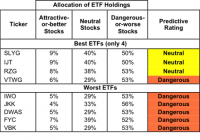
Summary Small Cap Growth style ranks 10th in 2Q15. Based on an aggregation of ratings of 11 ETFs and 498 mutual funds. SLYG is our top rated Small Cap Growth ETF and VSCRX is our top rated Small Cap Growth mutual fund. The Small Cap Growth style ranks 10th out of the 12 fund styles as detailed in our 2Q15 Style Rankings report . It gets our Dangerous rating, which is based on an aggregation of ratings of 11 ETFs and 498 mutual funds in the Small Cap Growth style. Figures 1 and 2 show the five best and worst rated ETFs and mutual funds in the style. Not all Small Cap Growth style ETFs and mutual funds are created the same. The number of holdings varies widely (from 29 to 1214). This variation creates drastically different investment implications and, therefore, ratings. Investors seeking exposure to the Small Cap Growth style should buy one of the Attractive-or-better rated ETFs or mutual funds from Figures 1 and 2. Figure 1: ETFs with the Best & Worst Ratings – Top 5 (click to enlarge) * Best ETFs exclude ETFs with TNAs less than $100 million for inadequate liquidity. PowerShares Fundamental Pure Small Growth Portfolio ETF (NYSEARCA: PXSG ) and Vanguard S&P Small Cap 600 Growth (NYSEARCA: VIOG ) are excluded from Figure 1 because their total net assets are below $100 million and do not meet our liquidity minimums. Figure 2: Mutual Funds with the Best & Worst Ratings – Top 5 (click to enlarge) * Best mutual funds exclude funds with TNAs less than $100 million for inadequate liquidity. Transparent Value Small Cap Fund ( TVSIX , TVSFX ) and Oak Associates River Oak Discovery Fund (MUTF: RIVSX ) are excluded from Figure 2 because their total net assets are below $100 million and do not meet our liquidity minimums. State Street SPDR S&P 600 Small Cap Growth (NYSEARCA: SLYG ) is our top-rated Small Cap Growth ETF and Virtus Small-Cap Core Fund (MUTF: VSCRX ) is our top-rated Small Cap Growth mutual fund. SLYG earns a Neutral rating and VSCRX earns an Attractive rating. One of our favorite stocks held by Small Cap funds is Universal Insurance Holdings (NYSE: UVE ), which earns a Very Attractive rating. Since 2009, Universal Insurance has grown after-tax profit ( NOPAT ) by 21% compounded annually. In addition to its NOPAT growth, the company has increased its return on invested capital ( ROIC ) to 39% in 2014, up from 16% in 2011. Economic earnings have also been positive since 2007. Despite the impressive profit growth achieved by Universal Insurance, the stock remains undervalued. At its current price of $24/share, UVE has a price to economic book value ( PEBV ) ratio of 0.9. This ratio implies the market expects Universal Insurance’s NOPAT to decline by 10% from current levels. However, as noted above, Universal has grown NOPAT by double digits over the past five years. If Universal Insurance Holdings can grow NOPAT by just 8% compounded annually for the next 10 years the stock is worth $38/share today – a 58% upside. Vanguard Small-Cap Growth ETF (NYSEARCA: VBK ) is our worst rated Small Cap Growth ETF and AllianzGI Ultra Micro Cap Fund (MUTF: GUCAX ) is our worst rated Small Cap Growth mutual fund. VBK earns a Dangerous rating and GUCAX earns a Very Dangerous rating. One of our worst rated stocks held by GUCAX is Cardiovascular Systems (NASDAQ: CSII ), which earns our Dangerous rating. NOPAT losses have increased every year since 2012, expanding from -$14 million to over -$33 million in 2014. ROIC has also been negative each year since 2012 and is currently -32%. This equates to Cardiovascular Systems destroying 32 cents of every dollar invested into the business. Despite all of this, CSII’s stock price does not reflect the company’s deteriorating performance. Since 2012, the stock has tripled in price. When considering the fundamental performance of the company over this period, we believe the stock to be overvalued. To justify its current price of $29/share, the company would need to achieve positive pretax margins immediately and grow revenue by 35% compounded annually for the next 18 years . This seems very optimistic given that the company has never grown revenue above 31% year over year, and has remained unprofitable while doing so. Figures 3 and 4 show the rating landscape of all Small Cap Growth ETFs and mutual funds. Figure 3: Separating the Best ETFs From the Worst ETFs (click to enlarge) Figure 4: Separating the Best Mutual Funds From the Worst Funds (click to enlarge) Sources Figures 1-4: New Constructs, LLC and company filings Disclosure: David Trainer and Allen L. Jackson receive no compensation to write about any specific stock, style, style or theme. Disclosure: I/we have no positions in any stocks mentioned, and no plans to initiate any positions within the next 72 hours. (More…) I wrote this article myself, and it expresses my own opinions. I am not receiving compensation for it. I have no business relationship with any company whose stock is mentioned in this article.

NiSource Is Overvalued And Speculative

Summary NI is not suitable for either the Defensive Investor or the Enterprising Investor following the ModernGraham approach. According to the ModernGraham valuation model, the company is overvalued at the present time. The market is implying a 10.15% earnings growth over the next 7-10 years, considerably more than the rate the company has seen in recent years. Utilities often attract investors due to consistent earnings and dividend payments, and NiSource (NYSE: NI ) is no exception. Several qualitative factors make the company interesting to numerous investors. For example, Seeking Alpha contributor Josh Young recently wrote that the company’s spin off of its pipeline business makes it potentially a good value, a view that The Socially Responsible Investor also holds . Both of these articles provide great qualitative issues to consider, but one must first look at a quantitative analysis of the company. In fact, Benjamin Graham, the father of value investing, taught that the most important aspect to consider is whether the company is trading at a discount relative to its intrinsic value. It is through a thorough fundamental analysis that the investor is able to determine a potential investment’s merits. Here’s an updated look at how the company fares in the ModernGraham valuation model. This model is inspired by the teachings of Benjamin Graham and considers numerous metrics intended to help the investor reduce risk levels. The first part of the analysis is to determine whether the company is suitable for the very conservative Defensive Investor or the less conservative Enterprising Investor who is willing to spend a greater amount of time conducting further research. In addition, Graham strongly suggested that investors avoid speculation in order to remove the subjective elements of emotion. This is best achieved by utilizing a systematic approach to analysis that will provide investors with a sense of how a specific company compares to another. By using the ModernGraham method , one can review a company’s historical accomplishments and determine an intrinsic value that can be compared across industries. NI data by YCharts Defensive Investor – Must pass at least 6 of the following 7 tests: Score = 5/7 Adequate Size of Enterprise – Market capitalization of at least $2 billion – PASS Sufficiently Strong Financial Condition – Current ratio greater than 2 – FAIL Earnings Stability – Positive earnings per share for at least 10 straight years – PASS Dividend Record – Has paid a dividend for at least 10 straight years – PASS Earnings Growth – Earnings per share has increased by at least one-third over the last 10 years, using three-year averages at the beginning and end of the period – PASS Moderate PEmg (price over normalized earnings) ratio – PEmg is less than 20 – FAIL Moderate Price to Assets – PB ratio is less than 2.5 or PB x PEmg is less than 50 – PASS Enterprising Investor – Must pass at least 4 of the following 5 tests tobe suitable for a Defensive Investor: Score = 3/5 Sufficiently Strong Financial Condition, Part 1 – Current ratio greater than 1.5 – FAIL Sufficiently Strong Financial Condition, Part 2 – Debt-to-Net Current Assets ratio less than 1.1 – FAIL Earnings Stability – Positive earnings per share for at least 5 years – PASS Dividend Record – Currently pays a dividend – PASS Earnings Growth – EPSmg greater than that 5 years ago – PASS Valuation Summary Key Data Recent Price $46.54 MG Value $40.93 MG Opinion Overvalued Value Based on 3% Growth $23.43 Value Based on 0% Growth $13.74 Market Implied Growth Rate 10.15% Net Current Asset Value (NCAV) -$50.77 PEmg 28.80 Current Ratio 0.82 PB Ratio 2.26 Balance Sheet – March 2015 Current Assets $2,261,000,000 Current Liabilities $2,758,000,000 Total Debt $7,958,000,000 Total Assets $24,899,000,000 Intangible Assets $3,928,000,000 Total Liabilities $18,375,000,000 Outstanding Shares 317,400,000 Earnings Per Share 2015 (estimate) $1.73 2014 $1.67 2013 $1.70 2012 $1.39 2011 $1.03 2010 $1.01 2009 $0.84 2008 $1.34 2007 $1.14 2006 $1.14 2005 $1.04 Earnings Per Share – ModernGraham 2015 (estimate) $1.62 2014 $1.49 2013 $1.33 2012 $1.14 2011 $1.04 2010 $1.06 Dividend History NI Dividend data by YCharts Conclusion NiSource does not qualify for the Enterprising Investor or the more conservative Defensive Investor. The Defensive Investor is concerned by the low current ratio along with the high PEmg ratio, while the Enterprising Investor is only concerned with the level of debt relative to the current assets. Therefore, all value investors should only proceed with the next stage of the analysis, which is a determination of an estimate of intrinsic value, with a speculative attitude in mind. From a valuation side of things, the company has grown its EPSmg (normalized earnings) from $1.04 in 2011 to only an estimated $1.62 for 2015. This level of demonstrated growth does not support the market’s implied estimate for earnings growth of 10.15% over the next 7-10 years. The company’s recent earnings history shows an average annual growth in EPSmg of around 11.22%; however, the ModernGraham valuation model reduces such a rate to a more conservative figure, assuming some slowdown will occur. As a result, the model returns an estimate of intrinsic value falling within below the current price, indicating NiSource is overvalued at the present time. Disclosure: I/we have no positions in any stocks mentioned, and no plans to initiate any positions within the next 72 hours. (More…) I wrote this article myself, and it expresses my own opinions. I am not receiving compensation for it (other than from Seeking Alpha). I have no business relationship with any company whose stock is mentioned in this article.