Tag Archives: etf-hub

ETF Asset Report Of H1: Currency Hedging Tops; U.S. Flops

As we step into the second half of 2015, it might be useful to look at how the $2.16-billion ETF industry performed in the first half of the year. After analyzing, we can conclude that currency-hedged ETFs and developed markets were the star performers in terms of asset gathering, as these saw maximum inflows, while the broader U.S. market was the laggard. Though “Grexit” worries in June had a last-minute impact on the half-yearly asset report, it could not totally derail the original sentiments. Let’s find out the top gainers and losers in terms of asset growth in the first half of 2015 (Source: etf.com ). Gainers Currency Hedging – WisdomTree Europe Hedged Equity ETF (NYSEARCA: HEDJ ) Currency hedging as a technique rocked in the first half of this year when it came to playing the developed economies like Europe. The rounds of monetary easing and the launch of the QE policy revived the eurozone this year. While policy easing devalued European currencies, the greenback strengthened on rising rate worries in the U.S. This policy differential made the currency hedging theme a shining star in 1H. Thanks to this trend, HEDJ, an ultra popular Europe ETF, was at the helm, having amassed over $14 billion in assets so far. Another exchange-traded fund, the Deutsche X-trackers MSCI EAFE Hedged Equity ETF (NYSEARCA: DBEF ), which tracks the stocks from Europe, Australia and the Fast East, also added about $10.7 billion to its asset base and took the second spot. Developed Economies – iShares MSCI EAFE ETF (NYSEARCA: EFA ) Since accommodative policies were common in developed nations, from Europe to Japan to Australia and some emerging economies, EFA and the Vanguard FTSE Developed Markets ETF (NYSEARCA: VEA ) took the third and tenth spots in the list, respectively. EFA hauled in about $6 billion, while VEA gathered about $2.7 billion in assets. Among the developed economies, Japan drew sizeable investor attention on stepped-up economic stimulus and after having come out of a technical recession in the final quarter of 2014. Though aggressive stimulus devalued the yen and bolstered the appeal for the hedged Japan ETFs, regular funds also did well in the first half. As a result, the WisdomTree Japan Hedged Equity ETF (NYSEARCA: DXJ ) and the iShares MSCI Japan ETF (NYSEARCA: EWJ ) – taking the sixth and seventh spots – saw inflows of $4.4 billion and $3.24 billion, respectively. Europe ETFs also gave an all-star performance, despite Greek debt default worries. Accordingly, the Vanguard FTSE Europe ETF (NYSEARCA: VGK ) and the iShares MSCI Germany ETF (NYSEARCA: EWG ) – the eighth and ninth position holders, each stacked up over $2.7 billion in assets. Vanguard ETFs – Vanguard Total Stock Market ETF (NYSEARCA: VTI ) and Vanguard S&P 500 ETF (NYSEARCA: VOO ) Since the relatively smaller market cap U.S. stocks rocked the show in 1H being better bets to guard from the rising dollar, the success behind VTI was self-explanatory. As the name suggests, VTI targets stocks across the capitalization spectrum and amassed about $4.9 billion assets. However, this does not seem the sole reason for the fund’s success. Vanguard’s low-cost approach was immensely popular in the last few years, which is why the issuer saw its asset base growing by leaps and bounds. Probably this was why VOO saw net asset inflows of $4.5 billion in 1H, despite the broader market underperformance. Losers U.S. – SPDR S&P 500 ETF Trust (NYSEARCA: SPY ) SPY, having witnessed an outflow of $42.7 billion in assets to-date, was the hardest hit. Though it started to gain traction on several occasions this year in line with the broader U.S. economic recovery, it could not woo investors. After all, the S&P 500 was flat in the first half. A soaring greenback and a harsh winter in the first quarter wrecked havoc on this benchmark index. Another fund by iShares, the iShares Core S&P 500 ETF (NYSEARCA: IVV ), also lost about $2.37 billion in assets. Investors should note that other ultra-popular ETFs that track key U.S. bourses like the Nasdaq and Dow Jones saw assets bleeding out of their products. The PowerShares QQQ Trust ETF (NASDAQ: QQQ ), which looks to track the tech-heavy Nasdaq, shed about $2.83 billion in assets and became the third-highest loser of 1H. The SPDR Dow Jones Industrial Average ETF (NYSEARCA: DIA ) too was in no better position, having lost about $1.67 billion in assets. Emerging Markets – iShares MSCI Emerging Markets (NYSEARCA: EEM ) The fund comes as a distant second, seeing a net exodus of about $3 billion in assets. The Fed rate hike worry was the major reason for investors’ aversion to the space. An anticipation of a cease in cheap dollar inflows may have caused investors to flee the space. Rate-Sensitive Sectors – Consumer Staples Select SPDR ETF (NYSEARCA: XLP ) and iShares U.S. Real Estate ETF (NYSEARCA: IYR ) Rate hike concerns sent jitters in the high-yielding sectors of the U.S. economy, leading investors to shy away from consumer staples and REIT ETFs, known for their high dividend yield. As a result, XLP had to sacrifice about $2.66 billion in net assets, while IYR surrendered about $1.61 billion. Original Post
Prediction Is Difficult. Especially About The Future

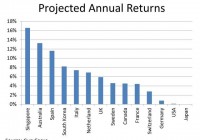
In the immortal words of the physicist Niels Bohr, “Prediction is very difficult. Especially if it’s about the future.” I rarely make firm market forecasts. But I do like to look at broad valuation numbers and see what they imply about future returns. You know the refrain: Past performance is no guarantee of future results. But the following returns estimates, courtesy of data site GuruFocus , give us a little historical perspective. GuruFocus bases its estimates on three factors: Expected economic growth, based on the average growth over the last business cycle. Expected dividend returns, based on the average dividend yield of the past five years. Change in market valuation (the assumption is that the ratio of market cap-to-GDP will revert to its average over a full market cycle, or 7-8 years). So, what do the numbers suggest? (click to enlarge) I’ll start with the good news. Several world markets are priced to deliver solid returns over the next eight years. In particular, Singapore, Australia and Spain are priced particularly attractively, with implied future returns well over 10% per year. Now, keep in mind that Singapore’s economic growth is highly dependent on trade flows between China and the West, Australia is highly dependent on selling commodities to China, and Spain is at the center of the eurozone sovereign debt crisis. All of these countries have murky near-term outlooks, and the projections for economic growth based on the past might not be realistic for the future. But once the dust settles, all might make for attractive “fishing ponds” for investment. Now for the bad news. The US market – where you’re most likely to have the bulk of your assets invested – is priced to deliver annual returns of approximately zero over the next eight years. And it’s not just the market cap-to-GDP ratio that suggests this. As I wrote recently , other metrics, such as the cyclically-adjusted price/earnings ratio (“CAPE”), point to similarly disappointing returns going forward. And allocating your funds to European or Asia-Pacific funds might not help you much. Germany and Japan, which tend to dominate European and Asian-Pacific funds, are priced to deliver equally disappointing returns going forward. So, what’s the takeaway here? In order to avoid lousy returns over the next several years, you’re going to have to invest differently than you might have in the past. You’re going to have to look more aggressively overseas, and within the overseas universe, you’ll need to underweight the most common international markets. This article first appeared on Sizemore Insights as Prediction is Difficult. Especially About the Future Disclaimer: This article is for informational purposes only and should not be considered specific investment advice or as a solicitation to buy or sell any securities. Sizemore Capital personnel and clients will often have an interest in the securities mentioned. There is risk in any investment in traded securities, and all Sizemore Capital investment strategies have the possibility of loss. Past performance is no guarantee of future results. Original Post

BGH: High Yield, Short Duration – Is This The Place To Be Right Now?

2014 was unkind to Babson Capital Global Short Duration High Yield Fund. It appears to be getting back on its feet. While high yield is risky overall, staying short is a safer way to play the space. Babson Capital Global Short Duration High Yield Fund’s (NYSE: BGH ) net asset value, or NAV, fell nearly 13% last year. However, its started to stabilize this year. Which shows the risks of high yield, but doesn’t tarnish the potential benefit of staying short term. If you are looking for a high yield fund, but are worried about low interest rates, you might consider taking a look here. What’s in a high yield? I recently took a look at a couple of high yield closed-end funds , or CEFs, with broad investment mandates. Essentially, the two finds I compared, BlackRock Corporate High Yield Fund (NYSE: HYT ) and Dreyfus High Yield Strategies Fund (NYSE: DHF ), both have notable leeway when it comes to their portfolio selections. That’s not the case at BGH . Sure, it can invest around the world, but its average duration has to come in at three years or less. Why is that relevant? Because shorter duration bonds tend to be less impacted by changes in interest rates. So with interest rates near historic lows, if you are concerned about the impact of a rising yield environment, you’d want to stay toward the shorter end of the duration spectrum. HYT’s “model” duration was around five years at the end of the first quarter. DHF’s average duration was a touch over three years. BGH’s was a little under two years. Looking at this from a big picture perspective , this means that if interest rates were to increase by one percentage point, BGH’s value would be expected to decline by around 2%. DHF would fall by around 3% and HYD 5%. If rates fell, the opposite would happen, with BGH gaining less than the others. So, if you are concerned about interest rates going up but are still looking for a high yield fund, a short-term option like BGH might be worth a quick review. Short history That said, I looked at BGH because a reader requested it. The fund’s IPO was in late 2012, so it’s fairly young and doesn’t have much of a track record to go off of (less than three years). That doesn’t tarnish the value of its short duration focus, but it does mean the fund hasn’t been tested by time. So that’s a grain of salt you’ll need to take if you decide to invest here. However, it’s worth noting that last year was a tough one on the fund largely because of its exposure to oil companies ( recently around 20% of assets). With oil prices declining some 50% in the back half of 2014, it’s not surprising that BGH saw its NAV decline nearly 13% last year. That drop spoiled what was looking like a solid history. The fund IPOed with an NAV of roughly $23.80 per share. That had increased to nearly $25.25 by the start of 2014 only to drop to $22 by the end of the year. It remains around that level today, after having dropped even further at the start of 2015. There’s two takeaways here. First, this is a high yield fund, so even a short duration can’t offset the risk of investing in the debt of financially weak companies. (Note that HYD saw a similar NAV drop.) Two, the downdraft, at this point, appears to be over. So watch the NAV to see if management can get it to start moving higher again. This is, literally, the first time BGH has dealt with notable adversity. What else is worth knowing? Like many competing high yield CEFs, BGH makes use of leverage to enhance returns. Right now leverage stands at nearly 25% of assets. That helps boost yield, since BGH’s borrowing costs are lower than the interest it receives on its investments. And leverage can enhance returns if bond prices go up-but can also augment losses if bond prices decline. So leverage cuts both ways. Keep this in mind as it increases volatility even for a fund with a short duration. Leverage, however, also increases costs since the fund has to pay interest expenses. In fact, BGH is not a cheap fund to own, with an expense ratio of more than 2%. That may be fine with yield-hungry investors, however, since the fund’s yield is around 10%. But if you are looking for a cheap fund to own, this isn’t it. Without a longer history, it’s too soon to tell if 2014’s poor showing was an aberration. But certainly such a high yield gets increasingly hard to justify when the NAV is falling. However, return of capital doesn’t appear to be an issue yet since the fund avoided that type of distribution in 2013 and 2014. So, so far, BGH should probably get the benefit of the doubt here. Just keep in mind that a fund with a 10% yield is likely to be giving you all of your return in the form of distributions. That, in turn, makes it harder to grow NAV. While bonds are all about the income, a long-term trend of a declining NAV will most likely lead to distribution cuts at some point. So it is really important to watch BGH to see what happens on the NAV side of things from here. That remains true even though the fund is trading hands at a 10% discount to NAV. Indeed, that’s only a bargain if net asset value can recover from downdrafts like the one experienced in 2014. Too early for most At this point, I’d say BGH is a little too young for my tastes. I see value in its short duration peg, which might interest investors who want high yield exposure but want to limit interest rate risk. However, without a lot of history to go on (and one good year followed by one bad year in its short life), it’s hard to get a read on the value this fund would have in a portfolio. Disclosure: I/we have no positions in any stocks mentioned, and no plans to initiate any positions within the next 72 hours. (More…) I wrote this article myself, and it expresses my own opinions. I am not receiving compensation for it (other than from Seeking Alpha). I have no business relationship with any company whose stock is mentioned in this article.