Tag Archives: etf-hub

Rising Rates Are Good For PHK, Part II
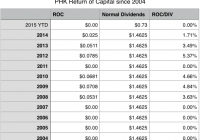
Summary PHK pays out 19.2% of its NAV in dividends to shareholders. This distribution is unsustainable, as the fund’s managers have increasingly relied on active investment in bonds, currencies, and derivatives to sustain payouts with minimal return of capital, thus increasing risk. If interest rates rise, PHK is likely to become less reliant on this riskier approach as its NII will increase. The greatest concern regarding Pimco High Income Fund (NYSE: PHK ) is its payout to NAV ratio. With NAV of $7.62 as of July 2nd and annual dividend payouts of $1.46256, the fund needs to get a 19.2% return to sustain its dividend. Bears argue that this is impossible, and that the fund has to return capital and deplete its NAV to maintain the unsustainable dividend. However, according to CEF Connect , PHK has not paid a Return of Capital in over a year. On top of that, PHK’s history of funding distributions through ROC is moderate. While 1.71% of distributions came from ROC last year, that is down from the prior two years: Also significant: the fund has not resorted to ROC to fund distributions in years of rising rates — years of ROC distributions coincide with times of heightened economic crisis (2008, 2009, 2010) for the most part, although the reliance of ROC during 2012, 2013, and 2014 indicates the fund has had some difficulty in covering distributions from income along. However, the consistent decline in ROC and the absence of ROC so far for 2015 suggests that the fund has been able to wean itself off this stop-gap. There is still a fear that the fund will need to resort to ROC soon, since the average coupon of the fund, according to its most recent holdings report , is 5.165%. Even with leverage, which has fallen to 29% in recent months, it seems there is no way the fund can return 19%. So how can PHK continue to cover dividends when it is paying out 19% on NAV? Clipping Coupons To understand this, we first need to take a step back and remind ourselves that the income a bond holder receives is not necessarily the same as the coupon rate. Bonds are frequently bought at a discount, particularly by institutional investors who have greater access to a market that is much less liquid than equities. Since PHK does not reveal the price it has paid for its holdings, and we can only infer how long it keeps certain holdings in its portfolio, coupon rates are useless in determining the sustainability of the dividend or the fund’s ability to earn a 19% return on NAV. Additionally, the fund’s use of derivatives, its arbitrage and hedging from shorting, and its currency trades make it impossible to know exactly how well operations can fund distributions to shareholders. A better way to understand the return it is getting from its portfolio is to compare its net investment income to its NAV. If we look at these, we see that the fund is now earning about a 12.4% return: This is nowhere near the 19% return that is necessary to sustain the dividend in perpetuity, but is much better than the coupon rates suggest. However, this might become the wrong way to look at this fund if rates rise sufficiently. A Better Investment on Rising Rates While it is undeniable that the low interest rate environment hurts PHK’s NII and its ability to sustain its dividend, the sustainability of those payouts improves considerably in times of higher rates, as the above chart suggests. NII has fallen 43% from 2006 to 2015 due to lower interest rates, and its NII is likely to rise if rates rise and the fund is able to purchase discounted issues with a higher coupon rate. The fund’s recent decline in leverage might indicate its managers are anticipating a rise in rates and are positioning themselves accordingly by freeing up access to capital. Much more crucially: a rise in rates will also help the fund cover dividends, as its NII-to-Dividend Ratio remained well over 100% until the Global Financial Crisis in 2008: Surprisingly, the fund’s NII-to-Dividend ratio remained strong in 2009, when its NAV plummeted to less than $3 at its lowest point. At that time, and for several years since then, the fund has been able to more than cover dividends through investment operations — the kind of arbitrage, churn, and derivative trading that investors pay for. (The significant exception, in 2012, was during Bill Gross’s tenure as manager of the fund. He is no longer with the fund or PIMCO.) The fact that the fund has relied on this kind of active speculation more than before 2008 suggests that there is considerably greater risk in the fund than there was then, but it may also suggest that the fund will become less reliant on such tactics when rates rise. While it is true that the total capital PHK has to invest is much less than in 2005-2008, making it a riskier investment than it was then, its access to higher-yielding bond opportunities in a rising rate environment may make it a less risky investment than it has been since 2008 and throughout the 7 years that the fund maintained its monthly dividend payouts. Conclusion PHK is not without its risks. Its reliance on derivatives and investment operations, particularly since 2009, means greater volatility in dividend coverage and a greater risk in a decline in NAV, as we have seen in four of the last 8 years since the Global Financial Crisis, including this year. At the same time, the fund’s ability to earn higher rates of income in periods of rising rates means that a sell-off due to rising rates is unwarranted. Most significantly, if rates do rise later this year or next year, PHK may find it easier to earn income from the high yield market and become less reliant on derivatives and active trading to boost returns. Disclosure: I am/we are long PHK. (More…) I wrote this article myself, and it expresses my own opinions. I am not receiving compensation for it (other than from Seeking Alpha). I have no business relationship with any company whose stock is mentioned in this article.
Refresh Your Portfolio With Some Green (Investments)

Summary Sustainability is an investable opportunity. A variety of sustainable investment instruments will suit the unique risk tolerance of different investors. Sustainable-themed mutual funds are a good way to get exposure to this investment opportunity. Green investing, or sustainable investing, is the type of investment that intentionally seek sustainable, environmentally friendly outcome. Examples of green investing include the stock of a clean energy company, and a project finance to reduce carbon footprint of urban housing communities. Green investing is NOT just for tree huggers. A 2009 study shows that “carbon legacy” of just one child is worth as much as 20 times the emission saved by a person who drive a high-mileage car, recycle, use energy-efficient appliances and light bulbs, etc. With global population projected to reach almost 10 billion by 2050 ( link ), the subsequent exponential growth in carbon emission will make sustainability an ever pressing concern. Sustainability is an investable opportunity. Everyone’s portfolio needs a refresh with some green in it. The good news is, there have already been a plethora of options to suit the unique risk tolerance of different investors. The options span from conservative fixed income instruments (rated as high as AA) to nano-cap high risk stocks, any many things in between. Green investing is not just project finance. One big misconception about green investing is that the underlying investment is some obscure high-tech project in the field that may or may not turn a profit. Granted, project finance is needed for global sustainability and large banks like Deutsche Bank are actively involved in it; however, many actively traded stocks and fixed income instruments allow retail investors to tap into the theme, too. In this way, with reasonable capital commitment and a diversified portfolio, retail investors are on the right path to realize positive returns with minimal project risk. Below I will discuss just a few such investments. The true scope of available instruments is far beyond what I can cover here. Indices A handful of green-related indices already exist in the market place. These are easy ways to track the performance of green investment, which is useful for benchmarking relevant mutual funds and ETFs, which I will touch on later. But first, a brief overview of the key sustainability indices. Dow Jones Sustainability Indices (DJSI) Family Launched in 1999, the (DJSI) were the first global equity indices tracking the financial performance of leading sustainability-driven companies globally. Various sub-indices are available for different regions, such as DJSI World, DJSI United States, and DJSI Eurozone etc. A stocks is only selected if it scores high enough in an integrated assessment of economic, environmental and social factors. Dow Jones conducts annual assessment to ensure the index components remain best-in-class in their sustainability outcome. Due to the methodology, invariable most companies selected are public, large-cap companies. These companies, such as Abbot Labs (NYSE: ABT ) and TD Bank (NYSE: TD ), have long track record as successful companies. S&P Green Bond Index (SPUSGRN) This is the fixed income cousin of the DJSI. A first-of-its-kind index, the S&P Green Bond Index is designed to track the global green bond market. The index was only launched in July 2014. For a bond to be included in the index, the bond issuer has to explicitly disclose the use of proceeds or its compliance with the Green Bond Principals has been independently verified. The index is characterized by medium duration (5 years) and relatively low risk with Yield to Worst of 1.8% Index Funds There are a handful of green index funds available. Even the grandfather of index investing, Vanguard, offers the Vanguard FTSE Social Index Fund (MUTF: VFTSX ). Again, this shows green investing is serious business. Instead of repeating the long list, here I recommend a few for different types of investors. If you are just tipping your toes in to green investing – the TIAA-CREF Social Choice Equity Fund (MUTF: TICRX ) The TIAA-CREF Social Choice Equity Fund is open to both institutional and retail investors. If you are just dipping your toes in this new category, TISCRX allows you to test the thesis for as low as $250. The fund’s style is mostly large-cap U.S. stocks balanced between growth and value stocks. Its solid track record makes the fund a wise investment decision by itself too- the fund has returned 0.24% YTD and 16.2% for the past five years. If you are laser focused on net returns – the DFA U.S. Sustainability Core 1 Portfolio (MUTF: DFSIX ) The DFSIX has stood out among green mutual funds for its stellar performance. Returning investors 2.8% YTD, its annualized return for the past five years is impressive at 17.9%. The fund’s style is mostly large-cap U.S. stocks balanced between growth and value stocks. The fund’s its top holdings include Apple (NASDAQ: AAPL ), Microsoft (NASDAQ: MSFT ), and Exxon Mobil ( XOM). Better yet, as an investor you get to keep most of the performance, as the fund’s expense ratio is only 0.32% If you have a more global taste – the New Alternatives Fund ( NALFX) The New Alternatives Fund, managed by Accrued Equities, devotes about 60% of capital to non-U.S. stocks and the rest to domestic stocks. With a slightly elevated expense ratio of 1.08%, the fund gives investors exposure to global stocks that focus on alternative energy. The fund is co-managed by the fund’s founder Mr. Schoenwald since 1982 and Mr. Rosenblith since 2010. Year to date, the fund has returned a respectable 13.7% and it annualized a sound return of 10.6% in the last 5 years. An ETF Pick – the PowerShares WilderHill Clean Energy Portfolio ETF ( PBW) PowerShares WilderHill Clean Energy Portfolio ETF is a clean energy ETF; ETFs are similar to index funds but trade like stocks. PBW is composed of over 40 stocks, with an expense-ratio cap of 0.6%. Some of its top holdings are in Tesla (NASDAQ: TSLA ), which manufactures electric cars, and Ameresco (NYSE: AMRC ), which provides energy efficient solutions to electricity providers and consumers alike. The above is a just a sneak peak of the plethora of green equity funds available. For fixed income funds, a whole new dynamic of public-private partnership is at play as well. In future post, I will explore select fixed income instruments, especially those with innovative structure here and abroad. Disclosure: I/we have no positions in any stocks mentioned, and no plans to initiate any positions within the next 72 hours. (More…) I wrote this article myself, and it expresses my own opinions. I am not receiving compensation for it (other than from Seeking Alpha). I have no business relationship with any company whose stock is mentioned in this article.

Why I’ll Be Shopping For A VIX Short This Week

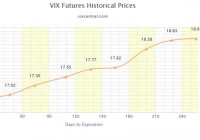
Summary U.S. economics still remain positive. Historical patterns for UVXY show us that further upside risk in this environment is limited. The Greece situation is way overblown. Hello everyone, Last week we discussed why all of the people that shouted “short volatility” the second it spiked were incorrect. On the night of 7/5 futures spiked to 19 but have settled to between 17-18. There are a couple ways to play this scenario. My favorite VIX candidates are the Proshares Ultra VIX Short-Term VIX Futures ETF (NYSEARCA: UVXY ) and its sister, the Proshares Short VIX Short-Term Futures ETF (NYSEARCA: SVXY ). UVXY This ETF invests in front and second month VIX futures, which can be found on the CBOE website here . As of writing vixcentral.com continues to be down and I would use that link until it is back up. I have a library of articles on UVXY if you need additional information and reading. Below is a look at VIX futures at the close of market Thursday July 2, 2015. Markets were closed Friday. Futures were still in contango at the end of last week, however they have entered backwardation several times now. This metric is my preferred measure of when to short volatility. (click to enlarge) UVXY benefits when futures are in backwardation. For more on contango and backwardation, watch this short video . I do not expect contango to hang around for more than a week. U.S. Economics For the best view on the U.S. economy each week, I recommend Jeff Miller’s “Weighing the Week Ahead” series. Here is a link to his author page on Seeking Alpha. This is, hands down, the best free review of the previous week and summary of the week ahead. I highly recommend having Jeff as one of your followings. My view is that the economy is still improving. Our GDP has been looking like Amazons earnings lately but we may now have that permanent seasonal economy. Da Fed If you read my article on Janet Yellen then you know what Fed speak can do for the markets. We have a lot of Fed speech this week and I expect that to have an overall soothing effect. If the dollar remains stronger I believe this will delay the Feds rate hike from September. As I have previously stated, they are in no hurry to raise rates and will be carefully looking over incoming data. At the first sign of weakness I would expect them to blink. SVXY This ETF works in the opposite way UVXY does. You could look into purchasing shares but I would warn that if conditions worsen or backwardation persists, it will have negative implications. Options I will be shopping and hopefully purchasing SVXY and selling UVXY call options sometime this week. Greece I highly appreciate the Greek people providing us with this opportunity. However, as with any volatility spike people are usually suffering. I wish them the best in their recovery and I hope they are able to work out a fair and equitable solution that enables their economy and quality of life to grow. Disclaimer Although I am shorting volatility this week, it is not for everyone. I could be wrong on my assessment and lose a lot of money. If you are not ok with losing money, then you should not be trading volatility or anything else for that matter. Historically speaking this situation will resolve itself and the market has entered oversold conditions. The only other surprises I see here should be positive. If you don’t understand how UVXY and SVXY work, you should check out my library of educational resources here on Seeking Alpha before investing in either of these products. Coverage For live coverage of volatility you can follow me here on Seeking Alpha, on Twitter, or on StockTwits, just search Nathan Buehler. I recommend following me on at least one of these to prevent any editorial delays associated with publishing full articles. Disclosure: I am/we are short UVXY. (More…) I wrote this article myself, and it expresses my own opinions. I am not receiving compensation for it (other than from Seeking Alpha). I have no business relationship with any company whose stock is mentioned in this article.