Tag Archives: etf-hub

Use Dividend Stocks And ETFs To Augment Long-Term Returns

Long-term investors should use high-quality dividend stocks and ETFs. Dividend stocks provide greater total returns, with dividend reinvestment, over the long term. While high dividends are nice, investors should also focus on high quality. Over the long term, high-quality, dividend-paying stocks and exchange-traded funds could produce outperforming results. Stocks with high dividend yields are the best way for investors to buy income in the current market, and if the positions are held over the long haul through short-term volatility, one may find the investment outperforming the overall market on a total return basis, writes Philip van Doorn for MarketWatch . For instance, the S&P 500 Dividend Aristocrats, which tracks over 50 stocks that have raised their dividends annually over at least 25 years, has outperformed the S&P 500 over long periods. Over the past 10 years, the S&P 500 Dividend Aristocrats have generated a 178% total return, with dividends reinvested. In contrast, the S&P 500 index has returned 117% over the same period. ETF investors can also track the S&P 500 Dividend Aristocrats through the ProShares S&P 500 Aristocrats ETF (NYSEArca: NOBL ) . NOBL has increased 11.4% over the past year, compared to the 10.4% gain in the S&P 500. The ETF also comes with a 1.62% 12-month yield. Additionally, research has found that high-quality, high-dividend stocks tend to outperform and produce better risk-adjusted returns. For instance, Chris Brightman, Vitali Kalesnik and Engin Kose found that among the largest 1,000 U.S. companies, a smaller group of 100 high-yield, high-profitability companies generated the highest total returns with the lowest volatility from 1964 through 2014. Brightman, Kalesnik and Kose also screened for quality, or distress risk, and accounting red flags, and found that the high-quality firms typically outperformed low-quality businesses. However, investors had to give up some dividend growth rates when picking high-quality companies. Investors can also track high-quality, high-dividend stocks through ETF options. For instance, the iShares Core High Dividend ETF (NYSEArca: HDV ) , which tracks high-quality U.S. companies that have been screened for financial health and relatively high dividends, has a 12-month yield of 3.40%. The Vanguard High Dividend Yield ETF (NYSEArca: VYM ) targets the largest and highest dividend-paying stocks and comes with a 2.84% yield. VYM does not sacrifice quality for its quest for yield. Instead, the ETF includes a blend of both approaches and includes about 50% of its assets in stocks with wide economic moats, according to Morningstar . Max Chen contributed to this article . Disclosure: I/we have no positions in any stocks mentioned, and no plans to initiate any positions within the next 72 hours. (More…) I wrote this article myself, and it expresses my own opinions. I am not receiving compensation for it. I have no business relationship with any company whose stock is mentioned in this article.
Talking Telecom ETF Opportunity

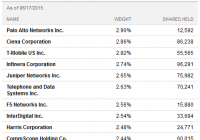
Summary Investors may find opportunities in the telecommunicationns sector. Closer look at the SPDR S&P Telecom ETF. Exposure to some other high-growth areas, like cyber security and cloud computing. By Todd Shriber & Tom Lydon Among sector exchange traded funds, telecom ETFs are usually the smallest and most overlooked – factors that belie occasional opportunity with this slow-growth group. The SPDR S&P Telecom ETF (NYSEArca: XTL ) is one telecom ETF that currently holds some allure and that allure is derived from a key advantage: XTL is not your run-of-the-mill telecom. Said another way, investors looking for an ETF heavy on telecom giants like AT&T (NYSE: T ) and Dow component Verizon (NYSE: VZ ) should look elsewhere. XTL, which turned four earlier this year, is an equal-weight fund where none of its 57 holdings account for more than 2.9% of its weight. Last year’s top-performing telecom ETF with a gain of just over 5.2%, XTL is up 5.6% this year and its technical condition is improving. “The recent move toward the upper resistance means that traders will want to watch for companies in this sector because they could be due for a surge in momentum. Based on the pattern, traders will look to enter positions in the ETF once the price closes above the upper trendline near $60.50,” according to Investopedia . XTL is arguably more of a tech fund with nearly two-thirds of its weight devoted to communications equipment makers, some of which have exposure to high-growth areas of the technology sector, such as cyber security and cloud computing. The ETF’s top 10 holdings include cyber security and communications equipment giants Palo Alto Networks (NASDAQGS: PANW ), Juniper Networks (NASDAQGS: JNPR ) and Harris (NYSE: HRS ) as well as Dow component Cisco (NASDAQGS: CSCO ). “Ken Leon, an equity analyst at S&P Capital IQ, thinks that while telecom service providers have been cautious over the past several years due to the economy, spending will likely begin to rebound in the second half of 2015, as new technologies gain broader market acceptance. For 2016, S&P Capital IQ expects accelerated equipment funding related to cloud computing and data centers from the enterprise and government markets,” said S&P Capital IQ . In addition to Cisco, Juniper and Palo Networks, XTL holds several other stocks that are also found in the PureFunds ISE Cyber Security ETF (NYSEArca: HACK ) and the First Trust ISE Cloud Computing Index Fund (NasdaqGM: SKYY ) – two of this year’s top-performing tech industry ETFs. S&P Capital IQ has a marketweight rating on XTL. The ETF charges 0.35% per year and has more than doubled in size this year to $78.6 million in assets under management. SPDR S&P Telecom ETF Top 10 Holdings Table Courtesy: State Street Global Advisors Disclosure: I/we have no positions in any stocks mentioned, and no plans to initiate any positions within the next 72 hours. (More…) I wrote this article myself, and it expresses my own opinions. I am not receiving compensation for it. I have no business relationship with any company whose stock is mentioned in this article.

3 ETF Winners And A Loser Post Fed Meeting

The latest Fed meeting was arguably the most closely eyed one in quite some time, as investors highly wagered on a September timeline liftoff for the first rate hike in nine years. Expectations of strong cues on the looming policy normalization were not washed away as the meeting was pretty meaningful and informative for the global asset classes. First of all, the Fed appeared pleased with the pickup in the U.S. economic growth in the second quarter of 2015, but not overenthusiastic. The Fed sees the current momentum as ‘ moderate ‘. Job growth numbers and an uptick in housing data were reasonably satisfactory but sluggish business fixed investment and net exports were the causes of concerns for the Fed. Inflation is still short of the Fed’s longer-term target due to the free fall in energy prices last year and declining prices of non-energy related imports, per the Fed minutes. The Fed expects the price index to remain under pressure in the near term, though it will perk up in the medium term. The Fed made it clear that it is well on its way to tighten the policy some time this year, but to reciprocate to this lukewarm economic recovery, it indicated a slower pace of rate hike when the step is actually taken. Added to this, the Fed slashed its projection for the benchmark interest rate for 2016 and 2017, though the guidance for the ongoing year was kept unchanged. The median estimate for 2016 was cut to 1.625% from 1.875% guided in March, and for 2017, it was reduced to 2.875% from 3.125% projected in March. If this was not enough, the Fed lowered the expectation for real GDP for 2015 to 1.8-2.0% from 2.3-2.7% guided in March. Market Impact The reductions combined prompted some big moves in various markets and asset classes as traders started to adjust their positions according to the Fed’s actions. The U.S. dollar was among the big movers as it slipped to a three-week low following the cut in longer-term U.S. interest rates forecast, per Bloomberg. Yield on the benchmark 10-Year U.S. Treasury note remained 2.32% for the last two days (ended June 17, 2015) mostly due to ‘Grexit’ worries which suddenly bolstered the appeal for the safe haven assets despite rate hike concerns in the U.S. In the fixed income market, short-term bonds were among the gainers. Below we discuss a few ETFs which were among the biggest movers after the Fed minutes and could remain in focus as there appears no maddening rush to normalize interest rates. Dollar – The Loser PowerShares DB USD Bull ETF (NYSEARCA: UUP ) This fund is the prime beneficiary of the rising dollar as it offers exposure against a basket of world currencies. These include the euro, Japanese yen, British pound, Canadian dollar, Swedish krona and Swiss franc. This is done by tracking the Deutsche Bank Long US Dollar Index Futures Index Excess Return plus the interest income from the fund’s holdings in U.S. Treasury securities. Needless to say, the fund underperforms in a falling dollar scenario. In terms of holdings, UUP allocates nearly 58% in euro and 25% together in Japanese yen and British pound. The fund has managed an asset base of $1.42 billion so far and it sees an average daily volume of 3 million shares. It charges 75 bps in total fees and expenses. Due to intense selling pressure, this dollar ETF was down about 0.9% at the close of trading on June 17, 2015 and lost over 1% after hours. The Gainers Gold Mining – Market Vectors Gold Miners ETF (NYSEARCA: GDX ) As soon as the greenback dips, commodity prices rise. Gold, one of the key precious metals, has emerged from the slump. SPDR Gold Shares (NYSEARCA: GLD ) tracking the gold bullion added about 0.5% (as of June 17, 2015), while the largest big-cap gold mining ETF, GDX , added about 2.9% on the same day. The latter saw more gains as it often trades as a leveraged play on gold. However, investors should note that the gains were short-lived as both ETFs were down after hours. GDX fell 0.4% while GLD lost 0.1% after the market closed. GDX is one of the popular gold mining ETFs in the market today with assets of $6.04 billion and a trading volume of roughly 35 million shares a day. The fund charges an expense ratio of 53 basis points a year. GDX is heavy on Canada with more than 50% focus. Short-term Treasury – iShares 1-3 Year Treasury Bond ETF (NYSEARCA: SHY ) The reduction in rate projections and a somewhat soft tone of the Fed regarding the rate hike made short-term Treasury ETFs a winner. This fund tracks the Barclays U.S. 1-3 Year Treasury Bond Index and holds 98 securities in its basket. The fund has an average maturity of 1.84 years and effective duration of 1.82 years. SHY is the most popular and most liquid ETF in the short-term bond space with AUM of $8.74 billion and average daily volume of more than 1.4 million shares. Expense ratio came in at 0.44% and its yield stands at 0.44%. The fund was up 0.02%. Emerging Market Dividend – ALPS Emerging Sector Dividend Dogs ETF (NYSEARCA: EDOG ) An indication of a sluggish trail of rate hike made emerging markets ETFs strong performers, while the dovish policy (presumably) brightened the dividend investing theme. This fund applies the ‘Dogs of the Dow Theory’ on a sector-by-sector basis. It reflects the performance of the emerging market equities with above-average dividend yields. The fund gives investors roughly equal exposure to all the sectors. This approach results in a portfolio of about 50 stocks with each security accounting for less than 2.79% of total assets. EDOG has accumulated $12 million in AUM. It charges 60 bps in annual fees and has an annual dividend yield of 3.79%. The fund was up 1.17% on June 17, 2015. Original Post