Tag Archives: earnings-center

A Compilation Of The Best International Equity ETFs

Summary I’m rounding up six of my favorite international equity ETF investments. I’m temporarily bearish on two of them for exposure to H-Shares in Hong Kong. I want international diversification without China. I like VNQI despite a high expense ratio because it is a fairly unique ETF for diversification. My favorite international ETF is SCHF due to the rock-bottom expense ratio. I’ve been holding off on purchases due to correlations on international investments. If China crashes, it may drag down most international investments. That could create an excellent buying opportunity on SCHF. Investors should be seeking at least some international exposure in their portfolio for diversification. To help with that challenge, I rounded up several of the ETFs that I believe offer some of the most compelling alternatives. These options have low expense ratios relative to the sectors they are covering and each is free to trade in at least one brokerage. Given the volatility of international equity markets, I consider a lack of trading costs to be a nice bonus for investors that may want to rebalance frequently. Since I want these assets to be solid targets for rebalancing, I also want strong liquidity so the bid-ask spread will be small. Below is a short list of contenders for the best international ETFs: Vanguard Global ex-U.S. Real Estate ETF (NASDAQ: VNQI ) Schwab International Equity ETF (NYSEARCA: SCHF ) Schwab Emerging Markets ETF (NYSEARCA: SCHE ) Schwab International Small-Cap Equity ETF (NYSEARCA: SCHC ) Vanguard FTSE Emerging Markets ETF (NYSEARCA: VWO ) Vanguard Total International Stock ETF (NASDAQ: VXUS ) While I like all of these ETFs for long-term returns due to low expense ratios, I feel some are more compelling than others at the present time. Different Exposure Diversified investments in global real estate are very rare. This is a niche sector, and I like the diversification benefits of including it in a portfolio. If the expense ratio was present on another ETF (.24%), I would find that expense ratio less attractive. However, for this niche market, it is a fairly low expense ratio. Another major factor for me right now is safety. I have been vocal about my bearish assessment of China and that means I prefer international equity with less exposure to China. Comparative Rankings for Emerging Markets In this list, which does not contain a single loser, I would personally put SCHE and VWO at the bottom because I’m not big on emerging markets right now. This is a temporary placement based on my assessment of which countries I want to include in my portfolio. China is being classified as an emerging market and has a heavy weight in these ETFs. That doesn’t mean that they are specifically holding the A-shares for Chinese equities, but I’m not big on the H-shares in Hong Kong either. I expect a crash in the Chinese market to result in dramatic losses of wealth for domestic consumers, and I see that loss of consumer wealth as causing a fundamental problem for sales in the country. Declining sales may drive declining earnings and that would justify lower valuations of the companies regardless of which market is being used to create exposure to businesses in China. If I were bullish on China, I would rank these two ETFs as being extremely attractive. Given my bearish stance, the combination of large positions in China and high correlation between emerging markets during times of stress (again, not the fault of the ETFs) makes me want to underweight emerging markets and severely underweight China. I favor trading shares of SCHE for free trading in a Schwab account. Investors with free trading on VWO should make the exact opposite argument. VNQI The market exposures are concerning me for VNQI, but holdings in China are fairly slow while still offering me a very unique portfolio. Since I want diversification and don’t want China, this is a natural choice for inclusion though I may be heavier on it than I really want to be. It is running around 13% to 14% of my portfolio. International Equity This section is looking at international equity that is not specified as emerging markets. These ETFs should hold more developed markets, and I expect them to be less volatile. I like all three of these ETFs (SCHF, SCHC, and VXUS) as solid options for international exposure, but the high correlation of emerging markets does not end with the other emerging markets. The emerging markets also have a fairly strong correlation to international equities when the markets are stressed. A terrible performance by China could hurt these ETFs because of the correlation even though they have solid holdings in markets that I consider to be more fundamentally sound. I don’t want to give up international equity exposure, and these are some of the best ETFs for gaining it. They all offer expense ratios below .20 and exposure to markets that I think are less risky than the emerging markets. I picked SCHF as my ETF to hold for a couple reasons. While the free trading is nice for making small additions, the ETF also delivers rock-bottom expense ratios for international ETFs. If I decide to make any additions to my international equity exposure, SCHF is the easy choice. SCHC offers some very interesting exposure elements with small-cap equity, but I’m concerned about market stress and correlations. Therefore, I figure small-cap international equity is more risky than large-cap international equity. Conclusion I find all six of the ETFs to be legitimate contenders for best of breed in their respective category. Due to expense ratios and a desire for more developed markets and larger companies, SCHF is the easy choice for my portfolio. The thing that makes me hesitate to buy more shares is not a concern about the fundamentals of the companies being overvalued; it is concerns about correlation to China hurting international returns. To conclude that though, if China crashes and correlation drags down share prices on SCHF, I’ll be one of the investors buying the cheap shares to take advantage of the situation. Disclosure: I am/we are long VNQI SCHF. (More…) I wrote this article myself, and it expresses my own opinions. I am not receiving compensation for it (other than from Seeking Alpha). I have no business relationship with any company whose stock is mentioned in this article. Additional disclosure: Information in this article represents the opinion of the analyst. All statements are represented as opinions, rather than facts, and should not be construed as advice to buy or sell a security. Ratings of “outperform” and “underperform” reflect the analyst’s estimation of a divergence between the market value for a security and the price that would be appropriate given the potential for risks and returns relative to other securities. The analyst does not know your particular objectives for returns or constraints upon investing. All investors are encouraged to do their own research before making any investment decision. Information is regularly obtained from Yahoo Finance, Google Finance, and SEC Database. If Yahoo, Google, or the SEC database contained faulty or old information it could be incorporated into my analysis.
The Vanguard Short-Term Bond ETF Is A Great Replacement For Cash

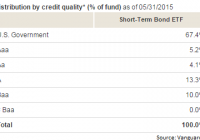
Summary The Vanguard Short-Term Bond ETF delivers excellent diversification benefits relative to the equity market without being as miserable as a savings account. The bonds in the Vanguard Short-Term Bond ETF are focused on very high credit quality but there is a small selection of lower rated bonds to enhance returns. The Vanguard Short-Term Bond ETF bond selections contain some diversification in maturity to give investors a focus on short term investments without giving up on yield. The Vanguard Short-Term Bond ETF (NYSEARCA: BSV ) is a solid bond fund for the very conservative investor that wants a place to park while earning a better return than a savings account will offer. Lately I’ve been concerned about the market being relatively highly valued. I don’t intend to retire for quite a while (measured in decades), so I’m willing to be more aggressive with my portfolio. Despite being willing to accept additional risk on my portfolio, I want to be compensated for taking risk. While I still like certain parts of the market (as shown by buying diversified REIT ETFs), I’m looking for ways to get better diversification in the portfolio. The desire for better diversification across asset classes has pushed me to make a few hard decisions. For instance, it is pushing me to slow my rate of purchases on additional equity so I can have more money on hand to buy in if we see a significant retreat in equity prices. Those expectations and desires bring to me look for some solid bond ETFs so I can at least get a little interest on the money that I would otherwise have to hold in cash. Low volatility and low correlation with the domestic stock market are major concerns, but I also want something with reasonable liquidity and low expense ratios. When the yields on bonds are terrible, and I believe that is a fair statement today, a high expense ratio would eat a substantial portion of the returns. In this case, the expense ratio is only .10%. It is in my nature to be cheap and I have to admit, that .10% sounds fair to me. It thoroughly beats many bond funds on expense ratio. How volatile is the Vanguard Short-Term Bond ETF? I started by checking for correlation with the SPDR S&P 500 Trust ETF (NYSEARCA: SPY ) by comparing the monthly changes in dividend adjusted closes over the last 8 years. The correlation was 3.34%, which is beautiful. By virtually any measure, incorporating BSV into a portfolio is going to materially reduce the risk of the portfolio. While SPY had a standard deviation of 4.6% in monthly returns, BSV only had a deviation of .777%. Low correlation and low volatility is exactly what we should expect for a fund invested in short-term high quality bonds, but it is always worth double checking. Sources of Return With the returns on short term maturities being very low, investors should consider having at least a little bit of credit risk or duration in their portfolio even if they want to focus on short term holdings. I checked both of those areas to see how the Vanguard Short-Term Bond ETF was doing on internal diversification. Credit The following chart shows the credit quality breakdown: In my opinion, this is a fairly reasonable allocation for an ETF that an investor might want to use as a substitute for cash in their portfolio if they expect to be holding that cash for a few months at a time. The ETF portfolio drops down to ratings as low as Baa but keeps the majority of their holdings in very high credit quality bonds. Maturity The next chart shows the maturity of the various bonds Again the maturity distribution looks good for short term holdings. By dividing the holdings between the different maturities rather than focusing them around a specific point there is more diversification across the short term yield curves which should produce a slight decrease in the expected level of volatility for the expected level of income. A Potential Cash Replacement Looking at the monthly returns over 8 years, I found there was only one month where the change in the dividend adjusted close was equal to 2% or greater. In that one month, it was precisely at 2%. Due to the positive returns from interest and low levels of duration and credit and risk the downside risk is fairly low. Of course, if an investor is using it as a replacement for cash they’ll need to use a brokerage that lets them buy and sell it with no commissions. Conclusion I like the portfolio for the Vanguard Short-Term Bond ETF. The yields are still weak, but that is an issue with high quality short term yields being very low rather than a problem with the underlying ETF. Given the low risk of the bond ETF, I like this fund as a source of diversification in the portfolio. It’s too bad free trading on the ETF is not more widely available, because this looks like a solid place to park cash when the market gets too rich or when investors are just looking for new options. The combination of a small amount of duration with a little credit risk makes this option more appealing to me than a fund that refused to take on any risk in those categories. Disclosure: I/we have no positions in any stocks mentioned, and no plans to initiate any positions within the next 72 hours. (More…) I wrote this article myself, and it expresses my own opinions. I am not receiving compensation for it (other than from Seeking Alpha). I have no business relationship with any company whose stock is mentioned in this article. Additional disclosure: Information in this article represents the opinion of the analyst. All statements are represented as opinions, rather than facts, and should not be construed as advice to buy or sell a security. Ratings of “outperform” and “underperform” reflect the analyst’s estimation of a divergence between the market value for a security and the price that would be appropriate given the potential for risks and returns relative to other securities. The analyst does not know your particular objectives for returns or constraints upon investing. All investors are encouraged to do their own research before making any investment decision. Information is regularly obtained from Yahoo Finance, Google Finance, and SEC Database. If Yahoo, Google, or the SEC database contained faulty or old information it could be incorporated into my analysis.

CEMIG – A Good Company Facing Some Bad Storms

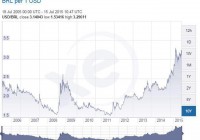
Summary The company lost the concessions for about 40% of its electricity production, and the effect of that should lower net income by 50%. It is a stable company not at risk of bankruptcy, getting close to the bottom with its current price decline. The positive long-term economic outlook for Brazil should also positively influence CIG. The downside risk of investing in CIG is about 35%, and the upside expectation is about 100% or more in the next few years. Stable but state-owned energy company Companhia Energética de Minas Gerais (NYSE: CIG ) operates in generation, transmission, marketing and distribution of electricity, energy solutions (Efficientia S.A.) and distribution of natural gas (Gasmig) in 23 Brazilian states and in Chile. The Cemig Group comprises of the holding company (Cemig), its two main wholly-owned subsidiaries – Cemig Geração e Transmissão S.A. (‘Cemig Generation and Transmission,’ or ‘Cemig GT’) and Cemig Distribuição S.A. (‘Cemig Distribution,’ or ‘Cemig D’) – and other subsidiaries and affiliates; a total of 206 companies, 18 consortia and two Equity Investment Funds (FIPs). With a direct interest of 26.06%, CIG also controls Light S.A., an electricity distributor serving 31 cities in the state of Rio de Janeiro, a region with over 11 million consumers. CIG also has an interest of 43.36%, exercising control, in the transmission company Taesa (Transmissora Aliança de Energia Elétrica S.A.). As part of a growth strategy increasingly aiming to expand in renewable energy sources, in 2014, CIG became part of the control block (27.4%) of Renova, a leading company in Brazil’s wind power market, which also owns investment portfolios in solar and other renewable sources. The controlling stockholder of CIG is the State of Minas Gerais in Brazil, which owns 51% of the common (voting) shares. Another major stockholder is AGC Energia S.A., holding 32.96% of the common shares. CIG is a strongly-positioned energy company that is state owned. Every investor should be aware of the ownership issue because according to Transparency International , Brazil should improve on transparency in local governments and integrity in public contracting. As you will see later, those are the issues that are hammering CIG at the moment. Macro look CIG has been hammered with really bad news lately (about this later), and when this is combined with the trouble the Brazilian economy is currently going through, a 70% decline in its share price in the last 3 years should not be a surprise. Figure 1. shows that the Brazilian currency has depreciated by 50% in relation to the US$ in the last 5 years, and the depreciation trend is still strong. An investment in CIG is not only an investment in a company, but also a currency bet. Figure 1. USD vs. BRL (click to enlarge) Source: xe.com On the other hand, Brazil is currently in an economic slowdown that does not affect CIG because it is a non-cyclical company, and according to the World Bank , Brazil’s economy is expected to fall by 1.3% in 2015 but grow in 2016 by 1.1% and 2.0% in 2017. The turnaround in the economy could be a positive sign for investing in Brazil and will presumably have a positive impact on the currency. Also a turnaround would be very helpful for CIG because of its short-term debt structure (Figure 2.) with an average debt cost of 7.05% in real terms (currently, the inflation in Brazil is just below 9%). Figure 2. CIG’s debt (click to enlarge) Source: Cemig IR Current bad news that hammered the stock To find out what is really happening, you have to search for Brazilian news agencies because news about CIG flies under the radar of the big international news agencies. A few days ago, CIG managed to finance only 60% of the one billion R$ offering with a 7.97% interest rate. The most plausible reasons for that are the high debt of Brazilian energy companies in general and the current out-of-favor status of the sector. Before the failed financing issue, Fitch also degraded CIG’s credit rating from “AA” to “AA-” because of its aggressive acquisition plans, high dividend payout ratio, and political risks. But the most important bad news is the loss of the concession contracts for the Jaguara, São Simão, and Miranda hydroelectric plants that accounted for about 40% (Fitch 36% and Diariodocomercio 45%) of the company’s electricity generation potential. The loss of the contracts should have a negative impact of R$1.5 billion on CIG’s annual EBITDA. Consequently, it should impact a little bit less than 50% of CIG’s net profits that were at R$3.1 billion for 2014. Valuation Because of the currency risk, I will base my valuation on the dividends in order to clearly see what an international investor can expect in the future. The current dividend is US$0.15 per share; it is 25% of the 2014 net earnings and not 50% as usual and statutory due to the low levels in the electricity-generating water reservoirs. As soon as the financial situation of the company stabilizes and the water levels rise, CIG will pay out the rest of the dividend up to the statutory 50% of the net earnings for 2014. I am going to continue using the 25% payout ratio to take a large margin of safety. In the worst case scenario, assuming that CIG will not be able to renegotiate the concession contracts for the Jaguara, São Simão and Miranda hydroelectric plants, its net income will probably fall by 50% and the dividend will fall accordingly. Thus, in the future, we can expect a dividend of US$0.07 per share and EPS of around US$0.28. If we add the 15% depreciation of the Brazilian Real (R$) in relation to the US dollar, we get a constantly lower dividend in real terms for international investors. So in the worst case scenario, with all the risks accounted for, and expecting a P/E ratio of around 8, the share price of CIG should be US$2.24, a downside risk of 35% at the moment. Conclusion I am not sure that all will be so bad as it is at the moment, and that the current situation with the concessions is final. If the company manages to renegotiate the contracts, and we see a turnaround in the Brazilian economy with lower interest rates, CIG’s strong growth strategy would be boosted, and it could become a very successful investment. By keeping the current EPS of US$0.65 and by adding a P/E ratio of 10, we find ourselves very quickly with a US$6.5 valuation per share. As soon as the economic situation in Brazil improves, and the management works out a deal with the government for the concessions, the stock has a very large positive potential. I would put the downside risk to US$2.24 and the upside expectation to US$6.65 in the next two years. So the upside expectation is about 100%. Due to the current financial problems and concession contract issues, I will not initiate a position at the moment but wait to get better buying opportunities with a larger safety margin. I believe CIG is a sound company that is currently in a bad internal and macro position but without any bankruptcy risks on the horizon, and getting very close to the bottom of its price decline (the time frame for the bottom should be about one or two years; that for me is very short term but for the majority of investors a very long term). Disclosure: I/we have no positions in any stocks mentioned, and no plans to initiate any positions within the next 72 hours. (More…) I wrote this article myself, and it expresses my own opinions. I am not receiving compensation for it (other than from Seeking Alpha). I have no business relationship with any company whose stock is mentioned in this article.