Tag Archives: earnings-center

The Low Volatility Anomaly: Leverage Aversion Hypothesis

This series digs deeper into the Low Volatility Anomaly, or why lower risk stocks have historically produced stronger risk-adjusted returns than higher risk stocks or the broader market. The CAPM links expected returns with an asset’s sensitivity to systematic risk, but the model assumptions are impractical. This article covers a deviation between model and market that may contribute to the outperformance of low volatility strategies. Given the long-run structural alpha generated by low volatility strategies, I am dedicating a more detailed discussion of the efficacy of this style of investing. In the first article in this series , I provided an introduction to the strategy with a simple example demonstrating a low volatility factor tilt (replicated through SPLV ) from the S&P 500 (NYSEARCA: SPY ) that has generated long-run alpha. In the second article in this series , I provided a theoretical underpinning for the presence and persistence of a Low Volatility Anomaly, and linked to articles depicting its success dating back to the 1930s. This article demonstrates that violations of the assumption of the Capital Asset Pricing Model (CAPM) lead to deviations between model and market that pervert the presumed relationship between risk and return. Empirical evidence, academic research and long time series studies across asset classes and geographies have shown that the actual relationship between risk and return is flatter than the model or market expectations suggests. The third article in this theory lays out a hypothesis for why low volatility strategies have produced higher risk-adjusted returns over time. Leverage Aversion Hypothesis The fallacy of the Capital Asset Pricing Model assumption that investors are able to borrow and lend at the risk-free rate might be the supposition that most perverts the model application from real world practice. Certainly not all investors are able to use leverage, and the cost and availability of leverage can deviate materially from any notion of a risk-free rate in times of stress. Intuitively, leverage-constrained or leverage-averse investors often choose to overweight riskier assets, increasing the price of risky assets and lowering expected return. If some market participants are overweight riskier assets characterized by lower expected returns, then they must be underweight lower risk assets which would be characterized by higher expected returns. In the CAPM model, rational market participants seeking to maximize their economic utility invest in the portfolio with the highest expected return per unit of risk, and lever or de-lever their portfolio to suit their own risk tolerance. In practice, however, many large institutional investors including most mutual funds and certain pension funds are constrained by the level of leverage that they can take. Furthermore, many individual investors lack the sophistication or access to attractively priced leverage. The growing increase in the assets under management of exchange traded fund products with embedded leverage could well signal small investor’s inability to access leverage directly on favorable terms. If market participants respond by being overweight riskier securities, then the relationship between risk and expected return is altered. Building on the long time series studies from Black and Haugen of the relative outperformance of lower volatility assets in the last article in this series, Frazzini and Pederson (2010) empirically demonstrated the alpha-generative nature of low beta assets across twenty international equity markets, Treasury bonds, corporate bonds, and futures. The duo also introduced a “Betting Against Beta” factor that gave the paper its name. The factor is effectively a zero beta portfolio that is long leveraged low-beta assets and short high-beta assets to produce statistically significant risk-adjusted across many markets, geographies, and time intervals. This study also demonstrated that the return of the BAB factor is sensitive to funding constraints as one would expected in a trade involving leverage. The persistence of an alpha-generative strategy involving leverage applied to low volatility assets, whose excess return is in part a function of the funding environment, supports the Leverage Aversion Hypothesis as an explanation for the Low Volatility Anomaly. In the next section of this series, we will tackle how the delegated agency model typical of investment management may also contribute to the outperformance of Low Volatility strategies. Disclaimer My articles may contain statements and projections that are forward-looking in nature, and therefore, inherently subject to numerous risks, uncertainties and assumptions. While my articles focus on generating long-term risk-adjusted returns, investment decisions necessarily involve the risk of loss of principal. Individual investor circumstances vary significantly, and information gleaned from my articles should be applied to your own unique investment situation, objectives, risk tolerance, and investment horizon. Disclosure: I am/we are long SPLV, SPY. (More…) I wrote this article myself, and it expresses my own opinions. I am not receiving compensation for it (other than from Seeking Alpha). I have no business relationship with any company whose stock is mentioned in this article.
Vanguard’s 5 Best No-Load ETFs And Index Funds To Make Into A Portfolio

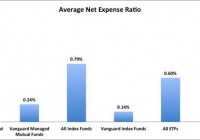
The best no-load ETFs and index funds will help you create a diversified portfolio. Vanguard Funds is the place to start when it comes to finding the best no-load ETFs and index funds. When you are replicating an index, cost and portfolio drift are two of the main issues. Vanguard Funds started the first index fund back in the 1970s, and their ability to limit portfolio drift is well documented. How the best no-load ETFs and index funds do on cost We did some research, which you can see in this chart: (click to enlarge) Source: Morningstar Looks like Vanguard Funds are leading the way in cost no matter which type of investment you wish to purchase. In this article, we focus on the best no-load ETFs and index funds from Vanguard. Which should you buy to make your globally-balanced portfolio – the best no-load ETFs or index funds? We have done a lot of comparison shopping, and our preference is the Vanguard Admiral Shares Index Funds. However, they are not available everywhere; they have a $10,000 minimum purchase, and they do not trade during the day like an ETF. If any of these are issues for you, then we recommend you purchase the Vanguard ETF shares. Want to make a five Vanguard fund portfolio that will cover the planet? Here is what you should buy: Vanguard S&P 500 ETF (NYSEARCA: VOO ) or (MUTF: VFIAX ) – This fund buys the 500 stocks selected by S&P to represent the U.S. large cap stock universe. It has the advantage of being an index that is recognized and purchased around the world. A limited number of stocks with growing global demand and an incredibly low 0.05% expense ratio make this a good core holding for your portfolio. Vanguard Extended Markets ETF (NYSEARCA: VXF ) or (MUTF: VEXAX ) – This fund contains all of the U.S. common stocks regularly traded on the New York Stock Exchange and the Nasdaq over-the-counter market, except those stocks included in the S&P 500 Index. This fund fills in the blanks that are missing from the S&P 500 Index. It holds a total of 3,078 US stocks, mostly mid and small caps, which gives you fantastic coverage of the U.S. stock market. Vanguard Total Bond Market ETF (NYSEARCA: BND ) or (MUTF: VBTLX ) – This ETF tracks the Barclays U.S. Aggregate Float Adjusted Index. It covers a wide range of public, investment-grade, taxable bonds in the United States-including government, corporate, and international dollar-denominated bonds, as well as mortgage-backed and asset-backed securities-all with maturities of more than one year. The ETF invests by sampling the index and currently holds 6,166 bonds. Vanguard Total International Stock ETF (NASDAQ: VXUS ) or (MUTF: VTIAX ) – This ETF tracks the market-cap weighted FTSE Global All Cap ex US Index, which covers 99% of the world’s global market capitalization outside the US. The ETF holds 5,512 stocks from 46 developed and emerging markets. Vanguard Total International Bond ETF (NASDAQ: BNDX ) or (MUTF: VTABX ) – This fund tracks the Barclays Global Aggregate ex-USD Float Adjusted RIC Capped Index (USD Hedged). The index includes government, government agency, corporate, and securitized non-U.S. investment-grade fixed income investments. They are all issued in currencies other than the U.S. dollar, with maturities of more than one year. To minimize the currency risk, the ETF will attempt to hedge its currency exposures. The ETF currently holds 2,246 bonds. With just five Vanguard ETFs or index funds you get exposure to 9,090 stocks and 8,412 bonds. This is incredible diversification! There are pros and cons to every portfolio. You may want to read “Vanguard’s Best ETF Index Funds for Building a Global Portfolio” to get a better understanding of the strengths and weaknesses of each portfolio type. Originally published 2/6/14. Updated on 7/20/15. Share this article with a colleague

Market Beginners Portfolio – July Update

Summary The Market Beginners Portfolio has had a difficult time over the past few months. The portfolio has significant potential for future growth. I chose to invest in Frontier Communication Corporation because of the future opportunity it provides. Introduction As many of my subscribers know, I have written a large number of portfolios talking for a variety of different goals. However, the original Market Beginners Portfolio represented my first attempt at creating a portfolio designed for someone incorporating multiple different points of view. The overall goal of this portfolio is to create a sample portfolio for someone with $100,000 to invest. The portfolio will be composed of both ETFs and Individual Stocks designed to maximize both safety and income for the portfolio. However, rather than focusing on just income for the portfolio, I will also be focusing on overall stock growth. This portfolio is centered towards overall growth and that involves growth both in the form of income and portfolio value. Rules Discipline is the backbone of any major portfolio. As a result, any good portfolio requires at least a few rules to help keep things in balance. This portfolio has two. The first rule is no new money may be added to the portfolio. While this is not a restriction most people generally face, it is helpful for managing a portfolio and as a result is a rule I include in most of my portfolios. The second rule is that no stock or ETF may make up more than 20% of the portfolio. While having different ETFs or secure stocks may help with the portfolio’s safety, minimizing your positions in different stocks helps to maintain your portfolio’s security. Portfolio Stock Name (Ticker) Number of Shares Purchase Price Current Price Johnson & Johnson (NYSE: JNJ ) 100 $100.55 $100.09 Chevron (NYSE: CVX ) 100 $107.70 $93.14 Pimco Strategic Income Fund (NYSE: RCS ) 1000 $9.19 $8.49 Bank of America (NYSE: BAC ) 1000 $16.47 $18.10 Monsanto Company (NYSE: MON ) 100 $118.25 $107.07 Vanguard Total Stock Market ETF (NYSEARCA: VTI ) 100 $108.73 $109.96 Vanguard Dividend Appreciation ETF (NYSEARCA: VIG ) 200 $81.18 $80.77 Original Portfolio Value: $85,430 Total Cash: $14,570 Current Portfolio Value: $83,770 Current Cash: $14,570 Change In Portfolio Value: -1.94% Portfolio Discussion The portfolio has had a relatively difficult time – it has lost 1.94% over the past few months. Much of this loss is due to a decrease in the prices of Chevron, Pimco Strategic Income Fund, and Monsanto Company. However, the portfolio has done an impressive job in Bank of America seeing that position increase by almost $2000. This helped offset some of the other more significant losses for the portfolio. As for decisions, I am choosing to keep the portfolio relatively simple. However, at this time I am making a 1000 share purchase in Frontier Communications Corporation (NASDAQ: FTR ) at $5.14 per share. That takes the cash position of the portfolio down to $9430. Frontier Communications Corporation is a solid company that has had a difficult time dropping from $8.42 earlier in the year. However, management at the company is solid and the company offers a 8.17% dividend at current prices. Cash I continue to hold a significant cash stake in the portfolio amounting to almost 10% of its assets. Future dividends should help to increase the portfolio’s cash position. The market is currently near all time highs and I am hoping to be able to let the portfolio’s cash position grow until better opportunities can be identified. Conclusion The portfolio has had a difficult time recently losing almost 2% of its value. Despite significant losses in other regions, the portfolio managed to make some of the losses back due to a significant increase in the value of Bank of America. I also chose to invest in Frontier Communications Corporation this month. The company has had a difficult time in recent months and as a result now offers a significant dividend amounting to over 8%. I hope to see this portfolio recover and continue growing in future months. Disclosure: I/we have no positions in any stocks mentioned, and no plans to initiate any positions within the next 72 hours. (More…) I wrote this article myself, and it expresses my own opinions. I am not receiving compensation for it (other than from Seeking Alpha). I have no business relationship with any company whose stock is mentioned in this article.