Tag Archives: china
Pigs In China – A Longer-Term Reason To Like Corn
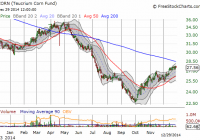
The Teucrium Corn ETF finally seems to be bottoming although technical challenges remain overhead at the 200-day moving average. China’s massive consumption of pig meat creates tremendous demand for imported soy beans and corn to feed these pigs. Assuming this demand for pigs is sustainable, it promises to support corn prices, and thus dip-buying in Teucrium Corn ETF, over the longer-term. After an additional dip, my thesis for playing another bottom in Teucrium Corn ETF (NYSEARCA: CORN ) seems to finally be working. Since that article in mid-August, CORN is up 5.3% versus a 6.0% gain in the S&P 500 (NYSEARCA: SPY ). However, on the way to this gain, CORN first lost as much as 13%…so the ETF has a lot of work to do to balance out risk and reward. The next challenge for Teucrium Corn ETF : a downtrending 200-day moving average (DMA) Source: FreeStockCharts.com As I continue to patiently wait for this trade to unfold, I occasionally check in on relevant news to support or refute the thesis of a supply correction coupled with on-going strength in demand. One of the more fascinating pieces I have read along these lines comes from the Economist on December 20, 2014 titled ” Swine in China: Empire of the pig .” Before reading this piece, I had almost no understanding of the pig’s importance in Chinese history and diet. China’s increase in wealth in recent decades has simultaneously encouraged a massive increase in the consumption of pig meat: Since the late 1970s, when the government liberalised agriculture, pork consumption has increased nearly sevenfold in China. It now produces and consumes almost 500m swine a year, half of all the pigs in the world. This increase has brought a whole host of challenges to China’s government, farmers, and society as a whole. There are even environmental threats reaching into other countries. Since pig feed mainly consists of soy beans and corn (food scraps off the family table have long ceased being sufficient!), China’s demand for these crops has soared along with pig consumption. China cannot feed all its pigs and thus relies on imports. The International Institute of Social Studies in The Hague estimates… …more than half of the world’s feed crops will soon be eaten by Chinese pigs. Already in 2010 China’s soy imports accounted for more than 50% of the total global soy market. The kicker for corn comes from the trade organization, the US Grains Council: …by 2022 China will need to import 19m-32m tonnes of corn. That equates to between a fifth and a third of the world’s entire trade in corn today. China’s need for pig feed is so great that the International Institute for Sustainable Development claims China has (discreetly) purchased 5m hectares in developing countries for farming purposes. The Economist notes that, when Shuanghui, China’s largest pork producer, bought Smithfield Foods, an American firm, in 2013, it acquired huge stretches of Missouri and Texas. While the sustainability of China’s pig consumption is far from clear, it appears that China will imminently help pressure corn markets over the long-term. Along with this strength comes support for prices over time – the kind of support that makes dip-buying particularly attractive. The China/pig factor provides additional (and important) context to the on-going insistence from Deere’s CEO that corn prices will come back. Be careful out there!
China Internet ETFs Look To Rebound In 2015
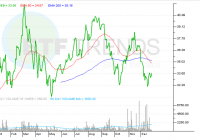
Summary Investors can use China-related ETFs to position for a turnaround in Chinese tech names. Closer look at a Chinese tech-specific ETF and broad China ETFs with tech exposure. An overview of the Chinese technology space. By Todd Shriber & Tom Lydon Despite the fervor surrounding Alibaba’s (NYSE: BABA ) September initial public offering, 2014 has been a disappointing year for exchange traded funds with exposure to Chinese Internet stocks. The silver lining in that scenario is that investors can scoop up ETFs such as the KraneShares CSI China Internet Fund (NASDAQ: KWEB ) and the Powershares Golden Dragon Halter USX China Portfolio (NYSEARCA: PGJ ) at favorable prices in anticipation of a significant 2015 rebound by Chinese Internet stocks. BitAuto Holdings (NYSE: BITA ) and Vipshop Holdings (NYSE: VIPS ) “may both advance an additional 32% in the next 12 months, according to average analyst estimates compiled by Bloomberg,” according to an article written for the news agency by Belinda Cao and Elena Popina . KWEB, the lone U.S.-listed ETF devoted exclusively to Chinese Internet stocks, allocates about 7.2% of its combined weight to Vipshop and Bitauto. The ETF has traded slightly lower this year. PGJ, the PowerShares offering, is not a dedicated China Internet ETF , but the fund does allocate a combine 58% of its weight to the technology and consumer discretionary sectors. That includes a 10% combined weight to Vipshop and BitAuto. While KWEB and PGJ have struggled this year, more traditional China ETFs with large weights to state-controlled enterprises have jumped amid rallies for those stocks, particularly financial services shares. For example, the iShares China Large-Cap ETF (NYSEARCA: FXI ) , the largest China country-specific ETF, is up 8.5%. Still, market observers see companies with exposure to the Chinese consumer, such as those held by KWEB and PGJ, as favorable plays for investors in 2015. “China’s 632 million Internet users still represent less than half of the country’s population, whose middle class was estimated at 200 million people by Alibaba Chief Executive Officer Jack Ma. Government data indicate the user total could rise to 850 million by 2015,” according to Bloomberg. Much of the 2015 potential and promise for China Internet ETFs will boil down to Alibaba’s ability to impress investors. The stock is KWEB’s largest holding at 10% of the fund’s weight. Although Alibaba is not currently a member of PGJ’s lineup, it could be in the future and it is unlikely that the ETF would rally in significant fashion if Alibaba languishes. The average analyst price target on Alibaba is just over $120 with two analysts forecasting prices of at least $130 . The stock currently trades around $106. The newly minted Emerging Markets Internet & Ecommerce ETF (NYSEARCA: EMQQ ) is another idea for investors to consider in the search for Chinese Internet exposure. EMQQ, which debuted in November, is not a dedicated China ETF, but the Emerging Markets Internet & Ecommerce Index devotes a significant portion of its weight to Chinese Internet names, including Alibaba, Tencent Holdings ( OTCPK:TCEHY ), JD.com (NASDAQ: JD ), Baidu (NASDAQ: BIDU ) and Vipshop. Those stocks combine for a third of the index’s weight . Nearly 30 of EMQQ’s holdings are Chinese companies. EMQQ’s underlying index allocates a combined 7.5% to Vipshop and BitAuto. KraneShares CSI China Internet Fund (click to enlarge) Todd Shriber owns shares of Alibaba.