Tag Archives: bstresource

Low Risk ETFs Beating SPY In 2014 – ETF News And Commentary

The U.S. economy had a shaky start to this year with a cold snap taking away all the warmth from Q1. To add to this, overvaluation concerns, worries over the withdrawal of QE support in the U.S. and stress between Russia and the West on the Ukrainian issue triggered a flight to safety in the initial months (read: 3 Low Risk ETFs for Market Turmoil ). Though spring sprung more jobs, better housing and manufacturing numbers, and raised confidence in the U.S. citizens leading the economy to advance 4.6% in Q2 and 3.9% in Q3, the global financial market again faltered to close out the year. Concerns over global growth especially in the big three foreign regions ─ Euro zone, Japan and China ─ and rising risks of a sooner-than-expected hike in the U.S. interest rates weighed heavily on stocks this month. Iraq instability, a protest in Hong Kong and Ebola crisis in West Africa have also taken a bite out of stock market returns. If this was not enough, oil prices have moved back to the recession-ridden phase of 2009, losing about 45% since the start of the year (read: Volatility ETFs in Focus on Oil Upheaval ). Russia has once again started to hit headlines for all wrong reasons, with the latest being an upheaval in its currency and bond markets. Notably, Russia resorted to an extremely steep rate hike on December 16 to plug the plunge in its currency which has halved in price against the greenback this year. However, such a desperate move was in vein as the ruble did not find success in arresting its protracted downturn. It seems that Russian tumult and the oil crash will contaminate the risk-on trade sentiment at the end of the year. Investors are getting out of high-growth and high-beta stocks across the globe and seeking refuge in safe and income-oriented assets thanks to sluggish global economic indicators. If this was the snapshot of the year, low risk equities ETFs have all reasons to perform impressively. After all, the S&P has added 12% this year compared to a stellar 35% returned last year. The market sentiment simply moved back and forth with each economic release in the event-loaded 2014. This is especially true as low risk investments can prove quite effective in one’s portfolio in arresting downside risks as compared to high beta products. It is one of the most popular investing themes at present, given the occasional jump in volatility since the start of the year. Below, we have mentioned two low risk ETFs which soothed investors’ nerves in 2014 having returned more than the broader market ETF SPDR S&P 500 ETF (NYSEARCA: SPY ) in the time frame. S&P MidCap Low Volatility Portfolio (NYSEARCA: XMLV ) This overlooked ETF looks to follow the S&P MidCap 400 Low Volatility Index. The product invests about $53.2 million in assets in 80 stocks. From a sector look, financials takes half of the portfolio followed by about 15% of assets invested in utilities and 7.4% in materials. The portfolio has minimal company-specific concentration risk with no product accounting for more than 1.63%. Church & Dwight Co., Alleghany Corp and HCC Insurance Holdings are top three choices. The product charges about 25 bps in fees. The fund is up 16.8% so far this year. PowerShares S&P 500 Low Volatility Portfolio (NYSEARCA: SPLV ) This ETF provides exposure to about 100 U.S. stocks with the lowest realized volatility over the past 12 months by tracking the S&P 500 Low Volatility Index. Like other two choices, the fund is also widely spread across a number of securities as none of these holds more than 1.27% of assets. However, the product is tilted toward financials at nearly 33% share while utilities (18.1%), consumer staples (18.1%), industrials (12.2%) and health care (7.93%) round off to the top five (read: 3 Utility ETFs Surviving the Market Turmoil ). SPLV is the largest and the most popular ETF in the low volatility space with AUM of $4.98 billion. The fund charges 25 bps in annual fees and is up about 15.3% year to date.
One Of The Best ETFs I’ve Found So Far: SCHD

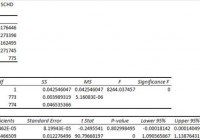
Summary I’m taking a look at SCHD as a candidate for inclusion in my ETF portfolio. The risk level, measured in standard deviation of daily returns is great. The ETF looks even better if combined with other major funds such as SPY. Investors should be seeking to improve their risk adjusted returns. I’m a big fan of using ETFs to achieve the risk adjusted returns relative to the portfolios that a normal investor can generate for themselves after trading costs. I’m working on building a new portfolio and I’m going to be analyzing several of the ETFs that I am considering for my personal portfolio. One of the funds that I’m considering is the Schwab U.S. Dividend Equity ETF (NYSEARCA: SCHD ). I’ll be performing a substantial portion of my analysis along the lines of modern portfolio theory, so my goal is to find ways to minimize costs while achieving diversification to reduce my risk level. What does SCHD do? SCHD invests in large dividend companies. It has shined in my first look at the fund. I was originally planning a 10 to 15% position for a dividend ETF, but now I’m contemplating raising that position up as high as 20 to 25%. At this point, the portfolio is still in the planning and funding stage. Does SCHD provide diversification benefits to a portfolio? Each investor may hold a different portfolio, but I use (NYSEARCA: SPY ) as the basis for my analysis. I believe SPY, or another large cap U.S. fund with similar properties, represents the reasonable first step for many investors designing an ETF portfolio. Therefore, I start my diversification analysis by seeing how it works with SPY. I start with an ANOVA table: (click to enlarge) At first look it may seem like the correlation of 91.42% would mitigate the diversification benefits of using SCHD with a major fund like SPY, but 91% still offers some meaningful benefits as long as the ETF can stand on its own strengths. In my opinion, SCHD passes that test and is a very viable candidate. Standard deviation of daily returns (dividend adjusted, measured since late 2011) This is the strongest area for the ETF. The returns are remarkably stable relative to most equity investments. Generally speaking, standard deviation of daily returns is the realm of SPY. Most ETFs look fairly poor when compared to just holding the S&P 500. The only reason those other equity ETFs can be useful under modern portfolio theory is diversification benefits when used as a fairly small percent of the portfolio. For the period I selected for comparison, the standard deviation on daily returns for SPY is 0.7754%. For SCHD the standard deviation of daily returns is 0.6651%. Mixing it with SPY I also run comparison on the standard deviation of daily returns for the portfolio assuming that the portfolio is combined with the S&P 500. For research, I assume daily rebalancing because it dramatically simplifies the math. With a 50/50 weighting in a portfolio holding only SPY and SCHD, the standard deviation of daily returns across the entire portfolio is 0.7124%. That is a very attractive risk position for a portfolio that only contains two ETFs. Why I use standard deviation of daily returns I don’t believe historical returns have predictive power for future returns, but I do believe historical values for standard deviations of returns relative to other ETFs have some predictive power on future risks and correlations. Yield The distribution yield is 2.52%. The SEC 30 day yield is 2.84%. For a dividend investor that wanted to minimize trading costs, that is a fairly strong yield on an ETF with less systematic risk than SPY. Expense Ratio The ETF is posting .07% for an expense ratio, which is very low. Market to NAV The ETF is trading at a .05% premium to NAV currently, but that is fairly close. A twentieth of one percent is not exposing an investor to a large risk in that regard. This value can change suddenly, so investors should check before submitting a trade. Largest Holdings The biggest holdings are around 4 to 5% of the portfolio. I prepared the following chart to break it down: (click to enlarge) I’m fairly happy with the construction of the top of the portfolio. At present, I’m not very optimistic on Verizon (NYSE: VZ ) or AT&T (NYSE: T ) because I think the industry risk is still being priced into the companies after Sprint (NYSE: S ) became much more aggressive. However, in the longer term (5 to 20 years) I think it makes sense to include them in the fund. Conclusion I’m currently screening a large volume of ETFs for my own portfolio. I’ll do a little more digging on SCHD later and post what I find. The portfolio I’m building is through Schwab, so I’m able to trade SCHD with no commissions. I have a strong preference for researching ETFs that are free to trade in my account. I’m expecting that SCHD will end up with a significant position in my portfolio.

Deutsche Liquid Alts Outlook: Overweight Long/Short Equity

While global equities lost ground in the third quarter of 2014, liquid alternatives consolidated their gains from the first half of the year. Discretionary macro and trend-following strategies were among the top performers, according to a briefing paper published by Deutsche Asset & Wealth Management (Deutsche), as diverging central bank policies provided opportunities for alternative strategists in the fixed-income and currency markets. In the paper, Deutsche offers a brief review of each of the following alternative strategies and current recommendations for portfolio positioning of each strategy: Long/short equity Market neutral equity Discretionary macro CTAs Credit strategies Event-driven Distressed What follows is a summary of Deutsche’s analysis of each alternative strategy. Long/Short Equity The choppiness of the broad stock market in Q3 – “risk-off” in July; “risk-on” in August; and mixed in September – put the focus on stock picking, the long/short equity specialty, rather than trend following or asset allocation. U.S. stock pickers in particular found “the operating environment more supportive than in European markets,” according to Deutsche. Market Neutral Market-neutral equity strategies underperformed in the second quarter but bounced back in the third, with the HFRX Equity Market Neutral Index posting its second-largest gain in more than three years in August. According to Deutsche, “gains occurred across factor-based models as well as fundamental and trading strategies.” As the broad bull market in stocks led to a flight of assets from market-neutral strategies, it became easier for market-neutral strategists, less constrained by size, to find better opportunities. What’s more, the flow of funds out of market-neutral has led to the survival of the fittest managers, improving their prospects for Q4 and 2015. Discretionary Macro Deutsche says the third quarter of 2014 was a “defining period” for discretionary macro strategies, with the class advancing in each of the quarter’s three calendar months. Positive performance was delivered by substantial bets on the dollar vs. the euro, as well as directional positioning in long bonds, and relative-value equity trades. Returns over the quarter were broadly based across asset classes. Commodity Trading Advisors CTAs posted gains in the third quarter, despite the continued decline in most commodities markets. The HFRX Systematic Diversified CTA Index added 1.55% in August, thanks to currency trends, rising U.S. bond prices, and further advances in the U.S. stock market. Credit Strategies Credit-strategy managers that were net-short high-yield bonds or had balanced books in the third quarter were rewarded, according to Deutsche. The bearish turn for high yield was caused by the “valuations in this sector moving ahead of fundamentals.” Relative-value credit strategies benefitted from corporations’ continued and elevated levels of refinancing. Event-Driven Kiboshed tax-inversion mergers weighted on event-driven strategies in the third quarter, as Congress passed laws discouraging the tax-reduction strategy that had been a boon to M&A activity. Two unrelated deals also fell through in early August: Sprint’s proposed takeover of T-Mobile, and 21 st Century Fox’s proposed acquisition of Time Warner. Distressed Investors in distressed assets had “nowhere to go” in the third quarter, according to Deutsche. The HFRX Distressed Index gave back gains over the period “as spreads backed up across many segments of the market.” Conclusion Deutsche concludes its briefing with a list of nine expectations, as well as allocations to strategies ranging from “overweight” to “underweight” for each alternative class. Long/short equity, market-neutral equity, and event-driven are given “overweight” ratings; Discretionary macro and credit strategies are given “overweight/neutral” ratings; CTAs are given a “neutral/underweight” rating; and Distressed strategies are assigned a pure “underweight” rating. Overall, Deutsche’s 12-month forecast for alternative strategies is “neutral/positive” with a projected 9.1% return. For more information, download a pdf copy of the report .